info@biomedres.us
+1 (502) 904-2126
One Westbrook Corporate Center, Suite 300, Westchester, IL 60154, USA
Site Map
 ISSN: 2574 -1241
ISSN: 2574 -1241
ISSN: 2574 -1241
Received: January 08, 2025; Published: March 03, 2025
*Corresponding author: Boffo Aborasomalah, Ghana Health Service, Ghana
DOI: 10.26717/BJSTR.2025.60.009509
Introduction: The study assessed the health management challenges faced by tuberculosis (TB) patients in the
Adentan municipality, focusing on the interventions in place, and highlighting the strength and the areas that
need improvement in the healthcare system.
Methodology: A quantitative research method was used. The study targeted adult TB patients currently undergoing
or have completed treatment in selected healthcare facilities from 2020 to 2024, their relatives, and
healthcare providers. A number of 116 patients participated in the research.
Findings: Most respondents sought help from healthcare facilities upon noticing symptoms, demonstrating the
importance of the availability and proximity of healthcare services. Supporting systems for TB patients were
found to be robust, with a higher level of family and self-support and additional support provided by healthcare
facilities.
Conclusion: The study concludes by calling for enhanced health education, faster case detection processes, and
treatment. Healthcare managers and decision-makers need to commit more resources to training human resources
for the treatment of TB.
Tuberculosis (TB) is a communicable disease caused by a group of bacillus called Mycobacterium tuberculosis complex which can be transmitted through droplet nuclei while coughing, sneezing, shouting, or singing (Tadele, et al. 2022). Despite the advent of many forms of effective treatment and strategies TB remains a major public health problem. In 2017 there were an estimated 10 million new TB cases, 1.6 million TB deaths, and 558,000 rifampicin-resistant TB cases worldwide (Tesema, et al. [1]). Also in 2018, 10 million people were diagnosed globally with the disease resulting in close to 1.5 million deaths (Sylverken, et al. [2]). Tuberculosis (TB) is a leading cause of morbidity and mortality worldwide, particularly in low- and middle-income countries. Despite significant advances in TB diagnosis, treatment, and prevention, the disease remains a major public health challenge, with an estimated 10.6 million new cases and 1.6 million deaths globally in 2021 alone (World Health Organization [WHO], [3]). The burden of TB is exacerbated by the complex and prolonged treatment regimens required, the emergence of drug-resistant strains, and the significant social and economic barriers that patients face in accessing and adhering to treatment (Kyu, et al. [4]). The human resource of Ghana is thus heavily affected considering the frightening numbers that are diagnosed with tuberculosis. To reduce the TB menace, the Directly Observed Therapy Short-course (DOTS) developed by the World Health Organisation, has been accepted as a strategy for the cure of Tuberculosis globally (Tetteh, et al. [5]).
Between 2000 and 2017, about 54 million lives were saved by TB diagnosis and treatment to achieve the United Nations (UN) Sustainable Development Goals (SDGs) target of ending the TB epidemic by 2030 (Tesema, et al. [1]). The DOT component accounts for about 75 % of the provider costs of TB treatment, which recommends that patients complete the course of treatment under the direct observation of a treatment partner or supporter who is trained and overseen by health services to ensure patients’ treatment adherence (McLaren, et al. [6]). Its implementation is based on certain key pillars which include:
• Government commitment; case detection by predominantly
passive case-finding.
• Standardized short-course chemotherapy to at least, all confirmed
sputum smear-positive cases provided under proper case
management conditions.
• System of regular drug supply.
• A monitoring system for programme supervision and evaluation
Despite the efforts made, many TB patients (about 37%) of new TB cases remain undiagnosed especially in Sub-Saharan Africa, although the report suggests an improvement in TB case detection and treatment rates (WHO, [7]). Treatment success rates in Sub-Saharan Africa continue to be excessively low (Ejeta, et al. [8]).
Problem Statement
Many countries with support from the World Health Organization (WHO) put in many initiatives to control TB. Ghana, like other countries, has adopted strategies proposed by the WHO for the treatment and control of TB. Despite that, TB remains a key public health problem in the country. An estimate made by the World Health Organization shows that Ghana should be reporting 45,000 TB cases annually, however, only one-third of the cases are noticed, out of which about 12000 died (Yahaya, et al. [9]). Tuberculosis has an impact on both those who are currently fighting the disease and the quality of life for those who have survived treatment. Drug-resistant tuberculosis (DR-TB) is also another shock that inflicts physical, psychological, and socioeconomic burdens on individuals and households. Drug-resistant TB is a major threat to the progress of TB control and care. The duration of the TB medication and the number of tablets taken each day also put clients on certain challenges (Gyimah, et al. [10]). Although there have been several studies conducted to determine the treatment outcomes of TB patients who are put on Directly Observed Therapy Short-course (DOTS) in Ghana, no study has been conducted in Adentan municipality where there is no major Government Hospital to ascertain the challenges that confront TB patients during treatment and the mechanisms they adopt to adhere to treatment, hence, the need to conduct this study to assess health challenges facing TB patients in Adentan municipality.
Objectives
To assess the health management and its challenges faced by the Tuberculosis patients in Adentan municipality. It is also to look at the behavioural and Occupational factors contributing to TB infection. Research Questions
1. What were the lifestyles of TB patients before being diagnosed in Adentan municipality?
2. What are the health management challenges faced by TB patients in Adentan municipality?
Significance of the Study
This study is significant because it aims to deepen the understanding of the health management challenges faced by TB patients which are critical factors influencing treatment outcomes and overall quality of life to inform decisions. One of the major contributions of this study is its focus on the specific challenges TB patients face during the treatment period. Identifying and analysing these challenges, this research can provide valuable insights into the barriers that prevent patients from completing treatment. This understanding is important for healthcare providers in the Adentan municipality, policymakers, and public health practitioners in developing new effective TB management strategies that are responsive to patient realities.
Scope of the Study
This study focused on assessing the health management challenges under a quantitative research framework. The study targeted adult TB patients currently undergoing or have completed treatment in selected healthcare facilities from 2020 to 2024, their relatives, and healthcare providers. The population included patients from people living in and around Adentan Municipality where a lot of people work in both formal and informal sectors in the Central Business District of Accra. The study was conducted within Adentan municipality in the Greater Accra region of Ghana country, focusing on all healthcare facilities that carry out TB activities. The facilities represent areas with different levels of healthcare access and socioeconomic conditions, providing a comprehensive overview of the challenges faced by TB patients. The study quantitatively examined key variables related to TB management challenges, including economic, barriers to accessing DOTS, accessibility to healthcare services, and the psychological and social impacts of TB, such as stigma and isolation. The study utilized a structured questionnaire to collect data from TB patients. This instrument is designed to measure the extent of the challenges faced by patients. A quantitative method was employed to analyse the data, including descriptive statistics to summarize the characteristics of the study population and inferential statistics to identify relationships between health management challenges. The study looked at the significant factors that influence treatment adherence and patient outcomes.
Global Literature Review.
Tuberculosis remains a global health concern, with significant morbidity and mortality rates, particularly in developing countries. According to the WHO (2022), approximately 10 million people fell ill with TB in 2021, with 1.6 million deaths. The disease predominantly affects adults in their most productive years, causing substantial economic and social burdens. TB is one of the top 10 causes of death worldwide and the leading cause of a single infectious agent (WHO, [11]). The disease disproportionately affects low- and middle-income countries, with over 95% of TB cases and deaths occurring in these regions (Centers for Disease Control and Prevention [CDC], [12]). Globally, TB continues to affect millions of people, with the WHO reporting over 10 million new cases and 1.5 million deaths in 2021 (WHO, [11]).
Tuberculosis in Ghana
TB remains a public health concern in Ghana, with the World Health Organization (WHO) highlighting the country as one with a high burden of TB (WHO, 2023). The incidence of TB in urban areas, particularly in densely populated municipalities poses additional challenges due to socio-economic factors and healthcare infrastructure limitations (Nyaaba, et al. [13]). The majority of the population in the municipalities in urban areas is made up of people of middle –lower class people most of whom live under unfavourable conditions like slum areas with limited health infrastructure, low income, overcrowding, alcoholism, smoking, inadequate nutrition among others. This situation makes them vulnerable to developing TB disease. Ghana is among the 30 high TB burden countries, with an estimated incidence rate of 156 per 100,000 population in 2021 (National Tuberculosis Control Program [NTP], [14]). Tuberculosis management in Ghana is bedevilled with several challenges, including inadequate healthcare infrastructure, limited access to diagnostic services, delay in seeking care and stigma associated with the disease. In Ghana, TB remains a significant public health concern, with an estimated incidence rate of 152 cases per 100,000 population (Ghana Health Service [GHS], [15]). The high burden of TB in Ghana can be attributed to several factors, including poverty, overcrowding, and a high prevalence of HIV, which increases susceptibility to TB (Getahun, et al. [16]). This is true since the people living in overcrowded areas in poverty normally engage in risky behaviours like unprotected sex, substance abuse alcohol use which make them predisposed to tuberculosis.
The study result has revealed that lifestyle risk factors for tuberculosis are multi-layered. Contact with different lifestyle exposures including smoking, high body mass index, irregular sleep at night, stress level, frequency of junk food, eating out per week, stress-induced eating, and frequency of physical inactivity was associated with the probability of developing tuberculosis (Alsharani, et al. [17]). Lifestyle is a key determinant in whether a person will develop a certain condition or not and TB is not an exception. One’s lifestyle can make the individual healthy and strong or weak and immunocompromised. So, this literature is not out of place. However, a longitudinal study could have been used to establish a strong justification of how irregular sleep at night, stress level, frequency of junk food, eating out per week and stress-induced eating contribute to TB disease. The researchers did well by establishing that TB patients took some initiative to manage their health when the first symptoms were seen like a cough. However, they were not able to establish whether the TB patients who visited traditional healers, churches, drug stores or self-medicated before visiting healthcare facilities were rural settlers who were far from healthcare facilities and found it difficult to access care from professionals or they had access for care facilities but chose not to visit health care professionals until their condition became worse. They could not also state the difference in healthcare-seeking behaviours between rural, suburban and urban area TB patients.
Study Design
This study adopted a quantitative descriptive cross-sectional design since survey data was collected from many individuals at a single point in time and allows the use of questionnaires with closed-ended questions.
Study Location
The study location was the Adentan Municipality in the Greater Accra Region, and it involved all treatment centres in the municipality.
Study Population
A research population is defined as “the entire group of people that a particular study is interested in”, a sample is the part or portion of the population (Divakar [18]). The study population refers to the entire group of individuals or entities the research intends to generalize about. It is the group from which a sample is drawn for a study, and the characteristics of this population define the scope and applicability of the research findings. These individuals have similar important experiences and characteristics. Therefore, the Adentan Municipality was selected because it has no major government hospital. It is an urban residential surrounded by some rural dwellers. Preliminary research before this research showed that there are some difficulties when it comes to TB treatment in the area.
Sample Size
In all, 116 participants agreed to take part in the study. The sample size was determined using the Cochran formula of 𝑛 = 𝑧2𝑝𝑞/𝑑2, where 𝑛 = minimum sample size, 𝑧 = 1.96 which is the corresponding z-score to 95% confidence interval, 𝑝 = estimate of proportion for TB patients, their relatives and health professionals taking care of TB clients = 0.083, 𝑞 = estimate of proportion of non-TB patients (1 – 𝑝) = 0.917, 𝑑 = margin of error = 5%.

Sampling Method
The study participants were selected using simple random sampling. Simple random sampling is a fundamental technique in statistical sampling that ensures that every member of a population has an equal chance of being selected and helps make unbiased inferences about the population. It was carefully implemented to ensure it was feasible and effective in practice. This sampling technique was considered because it was easy to use. Also, it ensured that every TB patient who had been diagnosed and attended TB care services had an equal chance of being selected.
Tools and Methods of Data Collection
Data was collected using a structured questionnaire administered to study participants, and the collected data was transferred into Microsoft Excel from the questionnaire.
The aim of this study was to assess the health management challenges in the Adentan Municipality. The analysis and interpretation of data were carried out based on the questions that the study sought to find answers to. A total of 116 questionnaires were administered to study participants and all participants answered the questionnaire, giving a response rate of 100%. The research findings were presented based on the research objective set for the study.
Behavioural and Occupational Factors Contributing to TB Infection
Table 1 shows the behavioural and occupational factors that contribute to TB infection among TB patients. This determines how the study participants managed their health and the lifestyle they lived before they were diagnosed of TB and the actions they took after the first symptoms of TB was noticed in them. Most of the study participants 90 (77.6%) were non-smokers before they had the tuberculosis infection while 26(22.4%) were smokers before developing the disease. Majority of the participants 109 (94.0%) were not smoking as at the study period while 7(6.0%) said they were smocking even when they have been diagnosed of TB. When asked which of these substances do you use, 29 (25.0%) said cigarette, 17(14.7%) said they were sniffing powder, and 1(0.9%) said weed. Most of the study participants 78 (67.2%) were people who drank alcohol before been diagnosed of TB and 38(32. 7%) were not drinking. Also, 51(65.4%) out of the 78 people who were drinking before they were diagnosed of TB said they took alcohol once daily; 9(11.5%) said they took alcohol more than once daily; 8 (10.3%) said three or more per week, with 8(10.3%) indicated that they rarely took alcohol. When asked whether they were drinking after being diagnosed of TB, most of the participants 107(92.2%) said no, while 9(7.3%) responded yes. Also, 49(42.2%) responded ‘yes’ to whether their job exposes them to dust, while 67(57.8%) responded ‘no’. Majority of study participants 98(84.5%) said their occupation did not expose them to smoke, while 18(15.5%) responded indicated that their occupation exposes them to smoke.
Table 1: Behavioural and Occupational factors contributing to TB infection.

Only 6(5.2%) of the participants were practicing regular physical exercise, while 110(94.8%) were not exercising. Furthermore, majority of the study participants 45(38.8%) sought for help when they started having symptoms of TB after one week, 37(31.9%) sought for help after 3 days, 21(18.1%) sought for help after two weeks, 11(9.5%) sought for help after more than two weeks; whiles 2(5.2%) sought for help immediately they had symptoms. Additionally, majority of the participants 70(60.3%) sought for help in the healthcare facility after having the symptoms of TB; 44(37.9%) sought for help from the pharmacy or chemical shop, while only 2(1.8%) sought for help from the church through prayers. When asked about how long it took for the participants to be diagnosed with TB after having signs and symptoms, most of them 45(38.8%) said a month; 33(28.4%) said after two weeks; 26(22.4%) said more than a month; 7(6.0%) said after a week; 3(2.6) said after a few days, with 2(1.7%) being diagnosed immediately.
Challenges Faced by TB Patients During Treatment
Table 2 shows the challenges Tuberculosis patients in the Adentan municipality faced. Most of the study participants 65(56.0%) said they were not facing any economic challenges when they were asked whether they faced any economic challenges while 51(44.0%) said they had economic challenges. Also, 41(35.3%) of respondents said they lost their incomes, 24(20.7%) said they lost their employment, 3(2.6%) said they were indebted, while 1(0.9%) sold properties to cater for needs. When asked about the amount the study participants spent in managing their condition on monthly bases, majority of the participants 75(64.7%) said they spent less than GHC300.00; 13 (11.2%) said they used between GHC 400 and GHC600.00; whiles few respondents 3(2.5%) said they were not spending any amount on their condition. Majority of TB patients 83(71.6%) said they had no challenges in taking their TB medication, whiles 33(28.4%) answered yes indicating they had challenges in taking their TB medication. With the kind of challenges faced by client in taken their medication, 20(17.2%) of participants said they felt weak after taking medication; 14(12.1%) said they had the tendency to forget their medication, 12(10.3%) mentioned food not been available; while few 4(3.4%) said taking more than one tablet of medicine every day for six months was a big challenge. In addition, the majority of the study participants 79(68.1%) stated that they had psychological effects after being diagnosed with TB; whiles 35(30.2%) said they did not experience any psychological problems after they were diagnosed TB. Furthermore, with the type of psychological effects the TB clients faced, most 45(38.8%) mention stress,33(28.4%) mentioned anxiety, 31(26.7%) mentioned depression, 4(3.4%) mentioned fear while the least 1 mentioned inferiority complex. Majority 83(71.9%) of the responded said they had no negative reaction from people due to TB; whiles 33(28.4%) said they experienced negative reactions from people due to TB disease.
Table 2: Challenges faced by TB patients during treatment.
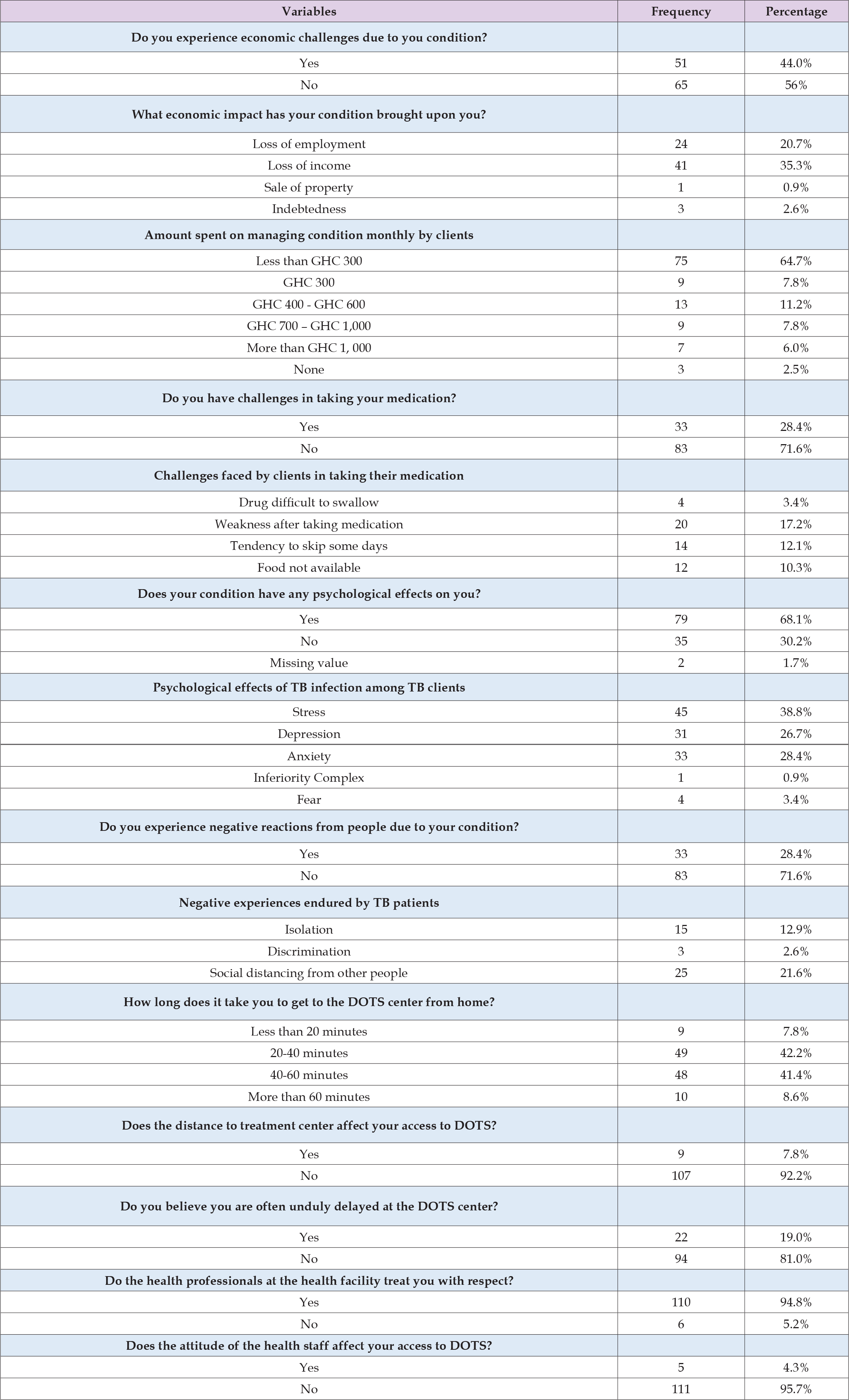
Moreover, 25(21.6%) experienced social distancing from other people, 15(12.9%) clients experienced isolation and 3(2.6%) experienced discrimination. In addition, majority of respondents 49(42.2%) said they spent between 20 and 40 minutes to get to the treatment centre; 48(41.4%) traveled 40-60 minutes to the DOTS centre; 10(8.6%) traveled more than 60 minutes; and 9(7.8%) traveled less than 20 minutes; however, majority of TB patients 107(92.2%) said distance to DOTS center did not affect their access to the TB medication and 9(7.8%) said the distance affected their access to the TB medication. Concerning whether clients were unduly delayed at the DOTS center, 94(81.0%) said ‘no,’ while 22(19.0%) said ‘yes’. When clients were asked whether the healthcare professional treated them with respect, 110 (94.8%) answered ‘yes’ and 6(5.2%) answered ‘no’. Also, when asked whether the attitude of the healthcare staff affect their access to their tuberculosis medications, the vast majority 111(95.7%) said ‘no’, whiles few 5(4.3%) said ‘yes’. Figure 1 below shows the responses of the study participants concerning the attitude of the healthcare staff towards them while they received treatment. Of the 116 participants included in the study, 52.6% said the attitude of the staff was very good; 21.6% said the attitude of the staff was good, 19% said the attitude of staff was excellent, 5.2% said the attitude was poor ; whiles 1.7% said the attitude was very poor.
Figure 1

Behavioural or Lifestyle and Occupational Factors Contributing to TB Infection
In this study, most of the study participants 77.6% were non-smokers before they had Tuberculosis infection, while 22.4% were smokers before developing the disease. Also, 14.7% of participants were identified to be using sniffing powder, which is also tobacco-related, although not in the form of smoke. The use of tobacco among over 30% of participants in this study could be a significant contributing factor of TB infection as recorded in similar other studies. Amaral and Adi (2021) revealed that among the lifestyles that are very risky to increase health vulnerability in TB patients include smoking, drinking alcohol, using illegal drugs, inadequate consumption, living in a slum environment, lack of air ventilation, lack of exercise, lack of sleep, urban life, lack of glycemic control, sugar consumption, and living with TB patients (Amaral, et al. [19]). This research could not look at other risky lifestyle factors like lack of ventilation, contact with known TB patients, and where the participants lived. It did not also look at other factors like sugar consumption, inadequate food consumption, and lack of sleep because they need more time to be able to determine their association with tuberculosis infection in an individual. Neither type of research asked the participants who were non-smokers to have contact with any known smoker either before diagnosis or currently to help determine the possibility of association to their developing Tuberculosis infection. This is because it is scientifically proven that people who have contact with the chain or serious smokers (known as secondary smokers) even have higher risks of developing lung-related conditions and can trigger TB infection than the smokers themselves.
This would have either confirmed or stated otherwise about other research works. The study result has revealed that lifestyle risk factors for Tuberculosis are multi-layered. Contact with different lifestyle exposures including smoking, high body mass index, irregular sleep at night, stress level, frequency of junk food, eating out per week, stress-induced eating, and frequency of physical inactivity was associated with the probability of developing tuberculosis (Alsharani, et al. [17]). This literature is from a qualitative research work which allows the participants more room to state other factors they believed contributed to their risk of developing TB but could not explain in detail how factors like high body mass index, irregular sleep at night, frequency of junk food, eating out per week, and stress-induced eating, were associated with the probability of developing tuberculosis. This research work again found out that most of the study participants 78 (67.2%) were people who drank alcohol before being diagnosed with TB and 38(32. 7%) were not drinking. 51(65.4%) out of the 78 people who were drinking before they were diagnosed with TB said they took alcohol once daily, 9(11.5%) said they took alcohol more than once daily while 8 (10.3%) said three or more per week and rarely respectively. This is about qualitative research by Park et al, where they found out that consistent heavy drinkers and heavy drinking quitters have a higher risk of TB than persistent non-drinkers (Park et al, 2022).
Risk factors associated with the patients were smoking, alcohol consumption, narcotic drug use, imprisonment, close contact history with active TB patients and chronic medical conditions (Senanayake et al, 2018). This research also confirms the above risk factors to developing TB as found out by this current work. In this study, 42.2% responded indicated that their jobs exposed them to dust while 57.8% of respondents indicated otherwise. Having this high number (42.2%) of participants exposed to dust suggests that dust is an environmental hazard to contracting TB. Most study participants (84.5%) said their occupation did not expose them to smoke while 15.5% responded ‘yes’ to the question of whether their occupation exposes them to smoke. Only 5.2% of the participants were practicing regular exercise while 94.8% were not exercising. In another different study, it was revealed that persistent non-exercisers and exercise quitters have a higher risk of TB than consistent exercisers, and in the subgroup analysis, a significant interaction was observed between lifestyle changes and age (Park et al, 2022). However, both works could not explain how lack of exercise can cause someone to develop tuberculosis, but one can say that lack of exercise weakens the immunity of an individual thereby giving way for the dormant TB bacteria to cause the disease. Most of the study participants (38.8%) sought help when they started having symptoms of TB after one week. This finding is like what was found in another research in Pakistan where they stated that nearly 50% of patients practised self-medication immediately after the onset of symptoms or, in 42.2% of cases, consulted the drug store for medication. This could have led to most participants seeking for healthcare after one week of showing the first symptom of TB.
Challenges Faced by TB Patients During Treatment
This research found that more than half of the study participants (56.0%) were not facing any economic challenges when they were asked whether they faced any economic challenges. This is in contrast to other works that said that economic challenge is one of the challenges confronting TB patients during therapy. A study conducted by (Nhassengo, et al. [20]) and colleagues on the experiences of the socioeconomic impact of tuberculosis and support needs among adults revealed that Out-of-pocket costs and income loss were the most reported financial impacts caused by TB. Both formal and informally employed participants emphasized that they had to stop working due to the disease-related weakness and adverse effects of treatment (Nhassengo, et al. [20]). However, 44.0% said they had economic challenges is still an indication that some TB patients go through economic difficulties. It was further found out that most of the participants 35.3% out of the 65 people who said they had economic challenges said they lost their incomes and 20.7% said they lost their employment. This further confirms what Nhassengo and friends stated in their work as stated and other research by Zhang and friends. Most Tuberculosis patients (71.6%) answered ‘no’ to the question of whether they were having challenges in taking their TB medication. Also, with the kind of challenges faced by the client in taking their medication, 17.2% said weakness after taking medication. This is because they have lowered their food intake due to loss of jobs and income. This is about another study where it was found out that, as for the social and psychological effects, about two-thirds of TB patients lost their jobs and another two-thirds lowered their food intake because of TB (Ghazy, et al. [21-23]).
The study on health management challenges faced by tuberculosis patients highlighted critical factors that influence an individual’s experience of having tuberculosis. The chance of someone developing tuberculosis disease has a link with the person’s occupational and lifestyle factors. The area of case detection needs tremendous improvement from case screening to diagnosis to reduce the time clients must wait to be diagnosed after they have visited the facility. Life in general comes with many challenges and so being diagnosed of tuberculosis also comes with its challenges. It is noteworthy to indicate that this research revealed the major challenge faced by TB patients in the study area to be psychological mostly emanating from loss of income, job, and other factors. The health care professionals must be commended for not adding extra cost to the burden of the TB patients there causing them to spend less than ghc300.00 monthly in managing their condition. Furthermore, the TB patients did not have any challenges about taking their medication.
Recommendations
Based on the findings, the following five recommendations are proposed to enhance tuberculosis control activities in the Adentan Municipality.
1. Management of every healthcare facility in the municipality should support the facility TB focal persons to transport the sample to the diagnostic centre themselves rather than keeping till the time the district focal person is available to send the samples to the laboratory.
2. Adentan Municipal Health Directorate should appreciate the good work done by the facility staff and encourage them to continue with their good relationship with Tuberculosis patients.

International Association of Landscape Archaeology, Czech Glass Society, Czech Republic

Department of Chemistry, Semenov Institute of Chemical Physics, USSR Academy of Sciences, Moscow, Russia

Neurology, LA BioMed Research Institute, USA

Associate Professor at Department of Breast and Thyorid Surgey, Chongqing General Hospital, China

Clinical Radiologist (MD) - Department of RADIOLOGY, Cosenza Hospital, Cosenza, Italy





 Abstract
 PDF
PDF



























