info@biomedres.us
+1 (502) 904-2126
One Westbrook Corporate Center, Suite 300, Westchester, IL 60154, USA
Site Map
 ISSN: 2574 -1241
ISSN: 2574 -1241
ISSN: 2574 -1241
Received: December 28, 2025; Published: February 26, 2025
*Corresponding author: Andrew Browning, Lincoln Memorial University DeBusk College of Osteopathic Medicine, Harrogate, Tennessee, United States
DOI: 10.26717/BJSTR.2025.60.009498
This case details the events that occurred following a middle-aged woman who presented with acute psychosis with altered mental status and psychiatric symptoms. Initially suspected to have a primary psychiatric disorder, the patient’s condition rapidly worsened despite psychiatric management, leading to an inpatient psychiatric hold, prompting further investigation. Over the course of several months, her symptoms progressed despite negative findings in her comprehensive workups including neuroimaging and extensive blood work. Ultimately, a diagnosis of Autoimmune Encephalitis (AE) was established 37 days after the onset of the patient’s symptoms. This rare and potentially reversible diagnosis was confirmed through the detection of increased IgG levels and oligoclonal bands in the cerebrospinal fluid (CSF). However, no specific antibody could be identified, and the source of antibody production remained uncertain. A PET scan was ordered to further investigate, but the patient was lost to follow-up. This case report highlights the clinical challenges of diagnosing AE, a rare but potentially life-threatening condition. Early recognition of its varied and often nonspecific symptoms is crucial for clinicians to maintain a high index of suspicion. While specific treatments for AE may vary, timely diagnosis is essential for initiating appropriate immunotherapy, supportive care, and psychiatric management. This approach can help optimize patient outcomes and ensure comprehensive care by enabling the patient to potentially achieve a full recovery, as AE, in some cases, can be reversible with prompt treatment.
Abbreviations: AE: Autoimmune Encephalitis; CSF: Cerebrospinal Fluid; CASPR2: Contactin-Associated Protein- Like 2; MOG: Myelin Oligodendrocyte Protein; ANAE: Antibody-Negative Autoimmune Encephalitis; NMDA: N-Methyl-D-Aspartate
Initial Visit
A 59-year-old Caucasian female with a past medical history significant for cholelithiasis, chronic obstructive pulmonary disease with emphysema, hydronephrosis of the right kidney, hypertension, peripheral neuropathy and prediabetes presents to the emergency department with altered mental status. She was brought in by ambulance, called by her husband, after “acting out” over the past few days. She was presenting with aggressive and combative behavior while experiencing a state of acute psychosis. Prior to the last two weeks the husband denied any history of psychiatric illness. Her urine drug screen was positive for Suboxone and THC. Urinalysis was without infection. Her laboratory evaluation was remarkable for the following: WBC 11.3 10x3/uL, MCV 96 fL, BUN 55 mg/dL, Creatinine 0.91 mg/ dL, AST 41 unit/L, and lactic acid 4.0 mmol/L. CT brain showed no acute intracranial abnormalities. Chest x-ray showed no focal consolidation, effusion, or pneumothorax. Initial physical exam demonstrated the following:
Psychical Exam in the Emergency Department
• Vitals & Measurements: T: 36.7 °C (Oral) HR: 119(Peripheral) RR: 20 BP: 138/86 SpO2: 97% HT: 165 cm WT: 46.4 kg IBW: 56.91 BMI: 17
• Constitutional: No acute distress, cooperative, non-responsive.
• Head: Normocephalic, atraumatic.
• Eyes: Extraocular movement intact, pupils equal, round, reactive
to light and accommodation, sclerae anicteric.
• ENT: Moist mucous membranes, oropharynx clear.
• Neck: Supple, full ROM, no signs of meningismus.
• Respiratory: No respiratory distress. Clear to auscultation
bilaterally, unlabored breathing.
• Cardiovascular: Regular rate and rhythm, 2+ distal pulses
bilaterally.
• Gastrointestinal: Soft, nondistended, nontender.
• Lymphatic: No lymphadenopathy noted.
• Musculoskeletal/Extremities:
• Nontender, full ROM. No pedal edema.
• Skin: Warm, dry.
• Neurologic: No focal neurologic deficits, CNII-XII intact, sensation
intact to light touch, moving all extremities. Psychiatric:
Awake, not answering questions, aggressive behavior.
Review of Systems in the emergency department:
• Constitutional: Patient denies fever, chills, sweating or
weight fluctuations. Patient endorses ongoing chronic pain
but denies pain today.
• HEENT: Patient denies any visual changes, no difficulty with
hearing, or difficulty swallowing. Patient also denies a sore
throat or rhinitis.
• Neck: Nontender and supple with no nuchal rigidity, no
lymphadenopathy, full range of motion Pulmonary: Patient
denies any dyspnea, wheezing, or cough.
• CV: Patient denies angina, palpitations, no history of murmurs
or cardiac arrhythmias. GI: Patient denies nausea, vomiting
or changes in appetite.
• GU: Patient denies urgency, frequency, or dysuria.
• Skin: Patient denies any rashes, bruising, or erythema.
• Neuro: Patient denies any chronic headaches, paresthesias,
weakness, syncope or seizures.
• Psychiatric: Acute psychosis with delusions and hallucinations
Hospital Course
On Day 1, the patient has been held in the emergency room overnight and is now evaluated by psychiatry for the first time. She is alert and oriented x3, unaware of her clinical situation. She is more cooperative and agrees to comply with testing but continues to be actively psychotic, later in the morning screaming and using hyper-religious language. At this point she has been medically cleared but from a psychiatric standpoint she is paranoid and having delusions of religious grandeur. The decision is made to refer the patient for inpatient psychiatric hospitalization. She spends the following week at an inpatient facility before being stabilized and released to home. Day 8, the patient returns to the emergency department by ambulance after aggression and belligerent behavior towards her husband. She is alert but unoriented. She is mildly tachycardic and borderline hypotensive. The remainder of her physical exam is unchanged from her initial presentation. She is very uncooperative and refuses to answer questions. Urine drug screen is positive for buprenorphine and her family states she has been taking it without a prescription. Day 9, psychiatry consults in the morning for the patient’s aggression, altered mental status, and suspected drug-induced psychosis. She is now more oriented and answers questions. She attributes her recent behavior to lack of sleeр and prefers to be discharged home. She confirms self-medicating with CBD for chronic back pain but denies using Suboxone. She denies history of suicidal ideation, mania, and hallucinations. A diagnosis of toxic encephalopathy is made at this point, given the patient’s history of self-medicating and nicotine withdrawal. She is assessed not to be a risk of harm to self or others, with multiple protective factors. She refuses to trial psychotropic medications for her symptoms. Discharge is recommended. Later in the afternoon, the patient’s mental status is altered once again and repeat labs are ordered.
Her husband is contacted and provides additional information, reporting that since leaving the inpatient psychiatric facility, she has been hallucinating daily, barely sleeping and eating, threatening to kill him, and refusing medications. The patient’s diagnosis is changed to acute psychosis. There are no obvious organic causes at this time. She is started on Abilify 2mg twice daily and Haldol 5mg every four hours as needed for agitation. She is then admitted for inpatient behavioral health care. Day 26, the patient has been receiving inpatient psychiatric treatment for the past two weeks. Upon reevaluation, her rapid cognitive decline and psychosis is yet to be explained. She is diagnosed with schizophreniform disorder and considered for further neuroimaging. Day 30, neuroimaging, including brain MRI and EEG, are unremarkable. She is intermittently ataxic, has fluctuating orientation, and continued paranoid delusions. Neurology is consulted and an autoimmune encephalopathy panel is pending. Day 31, the patient is now exhibiting manic symptoms of euphoria and decreased need for sleep. She is responding to internal stimuli, has myoclonic twitching and stereotypical movements. She is having both auditory and visual hallucinations. Lumbar puncture is pending. Day 32, the patient has proved to be treatment resistant on maximum doses of antipsychotic therapy and continues to be delusional with visual hallucinations and paranoia. CT of abdomen, pelvis, thorax and lumbar puncture were unremarkable. The patient left the inpatient psychiatric unit against medical advice to go back home with her family. Day 36, additional CSF results returned positive for 13 oligoclonal bands not found in the serum (Table 1). In addition, CSF IgG index and synthesis rate were both elevated at 1.09 and 13.23 respectively (Table 2). VDRL, cryptococcal antigen, and antibodies to Borrelia burgdorferi were negative. With these new lab findings, neurology was able to make a diagnosis of autoimmune encephalitis. Upon speaking with the patient’s family, she was seen by her primary care physician earlier in the day with continuing symptoms of agitation, paranoia and delusions. The patient’s family was then prompted to bring the patient back to the emergency department in order to be admitted and properly treated with high dose steroids and IVIG therapy.
Table 1: Autoimmune panel obtained from patient’s blood draw on day 31.

Table 2: Cerebrospinal fluid analysis obtained from fluoroscopy guided lumbar puncture on day 31.
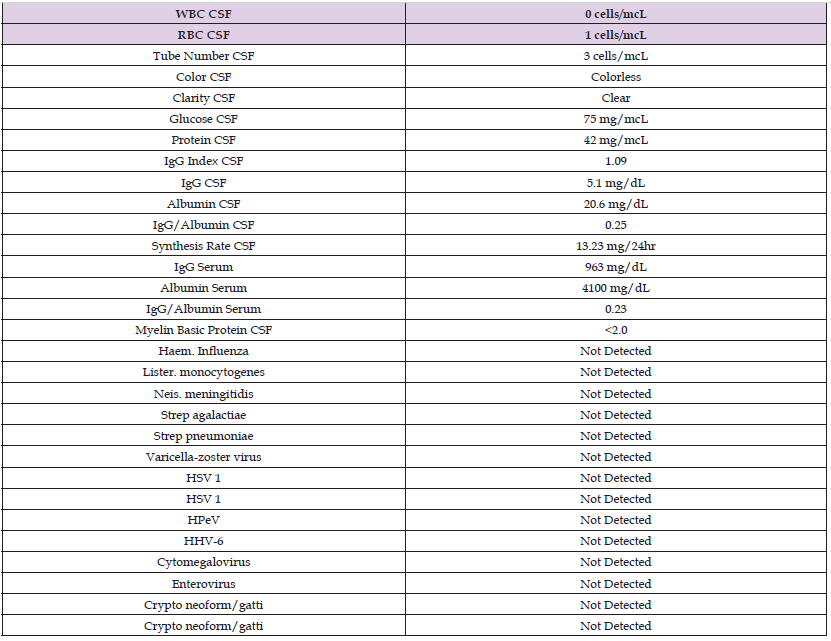
Day 37, the patient returned to the hospital and was admitted for prompt treatment with a plan for five days of IVIG treatment as well as 1000mg IV Solu-Medrol. Day 38-41, the patient remained in a paranoid and delusional state. Day 38, the patient was alert and oriented to self and place but unaware of the time and event of her being in the hospital, she was still experiencing visual hallucinations. Day 39, the patient is no longer experiencing hallucinations but still lacks insight into her medical condition. Day 40, the patient is fully alert and oriented, she no longer appears to have any psychotic features. Day 41, the patient was on her final day of treatment and was fully aware of her medical condition, fully alert and oriented with no psychotic features and her condition from the first day of admission had improved immensely. Day 42, the patient was discharged and able to return home to her family.
Autoimmune encephalitis (AE) is a group of neurological and psychological disorders that involve the body’s immune system forming antibodies and mistakenly attacking the brain, leading to inflammation and neuronal dysfunction. AE can be caused by the presence of antibodies directed against cell surface receptors, ion channels, or synaptic proteins [1]. This type of disorder can present with various manifestations of psychiatric, cognitive, and neurological symptomatology, making it difficult to successfully diagnose and treat. АЕ predominantly affects women between early adolescence and mid-50s, although cases outside this age range have also been reported [2]. This disorder is believed to follow an infection, but it can also occur without a known trigger [3]. The diagnosis of AE can be challenging, particularly due to the complicated nature in identifying the specific antibody produced by the patient’s immune system [4]. Antibodies associated with AE can include leucine-rich glioma-inactivated 1 (LGI1), contactin-associated protein-like 2 (CASPR2), N-methyl-D-aspartate (NMDA), Y-Aminobutyric acid A receptor (GABAA-R), IgLON5, myelin oligodendrocyte protein (MOG), glial-fibrillary-associated protein (GFAP), kelch-like protein 11 (KLH-11), and others [5]. In this case, a specific antibody was not identified as the source of the patient’s symptoms. This diagnosis, especially in the absence of detectable autoantibodies and characteristic MRI findings, presented a significant clinical challenge. Lacking a specific positive antibody test, a diagnosis of antibody-negative autoimmune encephalitis (ANAE) may be appropriate.
To reduce misdiagnoses, recommended probable criteria include the following:
1. Rapid progression (<3 months) of working memory deficit,
altered mental status, or psychiatric symptoms
2. Exclusion of well defined syndromes of autoimmune encephalitis
3. Absence of well characterizes autoantibodies in serum and
CSF, and at least two of the following:
a. MRI abnormalities suggesting autoimmune encephalitis b
b. CSF pleocytosis, CSF-specificoligoclonal bands, or elevated
CSF IgG index.
c. Brain biopsy showing inflammatory infiltrates and excluding
other disorders
4. Reasonable exclusion of alternative causes (Panel 2 table)
[6]
This patient initially presented with acute and rapidly progressing psychosis accompanied by altered mental status. Despite being admitted to an inpatient psychiatric unit for several weeks and receiving various psychiatric medications, her condition showed minimal improvement. Given the lack of progress, the clinical team decided to expand the diagnostic approach and consider other causes beyond the initial diagnosis of acute psychosis. Routine lab work and imaging were unremarkable, and there was little response to the prescribed medications. As a result, a cerebrospinal fluid (CSF) panel was ordered to evaluate for potential autoimmune causes, which led to the identification of CSF-specific oligoclonal bands-a significant finding that suggested an autoimmune etiology. However, the MRI did not show typical abnormalities associated with AE, which left one of the criteria for a definitive diagnosis unfulfilled. Given the patient’s improving response to treatment, a brain biopsy was not performed, and thus it could not be determined with certainty whether it would have confirmed or excluded encephalitis. Despite the normal MRI, the presence of oligoclonal bands and elevated IgG in the CSF ultimately supported the diagnosis of AE, though the specific antibody was not identified. After more than two months from the onset of her symptoms, AE was considered the most likely diagnosis. While the patient was eager to return home to her family, further antibody testing beyond the standard available tests was needed to confirm the precise nature of her AE.
However, without these additional tests, the exact subtype of AE remains undetermined. This case underscores an important clinical point: the absence of clear antibody markers or characteristic neuroimaging findings does not rule out AE [4]. In fact, the rapid progression of psychiatric symptoms, such as acute psychosis and aggressive behavior, coupled with the presence of CSF oligoclonal bands, should raise strong suspicion for an autoimmune cause, even in the absence of typical diagnostic indicators.9 This highlights the importance of a comprehensive clinical approach-clinicians must rely on both the clinical presentation and paraclinical findings, and an expert team discussion should guide treatment decisions [7,8]. Ultimately, AE is a dynamic condition that requires a high degree of clinical suspicion, and prompt, individualized management can lead to better recovery, even when the diagnosis is uncertain with an unremarkable lab workup [9]. Timely diagnosis is critical, as early intervention can significantly affect patient outcomes [7]. While there are no standardized treatment protocols for antibody-negative AE, several reports have shown that patients can benefit from immunotherapies, including corticosteroids and intravenous immunoglobulin (IVIG), even in the absence of confirmed autoantibodies [8]. In this patient, the administration of intravenous immunoglobulin (IVIG) therapy and Solu-Medrol (methylprednisolone) significantly alleviated the acute psychosis and confusion, leading to a noticeable improvement in her clinical status. These therapies, which are commonly used in AE, work by modulating the immune system to reduce inflammation and prevent further neuronal damage. While IVIG has been shown to be effective in many autoimmune disorders by providing passive immunity and reducing the pathogenic autoantibodies, corticosteroids like Solu-Medrol help to suppress the inflammatory response [10,11]. This combination therapy, although not universally standardized, has been reported to benefit many patients with antibody-negative AE, as seen in this case. Despite the positive response to treatment, it is important to note that there is currently no definitive cure for AE. Treatment is generally focused on reducing inflammation, managing symptoms, and preventing relapse, but the long-term prognosis can vary greatly depending on the severity and timeliness of intervention. A study retrospectively analyzed 358 patients with AE and found that rituximab treatment, especially when initiated early, significantly improved long-term outcomes, including a reduced relapse rate, in patients with NMDAR-, LGI1-, and CASPR2-AE [12]. However, other treatment options, including plasmapheresis and cyclophosphamide, may also be considered, particularly in cases where patients do not respond to first-line therapies or in those with more severe disease [4]. The choice of treatment is often individualized, based on clinical presentation, underlying autoimmunity, and expert opinion. Although remission is achievable in many cases, some patients may experience long-term cognitive and psychiatric sequelae, underscoring the need for ongoing follow-up and rehabilitation [13]. Thus, while current therapies such as IVIG and corticosteroids can significantly improve outcomes, research into more targeted and effective treatments remains essential. Early recognition, a comprehensive therapeutic approach, and expert collaboration are paramount in achieving the best possible outcomes for patients with AE, even in the absence of a definitive cure [14].
In conclusion, our patient was diagnosed with Autoimmune Encephalitis in accordance with her clinical picture. She presented with acute psychosis, hallucinations, agitation, and altered mental status. She was seen multiple times over the course of two months as her condition fluctuated and ultimately failed to resolve on its own. She was given supportive treatment while the cause of her symptoms was investigated in a joint effort by hospitalist and psychiatry services. Neurology was consulted and the available antibody assays were conducted to aid in the diagnosis. Fortunately, this rare psychiatric case had a positive outcome in a relatively quick period of time. Oftentimes patients like her experience even lengthier battles while trying to pinpoint the etiology of their psychiatric and neurologic symptoms. Hopefully, this case proves beneficial to healthcare providers in need of an answer for their patients.

International Association of Landscape Archaeology, Czech Glass Society, Czech Republic

Department of Chemistry, Semenov Institute of Chemical Physics, USSR Academy of Sciences, Moscow, Russia

Neurology, LA BioMed Research Institute, USA

Associate Professor at Department of Breast and Thyorid Surgey, Chongqing General Hospital, China

Clinical Radiologist (MD) - Department of RADIOLOGY, Cosenza Hospital, Cosenza, Italy





 Abstract
 PDF
PDF



























