info@biomedres.us
+1 (502) 904-2126
One Westbrook Corporate Center, Suite 300, Westchester, IL 60154, USA
Site Map
 ISSN: 2574 -1241
ISSN: 2574 -1241
ISSN: 2574 -1241
Received: February 17, 2025; Published: February 24, 2025
*Corresponding author: Lorenzo Righi, Azienda USL Toscana Sud Est, Siena, Italy
DOI: 10.26717/BJSTR.2025.60.009491
Objectives: To identify health needs in patients in home care according to the model-oriented assessment of
Marjory Gordon and nursing diagnoses according to the NANDA-I taxonomy.
Methods: Exploratory descriptive study that analyzed 104 medical records in January - April 2024, conducted
in Italy. The analysis looked at dysfunctional patterns of ascertainment nursing according to the Gordon model
and diagnoses according to the NANDA-I 2021-2023 taxonomy.
Results: 42 nursing diagnoses were identified. Most of the alterations are concentrated in the early Gordon
models, mainly physical needs, dysfunctions in the models of health perception and management, of nutrition
and metabolism, and of physical activity and exercise.
Conclusions: The identification of health needs, through the NANDA-I nursing diagnoses can contribute to the
management of nursing care in people with health needs in the health needs in the home environment.
Descriptors: Nursing; Nursing Diagnosis; Standard Nursing Terminology; Home Health Nursing; Home Care
Services.
In Italy, Ministry of Health Decree No. 77/2022 addresses the reorganization of territorial care by pursuing the objectives defined in Mission 6 of the National Recovery and Resilience Plan (PNRR). The regulation defines structural, organizational and technological standards for territorial care facilities and introduces new organizational and care models, such as community homes [1,2]. A central theme is the assessment of the health needs of the population, which is stratified into six levels of need, starting with the ‘healthy person’ (level 1) up to the ‘terminally ill person’ (level 6). These levels correspond to care responses characterized by actions/interventions that increase in complexity. In this framework, the Family and Community Nurse (IFeC) is a health figure of relevant importance. Specific university training is planned to acquire the necessary skills for the new functions required of nurses with this classification. The objectives are to prepare professionals who, guided by scientific evidence, guarantee holistic care and targeted responses to the health needs of the person, the family or the community, with a developed orientation to proactive health management and constant involvement in activities of promotion, prevention and participatory management of individual, family and community health processes [3]. In the Azienda USL Toscana Sud Est, the Obstetric Nursing Department introduced in 2022 the Family and Community Nurse and an organizational model centered on the human dimension of the person assisted and oriented towards “Relationship Based Care” [4].
Furthermore, in professional practice, the IFeC uses international taxonomies and associates them with the conceptual reference model. This is done in order to identify people’s health status and help them meet their health needs by providing personalized care [5]. In summary, the care process adopted involves an initial assessment with data grouped according to Marjory Gordon’s 11 functional models [6]. Next, the diagnostic process leads to the identification of health problems by means of nursing diagnoses according to the taxonomy of the North American Nursing Diagnosis Association - NANDA-I 2021-2023 [7]. Then comes the planning of care with the determination of the objectives and outcome indicators of the Nursing Outcomes Classification (NOC), and the selection of the appropriate interventions described in the Nursing Interventions Classification (NIC). Following the implementation of the interventions, the goodness-of-fit of the plan is verified through the intermediate or final verification of the outcome indicators [8,9]. Over time, a number of studies have focused on identifying the profile of nursing diagnoses in home care. Recently, in Brazil, two studies attempted to identify nursing diagnoses in home care patients [10,11].
The aim of this analysis is to describe and, as far as possible, to explore how the use of an assessment oriented to Marjory Gordon’s model and NANDA-I nursing diagnoses can assist the Family and Community Nurse in exercising his new role.
Ethical Aspects
The research project presented by a graduate nurse was approved by the members of the Scientific Committee of the Master’s Degree Course in Territorial Nursing at the University of Siena. The collection of data, in archived medical records, was authorized by the Nursing and Medical Directorate of the competent District Zone.
Research Design, Place and Period, Inclusion and Exclusion Criteria
The retrospective descriptive survey was conducted on a sample of medical records of persons in home care at the Casa della Salute in San Giovanni Valdarno (AR), Italy. The study was conducted from January 2024 to April 2024. Only records opened and closed in the year 2023 were included in the sample.
Study Protocol
In the period January-March 2024, a researcher (SB) collected the following data of interest from the medical records: gender, age, number of pathologies, mode and reason for service activation, dysfunctional patterns (according to M. Gordon model), nursing diagnoses identified (according to NANDA-I Classification), NOC and NIC activated, care plan status at the end of care, Modified Barthel Index (MBI) scales, Braden Scale, and ReTos. The data were collected in a predefined paper form, the anonymity of assisted assistants was guaranteed by replacing the name a progressive numbering. In a later step, these data were reported in a spreadsheet for processing. The interventions of interest are the dysfunctional patterns of M. Gordon assessment and the nursing diagnoses stated according to the 2021- 2023 taxonomy.
Results Analysis and Statistics
For the analysis, conducted in April 2024, descriptive statistics with frequency analysis was used. Central tendency values, averages and medians, and the respective dispersion values were calculated. Microsoft Excel© software was used to process the data, and data entry took place in April 2024.
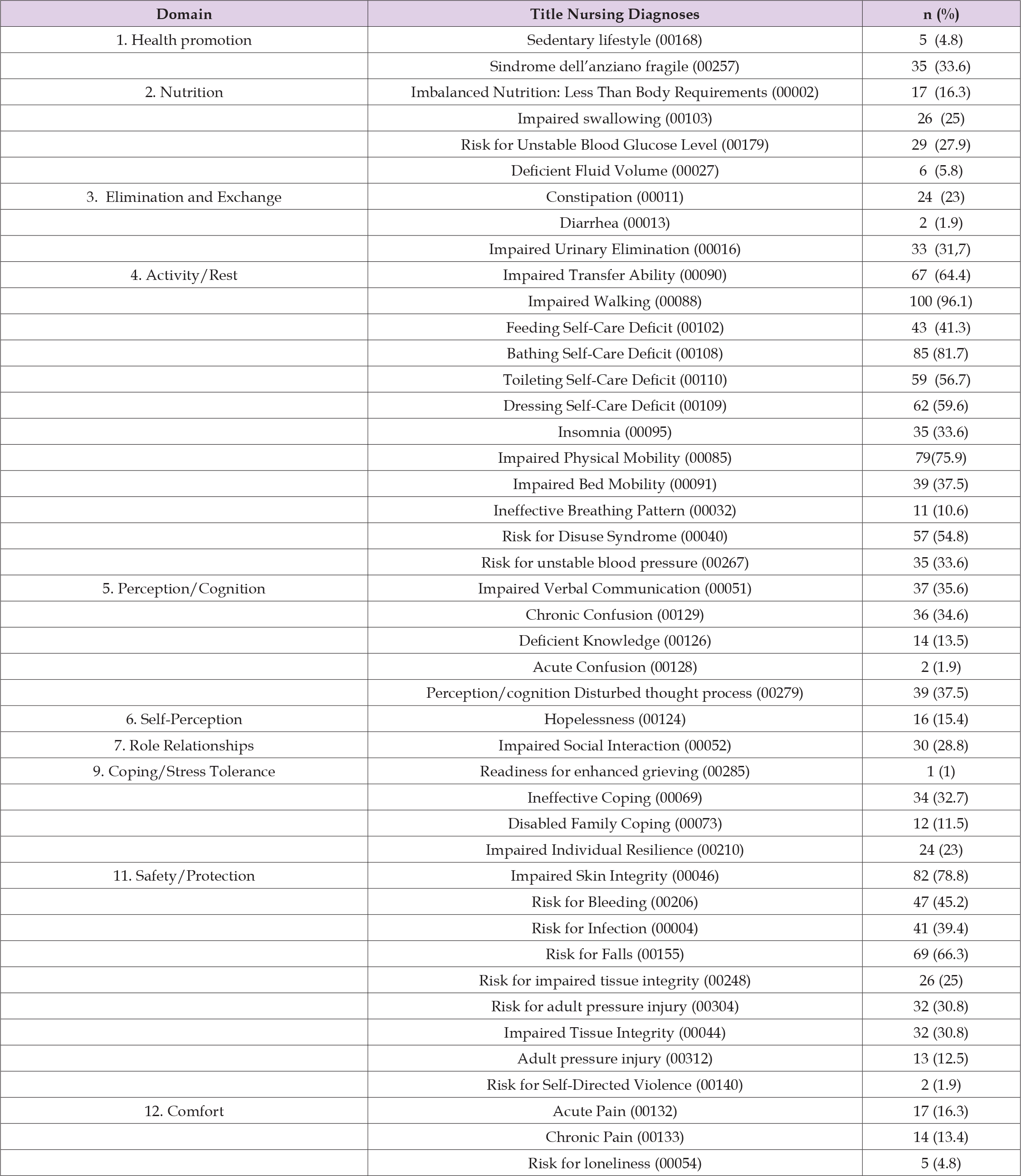
104 medical records that met the inclusion criteria were analyzed. The median age of the patients was 86 years, with a range of 43-104 years with a prevalence of the female gender (63%). The activation of the home care service occurred in three-quarters of the cases on the initiative of the General Practitioner, and in 23% following discharge from hospitalization. The reasons for activating hmanagement, nutrition and metabolism, and activity and exercise were found to be dysfunctional in more than 90% of the patients, while the cognitive-perceptual model was dysfunctional in 70%of the cases (Table 1) There were 42 nursing diagnosis titles identified (Table 2). The most frequent are: Impaired Walking (96.1%), Bathing Self-Care Deficit (81.7%), Impaired Skin Integrity (78.8%), Impaired Physical Mobility (75.9%), Risk for Falls (66.3%), Impaired Transfer Ability (64.4%) and Dressing Self-Care Deficit (59.6%).
Table 1: Distribution of Dysfunctional Health Patterns in Gordon’s Functional Health Patterns Assessment.

Table 2: Distribution of Titles of Nursing Diagnoses identified in the nursing assessment.
In our sample of 104 medical records, the median age of the patients was 86 years, which expresses the presence of a particularly elderly population. The activation of the service was requested in most cases by the general practitioner, mainly for the treatment of skin lesions, often after returning home following hospitalization. The values of the MBI, Braden Scale and ReTos (Tuscany Region Fall Risk Assessment Scale) indicate, respectively, a severe dependency in activities of daily living, a risk of developing pressure ulcers and an average risk of falls for this population of care recipients taken care of at home. These data point to a need for support in activities of daily living and actions to be taken to contain risks, indicating an important social need in addition to the health need, for which service activation is requested. This picture emerges from the nursing assessment, which revealed that, in almost all cases, patterns of health perception and management, nutrition and metabolism, and activity and exercise are dysfunctional. Most of the alterations are concentrated in Gordon’s early models, those more oriented to physical aspects. This phenomenon can be partly attributed to the healthcare motive that led to the activation of the service and partly to the learning phase of professionals in the use of nursing diagnoses. This implies a greater clinical familiarity with these aspects than in the later stages, when with more expert use of the nursing process, more complex diagnoses emerge, which are indicative of an advanced development of clinical competence.
In the phase of diagnostic reasoning, 1,438 nursing diagnoses were identified, divided into 42 different titles. Despite this variability, more than one third of the diagnoses were: Impaired Walking (00088), Impaired Transfer Ability (00090), Impaired Physical Mobility (00085), Risk for Falls (00155), Bathing Self-Care Deficit (00108), Dressing Self-Care Deficit (00109), and Impaired Skin Integrity (00046). This allows the Family and Community Nurse to intervene in the detection of such needs and to report or monitor potential critical situations to the General Practitioner, Social Worker or caregiver, also providing indications on services to be activated. From the health point of view, the diagnoses of Risk for Unstable Blood Glucose Level (00179) and Risk for unstable blood pressure (00267) can be useful to identify patients with hypertension and diabetes, who may need educational interventions due to lack of knowledge or skills, tasks that the nurse can perform at home. Caregivers can be involved in community initiatives for education on correct disease management, as envisaged at a regional level by the Region of Tuscany in the Model “IDEA: Incontri Di Educazione all’Autogestione delle malattie croniche” [12]. While, the nursing diagnoses that emerged, such as Impaired Social Interaction (00052), which indicates an insufficient or ineffective quality or quantity of social relationships, Impaired Comfort (00214), readiness for enhanced comfort (00183), Risk for Loneliness (00054) and Social Isolation (00053), can be useful to support caregivers in social aspects and in the management of the elderly person at home.
This our first investigation into the use of the NANDA-I nursing diagnoses has highlighted certain potentialities, which the Family and Community Nurse can exploit to improve his or her role as a collaborator in the assessment of the population’s health needs. These strengths are manifested both in the ability to take a holistic view to identify needs in the bio-psycho-social sphere of the individual and in the possibility of describing the detected problems using a standardized and shared language.
The identification of nursing diagnoses in home care develops the ability of professionals to take a holistic view to identify needs in the bio-psycho-social sphere of the individual. It promotes evidence- based quality care using a standardized and shared language. In the clinical practice of home nursing care, it fosters collaboration in the care team. It also supports the care recipient in social aspects in order to report or monitor potential critical situations and also provides guidance on services to be activated.
The study has some limitations. The retrospective study design, although adequate for the purposes of the investigation, limits the quantity and quality of the data available for analysis. Scarcity of similar experiences in the Italian literature. The sample indicated an elderly population with only two reasons for activating home care, this may have partly limited the heterogeneity of the identified needs. and it is not possible to investigate low prevalence conditions, feasible in longitudinal studies.

International Association of Landscape Archaeology, Czech Glass Society, Czech Republic

Department of Chemistry, Semenov Institute of Chemical Physics, USSR Academy of Sciences, Moscow, Russia

Department of Educational Sciences, Research Centre Qualities of Teachers, School of Education – HAN, Nijmegen, Netherlands

Associate Professor at Department of Breast and Thyorid Surgey, Chongqing General Hospital, China

Neurology, LA BioMed Research Institute, USA





 Abstract
 PDF
PDF



























