info@biomedres.us
+1 (502) 904-2126
One Westbrook Corporate Center, Suite 300, Westchester, IL 60154, USA
Site Map
 ISSN: 2574 -1241
ISSN: 2574 -1241
ISSN: 2574 -1241
Received: February 12, 2025; Published: February 24, 2025
*Corresponding author: Jieyi Wang, School of Basic Medical Sciences, Zhejiang Chinese Medical University, Hangzhou, China
DOI: 10.26717/BJSTR.2025.60.009490
Objective: Existing research has linked anxiety and depressed mood to Coronary Heart Disease (CHD). However,
the causal relationship between other subjective negative emotions (e.g. hurt feelings, guilty feelings, fed-up
feelings, and miserableness) and CHD has not been clarified. We utilized a genetic approach to investigate the
causal relationship between the above four subjective negative emotions and CHD.
Method: A bidirectional Mendelian Randomization (MR) study was performed. We used the genetic variant instruments
associated with hurt feelings, guilty feelings, fed-up feelings, and miserableness from the UK Biobank
Study as instrumental variables to check the bidirectional causal effects between them and CHD. Genetically
variant instruments for CHD were obtained from the CARDIoGRAMplusC4D database. We used Inverse Variance
Weighting (IVW) method to obtain MR estimates and other statistical methods in sensitivity analyses.
Results: The results of this study showed that the level of hurt feelings was associated with CHD Odds Ratio
(OR), 0.43; 95% Confidence Interval (CI), 0.21-0.85; P=0.02), and the level of miserableness was associated with
CHD (OR, 2.40; 95% CI, 1.18–4.88; P=0.02). The primary outcome remained robust in the sensitivity analysis.
However, we found no genetic evidence for a causal effect of CHD on hurt feelings, guilty feelings, fed-up feelings,
and miserableness.
Conclusions: Our findings suggest that, at the genetic level, experiencing miserableness is positively associated
with the risk of CHD, whereas experiencing hurt feelings is negatively associated with the risk of CHD. This
shows that not all subjective negative emotions contribute to the development of CHD.
Keywords: Coronary Heart Disease; Negative Emotion; Mendelian Randomization; Genetic; Hurt Feeling
Abbreviations: CHD: Coronary Heart Disease; CAD: Coronary Artery Disease; DALYs: Disability-Adjusted Life Years; IL-6: Interleukin-6; CRP: C-Reactive Protein, PTSD: Post-Traumatic Stress Disorder; Qol: Quality of Life; CI: Confidence Interval; IVW: Inverse Variance Weighting; MR: Mendelian Randomization; RR: Relative Risk; CABG: Coronary Artery Bypass Grafting; CBT: Cognitive Behavioral Therapy; BMI: Body Mass Index; SNPs: Single- Nucleotide Polymorphisms
Coronary artery disease (CAD) is the leading single cause of mortality and loss of disability-adjusted life years (DALYs) worldwide [1]. As a result of the progression of CAD, CHD is clearly one of the most advantageous epidemics globally, placing an enormous burden on healthcare everywhere. Finding risk factors and preventive factors for CHD and exploring the complications associated with CHD is a highly significant endeavour. A growing number of observational studies have shown that chronic stress and psychological trauma are non-negligible risk factors for CHD, [2] while good interpersonal relationships, which are a positive component of mental health, are protective factors for CHD [3]. The current research hotspot linking CHD and mental illness mainly focuses on CHD combined with depression. The existence of a malignant twin relationship between CHD and depression has been confirmed by a variety of research methods [4]. However, in mental health, research on the link between subjective negative emotions and CHD been limited to feelings of anxiety and depression, and research on other subjective negative emotions is still lacking. In a cohort observation, Cristiano and his colleagues found that the intensity of emotional symptoms (including anxiety and depressive symptoms) had a predictive value for the risk of developing atherosclerosis. At the same time, they demonstrated that the longitudinal effect of emotional symptoms on atherosclerosis is direct and not mediated by traditional cardiovascular risk factors [5].
Another prospective cohort study with up to 15 years of follow-up also observed that depressed mood predicted CHD events over a 15- year period [6]. Lei et al. [7] demonstrated genetically, by means of MR, that there is a causal relationship between unrelaxed states of anxiety, states of hypochondriasis, and coronary atherosclerosis [7]. In addition, several observational studies have found loneliness to be a risk factor for CHD. A meta-analysis of 16 longitudinal studies showed that even after adjusting for age, sex, and socioeconomic status, loneliness could contribute up to 30% to the excess risk of cardiovascular disease [8]. Christian et al. examined the association between loneliness and major adverse cardiovascular events with the UK Biobank study and found that lonely individuals had a higher risk of early death after cardiovascular disease event [9]. Talea, et al. in an observational study with a large sample of individuals found that participants with favourable social interactions had lower ambulatory blood pressure, while emotional responses amplified the effects of social interactions on cardiovascular health [10]. Based on the above, we can be aware that the relationship between anxiety, depressed mood and cardiovascular disease is well established. However, few studies have been reported on the link between other subjective negative emotions and cardiovascular disease, such as the link between hurt feelings, guilty feelings, fed-up feelings, miserableness, and CHD is not clear yet.
And the link between subjective negative emotions and CHD cannot be confirmed due to potential bias caused by confounders in observational and cohort studies. As a result, we conducted a MR study to confirm whether there is a causal relationship between hurt feelings, guilty feelings, fed- up feelings, miserableness, and CHD. The causal effect of most subjective negative emotions on CHD has been well established, but whether CHD can cause subjective negative emotions remains somewhat controversial. Decades of research have revealed that CHD patients with comorbid depression or anxiety and depressive states are common in the real world and that the two share common underlying mechanisms. Khandaker and his colleagues found that triglycerides, Interleukin-6 (IL-6), and C-Reactive Protein (CRP) were all common causal risk factors for both depression and CHD through a MR analysis of data from a cohort study [4]. Meanwhile, data from a large-sample prospective epidemiologic survey showed that patients with severe mental illness (including schizophrenia, bipolar disorder, and major depressive disorder) had an increased risk of CHD compared with controls (adjusted hazard ratio (adj HR)=1.54; 95% CI, 1.30-1.82; P<0.0001). Anxiety symptoms (Relative Risk (RR)=1.41; 95% CI, 1.23-1.61; P<0.0001), as well as persistent or intense stress or Post-Traumatic Stress Disorder (PTSD) (adj HR=1.27; 95% CI, 1.08-1.49), albeit to a lesser extent, may also be associated with an increased risk of developing CHD and increased mortality independently associated.
However, a recent MR study does not support the contention that anxiety and depressed mood cause CHD [11]. Moreover, in recent years, the direction of clinical trials has focused on the improvement of depressed mood in patients with CHD combined with depression, and there is a lack of clinical trials aimed at improving CHD symptoms or heart- related Quality of Life (Qol). Thus, we conducted a reverse MR study to further investigate the effect of CHD on subjective negative emotions.
A two-sample bidirectional MR study was designed to investigate the risk association between subjective negative emotions (including hurt feelings, guilty feelings, fed-up feelings, miserableness) and CHD (Figure 1). On the one hand, four subjective negative emotions were defined as four different exposures, while CHD served as the outcome. The instrumental variables for the four subjective negative emotions depended on three key assumptions:
1. Relevance assumption, i.e., that genetic variants should be strongly associated with subjective negative emotions,
2. Independence assumption, i.e., that genetic variants should be independent of potential confounders, and
3. Exclusion assumption, i.e., that genetic variants should be associated with CHD risk only through changes in subjective negative emotions. On the other hand, we considered the possibility of reverse causality and assessed the causal effect of CHD on four subjective negative emotions. Considering the assumptions of independence and exclusion, we performed a multiplicity screening of Single-Nucleotide Polymorphisms (SNPs) by searching the research studies and using an online tool (http://www. phenoscanner.medschl.cam.ac.uk/). Based on the results reported in the studies and presented in the online tool, we concluded that factors such as high blood pressure, body mass index (BMI), dyslipidemia, smoking, diabetes, obesity, gender, and educational level are associated with CHD, whereas the level of cortisol, level of catecholamine, autonomic nervous system dysfunction may be associated with subjective negative emotions. Therefore, we deleted SNPs that were simultaneously associated with the above factors to ensure the accuracy of this MR study (see Supplementary material online, Supplementary Table 1). Not only that, we also removed the SNPs for being palindromic and incompatible alleles to further strengthen the accuracy of the results.
Figure 1

Supplementary Table 1: Summary tabulation of the pleiotropy of genetic variation instruments associated with subjective negative feelings, coronary heart disease (BMI = Body mass index).

Genetic Associations with Subjective Negative Emotions
The Bristol Medical School’s MRC-IEU (Medical Research Council, MRC; Integrative Epidemiology Unit, IEU) provided all the data for this study, which improves the validity of GWAS summary data queries and reduces the likelihood of error in the interpretation of the data and in GWAS post-analyses, by changing the variant call format to preserve the summarized GWAS statistics (GWAS-VCF). We conducted an MR study by retrieving 4 GWAS of subjective negative emotions from the MRC-IEU. The following 4 types of subjective negative emotions were examined in this study:
1. Hurt feelings (249,799 cases; 199,620 controls)
2. Guilty feelings (129,383 cases; 321,321 controls)
3. Fed-up feelings (184,258 cases; 268,813 controls)
4. Miserableness (195,435 cases; 259,547 controls). SNPs strongly (P < 5 × 10⁻⁸) and independently (r2<0.001) associated with the four subjective negative emotions in the GWAS were used as the genetic instrumentation needed for this study. All traits analyzed in the GWAS statistics were derived from self-reported answers to questions asked via the assessment center touchscreen. The above data set was derived from responses to questions such as “Are your feelings easily hurt?” “Are you often troubled by feeling of guilty?” “Do you often feel ‘fed up’? “Do you often feel ‘fed-up’?” “Do you ever feel ‘just miserable’ for no reason?” [12]. These questions were used to determine whether the subject had that subjective negative emotion. Individuals who acknowledged the presence of the above subjective negative emotion were coded as cases and all other individuals were coded as controls.
Genetic Associations with CHD
We used summary statistics from a GWAS for CHD focused on European pedigrees conducted by Nikpay, et al. [13]. conducted a comprehensive survey of the fine genetic structure of CHD, and the diagnostic definitions of CHD in the studies they conducted included myocardial infarction, acute coronary syndromes, chronic stable angina, or coronary artery stenosis of >1%. Leveraging phased haplotypes from the 1000 Genomes Project, their work reports a GWAS analysis of 185,000 CAD cases and controls, analyzing 6.7 million common variants (minor allele frequency (MAF)>0.05) and 2.7 million low-frequency variants (0.005≦MAF ≦ 0.05) [13]. CHD summary statistics are also publicly available in the IEU Open GWAS database.
Statistical Analysis
We prioritized the random-effects IVW technique as the primary analytical method to investigate the causal relationship between the four subjective negative emotions mentioned above and CHD, while excluding heterogeneity and pleiotropy as much as possible. IVW was combined with Wald ratio estimation to provide a consistent assessment of the causal effect between the exposures and the outcomes. Given that IVW estimates may be affected by flawed instrumental bias or pleiotropy, we examined the validity and robustness of the results by conducting sensitivity analyses using MR-Egger. MR-Egger can be used for multivalence estimation when the instrumental variables are invalid and there is insufficient evidence of directed multivalence with a zero intercept [14]. We used the Cochran Q statistic to assess heterogeneity and utilized the MR-Polyvalent Residual Sum of Outliers method (MR-PRESSO) to identify and eliminate possible outliers as well as to reassess heterogeneity [15]. The Two Sample MR (version 0.5.7; https://github.com/MRCIEU/ TwoSampleMR)andMRPRESSO(version1.0;https://github.com/rondolab/ MR-PRESSO) tools in the R software (version 4.3.1; R Foundation for Statistical Computing, Vienna, Austria) were used as the main analytical packages. Statistical significance in analytical statistical tests for MR was set at P<0.05. We provide scatterplots, forest plots, leave-one-out plots, and scatter plots depicting the association of genetically measured subjective negative emotions with CHD.
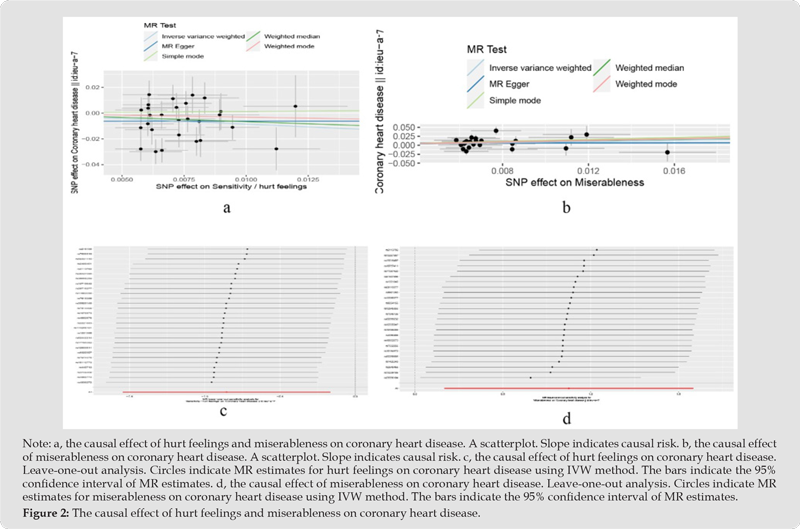
In our study, the causal effect of four subjective negative emotions as potential risk factors for CHD was examined, two of which showed evidence of association with CHD risk. Scatter plots can visualize these results fairly intuitively (Figures 2a & 2b). After excluding 1 palindromic SNP and 1 outlier, the hurt feelings (IVW OR per SD change: 0.425; 95% CI, 0.213-0.847; P = 0.015) was negatively associated with the risk of CHD as shown by the results of the standard IVW analyses, suggesting that it has a protective effect against the occurrence of CHD. To ensure the efficacy of the conclusion that hurt feelings provide a protective effect and reduces CHD risk, several analyses were performed. The MR Egger intercept test for hurt feelings (intercept, -0.006; standard error, 0.015; P = 0.678) indicated no horizontal pleiotropy. In addition, the Cochran’s Q statistic for hurt feelings (Q = 42.898; I2 = 0.371)indicated potential heterogeneity between instrumental SNP effects. Leave-one-out analyses indicated that the effect of hurt feelings on CHD was not significantly driven by any single SNP (Figure 2c). The corresponding forest and funnel diagrams were provided in the Supplementary material online Supplementary Figures 1 & 2. In another study of the effect of miserableness on CHD, no outliers were found, but 11 SNPs for palindromes or incompatible alleles were excluded to ensure the reliability of the results.
Figure 2
Supplementary Figure 1

Supplementary Figure 2

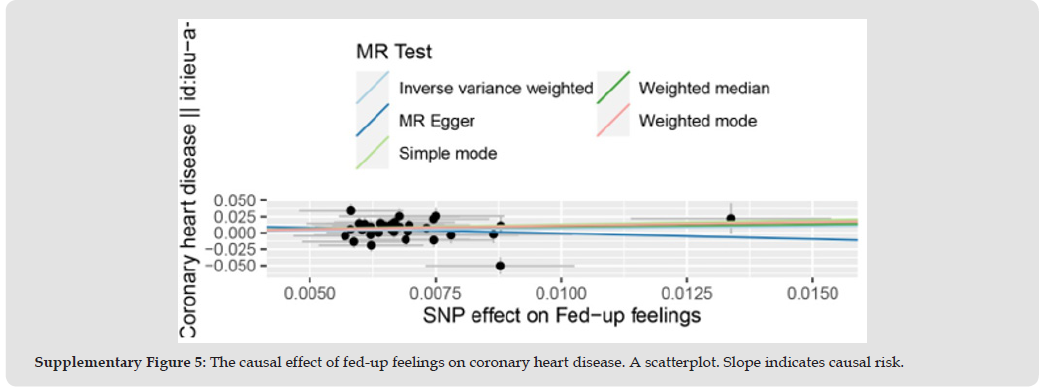
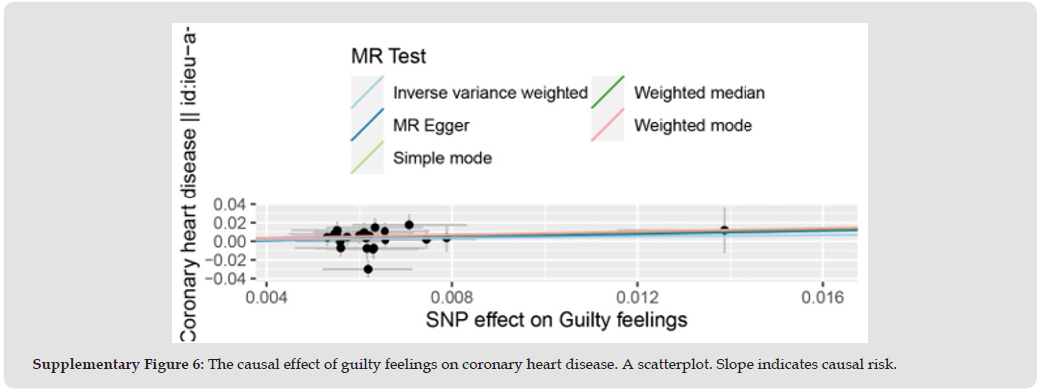
Its IVW analysis showed that miserableness (IVW OR per SD change: 2.400; 95% CI, 1.182-4.876; P =0.015) was predictably associated with the risk of CHD, suggesting that it is a risk factor for the occurrence of CHD. We performed sensitivity analyses to ensure the efficacy of the finding that miserableness increase the risk of CHD. The MR Egger intercept test for miserableness (intercept, 0.006; standard error, 0.138; P = 0.673) indicated no horizontal pleiotropy. In addition, the Cochran’s Q statistic for miserableness (Q = 32.135; I2 = 0.253) indicated less heterogeneity between instrumental SNP effects. Leave-one-out analyses indicated that the effect of miserableness on CHD was not significantly driven by any single SNP (Figure 2d). The corresponding forest and funnel diagrams were provided in the Supplementary material online, Supplementary Figures 3 & 4. Causal associations between other subjective negative emotions, including the fed-up feelings (IVW OR per SD change: 2.000; 95% CI, 0.947-4.226; P = 0.069), and guilty feelings (IVW OR per SD change: 1.520; 95% CI, 0.757-3.050; P = 0.239), and CHD were not statistically significant, i.e., there was a lack of strong genetic evidence linking them to the risk of developing CHD. Scatter plots of the causal effects of these two subjective negatives on CHD are shown in the Supplementary material online, Supplementary Figures 5 & 6. In addition, we swapped previous exposure factors and outcomes and conducted another two- sample MR study.
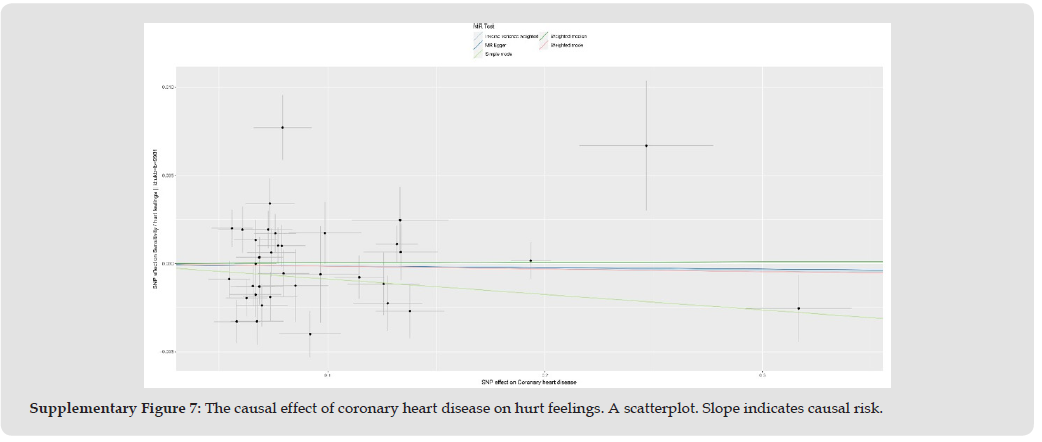
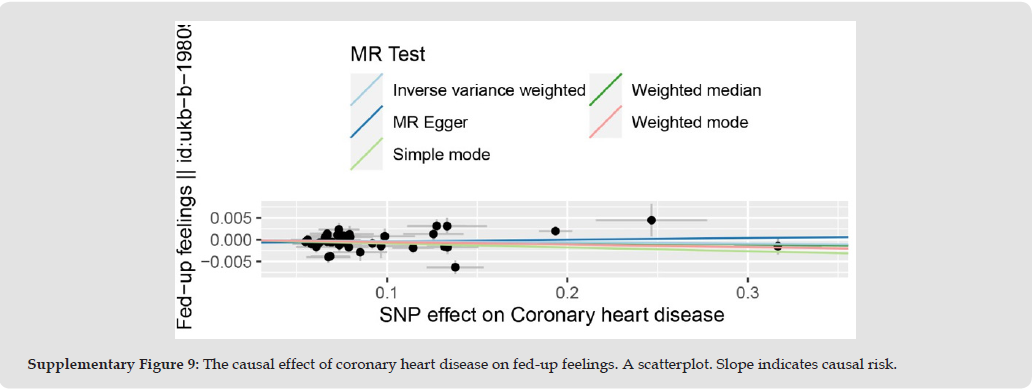
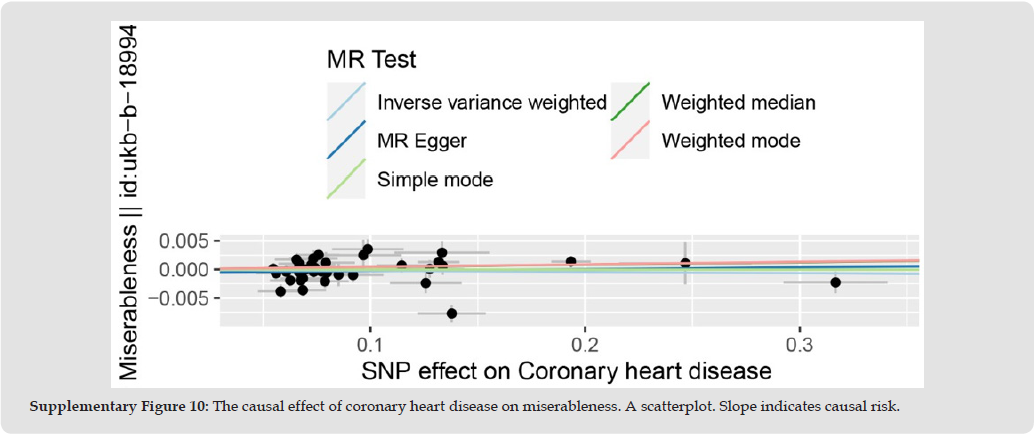
In the results of the reversed MR, we found no evidence that CHD affects any of the subjective negative emotions. Following the same procedure as in the previous study, our final results suggest that CHD does not have a causal effect on hurt feelings (IVW OR per SD change: 0.999; 95% CI, 0.992-1.006; P = 0.708), guilty feelings (IVW OR per SD change: 1.003; 95% CI,0.997-1.009; P = 0.279), fed-up feelings (IVW OR per SD change: 0.997; 95% CI, 0.991-1.003; P =0.322), or miserableness (IVW OR per SD change: 0.998; 95% CI, 0.991-1.005; P = 0.522). Scatter plots of the causal effects of CHD on these subjective negatives are shown in the Supplementary material online Supplementary Figures 7-10.
Supplementary Figure 3

Supplementary Figure 4

Supplementary Figure 5
Supplementary Figure 6
Supplementary Figure 7
Supplementary Figure 8

Supplementary Figure 9
Supplementary Figure 10
In this study, we demonstrated the presence of protective factors for CHD even among subjective negative emotions. To the best of our knowledge, this is the first study to apply MR methods to investigate the potential causal relationship between these four subjective negative feelings and CHD. Our MR findings suggest that hurt feelings are protective against CHD risk, and pairs of miserableness increase the risk of CHD; whereas the causal relationship between fed-up feelings, guilty feelings and CHD, and the causal relationship of CHD to the four subjective negative emotions did not find supportive evidence at the genetic level. Our results reveal a stable causal relationship between miserableness and CHD, which is in accordance with what academics have always known. The miserableness is a typical negative emotion [16]. Cross-sectional studies had shown that most people with CHD experience multiple subjective negative emotions at the same time. Retrospective studies found that subjective negative emotions usually precede the onset of CHD [17]. Some prospective cohort studies have shown that people with multiple subjective negative emotions have a higher risk of developing CHD than those without subjective negative emotions [18]. Even Li, et al. found that subjective negative emotions were predictive of poor prognosis for stent implantation in patients with CHD [19].
The miserableness that we studied is often present in depressed patients along with other negative emotions, which can lead to depressed patients triggering an emotional experience of a mixture of multiple negative emotions when encountering a particular situation [20]. Although depression contributing to the onset of CHD has been widely studied in academia, among the different negative emotions of depression linked to CHD, the main ones that have been examined are depression, anxiety, and anger/hostility [21]. Our findings may add to the argument that several negative emotions have a causal effect on CHD, i.e., in addition to emotions such as depression, anxiety, and anger/hostility, miserableness is one of the major risk factors for CHD. The mechanisms by which the miserableness increases the risk of CHD are not well understood, and several potential mechanisms may exist. Biologically, multiple mechanisms may be involved in the development of CHD. Common mechanisms by which miserableness lead to an increased risk of CHD include chronic inflammation, endothelial dysfunction, and increased platelet activity [22,23]. It has also been found that miserableness can be produced after acute stress and can increase the risk of CHD by reactivating the cardiac vagus nerve and evoking sympathetic stimulation [24]. From a sociological point of view, in addition to mental illnesses such as depression, the frequent experience of miserableness may also belong to a personality trait known as Type D.
People with Type D personality often feel miserable and try to avoid confrontation with others in social situations, which leads to social inhibition, which is not conducive to the establishment of good interpersonal relationships [25]. And one study found negative effects in patients with Type D personality traits who underwent Coronary Artery Bypass Grafting (CABG) [26]. At the same time, frequent miserableness may lead to an irregular and unhealthy lifestyle, which may increase the risk of CHD [27]. Numerous studies have provided consistent evidence for the benefits of positive emotions on cardiovascular health. Positive mood was found to be associated with a reduced incidence of CHD in a Canadian Health Survey population study [28]. Another cohort study found an age-adjusted risk ratio of 0.38 (95% CI, 0.22-0.64) for combined nonfatal myocardial infarction and CHD death in men who reported higher levels of emotional self-regulation compared with men with lower levels. the risk of combined angina, nonfatal myocardial infarction, and CHD death was reduced by 20% for each 1-SD increase in the level of emotional self-regulation [29]. Another prospective cohort study that included both men and women reported that high levels of emotional vitality had a multivariate- adjusted relative risk of 0.81 (95% CI, 0.69-0.94) for CHD, and a significant dose-response relationship was found for this association (P< .001) [30].
In addition, heart rate variability and coronary artery stenosis severity were reduced by employing adaptive mood regulation strategies (e.g., positive refocusing, refocusing programs) [31]. Originally developed for patients with major depressive disorders, Cognitive Behavioral Therapy (CBT) has recently been found to be effective in reducing the risk of developing cardiovascular disease [32]. Usually, we regard all subjective negative emotions as risk factors for CHD. However, the results of our MR study broke this conventional understanding because our MR results showed that hurt feeling and CHD were negatively correlated. The fact that hurt feelings are a protective factor for CHD is not consistent with previous knowledge. At the same time, there is a lack of studies on the causal relationship between hurt feelings and CHD. To explain this, we first need to understand what hurt feelings are and why it occurs. Hurt feelings often imply sensitivity, usually occurring after rejection or devaluation by the other person, and encompassing various forms such as unfulfilled promises, and dependence on someone who is distant. Although hurt feelings are a subjective negative emotion, it is characterized at its core by commitment, dependence, and vulnerability, [33] which are not entirely negative characteristics. The characteristic of vulnerability implies a desire or need for an emotional connection with the other person. And the two traits of commitment and dependence can cause a person to attempt to restore the other person’s trust, acceptance, recommitment, or closeness in constructive ways, such as effortful giving and pleasing, after experiencing hurt feelings.
This constructive behavior is conducive to inducing the other party’s compensation and establishing the restoration of a harmonious relationship, which is conducive to repairing or even enhancing interpersonal relationships in terms of results. It is worth noting that people who are prone to experiencing hurt feelings tend to react in a constructive rather than a destructive way. Hurt feelings are distinct from anger/hostility. Feelings of anger/hostility drive a person to adopt confrontational behaviors to achieve the desire/purpose of controlling the other person, and he or she can exacerbate the breakdown of relationships [33]. This point may be one of the important reasons why hurt feelings are a protective factor for CHD. Interpersonal relationships are strongly associated with the development of CHD. Anger/hostility is positively correlated with the frequency and intensity of negative interpersonal interactions, and it may cause higher mean dynamic systolic blood pressure levels through negative interpersonal interactions, which in turn increases the risk of developing cardiovascular disease [34]. Individuals who have had poor interpersonal relationships, or who are lonely, are 30% more likely to develop CHD and stroke, [35] and married couples with good interactions have significantly lower dynamic blood pressure than separated couples [36]. Interpersonal trust is an important determinant of cardiovascular health, i.e. good interpersonal relationships reduce the risk of cardiovascular disease.
One study of 8,335 individuals without CHD followed for 5 years found that good interpersonal relationships (HR = 0.65; 95% CI, 0.50- 0.85)were associated with a reduced risk of CHD [37]. In another 38- year cohort study, Piroska et al. found that in late adolescence, men who had a confidant with whom they could confide had a decreased risk of CHD [38]. We hypothesize that feelings of hurt mediate positive interpersonal relationships, which in turn protect against CHD, but further research is needed to confirm this. Meanwhile the quality of interpersonal relationships depends on the synergistic effect of social context, individual temperament and personality traits. Interpersonal relationships can trigger autonomic responses ranging from sympathetic arousal to vagal modulation of cardiovascular activity, and from changes in energy intake and expenditure to changes in physical activity habits, [39] all of which may have a potential impact on CHD. Although numerous observational and cohort studies have found an effect of CHD on subjective negative emotions, we failed to provide consistent evidence in our MR. In the MR study by Li et al. also failed to find a causal link of CHD on depression, [40] which is similar to our findings. This inconsistency may be the result of potential bias in observational and cohort studies. It may also be possible to demonstrate that the effect of CHD on subjective negative emotions is not determined by the laws of genetics but is more closely related to acquired social factors.
Our MR study supports the pathogenic significance of miserableness in CHD, while refuting the notion that all subjective negative emotions are causally linked to CHD, using the example of hurt feelings. On the basis of potential mechanistic speculations, we support the consideration of miserableness and interpersonal relationships as modifiable risk factors for CHD. However, this study still has several limitations. First, the presence or absence of subjective negative emotions was a self-reported outcome by the participants, which lacked an objective indicator, and there may have been emotional concealment by some individuals, affecting the accuracy of the outcome. Second, there are some established limitations of MR, such as unknown confounders between the four subjective negative emotions and CHD that may have affected the results, despite the fact that we manually eliminated some confounders and used different analytical methods to test for potential pleiotropy. Third, our use of participants from all studies focused primarily on European ancestry, and it is unclear whether our findings can be extrapolated to other populations. Future studies with different populations are necessary to extend our findings. Fourth, the mediators by which the hurt feelings play a protective role against CHD are unclear, and the mechanisms involved have not been fully investigated. Despite these limitations, to the best of our knowledge, this is the first bidirectional MR analysis for the four subjective negative emotions and CHD described above.
We expanded on more associations between subjective negative emotions and CHD. More importantly, our findings suggest that not all subjective negative emotions are positively associated with CHD. Among them hurt feelings were shown to be negatively associated with CHD at the genetic level. Human emotions are complex, and just as hurt feelings are driven by the receipt of positive expectations, they may likewise have a positive impact. Therefore, we do not have to dismiss all subjective negative emotions across the board, nor do we have to be overly afraid of all our negative emotions. Further research could focus on exploring the mechanisms by which hurt feelings protect against the onset of CHD. Our findings provide strong genetic evidence that miserableness is causally and predictively associated with CHD, but hurt feelings are causally and predictively negatively associated with CHD. These results support that not all subjective negative emotions promote the development of CHD. This finding could help refine health education for people with CHD in the real world, i.e., there is no need to be prejudiced against all negative emotions.
The authors declare that the research was conducted in the absence of any commercial or financial relationships that could be construed as a potential conflict of interest.
None.
The authors thank all the investigators of UK Biobank study, MRCIEU for providing the data publicly.
All the data used in the present study had been publicly available. The original contributions presented in the study are included in the article/ Supplementary Material, further inquiries can be directed to the corresponding author.

International Association of Landscape Archaeology, Czech Glass Society, Czech Republic

Department of Chemistry, Semenov Institute of Chemical Physics, USSR Academy of Sciences, Moscow, Russia

Neurology, LA BioMed Research Institute, USA

Associate Professor at Department of Breast and Thyorid Surgey, Chongqing General Hospital, China

Clinical Radiologist (MD) - Department of RADIOLOGY, Cosenza Hospital, Cosenza, Italy





 Abstract
 PDF
PDF



























