info@biomedres.us
+1 (502) 904-2126
One Westbrook Corporate Center, Suite 300, Westchester, IL 60154, USA
Site Map
 ISSN: 2574 -1241
ISSN: 2574 -1241
ISSN: 2574 -1241
Received: February 14, 2025; Published: February 24, 2025
*Corresponding author: MM Radkevich, Peter the Great St. Petersburg Polytechnic University, Russia
DOI: 10.26717/BJSTR.2025.60.009489
The article is devoted to the study of the possibilities of jet electrolytic plasma polishing of coronary stents surfaces. The purpose of this work is to evaluate the possibilities of using jet electrolytic plasma treatment when polishing coronary stents and determine the conditions under which it is possible to obtain a high-quality surface with a low level of roughness. The paper exploring the possibility of polishing the surfaces of metal coronary stents based on cobalt alloy. Polishing was performed on a pilot installation of jet electrolytic plasma polishing. The features of polishing the surface of coronary stents with various schemes of electrolytic plasma treatment are studied. The optimal technological modes and electrolyte for processing such products were selected. The surface of the treated coronary stent was analyzed using a microscope. The possibility of using electrolytic plasma jet treatment as a method of finishing coronary stents and similar products has been demonstrated.
Keywords: Coronary Stent; Jet Electrolyte Plasma Treatment; Polishing, Modes; Technological Process; Stent; Surface Finishing; Polishing Technology; Electrolytic-Plasma Polishing
One of the most important tasks in the development of mechanical engineering is the development and production of equipment, the development of technologies in the field of medicine. This area includes electrochemical and electrophysical technologies. In particular, electrolyte- plasma polishing technologies can be implemented according to the following technological schemes: immersion in an electrolytic bath, electrolyte jets, as well as with the use of their combinations. A feature of the application of these technologies is the polishing of the surfaces of products with a high quality surface layer. In addition, it is possible to process products that have complex spatial and curved surfaces. An example of such products is coronary stents (Figure 1). In the production of medical devices such as implants, stents and other small products that require high precision and have a complex shape, the use of special electrophysical technologies is required. The complexity of the shape and small size of the products significantly complicate their polishing, as well as the subsequent application of special modifying coatings on them. The shape and small size of the coronary stent greatly complicate its mechanical polishing. Varieties of jet electrolyte-plasma treatment allow you to process products of any complexity, shape and small size. At the same time, high dimensional accuracy, productivity and the required surface roughness are ensured.
Figure 1

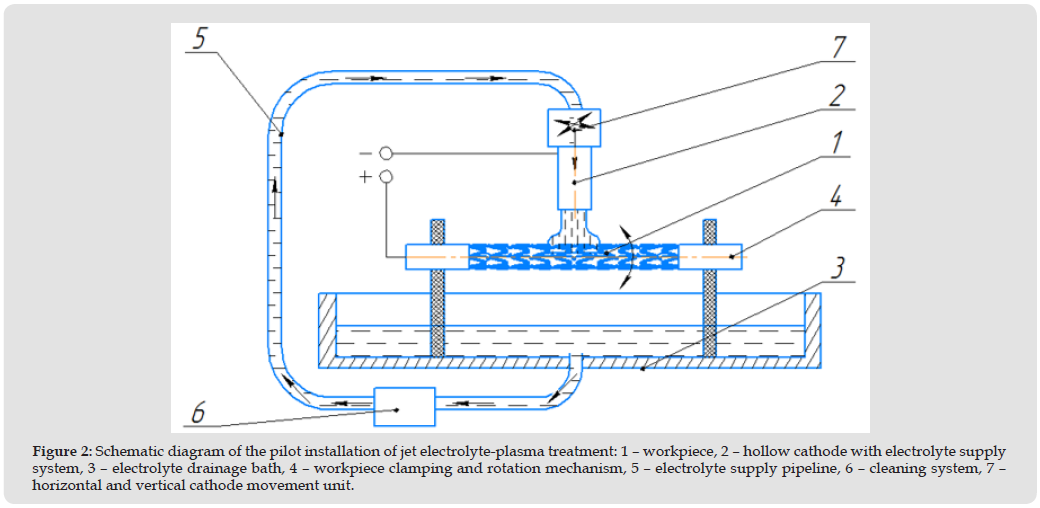
The schematic diagram of the pilot installation of jet electrolyte- plasma treatment according to various technological schemes for polishing the outer and inner surfaces of the stent is shown in Figure 2 [1,2]. Since the composition and concentration of the electrolyte is one of the main parameters of the processing process, its choice was based on a series of experiments of electrolyte-plasma polishing according to the scheme of immersing the product in a bath with an electrolyte. A solution of ammonium sulfate with the addition of ammonium citrate was used as an electrolyte [3,4]. During the polishing process, the electrolyte was heated to a temperature of T = 80° ± 3 °C, which was maintained by a thermocontroller, with an accuracy of 0.1 °C. The flow rate (w, l/h) of the electrolyte was recorded with a rotameter with a flow error of 2%. The voltage on the samples varied in the range of 20 - 500 V. stent blank tubes made of L605 steel and coronary stents with a diameter of 1.8 mm and a wall thickness of 0.1 mm, made using laser cutting technology, were used [5,6]. A microscope was used to examine the surface condition of coronary stents after electrolyte-plasma polishing.
Figure 2
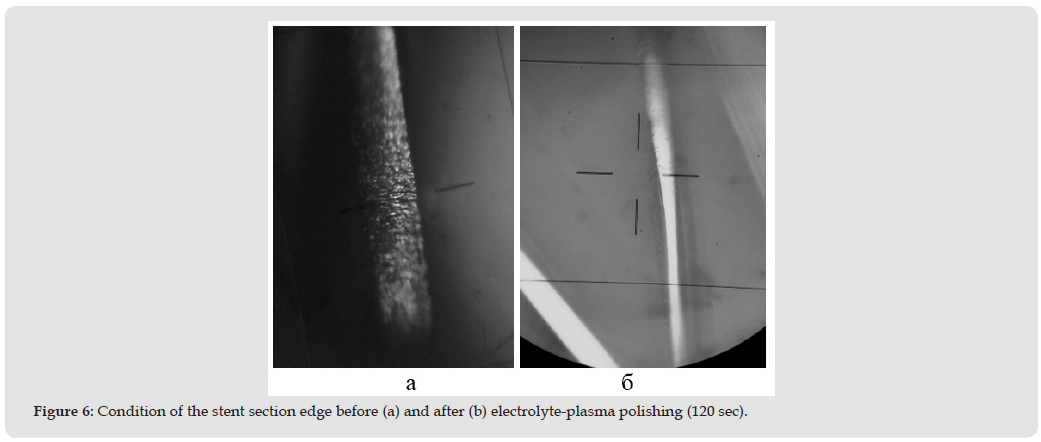
In the course of this work, several possible treatment schemes by jet electrolyte-plasma polishing were investigated [7]. In total, four different technological schemes and different designs of the specimen fastening device were used Figure 3. It was found that the best surface quality of the samples was obtained by using the scheme of jet electrolyte-plasma polishing with fixation in centers with or without immersion in the electrolyte Figure 4. In the course of polishing the samples, the rational parameters of operating modes for this steel were determined. Based on the results of the experiments, the volt-ampere characteristic was plotted in the form of a graph, that is, the dependence of changes in the parameters of the treatment mode in the process of electrolyte-plasma polishing [8]. The volt-ampere characteristic allows you to correct, clarify the parameters of optimal modes when polishing coronary stents: the voltage for polishing steel L605 U = 240... 260V, current density - 0.10... 0.16A/cm². At these modes, the process of polishing the coronary stents took 30, 60 and 120 seconds. The surface of the stent after polishing was examined using a microscope. Figures 4 & 5 show the surface condition of the curved walls of the outer surface at different stages of processing depending on the polishing time, as well as the effect of electrolyte-plasma polishing on the thickness of curved surfaces, bridges and edges (Figure 6). So, after the laser cutting operation, it can be observed that particles of melted metal, large roughness, deformed surface remain on the edges, which is eliminated by chemical etching of the stent edges. In our study, no preliminary chemical etching treatment was performed. By subjecting the workpieces prepared by laser cutting, electrolyte-plasma polishing, products with rounded edges and a good quality surface were obtained. As a result of the treatment, the surfaces of the stent have become shiny and visually the roughness has become less, the edges have acquired a rounded shape. After treatment, the stent did not lose its integrity, no cracks or other defects were noticed. Sometimes “tears” of metal particles of the surface layer of the product were observed, apparently due to a breakdown in the inter-electrode gap.
Figure 3
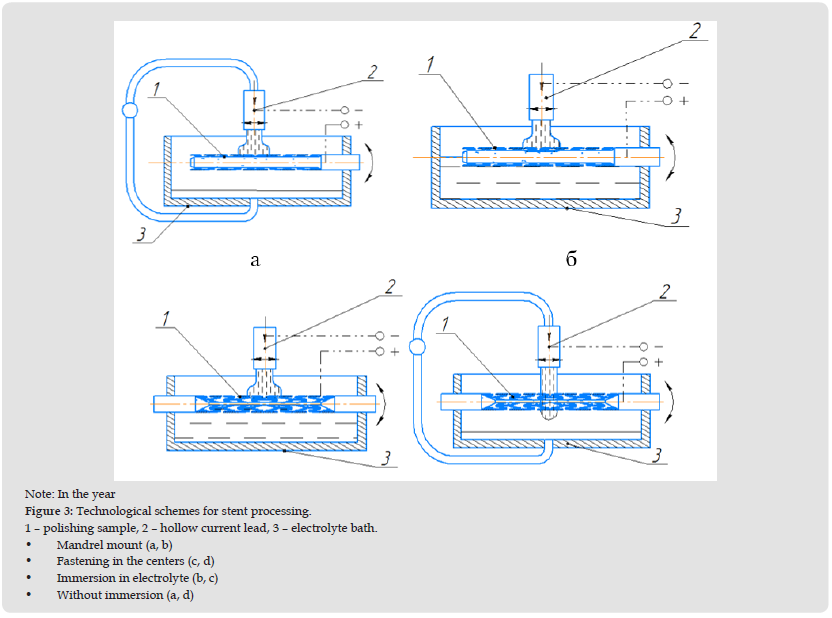
Figure 4
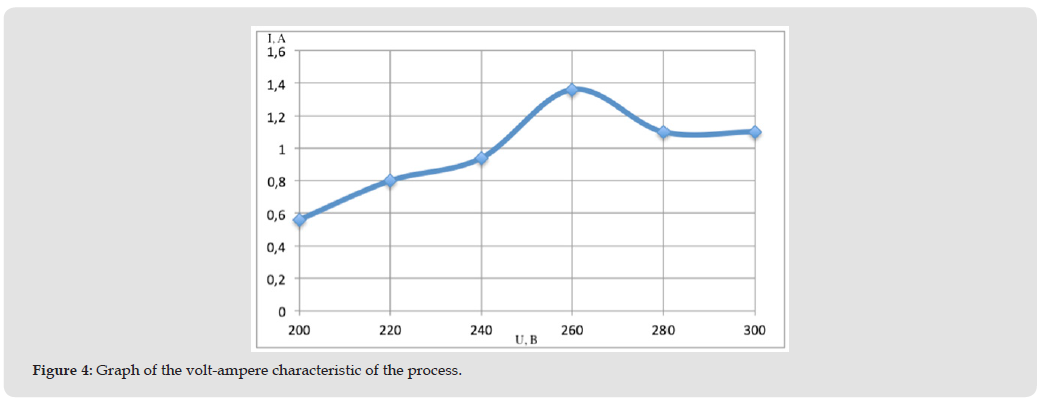
Figure 5
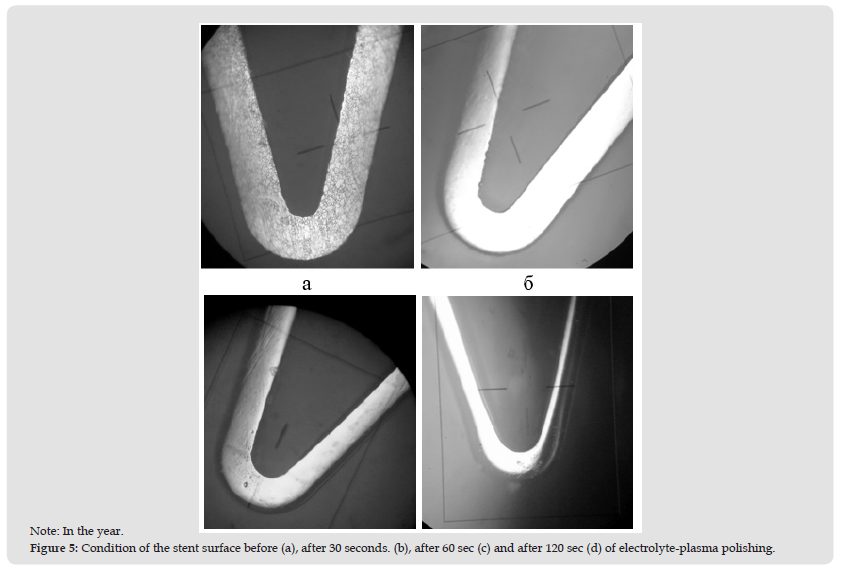
Figure 6
Taking into account the results of the work carried out, it becomes obvious that with the help of electrolyte-plasma polishing on coronary stents, it is possible to achieve a high-quality polished surface. However, it is still necessary to find optimal schemes for the introduction of this technology into industrial production in order to manufacture stents of various diameters, more complex cell shapes. It should also be noted that in order to achieve the best surface quality, it is necessary to additionally treat the inner wall of the stent according to other schemes of electrolyte-plasma polishing of the internal surfaces of pipes [9-11]. The coronary stent used in this study is a rather complex product. It consists of sinusoidal segments (cells) interconnected by nonlinear convoluted bridges. In the works [12-15] of previous researchers, it was shown that polishing coronary stents with this kind of bridges is problematic, since in the process of processing these elements thin and become thinner faster than other structural elements. In the course of our research, it was shown that the polishing of the stent was uniform and without disturbing the shape of the connecting bridges. It should be noted that the processing of such small products requires careful control of the electrode gap, electrolyte flow rate and operating parameters of treatment modes.
Various schemes for polishing coronary stents using electrolyte- plasma technology are considered. Rational technological modes of treatment of external and internal surfaces of the stent by jet electrolyte- plasma treatment have been established. The results of the study give reason to conclude that the method of jet electrolyte-plasma polishing can be successfully used as a finishing treatment of small products, including those of complex design and shape.

International Association of Landscape Archaeology, Czech Glass Society, Czech Republic

Department of Chemistry, Semenov Institute of Chemical Physics, USSR Academy of Sciences, Moscow, Russia

Neurology, LA BioMed Research Institute, USA

Associate Professor at Department of Breast and Thyorid Surgey, Chongqing General Hospital, China

Clinical Radiologist (MD) - Department of RADIOLOGY, Cosenza Hospital, Cosenza, Italy





 Abstract
 PDF
PDF



























