info@biomedres.us
+1 (502) 904-2126
One Westbrook Corporate Center, Suite 300, Westchester, IL 60154, USA
Site Map
 ISSN: 2574 -1241
ISSN: 2574 -1241
ISSN: 2574 -1241
Received: February 10, 2025; Published: February 21, 2025
*Corresponding author: Alexandr Chernov, Department of General Pathology and Pathological Physiology, Institute of Experimental Medicine, 197022, Saint Petersburg, Russia
DOI: 10.26717/BJSTR.2025.60.009486
Glioblastoma multiforme (GBM) is a very aggressive tumor of the central nervous system. In patients with this diagnosis, with contemporary treatment standards, life expectancy is about 15 months. Due to the inherent GBM heterogeneity, it is possible to personally improve the treatment outcomes for patients by individually predicting an adequate regime administration. In this article, we consider, on the one hand, number of parameters of the GBM tissue cells as predictors reflecting the planned radiation therapy (RT) effectiveness: their intra- and intertumor heterogeneity, including the molecular genetic- and epigenetic modifications, GBM stem cells, damage in their DNA reparation and hypoxia level variations, as well as the response to in vitro irradiation of the tumor organoids. On the other hand, an alternative to such predictors may be the cellular and extracellular indices of the tumor microenvironment in the tumor bearing. For example, the ex vivo radiosensitivity of blood cells, extracellular vesicles, their measurements also allow to assess the RT effectiveness. The possibility of using these parameters as predictive biomarkers for the individually determining of the RT success both in experimental animals and in the clinical patients with GBM is discussed.
Keywords: Glioblastoma Multiforme; Radiation Therapy; Diagnostic Methods; Predictive Biomarkers
Glioblastoma multiforme (GBM) is a rare but highly aggressive malignant brain tumor with median untreated patients` survival of approximately is three months [1]. To date, for many cases, the reliable reasons of GBM occurrence and development have not been clearly established. Possible risk factors for GBM development include: age [2], the hereditary history of tumors [3], de novo germ line mutations [4], exposure to ionizing [5] and non-ionizing electromagnetic radiation of cellular phones [6]. Factors contribute to the GBM development and hinder the treatment of patients include: metabolic heterogeneity of tumor cells, among which there are cells with an increased rate of oxygen metabolism, glucose, proliferation, and dormant cells [7]; hypoxic tumor microenvironment (TME), which is a factor for the induction of epithelial-mesenchymal transition and tumor cell resistance [8]; development of multiple GBM cell radio- and chemoresistance associated with the presence of mutations in driver and suppressor genes, as well as with epigenetic modifications [9]. Given the short survival term after diagnosis, the timing of testing for personalized treatment regimens and including the entire prediction procedure, as well as the availability for translation of this technology when it is introduced into clinical practice, are critical. Currently used treatment protocols for GBM patients include surgical resection of the maximum possible tumor volume (49%) followed by RT (40%) and chemotherapy (CT) with temozolomide (TMZ) (11%) [10]. The use of radiation diagnostics (computer and magnetic resonance imaging) has made it possible to increase the accuracy and adequacy of ionizing radiation energy delivery to the tumor, while minimizing the irradiation of surrounding tissues and organs [11].
However, the overall survival (OS) median of GBM patients treated with RT and CT is still only about 14-19 months [1]. Taking into account such short OS rates in GBM patients with modern treatment methods, it is necessary to develop new short-term technologies for determining biomarkers for predicting RT effectiveness, which will allow for more successful access to its use in clinical practice. In recent experiments, to solve the problem, it is proposed to use 3D model cell systems isolated from patients’ tumors and their cultivation in vitro, ortho- and heterotransplantation inoculation of neoplasms in vivo in mice or rats and testing therapeutic effects on them [12,13]. Although 3D models simulate in vivo cell growth conditions and create hypoxia (pO2) gradients, methods for assessing the sensitivity, specificity, and prognostic significance of such systems have not yet been recommended for RT routine use in clinical guidelines [14,15]. The reasons for this, along with the impracticality for routine use in the clinic due to the length of time it takes to complete, the labor intensity, and the inaccessibility, is also the lack of data in the indicators on the cellular and non-cellular TME components, which may be more informative as predictors than the tumor ones themselves [15]. This review examines the main biological factors and processes that determine the RT effectiveness in GBM patients, as a known treating method of the patients with these malignant neoplasms. The results of changes in the GBM cell radiosensitivity, as well as their microenvironment, and the possibility of using these indicators for prediction are discussed. Finally, the results of the use of predictive indicators for the selection of GBM patients for more successful RT using are presented.
Many human and animal organisms’ tissues and cells are exposed to adverse environmental influences, including carcinogenic ones, and only target organs specific to a specific tissue or organ become malignant due to the metabolism peculiarities. At the same time, membrane, cytoplasmic and nuclear levels of malignant neoplasms chemoresistance are known [16], while tumor growth, metastasis and response to therapy are also determined by its TME [16,17]. Thus, the biological factors influencing the RT effectiveness for GBM can be divided into:
• Tumor factors, including intratumor heterogeneity (which is caused by driver and suppressor genetic, epigenetic and metabolic changes, cellular proliferation), differentiation, the degree of DNA repair mechanisms disruption, expression of marker proteins, intratumor hypoxia and others;
• Tumor microenvironment factors: cellular composition, vessels surrounding neoplasms and providing their metabolism, as well as influencing hypoxia, blood pH, intercellular vesicles transporting proteins, DNA, RNA, ionic composition, etc.
Cellular Tumor Factors
Intertumor Cellular Heterogeneity of GBM: Intertumor heterogeneity means that GBM cells from different patients have different molecular genetic profiles and, accordingly, the sensitivity to RT or chemoradiotherapy (CRT). To date, it has been proven that GBM is a highly heterogeneous tumor [18]. Molecular genetic changes include: deletions, duplications, amplifications, translocations, gene polymorphisms, the number of micronuclei, DNA breaks and base modifications; epigenetic changes include: alkylation of nitrogenous bases and histones, leading to changes in the level of DNA expression, circulating DNA, RNA, microRNA (miRNA), proteins and other biomarkers in tumor cells and non-malignant brain tissue [19,20]. Some of these factors can be used as prognostic indicators of OS in GBM patients (Table 1). The data in the Table 1 indicate that both genetic and epigenetic markers can be used to predict OS in GBM patients. On the other hand, for example, the expression of IDH1-R132H in primary GBM is about 10%, and the expression of the MGMT methylated promoter is observed in 43.1% of tumors, which reduces their prognostic value [21,22]. The expression of these markers can be influenced by the patients` age, their ethnicity, the presence of concomitant diseases, administered therapy (type of treatment, dose, duration), the of tumor malignancy degree, the state of the immune system (the number of cytotoxic T- and B- lymphocytes), as well as the number of resistant GBM stem cells, myeloid suppressor cells into TME. All these factors should be taken into account when assessing the predictive ability of genetic and epigenetic markers, which complicates their determination in clinical conditions.
Table 1: Biomarkers for predicting overall survival in GBM patients.

Note: IDH1 ‒ isocitrate dehydrogenase 1, histone H3F3A expression, YKL-40 ‒ chitinase-3-like protein 1, miRNA-221 ‒ microRNA-221
The effectiveness of prognostic indicators can be assessed experimentally based on growth inhibition in GBM experimental animals or in the clinic using radiological diagnostic methods by visualizing changes in tumor size and metastases during or after treatment [23]. At the same time, reliable differences in these indicators when compared with the initial ones can be obtained only after the onset of RT, as well as at the terminal stages of the study, which negates their predictive significance.
Intratumor Cellular Heterogeneity: Intratumor heterogeneity is caused by the cell diversity that differ in proliferative activity, sensitivity to therapy, are at different stages of cell death and at the same time express different molecular and genetic indicators. Proliferating cells are localized mainly at the GBM growth front, while dying cells are located inside it [24]. Malignant neoplasms contain cells with cytogenetic abnormalities: different numbers of micronuclei, chromosome copies, chromosomal aberrations (deletions, hyperaneuploidies, trisomies, translocations), which can be used to assess GBM radiosensitivity [25]. Life expectancy monitoring shows lower OS in patients with monosomy 10 and trisomy, monosomy into 7 chromosomes [26], however, their detection is comparatively labor-intensive and time-consuming. The micronucleus test, which requires less time to perform, is less sensitive and specific. With in the tumor, individual cells also vary in sensitivity to RT, which is called “intrinsic radiosensitivity” [11,27]. It was assessed in pre-treatment tumor samples using clonogenic analysis as the proportion of surviving tumor cells after exposure of 2 Gy ionizing radiation (SF2) dose [28]. Torres-Roca JF, et al. in 2005 proposed using the expression level of 10 genes characterizing of SF2 dose to predict radiosensitivity in vitro [29]. This index and genome-adjusted radiation dose (GARD) were correlated with patients’ OS. The authors found that treatment results depend on the patients’ tumor radiosensitivity [30,31]. Not all genetic changes identified by gene sequencing translate into malignant transformation [32]. At the same time, an analysis of 694 human cell lines showed that in vitro tumor cells, in general, are more radioresistant (LD50 = 2.29 Gy) than non-cancer cells (LD50 = 1.57 Gy) [33].
However, according to the authors, such analyses are still labor-intensive and require fairly expensive equipment and reagents. Some of the used gene panels showed poor predictive ability compared to randomly selected genes, and the cells are cultured in mediums differ from the cellular microenvironment of tumor. In addition, highly qualified specialists are required to implement these technologies, which complicates the translation of the obtained data into clinical practice, as well as the general availability of this approach.
Glioblastoma Stem Cells: One of the reasons for the intratumor heterogeneity of GBM is the presence of chemo- and radioresistant CD133+ GBM stem cells (GSCs). These cells were first isolated in 1992 by B. Reynolds and S. Weiss from the striatum of adult mice. It forms a small undifferentiated population in the tumor, capable of self-renewal and differentiation into neurons, astrocytes, and endothelial cells, which leads to tumor growth and its relapses [34]. Subsequently, it was shown that GSCs also express other markers: chemokine CXC ligand- 12 (CXCL12), transcription factors SOX2, NANOG and oligodendrocyte (OLIG2), aldehyde dehydrogenase-1 (ALDH1), nestin, integrin- α6, Notch [35]. It has been established in GBM heterotransplant models high SOX2 expression is associated with GBM radioresistance and maintenance of GSCs in an undifferentiated state [36]. Activation of the cell cycle checkpoint enzymes Chk1, Chk2 also results in cell cycle arrest in the S phase, which gives GSC time to repair DNA damage and increases the RT-resistance of GBM cells [37]. Knockout of the NOTCH1 receptor gene in GBM cell lines, on the contrary, reduces the proliferation rate, and the inhibition of its intracellular domain (NICD) in CD133+GBM cells significantly reduces their clonogenicity and simultaneously induces apoptosis, demonstrating the protective role of NOTCH in CD133+ GSC cells from RT [38,39]. The presence of GSCs, which have the properties of self-renewal and differentiation into many types of cells, determines the development of relapses and resistance to treatment in GBM patients. DNA repair mechanisms are activated predominantly in GSC cells, and elevated levels of CD133+GSC cells are detected in recurrent tumor samples even after high doses of RT [40,41]. Inhibition of the fork head box M1 transcription factor (FoxM1) in combination with ionizing radiation results in decreased SOX2 expression and tumor growth in GBM heterograft models, suggesting that the FoxM1-SOX2 pathway is involved in GSC sensitivity to radiation [42].
In addition, recent studies conducted by Gulyaev D.A. et al. on 16 GBM patients did not reveal reliable correlations between patients’ OS and the expression of molecular markers in GSCs: Nanog (r=0.055, p=0.840), nestin (r=-0.230, p=0.391), CD133 (r=-0.185, p=0.493), SOX2 (r=0.237, p=0.378), CD38 (r=-0.246, p=0.359), FOXM1 (r=0.408, p=0.117) [43]. The authors concluded that the determination of GSC markers in GBM patients does not affect the choice of treatment strategy and is not appropriate for predicting treatment outcomes in clinical practice.
Tumor Cell Response to Radiation Therapy
DNA Repair: In mammalian cells, DNA reparation is a wellknown mechanism for repairing damage caused by ionizing radiation, particularly RT. This process can occur in several ways: base excision repair, which eliminates damaged bases and single-strand breaks, non-homologous end joining and homologous recombination, which repair double-strand breaks in DNA [44-46]. Radiation-induced double- strand breaks and multiple DNA lesions are the leading lethal events for cells. They promote GBM cell radiation-induced G1/S phase arrest and their death mediated by p53-, p38MAPK/MK2-dependent transcription of the cyclin-dependent kinase inhibitor p21cip1/waf1 [37]. RT exposure activates DNA damage repair enzymes in GBM: ataxia-telangiectasia mutated protein kinase (ATM) and ataxia-telangiectasia Rad3-related serine-threonine protein kinase (ATR), which phosphorylate checkpoint kinases Chk2 (Ser-345) and Chk1 (Thr-68) [47]. Activation of these kinases maintains genome integrity and stability. In response to irradiation, GBM cells show increased activation of ATM, ATR, CHK1, PARP1, and RAD51 proteins, which repair DNA, leading to tumor cell proliferation [23]. These proteins can be used as markers of individual radioresistance of patients’ GBM cells, but only after the RT beginning, and not as predictors.
Intratumoral Hypoxia: A significant obstacle to effective RT is the intratumor hypoxic extracellular environment (pO2 is less than 13 mm Hg, 1.25%). Under such conditions, oxygen deficiency reduces the formation of reactive oxygen species (ROS), which may reduce the DNA damage of tumor cells in response to radiation with low linear energy transfer. This correlates with the resistance of GBM to RT, its aggressiveness, volume and OS patients’ reduction [48,49]. The hypoxic microenvironment in the GBM also promotes invasion and metastasis of tumor cells into surrounding brain tissue [45]. However, pO2 measurement using electrodes requires an easily accessible tumor, which has limited its use in GBM patients [50].
Prediction of RT Efficacy in GBM Patients Based on the Tumor Organoids Radiosensitivity
F. Jacob et al from the Mahoney Institute for Neurosciences at the University of Pennsylvania (Philadelphia, USA) have developed a method for obtaining GBM organoids (GBO) from patients without mechanical or enzymatic dissociation of the tumor material to the state of a single-cell suspension [51]. Three-dimensional GBO cultures obtained from the edge of the tumor tissue with minimal necrosis and a small amount of surrounding brain preserved the cellular heterogeneity, histological features, gene expression, and mutation profiles (EGFR amplification, EGFRvIII mutations, MGMT, PTEN, IDH1-mt) of the patients’ tumors. GBO expressed the markers of glial cells: GFAP, S100B, immature neurons - doublecortin, as well as GSC: nestin, brain lipid binding protein, transcription factors HOPX, SOX2 and OLIG2. GBO contained non-tumor macrophages, microgliocytes, oligodendrocytes, T lymphocytes and stromal cells that had a similar expression profile of many cytokine genes TNFA, IL1B and TGFB1 with the parent tumors. These GBOs also showed hypoxia gradients similar to those form during tumor growth in animal models. The GBM organoids obtained within 1-2 weeks showed high aggressiveness and infiltrating capacity when transplanted into the brain of immunodeficient mice. Comparison of the GBO cell mutational profiles with the responses of GBM to the chemotherapy, immunotherapy or RT made it possible to evaluate the personalized testing effectiveness of these therapies. Taken together, GBOs largely preserve tumor molecular characteristics, including inter- and intratumor transcriptomic and genomic heterogeneity. Single exposure testing of 10 Gy radiation and TMZ (50 μM) at the GBO model was performed by determining the percentage of cells expressing Ki-67, reflecting their proliferative activity in the tumor, and overall patient survival. In three of the seven GBO samples, a decrease in the percentage of Ki-67+ cells were observed after the test radiation exposure, which corresponded to a decrease in tumor volume or an increase in patient survival. In three other patients who showed no significant change in the percentage of Ki-67+ cells with this GBO testing, OS after treatment was below the median (1, 3, and 8 months). According to the authors, studies with a larger sample size are needed to establish the reliability of the relationship between GBO response and patient survival [51].
Although GBO cultures resemble their corresponding tumors in many characteristics, these models also have a number of limitations. As the authors’ experience has shown, the decisive factor for the most reliable GBO generation is the time from the moment of tumor resection in the patient to tissue processing. The ability to maintain and propagate GBO over long periods of time varied depending on the quality, GBM tissue composition, and the tumors` growth characteristics. For example, the majority of GBOs (96.4%) expressing the wildtype isocitrate dehydrogenase-1 gene (IDH1-WT) had an aggressive phenotype, whereas recurrent GBMs with a mutant IDH1 gene exhibited lower efficiency of GBO formation (66.7% and 75.0%). Routine identification of all GBO tumors is complicated by differences in the initial tumor volume and the time of GBO in vitro formation, taking into account the patient`s TME factors [51]. For now, this method remains quite expensive, has difficulties with standardization, translation into the clinic, and requires training of specialists with appropriate qualifications.
It is now recognized TME represents a material for an alternative way of identifying radiosensitive patients, reflecting both the carcinogenesis process development and the impact on the therapy antitumor effect [52,53]. In addition to circulating immune cells (granulocytes, lymphocytes, monocytes), TME also includes precursor cells: platelets, stromal cells (tissue fibroblasts), as well as extracellular components: proteins, DNA, miRNA, enzymes and extracellular vesicles, macro- and microelements. In 2010, R. Wang et al demonstrated CD133+GSCs can differentiate into endothelial progenitor cells (CD133+/CD144+), which give rise to mature, proliferating CD105+-endothelial cells [54]. These endothelial cells have the same genetic changes as GBM cells, such as EGFR gene amplification on chromosome 7 [55]. They form the GBM aberrant vascular network, consisting of hyperproliferative endothelial cells, glomeroid tufts and disorganized blood vessels [56]. Vascular endothelial cells serve as a protective niche for GSCs from RT and chemotherapy such as TMZ. Borovski T. et al. showed that when RT exposed, these GBM microvascular endothelial cells promote the proliferation of CD133+-GSCs, thereby maintaining these cells` population after therapy [57]. GBM microenvironment is also formed by the presence of immune cells, microglia and astrocytes, which contribute to tumor resistance and progression [58]. Noncellular GBM microenvironment` components include small lipid extracellular vehicles (EVs), which are released by cells into the extracellular space and transfer proteins, RNA, and DNA between cells [59]. Transport of these biomolecules facilitates the exchange of genetic and epigenetic information between tumor cells. In addition, EVs transfer DNA with genetic mutations from GBMs into normal cells, which alters gene expression and regulation in them, leading to the development of new tumor cell subpopulations with different genetic profiles and therapy resistance [60]. On the other hand, EVs maintain tumor heterogeneity due to GBM cells` interaction with microglia and astrocytes, which alters the behavior of the latter and the anticancer immune response [58]. Extracellular vesicles also contact components of the extracellular matrix and alter its physical properties, thereby influencing the GBM behavior and progression [59].
Increased acidity of the microenvironment in the hypoxic TME tumor leads to inactivation of some pH-sensitive agents. This increases resistance to therapy of aggressive and metastatic clones [61]. Levels of HIF-1α transcription factor are also associated with RT effects at TME. This factor initiates an adaptive response to ionizing radiation through activation of VEGF expression, which promotes endothelial cell survival [62]. To solve this problem, a combination of RT with immune checkpoint blockade can be used [63]. Wang Z. et al developed a biomimetic nanoplatform containing PD-L1 antibody-coated silica nanoparticles (αPD-L1) and a genetically modified mesenchymal stem cell membrane expressing the chemokine receptor CCR2 for targeted GBM chemokine radioimmunotherapy [64]. Using CCR2, this platform selectively binds to CCL2-expressing tumor cells, and when exposed to X-rays and radiosensitizers, immunomodulators are released from the nanoparticles and delivered directly to the tumor. This nanoconstruct was tested in two orthotopic GBM mice models, which showed increased tumor cell death, thereby increasing the efficacy and specificity of GBM radioimmunotherapy [64]. However, these approaches results are not yet used in routine clinical practice due to the complexity of implementing the technologies, their duration and the lack of the ability to standardize the methods.
Blood DNA Nucleoid Radiosensitivity Index as a Predictive Biomarker for RT Effectiveness in Glioma Animals and Patients
In 2010, in animal experiments, we showed that radioresistance of transplanted glioma-35 is associated with a change in the cell number in the leukocyte fraction [65]. A decrease in the number of these blood cells in one day after irradiation correlated with a decrease in gliomas` volume by the 21st day of the experiment and an increase in the life expectancy of the animals [11]. Later, Le Rhun E. et al. [66] confirmed these results in the clinic, assessing the relationship between myelosuppression degree, thrombocytopenia, anemia and lymphopenia during chemoradiotherapy with TMZ in 2073 GBM patients. It was shown low neutrophil counts were associated with better relapse-free survival (RFS) (p=0.011) and OS (p<0.001). Lymphopenia during CRT was associated with OS (p=0.009): grade 1–2 lymphopenia correlated with increased OS (HR=0.78, 98.3% CI=0.58–1.06), while grade 3–4 lymphopenia correlated with short OS (HR=1.08, 98.3% CI=0.75–1.54) [66]. It was found RT sensitivity is associated with TME cell metabolic disorder, since genetic and epigenetic changes were identified by analyzing changes in the structure of DNA nucleoids of leukocytes of irradiated tumor carriers [67,68]. We have suggested the induction of free radical formation during RT leads to an increase in the number of lesions in glioma cells and leukocytes` DNA nucleoids of irradiated ex vivo, and the degree of these lesions as an radiosensitivity index (S-index), which can be used as a predictive marker of RT effectiveness [69]. To predict glioma growth based on the S-index value, a study with subcutaneously implanted glioma into rats was conducted. In the blood of animals, the DNA concentration and leukocytes number were determined and the S-index value was calculated before the RT onset. The average S-index value in rats’ blood samples with gliomas was 0.73±0.05 relative units [11,69]. The radiosensitivity of the samples from experimental animals was assessed relative to non-irradiated control blood samples. The grafted tumors were subjected to a single local X-ray irradiation at 15 Gy dose. In the subgroup with an S-index value ≥ 1.0, the average lifespan of experimental animals was significantly longer than that of rats with an S-index value ≤ 1.0. Thus, testing animals using the S-index value allowed identifying radiosensitive ones before treatment for more successful RT implementation.
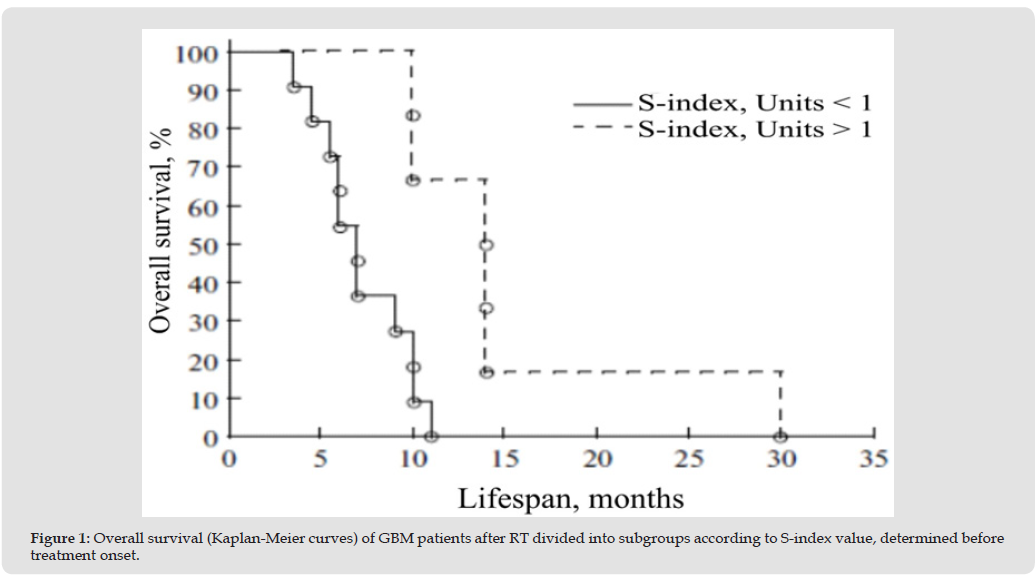
In the clinic, the blood leukocytes S-index determination also showed the possibility of using it as a predictive indicator for more successful RT in GBM patients [70]. Before the treatment beginning, the S-index values were measured in 18 GBM patients (10 men aged 49.7±4.5 yrs and 8 women aged 62.0±4.5 yrs) who received a RT course (SOD 51-60 Gy) in the clinical department of the Russian Scientific Center of Radiology and Surgery of the Ministry of Health of the Russian Federation (Saint Petersburg). It was established in the entire examined GBM patients, the average S-index value, determined before the treatment onset, was 0.78±0.10 relative units. In 6 patients (33%) who had 1.27±0.07 S-index value, the average OS was 13.0±1.0 months, while in 12 patients (67%) with 0.54±0.07 S-index value, a significantly lower OS was observed (7.2±1.0 months, p<0.05), (Figure 1). Thus, if the S-index of blood leukocytes in GBM patients exceeded 1.0, this indicated high their GBM radiosensitivity and provided grounds for predicting a more significant OS than in patients with an S-index ≤ 1.0. It should be noted the GBM patients analyzed by us were similar in age, histological tumor type and its malignancy grade to patients examined abroad, from whom GBO was obtained, molecular genetic studies were conducted and their radiosensitivity was determined [51], as well as to GBM patients, who had a survival time from 4.1 to 36.8 months after treatment in the clinic of the N.N. Petrov National Medical Research Center of Oncology of the Ministry of Health of the Russian Federation [43]. Therefore, by S-index measuring before the RT beginning, it is possible to individually assess the response to irradiation of DNA nucleoids of a blood sample containing leukocytes and circulating tumor cells. This allows for a more objective and reliable assessment of the radiation impact on the blood cell system as TME in the patient’s organism. The total time for determining the indicator we developed is 4 hours.
Figure 1
The development of a successful clinical test for predicting RT response is one of the pressing clinical challenges in radiation oncology [71]. Translation into the clinic of methods for assessing the tumor cells` radiosensitivity of patients could be one of the possible ways to solve the problem of personalized increase in RT effectiveness in GBM patients. Previous approaches to assess tumor radiosensitivity can be divided into three categories:
• Measurement of intrinsic tumor cell radiosensitivity (determining the fraction of surviving cells after ex vivo irradiation with 2 Gy dose [SF2]) [72];
• The assays to determine tumor oxygen levels (using pO2 electrodes [73]; and
• Determination of the proliferative potential of the malignancy [74].
Although preliminary data suggested the feasibility of each of these approaches, unfortunately none of them have entered in clinical practice. The main reason was all the developed technologies were highly impractical for routine clinical use. Thus, ex vivo SF2 determination required the use of primary tumor cells` clonogenic culture in vitro. This process had relatively low yield and took several weeks, which prevented its inclusion in the clinical decision-making process. Measuring tumor pO2 using electrodes requires easy access to the tumor, which has limited its widespread use. Finally, tumor proliferative potential was tested in a multicenter analysis by the European Organization for Research and Treatment of Cancer (Brussels, Belgium) in 476 head and neck cancer patients, where it was found not to be a significant predictor of clinical outcome. Current advances in the paradigm of this field involve the study of three-dimensional GBM organoids` cultures in vitro, which reproduce a number of histological features, cellular diversity, gene expression, and mutational profiles of tumor patients. Identification of predictive markers, levels (or percentage) of their significance, as well as prediction of RT outcome taking into account GBM cell radiosensitivity may allow selection of cancer patients for such a treatment scheme. A personalized approach to increasing RT effectiveness for use in GBM includes the development of methods for assessing tumor cells` radiosensitivity, TME, and the introduction of biomarkers into the clinic, ensuring the treatment process monitoring. For clinical use, methods must have sufficiently high sensitivity, specificity, be minimally invasive and short in execution, so that they can be used before and during therapy. In addition, the availability of predictive biomarkers that can be analyzed using reliable, standardized methods ensuring reproducible results should be considered. However, RT result prediction based on the in vitro own tumor cells` radiosensitivity or organoids obtained from them remains labor-intensive and does not take into account the main GBM parameters: the degree of tumor heterogeneity, the number of GSCs, tumor-associated macrophages, lymphocytes, fibroblasts, the spectrum of genetic, epigenetic, metabolic markers, their frequency, the level of expression, as well as changes in the TME: the quality of immune blood cells, the degree of hypoxia microenvironment, its acidity and the composition of extracellular components that contribute to the resistance of metastases, malignant growth progression and anticancer immune response suppression.
At the same time, the treatment outcome should not be so much the tumor, which can be removed surgically or by other means, but the patient’s organism, which allowed (gave the opportunity) for the neoplasm to manifest as malignant for an individual patient. In this regard, the TME analysis by determining the DNA nucleoids` radiosensitivity of blood leukocytes ex vivo currently seems more adequate and allows for the selection of radiosensitive GBM patients in a relatively short time period for the successful RT use, and in the case of their radioresistance, provides grounds for recommending the use of other treatment protocols [75-82].
The authors declare no conflict of interest.
This research was funded by the Ministry of Science and Higher Education of the Russian Federation, grant number №075-15-2022- 302 (20.04.2022).
Ivanov S.D. ‒ idea of the manuscript, editing, search of articles on the manuscript`s topic; Chernov A.N. ‒ writing of the manuscript, analyzing and interpreting data, editing, preparing the bibliography. All authors made a substantial contribution to the conception of the manuscript, acquisition, analysis, interpretation of data for the article, drafting and revising the article, final approval of the version to be published and agree to be accountable for all aspects of the manuscript.

International Association of Landscape Archaeology, Czech Glass Society, Czech Republic

Department of Chemistry, Semenov Institute of Chemical Physics, USSR Academy of Sciences, Moscow, Russia

Neurology, LA BioMed Research Institute, USA

Associate Professor at Department of Breast and Thyorid Surgey, Chongqing General Hospital, China

Clinical Radiologist (MD) - Department of RADIOLOGY, Cosenza Hospital, Cosenza, Italy





 Abstract
 PDF
PDF



























