info@biomedres.us
+1 (502) 904-2126
One Westbrook Corporate Center, Suite 300, Westchester, IL 60154, USA
Site Map
 ISSN: 2574 -1241
ISSN: 2574 -1241
ISSN: 2574 -1241
Received: February 11, 2025; Published: February 21, 2025
*Corresponding author: Tímea Hevér, North-Pest Centre Hospital - Military Hospital, Budapest, Hungary
DOI: 10.26717/BJSTR.2025.60.009485
According to the most recent professional guideline, in claudicating, low-risk patients with long life expectancy, open surgery is the preferred option for TASC-II D aorto-iliac lesions due to better primary and secondary patency rates compared to endovascular approaches (Recommendation IIb B) [1]. In the latter case, the choice of covered stent implantation shows better patency rates compared to metal stents. (Recommendation IIb B) [1]. A 75-year-old female patient with a history of hypertension, hypothyroidism, total laryngectomy and cervical dissection for tumor, left side thromboendarterectomy of common femoral artery and profunda artery with closure of XenoSure patchoplasty. Due to the rapid progression of the underlying disease, there was significant pain four months after surgery. CTA demonstrated an exulcerated combined plaque system between the celiac trunk and the superior mesenteric artery causing significant stenosis in the posterior wall of the aorta, 30% stenosis in the abdominal aorta, occlusion of the left internal iliac artery, and subtotal occlusion of the left common iliac artery with needle-point narrowing. We therefore planned to use BeBack® here. According to the decision of the Vascular Team, we prepared the patient for the less demanding endovascular procedure. The procedure was performed under spinal anaesthesia. We explored both groins of the patient because we planned to perform TEA on the right common femoral artery, the left side was previously operated and scarred. Following puncture of the dissected right common femoral artery, we accessed the aorta with a 0.035” hydrophilic Terumo® wire and then replaced it with Aortic ultra 260cm length superstiff wire. A 14F sheath (30 cm, Cook) was inserted. From left puncture through a 7F sheath 0.035” hydrophilic wire gently guided into the aorta via Vertebral® catheter (unobstructed despite subtotal occlusion due to maneuvering), then exchange to Pigtail catheter and performed first angiography (Figure 1).
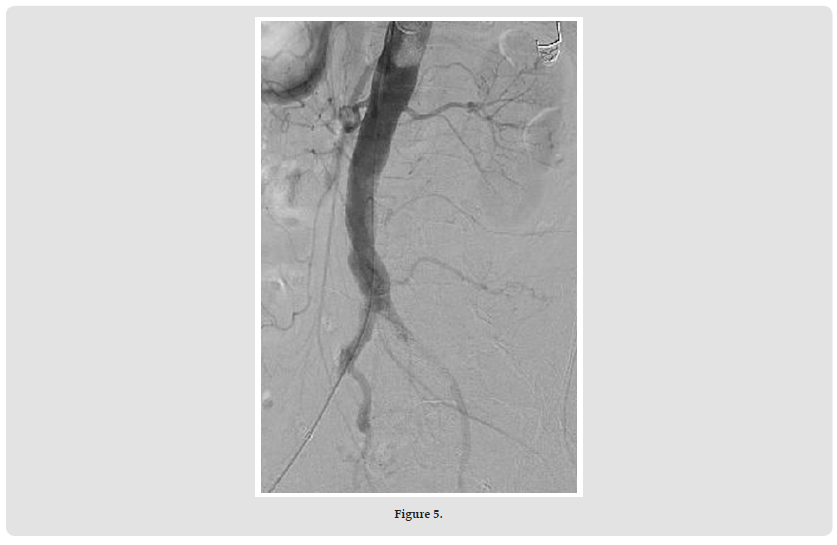
On the right side, the 18x38 mm BeGraft® Aortic Stent Graft (Bentley) was positioned halfway between the inferior mesenteric artery and the bifurcation, as planned (Figures 2 & 3). From both sides, a 10x37 mm BeGraft® Peripheral Stent Graft (Bentley) was deployed without predilatation into the iliac artery, positioned 10 mm up the aorta. After opening with a simultaneous kissing technique, angiography showed good results (Figure 4) and then the left side was stented with an 8x37 mm BeGraft® Peripheral Stent Graft (Bentley) with 10 mm overlap. The overlap was re-expanded with the 10 mm BeGraft® peripheral balloon. On control angiography, the inferior mesenteric artery and both internal iliac arteries remained open (the left side was also patent despite the preliminary CTA image) (Figure 5).
Figure 1

Figure 2
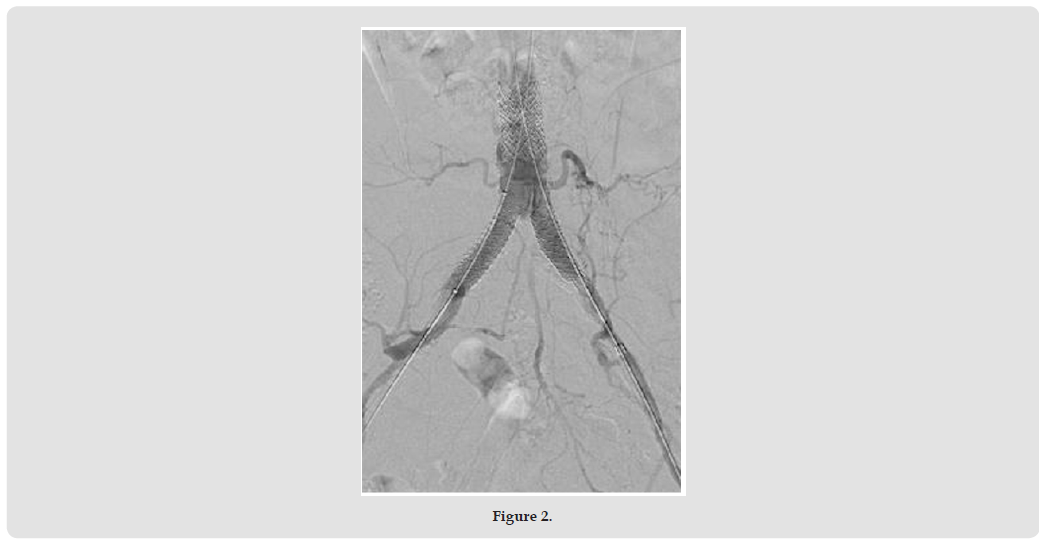
Figure 3
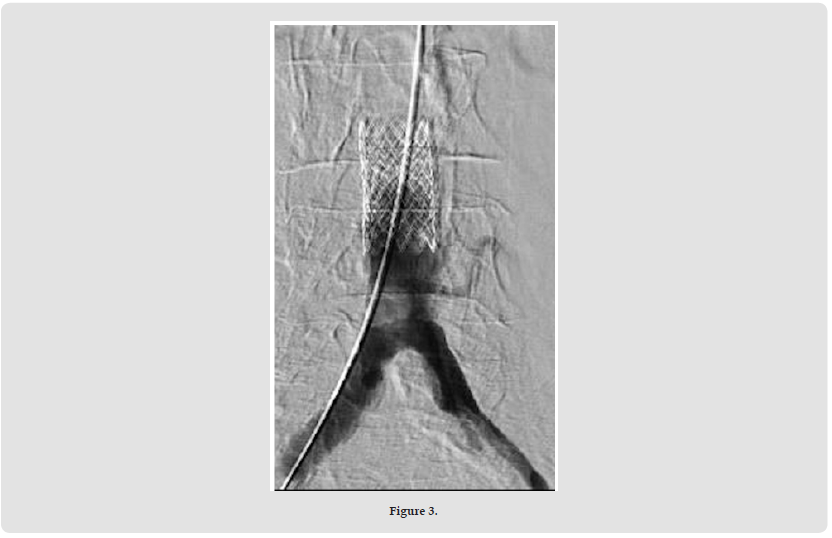
Figure 4

Figure 5
Finally, a longitudinal arteriotomy and thromboendarterectomy of the right common femoral artery was performed with distal intimal artery lowering according to Kunlin. There was a strong rebleeding from the profunda femoral artery and a moderate rebleeding from the superficial femoral artery. The arteriotomy was closed with Xeno- Sure® patch. The puncture was closed with a suture on the left side. The surgical wounds (left side after scar excision) were closed. The Doppler index of the limb was elevated after the procedure and the patient was free of complaints. This case also shows that the complex and multilevel variations make these cases favorable for the vascular surgeon, as not all lesions are suitable for endovascular treatment.

International Association of Landscape Archaeology, Czech Glass Society, Czech Republic

Department of Chemistry, Semenov Institute of Chemical Physics, USSR Academy of Sciences, Moscow, Russia

Neurology, LA BioMed Research Institute, USA

Associate Professor at Department of Breast and Thyorid Surgey, Chongqing General Hospital, China
Clinical Radiologist (MD) - Department of RADIOLOGY, Cosenza Hospital, Cosenza, Italy





 Abstract
 PDF
PDF



























