info@biomedres.us
+1 (502) 904-2126
One Westbrook Corporate Center, Suite 300, Westchester, IL 60154, USA
Site Map
 ISSN: 2574 -1241
ISSN: 2574 -1241
ISSN: 2574 -1241
Received: February 11, 2025; Published: February 21, 2025
*Corresponding author: Oleksandr H Minchenko, Prof, Department of Molecular Biology, Palladin Institute of Biochemistry of the National Academy of Sciences of Ukraine, Ukraine
DOI: 10.26717/BJSTR.2025.60.009484
Glutamine is a necessary substrate for glioblastoma cells and is important for tumor growth. We studied the impact of ERN1 knockdown on EGFR, ERBB2, TOB1, and CEBPB gene expressions in U87MG glioblastoma cells in response to glutamine deficiency. It was shown that the expression level of EGFR and ERBB2 genes was resistant to glutamine deprivation in control glioblastoma cells but ERN1 knockdown lead to up-regulation these gene expressions. Moreover, TOB1 and CEBPB gene expressions are sensitive to glutamine deprivation in both control and ERN1 knockdown glioblastoma cells but inhibition of ERN1 significantly increases the sensitivity of these genes to glutamine deprivation, especially CEBPB gene. These results demonstrated that ERN1, a major signalling pathway of endoplasmic reticulum stress, controls the sensitivity of all studied genes to glutamine deprivation in glioblastoma cells in a gene-specific manner and that the lower sensitivity of the expression of the studied genes in control glioblastoma cells to glutamine deficiency is due to endoplasmic reticulum stress, its ERN1 signalling pathway.
Keywords: ERN1 Knockdown; EGFR; TOB1; CEBPB; mRNA Expression; Glutamine Deprivation; U87MG Glioblastoma Cells
Glutamine is an essential substrate for tumor cell metabolism as a substrate for glycolysis, but the requirements for glutamine in cancer are heterogeneous [1-5]. Glutamine metabolism is vital for all cellular processes, including cancer development [6,7]. It is interesting to note that ERN1/IRE1 (endoplasmic reticulum to nucleus signalling 1/inositol requiring enzyme 1) mediated stress signalling modifies the effects of glutamine deficiency on the expression of many genes [8-13]. It has also been shown that the ERN1/XBP1 pathway is essential for the glutamine response and protection of β cells [14]. Transcription factor CEBPB (CCAAT enhancer binding protein) controls numerous metabolic processes including gluconeogenesis and immune response [15-18]. Epidermal growth factor receptor (EGFR/ErbB1) is activated after dimerization. The activated ERBB receptors bind to many signalling proteins and activate cancer-related signalling pathways [19-21]. ERBB2/HER2 is overexpressed in invasive carcinomas and increases tumour growth via cell cycle signalling [22,23]. It is important to note that the transducer of ERBB2, 1 (TOB1) function as a tumour suppressor and shows anti-proliferative properties that regulate cell growth via reducing the activation of the AKT/mTOR signalling pathway [24]. Furthermore, a decreased TOB1 expression and up-regulated phosphorylation of TOB1 in the nucleus supports stomach cancer and microRNA participates in this process [25,26].
Malignant tumors use endoplasmic reticulum unfolded protein response and its signalling pathways to increase cell proliferation under stressful environmental conditions including low glutamine [27-29]. Moreover, the activation of the ERN1 signalling pathway of the unfolded protein response is tightly linked to cell death, and inhibition of ERN1 function leads to significant suppression of glioblastoma cell proliferation and tumour growth [29-33]. Thus, the endoplasmic reticulum stress and glutamine supply are important factors of cancer progression. Still, the molecular mechanisms of stress-dependent regulation of the expression of tumour-related genes under glutamine deficiency are complex and have not yet been sufficiently elucidated. This study examined the expression of important regulatory genes in response to glutamine deficiency in control and ERN1 knockdown glioblastoma cells for evaluation of the possible significance of this nutrient supply in the controlling ERN1-mediated cell proliferation.
Cell Lines and Culture Conditions
In this study, we used two sublines of U87MG glioblastoma cells: control cells – stably transfected clone with overexpression of vector pcDNA3.1, and ERN1 knockdown cells – stably transfected clone overexpressed dnERN1, described previously [34]. Glutamine deprivation and growing conditions were described previously [13].
RNA Isolation
Total RNA was isolated from cells using the Trizol reagent according to the manufacturer’s protocol (Invitrogen, Carlsbad, CA, USA) as described previously [34].
Reverse Transcription and Quantitative PCR Analysis
The expression levels of, EGFR, ERBB2, TOB1, CEBPB, and ACTB mRNAs were measured in glioblastoma cells by quantitative polymerase chain reaction as described previously [35]. Thermo Scientific Verso cDNA Synthesis Kit (Germany) was used for reverse transcription as described previously [35]. Polymerase chain reaction was performed in triplicate. The expression of ACTB mRNA was used for normalization. The pair of primers specific for EGFR, ERBB2, TOB1, and CEBPB mRNAs was received from Sigma-Aldrich (St. Louis, MO, U.S.A.) and used for quantitative polymerase chain reaction: EGFR/HER1 forward 5’- aggtgaaaacagctgcaagg and reverse 5’- aggtgatgttcatggcctga (NM_005228.5); ERBB2/HER2 forward 5’- ggtggtctttgggatcctca and reverse 5’- accttcaccttcctcagctc (NM_004448.4); TOB1 forward 5’- agcccgaacaagatcactca and reverse 5’- cacgtctcctgggaagctta (NM_005749.4); CEBPB forward 5’- caagaagaccgtggacaagc and reverse 5’- agctgctccaccttcttctg (NM_005194.4). Primers ACTB were described previously [35]. Quantitative PCR analysis was performed as described previously [33]. The values of studied gene expressions were normalized to the expression of beta-actin mRNA and represented as percent of control (100%). All values are expressed as mean ± SEM from triplicate measurements performed in 4 independent experiments.
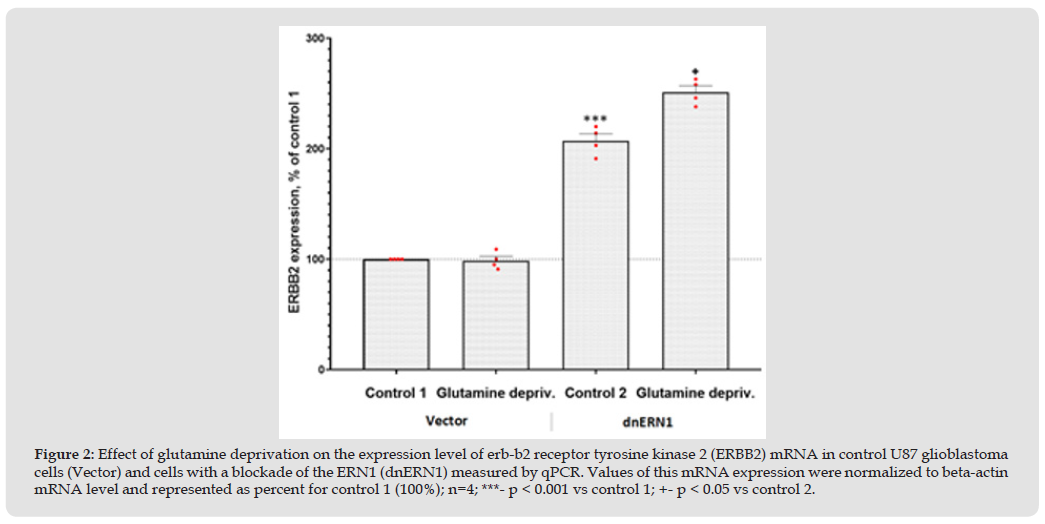
To investigate a possible role of endoplasmic reticulum stress response in the control of EGFR, ERBB2, TOB1, and CEBPB gene expressions in U87MG glioblastoma cells under low glutamine conditions we studied the impact of glutamine deprivation on the expression of these genes in control glioblastoma cells (transfected by empty vector) and cells with ERN1 knockdown. As shown in Figure 1, the expression of EGFR mRNA does not significantly change in control glioblastoma cells after exposure to glutamine deprivation in comparison with the cells growing in a complete DMEM medium. However, inhibition of enzymatic activity of ERN1 signalling protein by dnERN1 is enhanced the sensitivity of EGFR gene expression to this experimental condition. Thus, the level of this mRNA expression is increased by 27 % (p < 0.05) in cells without the enzymatic activities of the ERN1 signalling protein (Figure 1). Next, we investigated the effect of glutamine deprivation on the expression of gene encoding ERBB2 with inhibition of ERN1 function. As shown in Figure 2, the expression of this gene is resistant to glutamine deprivation resulting in control glioblastoma cells in comparison with no treated cells (control 1). At the same time, ERN1 knockdown also increases the sensitivity of ERBB2 gene expression to glutamine deficiency (+21 %; Figure 2). We also investigated the effect of glutamine deprivation condition on the expression of TOB1 (transducer of ERBB2, 1) gene in U87MG glioblastoma cells with ERN1 knockdown.
Figure 1

Figure 2
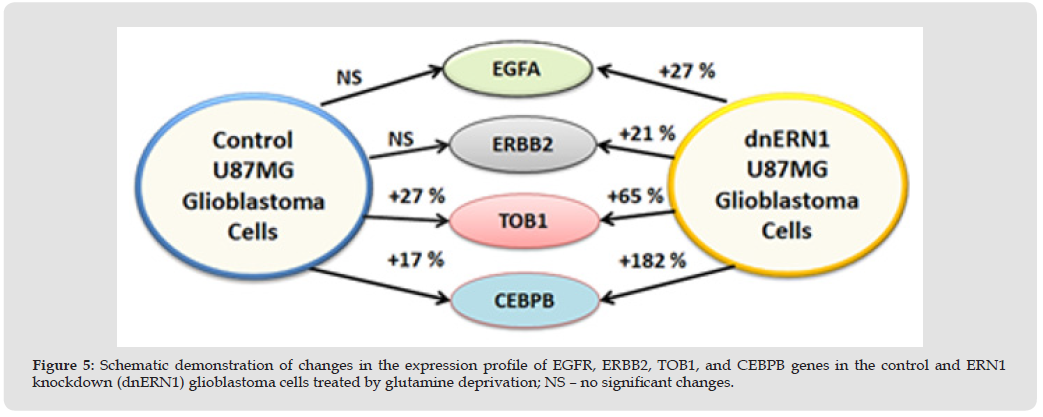
As shown in Figure 3, the expression of this mRNA is up-regulated in control glioblastoma cells treated by glutamine deprivation (+27 %) and inhibition of enzymatic activities of ERN1 signalling protein significantly increased the sensitivity of TOB1 mRNA expression to glutamine deprivation (+65 %) in comparison with cells growing with glutamine. We have also studied the effect of glutamine deprivation on the expression of gene encoding transcription factor CEBPB (CCAAT enhancer binding protein beta) in control and ERN1 knockdown glioblastoma cells. As shown in Figure 4, exposure of control glioblastoma cells under glutamine deprivation conditions leads to up-regulation of this mRNA expression (+17 %) in comparison with control cells growing under conditions with glutamine. Furthermore, the inhibition of ERN1 strongly induced the sensitivity of this gene expression (+182 %) to glutamine deprivation in glioblastoma cells (Figure 4). Thus, exposure of control glioblastoma cells under glutamine deficiency affects the expression of CEBPB and TOB1 genes but ERN1 knockdown significantly increases the sensitivity of all studied gene expressions to glutamine deprivation conditions, especially the CEBPB gene.
Figure 3

Figure 4

In this work, we studied the effect of glutamine deprivation on the expression of EGFR, ERBB2, TOB1, and CEBPB genes encoding important tumour-related factors in glioblastoma cells with the inhibition of ERN1, the major signalling pathway of the unfolded protein response. The results of our study clarify the possible mechanism of changed sensitivity to glutamine deficiency of the expression of genes encoding important factors associated with tumour growth in ERN1 knockdown glioblastoma cells [11-13]. Thus, our results indicated that ERN1, a major signalling pathway of unfolded protein response, controls the sensitivity of all studied genes to glutamine supply in glioblastoma cells in a gene-specific manner and that the lower sensitivity of the expression of EGFR, ERBB2, TOB1, and CEBPB genes in control glioblastoma cells to glutamine deficiency is due to stress-mediated polyresistance, in particular its ERN1 signalling pathway [13,29]. Results of this study summarized in Figure 5, clearly demonstrate the differential effect of decreased glutamine level on the expression of EGFR, ERBB2, TOB1, and CEBPB genes and ERN1-dependent character of changes in their expression profile in glioblastoma cells under glutamine deficiency in a gene-specific manner. These results are consistent with previously obtained data on ERN1-mediated dependence of many other gene expressions on glutamine deficiency [10-13]. Furthermore, we showed that the expression of tumour suppressor TOB1 and especially multi-functional transcription factor CEBPB has increased sensitivity to glutamine deficiency in glioblastoma cells with inhibited enzymatic activities of ERN1 compared to control cells (Figure 5).
Figure 5
Thus, increased expression of tumour suppressor TOB1 and especially multi-functional transcription factor CEBPB, which exerts multiple biological functions and also has anti-proliferative properties, agrees well with numerous data that inhibition of ERN1 suppresses the proliferation of cancer cells [17,18,24-26,30-33,36]. This study provides unique insights into the molecular mechanisms regulating the expression of genes encoding important proteins related to tumour growth in response to glutamine deprivation and their correlation with inhibition of ERN1 activity and reduced cell proliferation in cells harbouring dnERN1, attesting to the fact that endoplasmic reticulum stress, as well as glutamine, is a necessary component of malignant tumour growth and cell survival. Furthermore, our results validate the tight interaction of endoplasmic reticulum stress signalling pathway ERN1 with glutamine deprivation in gene expression regulation of tumour growth-related proteins. However, the detailed molecular mechanisms of ERN1-mediated dependence of gene expression on glutamine deficiency are not yet clearly defined and require further investigation.
This work was funded by the State Budget Program “Support for the Development of Priority Areas of Scientific Research” (Code: 6541030).
All authors declare that they reviewed the manuscript and have no conflict of interest.

International Association of Landscape Archaeology, Czech Glass Society, Czech Republic

Department of Chemistry, Semenov Institute of Chemical Physics, USSR Academy of Sciences, Moscow, Russia

Department of Educational Sciences, Research Centre Qualities of Teachers, School of Education – HAN, Nijmegen, Netherlands

Associate Professor at Department of Breast and Thyorid Surgey, Chongqing General Hospital, China

Neurology, LA BioMed Research Institute, USA





 Abstract
 PDF
PDF