info@biomedres.us
+1 (502) 904-2126
One Westbrook Corporate Center, Suite 300, Westchester, IL 60154, USA
Site Map
 ISSN: 2574 -1241
ISSN: 2574 -1241
ISSN: 2574 -1241
Received: February 07, 2025; Published: February 19, 2025
*Corresponding author: Samique March-Dallas, Department of Accounting, Finance, and Business Law, School of Business and Industry, Florida A&M University, Tallahassee, FL, USA
DOI: 10.26717/BJSTR.2025.60.009475
Dynamic cell culturing in vitro has critical applications in biomedical and environmental fields. Tissue engineering
scaffolds, which provide temporary 3D support for cell culturing, must meet five essential requirements:
1. Permit cell adhesion and growth while maintaining differentiated cell functions;
2. Demonstrate biocompatibility without inflammatory or toxic responses;
3. Exhibit biodegradability;
4. Provide sufficient porosity for cell adhesion and matrix regeneration; and
5. Be reproducibly processable into mechanically strong three-dimensional structures.
Using PC-12 cells and gelatin scaffolding, we successfully developed and validated a system meeting all five
requirements. Our results demonstrate successful cell attachment, growth, and confluence on various patterned
acrylic discs covered by a gelatin matrix. Notably, we achieved membrane reproducibility, mechanical strength,
and integrity using limited resources in a financially constrained environment, highlighting the potential for
meaningful research contributions from institutions with modest research budgets.
Keywords: PC-12 Cells; Tissue Engineering Scaffolding; Gelatin; Resource-Efficient Research
In a time with growing need for organ replacement due to failure, disease, or significant injury due to accidents, tissue engineering has emerged as a unique and essential field of research. Tissue engineering scaffolds are 3D materials that provide temporary support. To achieve the goal of tissue engineering for various applications, including wound healing, drug delivery environmental testing, and dynamic cell culturing, scaffolds must meet specific requirements. Effective tissue engineering scaffolds must meet five key requirements to provide viable mimics of the Extracellular Matrices (ECM:
1. The surface should permit cell adhesion, promote cell growth,
and allow the retention of differentiated cell functions.
2. It should be biocompatible; neither the polymer nor its degradation
by-products should provoke inflammation or toxicity in
vivo.
3. It should be biodegradable and eventually be eliminated.
4. The porosity should be high enough to provide sufficient space
for cell adhesion, extracellular matrix regeneration, and minimal
diffusional constraints during culture, and the pore structure
should allow even spatial cell distribution throughout the scaffold
to facilitate homogeneous tissue formation.
5. The material should be reproducibly processable into three-dimensional
structure, and mechanically strong. These properties
are necessary for cells to communicate chemically and physically
for proper cell adhesion, propagation, differentiation, function,
and overall viability (Engler, et al. [1-3]).
In this work, we present gelatin crosslinked thin films as a platform for tissue engineering scaffolding. The gelatin provides a means of forming different shapes, textures, and topologies for growing various tissues. Previous research has shown gelatin’s suitability for tissue replacement and drug delivery applications, confirming its alignment with the five core requirements (Dhandayuthapani, et al. [4]). Different materials have also been used for tissue engineering applications and drug delivery systems (Dhandayuthapani, et al. [4]). One peripheral application for the thin films mentioned here is dynamic in vitro cell culturing. This application now uses various scaffolds for studies and fabrication in environmental, biomedical, drug delivery research, and other fields. The significance of dynamic cell culturing is the increased maturation of specific cells and tissue relative to the stagnant in vitro environment. Also, several researchers in tissue engineering have explored the effect of topology and texture on cell proliferation. We explore scaffolding texture and topology effects using gelatin crosslinked glutaraldehyde materials for PC-12 pheochromocytoma cells. Our previous work shows the efficacy of using gelatin thin films crosslinked with glutaraldehyde as scaffolding for three cell lines. 15 Systems such as these can be employed to grow over a structural/anatomical mimic using the gelatin scaffolding and tested by treating them with various environmental toxins in either a traditional cell culturing or dynamic cell culturing environment.
Adding a structured three-dimensional environment, as mentioned in requirement (4), may assist in examining cancerous cell proliferation through a mimicked ECM or potential organ-like structure (Mason, et al. [5]). Previous studies has shown that even extracted tumors can maintain structure and organization, cellular heterogeneity, and oncogenic properties, grow in three dimensions, differentiate as in vivo, and be maintained for long periods (Freeman, et al. [6]). However, having an ECM scaffolding appropriate for cell growth may increase the ability of the tissue to proliferate, mature, and/or differentiate. We use cancerous cells in this work because of their resiliency, ease of availability for experimentation, and proof of concept. The execution of cutting-edge tissue engineering research at less resourced institutions represents a particularly compelling Return On Investment (ROI) opportunity in the scientific community. While many breakthrough discoveries emerge from well-funded research institutions, HBCUs like Florida A&M University demonstrate that significant scientific contributions can be achieved with modest resources when coupled with innovative approaches and dedicated researchers. This research paradigm offers multiple advantages: it provides crucial research training opportunities for underrepresented students in STEM fields, maximizes the utility of limited research funding through creative experimental design, and demonstrates that high-impact science isn’t solely dependent on expensive infrastructure.
Furthermore, the success of such resource-efficient research models could serve as a template for other institutions facing similar financial constraints, potentially democratizing access to advanced biomedical research opportunities. This should be an incentive for endowment organizations to consider smaller and less resourced researchers to extend their largesse as the ROI from such endeavours is considerably higher given the smaller investment required.
Methods
Gelatin thin films were produced according to the protocol listed below. The regimen was used based on cell viability studies in previous work. (McCollum, et al. [7-16]) Unique scaffolds were produced using a laser cutter to etch patterns onto the surface of an acrylamide wafer serving as a mold or under the surface of the thin film. In the context of molding, the matrix was applied to the patterned surface to obtain shape and texture effects for cell viability studies. Membrane reproducibility and strength were determined by removing the membrane from the scaffold and seeing if patterns emerged similar to the original mold.
Preparation of Topological Crosslinked Membrane
Creation of Acrylamide Molds: Adobe Illustrator was used to create the various patterns and designs which were then transferred to thin acrylic using a laser cutter to create a topology for the mold. Acrylamide Molds were either etched into three shapes (Reticular, diamonds, or small circles) or cut into three shapes (large holes, small holes, and slots) using a laser. The acrylamide Molds received one of four treatments
1. Untreated,
2. Covered with paraffin,
3. Sprayed with Pam, or
4. Covered with paraffin a
nd sprayed with Pam. Treated Molds
were placed in 6-well plates for subsequent collagen crosslinking.
Membranes were removed, and images were taken.
The images are shown in Figure 1.
Figure 1

Creation of Crosslinked Collagen Film: Collagen film was constructed by adding 0.2 g Bovine gelatin to 5 ml distilled water, incubating in a water bath for 10 minutes, and then adding 6.25 ml acetone. The collagen was then crosslinked using 0.5% glutaraldehyde. After collagen was crosslinked and allowed to dry for 5 days, it was rinsed multiple times with distilled water, air dried, and exposed to Ultraviolet (UV) light to add crosslinking. The crosslinked membrane was removed and placed into a new six-well plate, transferred to a flow hood, and UV-exposed for an additional hour. After the membrane was prepared, cells were then plated onto them.
Cell Cultures & Cell Imaging
Cell Culture: PC-12 cells were cultured at 5.5% CO2/37ºC in F-12K media (15% horse serum, 2% fetal bovine serum, L-glutamine, and Penicillin/Streptomycin). Cells were grown to 80% confluency split and plated onto a collagen crosslinked matrix at 100,000 cells/ mL (24-well uses 0.5 mL ~50,000 cells). Cells were then allowed to attach, grow, and divide over a week. Media was aspirated and refreshed every two to three days, and cells were assessed for cell viability on the seventh day by counting cells.
Cell Imaging: Dissociated cells derived from tissue culture, PC-12 cells, were plated and placed on the crosslinked matrix. Cells were allowed to settle, adhere, and grow for approximately 7 days. Cells were then imaged using white light under a filter associated with blue fluorescence, giving the image a blue tint under UV light. The image was acquired using the Q-pro image program. The microscopic image was obtained using the 4X objective and a 10X magnifier on the camera.
Pattern Analysis
Using the following rubric that we designed, the ease of membrane removal and pattern transfer were measured. The results are shown in Figures 2 & 3 below. The results showed that etched surfaces worked better than cut surfaces when removing the crosslinked membrane, and pattern transfer depended on the surface coating.
1. Membrane Removal Assessment
Membrane removal effectiveness was evaluated using a 4-point
scale:
0 – Unable to remove
1 – Removable but fragmented
2 – Removed in large chunk
3 - Most to all of the membrane was removed in one intact piece
2. Pattern Transfer Evaluation
0- No pattern visible
1- Barely visible pattern
2- Distinguished but weak pattern
3- Definitive Pattern
Figure 2
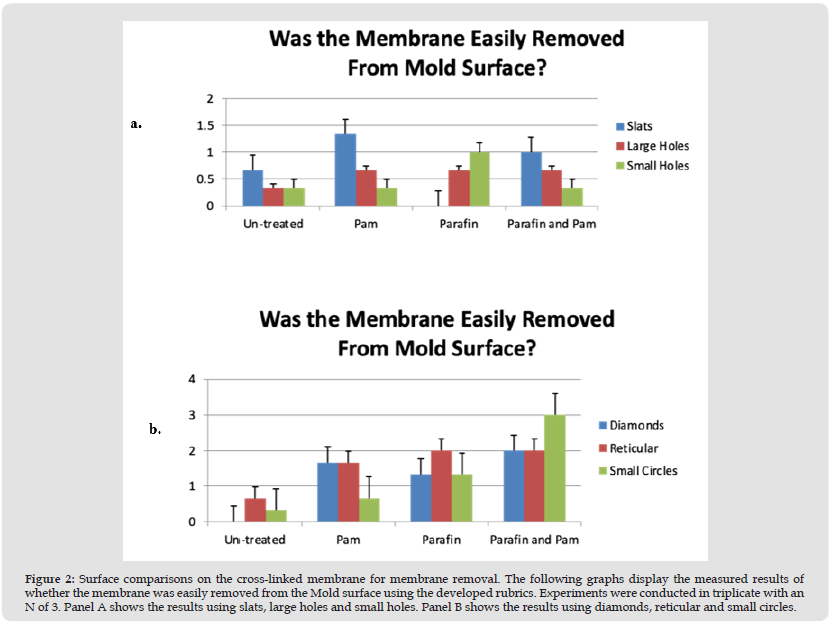
Figure 3

Images in a and b show representative membranes with their associated matrix. Experiments were conducted in triplicate with an N of 3. The following graphs display the measured results of whether the membrane was easily removed from the mold surface using the developed rubrics. Experiments were conducted in triplicate with an N of 3. Panel A shows the results using slats, large holes and small holes. Panel B shows the results using diamonds, reticular and small circles. The following graphs display the measured results of whether there was a pattern of mold visible in the membrane using the developed rubrics. Experiments were conducted in triplicate with an N of 3. Panel A shows the results using slats, large holes and small holes. Panel B shows the results using diamonds, reticular and small circles. Using a laser cutter, acrylamide molds were cut into three shapes: large holes, small holes, and slots. The acrylamide molds were left untreated, covered with paraffin, sprayed with Pam, or covered with paraffin and sprayed with Pam. The membrane and matrix were removed, and an inverse matrix was left inside the well, taking on the pattern of the openings left by the matrix. Images were taken and are shown in Figure 4. Images show representative membranes. We use the rubric for pattern establishment to measure an inverse pattern’s ability to form. The corresponding graph displays the results in Figure 5. The results showed that crosslinked collagen had difficulty leaving an inverse imprint when paraffin coats the matrix.
Figure 4

Figure 5
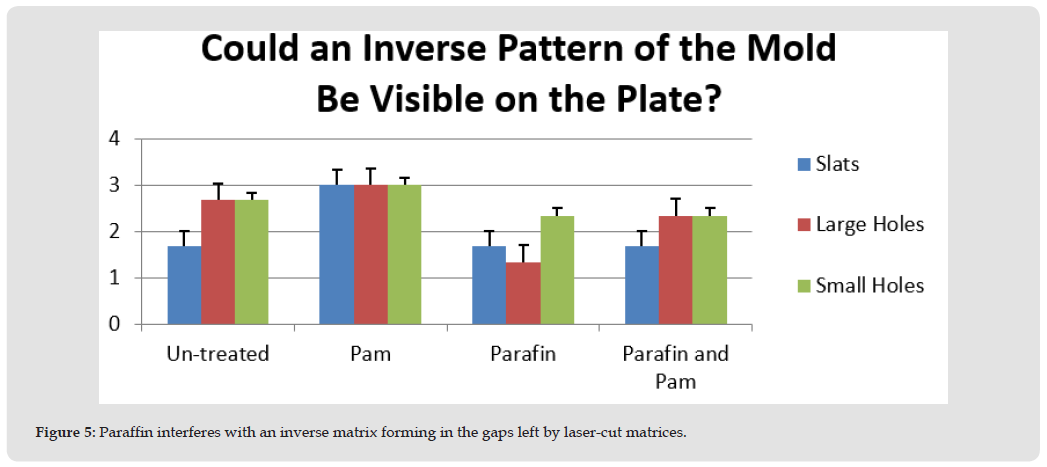
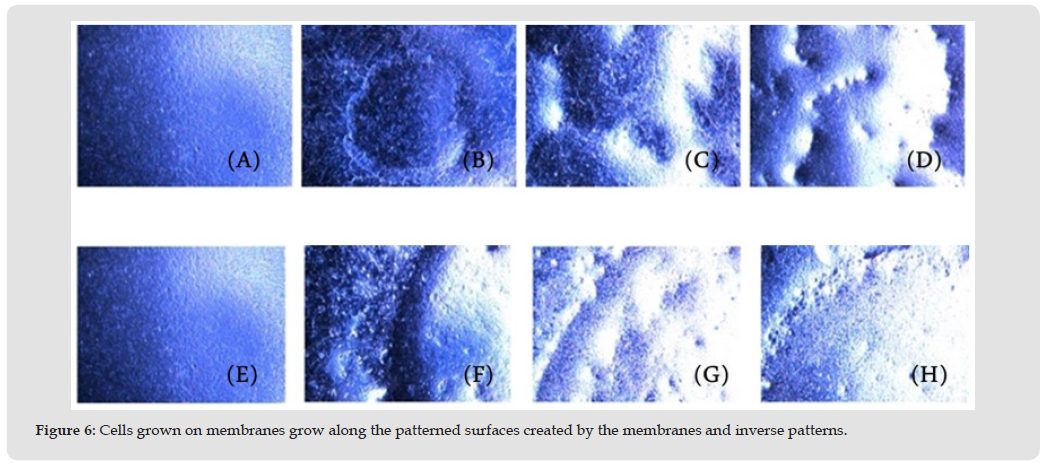
This suggests that paraffin somehow interferes with the ability of the matrix to deposit on the surface of the healthy bottom. The following graph displays the visibility of an inverse pattern of the mold on the plate. Patterned crosslinked membranes using etched surfaces and holes were sterilized using UV irradiation and placed in a 6-well plate where cells were placed on top and grown for 48 hours. The cell monolayer then took on the pattern left by the membrane used. The results are shown in Figure 6. Cultured cells with no membrane surface showed no pattern (A and E), while membranes formed from etched surfaces small circles (B), diamonds (C), and reticular (D) and openings such as large and small holes (F and G) showed patterns resembling the corresponding surface. Unfortunately, even at the lowest magnification, only part of the holes could be imaged simultaneously. Moreover, the inverse of a large circle demonstrated that the inverse could also be used to create a cellular growth pattern (H). The results depicted show whether a pattern developed classified by no membrane, etched surfaces, and openings.
Figure 6
Our results demonstrate successful creation of patterned membranes using both etched surfaces and cut openings. Surface treatments significantly affected membrane removal and pattern transfer quality.
Key findings include:
1. Surface Treatment Effects:
• Pam spray alone: Optimal for diamond patterns
• Paraffin alone: Best for reticular patterns
• Combined treatment: Most effective for small circles
2. Opening Pattern Results:
• Large holes: Successful with all surface treatments
• Slots: Best results with Pam spray
• Small holes: Optimal with paraffin coating
Our previous studies established that a membrane crosslinked with glut. A concentration below 0.78% could meet the first three requirements for creating a viable 3D tissue scaffold [15]. The purpose of these results is to establish whether or not properties necessary for 3D tissue scaffolding can be achieved according to the requirements mentioned previously, such as (4) the porosity should be high enough to provide sufficient space for cell adhesion, extracellular matrix regeneration, and minimal diffusional constraints during culture. The pore structure should allow even spatial cell distribution throughout the scaffold to facilitate homogeneous tissue formation, and (5) the material should be reproducibly processed into a three-dimensional structure, and mechanical strength could also be met. To finish evaluating the specific requirements of the collagen crosslinked with glut. Membrane experiments were designed to create structural/anatomical molds that the membrane would mimic as it crosslinks, creating a 3-D gelatin scaffolding that could be removed from the mold and utilized to grow cells upon creating a monolayer that would mimic the original gelatin matrix. The first set of experiments either etched surface patterns (small circles, small diamonds, or a reticular pattern) onto an acrylamide mold or cut openings (small holes, large holes, or slots) into an acrylamide Mold.
These patterns, both etched and cut, met part of the (4) criteria: the pore structure should allow even spatial cell distribution throughout the scaffold to facilitate homogeneous tissue formation. However, to satisfy requirement (5), the material should be reproducibly processed into a three-dimensional structure and mechanically strong, the membrane must be easily removable and reproducible, and a pattern created from the mold must be visible. Unfortunately, the magnification was still too high to allow complete imaging of the entire matrix, and thus, the whole pattern created by the mold could not be seen. Our previous experiments 15 showed that collagen could crosslink with glutaraldehyde on an acrylamide surface. However, we later discovered that the membrane also adhered to the acrylamide mold, making it harder to remove the membrane. To increase the completeness of membrane retrieval from the mold, different coatings were applied to the surface of the acrylamide (Pam, paraffin, or the combination of Pam and paraffin). Once the membranes formed, they were removed from the mold, imaged, and measured for ease of removal and pattern transfer using rubrics. The results showed that applying Pam alone, paraffin alone, and the combination of Pam and paraffin significantly increased the retrieval of membranes off etched surfaces. However, cut surfaces had varied results depending on the opening shape and type of covering.
Results showed that the membrane with large holes could be retrieved from the mold with pam alone, paraffin alone, or with pam and paraffin, while slots worked best with pam alone, and small holes worked best with paraffin alone. Furthermore, the results showed that pattern transfer varied depending on mold whether etched or cut, shape, and surface coating. In the etched surfaces, the diamond pattern transferred best with pam alone, while reticular patterns were better seen when paraffin alone was used, and small circles were best seen when both pam and paraffin were used. Openings created fragile membranes, and the larger the opening, the more arduous the task was to salvage the transferred membrane pattern. The results show that slots were unable to transfer patterns at all. Moreover, pattern transfer with small holes worked best when paraffin alone was used, while large holes were best viewed when pam and paraffin were used to coat the mold. An interesting effect occurred while using molds with cut openings. The crosslinked collagen in the holes left a pattern behind on the surface of the well where the mold had previously sat, creating an inverse pattern. Using a rubric to determine inverse pattern transfer, our results showed that paraffin whether alone or with pam interferes with inverse pattern formation. Our results demonstrate that when topographical collagen is crosslinked with glut, the membrane can be made and reproduced, thus meeting the requirements for reproducibility, mechanical strength, and integrity.
Once the membrane was removed and placed into a fresh 6-well plate, PC-12 cells were added to the surface. The cells were allowed to grow and replicate for a week, changing media every two to three days. By the end of the week, a monolayer of cells had formed on the surface of the membrane. Images were taken showing the monolayer of cells and whether or not they undertook the topological shape left by the membrane. The results showed that cells placed on no-membrane had no distinguishing pattern. Cells were placed on the etched surfaces, and the cut openings were taken from the topographical pattern left by the membrane. Moreover, the results showed that the topographical pattern left as an inverse to be making the membranes with large holes could also be used to create surfaces for cells to grow upon.
These results show that the porosity should be high enough to provide sufficient space for cell adhesion, extracellular matrix regeneration, minimal diffusional constraints during culture; and the pore structure should allow even spatial cell distribution throughout the scaffold to facilitate homogeneous tissue formation were met. The five requirements needed to create a 3D tissue engineering scaffold that provides temporary support for cell culturing have been achieved. Though challenging, the membranes’ reproducibility, apparent mechanical strength, and integrity were accomplished. PC-12 cells successfully grew on the patterned membranes, forming monolayers that adopted the underlying topographical features. Control surfaces (no membrane) showed random cell distribution, while patterned surfaces demonstrated organized cell growth following the designed patterns. An unexpected but valuable finding was the formation of inverse patterns in well surfaces beneath cut openings. This effect was inhibited by paraffin coating, suggesting a potential mechanism for controlling pattern transfer. The success of this research in a financially constrained environment provides a model for other institutions facing similar challenges. Key factors contributing to this success include efficient use of available resources, integration of student researchers, creative experimental design, and focus on fundamental scientific principles This work demonstrates that significant scientific contributions can be achieved with modest resources when coupled with innovative approaches and dedicated researchers. Future work should explore: Long-term cell viability on patterned surfaces, Application to other cell types, and Scale-up potential for larger tissue constructs.
The authors declare no conflict of interest.
We thank the following students for their data collection efforts and support: Cherna Cherfrere, Tamika Brown, Kyra Morgan, and Tonja Harris. This work was supported in part by the Department of Biology and Chemistry Title III programs at Florida A&M University, the NOAA Educational Partnership Program (EPP)-NOAA Environmental Cooperative Science Center (ECSC) Cooperative Agreement #NA11SEC4810001 and TCC-FAMU Bridges to the Baccalaureate in the Biomedical Sciences Summer Research Experience Program sponsored by NIH NIGMS Grant # R25GM107777.

International Association of Landscape Archaeology, Czech Glass Society, Czech Republic

Department of Chemistry, Semenov Institute of Chemical Physics, USSR Academy of Sciences, Moscow, Russia

Department of Educational Sciences, Research Centre Qualities of Teachers, School of Education – HAN, Nijmegen, Netherlands

Associate Professor at Department of Breast and Thyorid Surgey, Chongqing General Hospital, China

Neurology, LA BioMed Research Institute, USA





 Abstract
 PDF
PDF



























