info@biomedres.us
+1 (502) 904-2126
One Westbrook Corporate Center, Suite 300, Westchester, IL 60154, USA
Site Map
 ISSN: 2574 -1241
ISSN: 2574 -1241
ISSN: 2574 -1241
Received: January 08, 2025; Published: January 28, 2025
*Corresponding author: Criado Villalon Pablo, Servicio de Cirugía Oral y Maxilofacial, Hospital Universitario Marqués de Valdecilla, Santander, Spain
DOI: 10.26717/BJSTR.2025.60.009446
Introduction: Hemangiomas are benign vascular tumors defined by an atypical proliferation of blood vessels.
These lesions may develop in any vascularized tissue, including the skin, subcutaneous layers, muscles, and
bones. Intramuscular hemangiomas account for less than 1% of all hemangiomas and predominantly occur in
the musculature of the trunk and extremities. However, involvement of the temporalis muscle is exceedingly
uncommon.
Material and Methods: This study presents two newly identified cases of capillary hemangiomas affecting the
temporalis muscle, diagnosed using CT, MRI, and arteriography
Results: The surgery was perform with preoperative selective embolization of the donor vessels.
The hemangiomas were resected without any complications, the patients are free of disease five and nine years
after surgery
Discussion: Of 41 cases reported in the literature of hemangiomas of the temporalis muscle, only 37 are well
documented. Cavernous hemangioma is the most common type with 30 cases; 4 are capillary and 2 are mixed
type. Surgical excision was performed in 34 cases and 3 cases underwent clinical and radiological follow-up. Preoperative
embolization was performed only in 1 case of capillary hemangioma. Clinical and radiological findings,
as well as treatment options are discussed.
Keywords: Capillary; Hemangioma; Temporalis Muscle; Arteriography; Embolization
Hemangiomas are benign vascular neoplasms, accounting for approximately 7% of all benign tumors. Hemangiomas are most commonly found in the skin and subcutaneous tissue. Intramuscular hemangiomas (IMH) account for less than 1% of all hemangiomas and are predominantly located in the muscles of the tunk and extremities [1]. IMH in the head and neck region make up less than 15% of these cases, with the masseter muscle being the most frequently involved site [2-4]. However, IMH of the temporalis muscle are exceedingly rare, with only 41 cases documented in the literature to date (Table 1) [5-40]. Three categories of hemangiomas have been identified based on the type of vessels involved: capillary, cavernous and mixed [41]. Cavernous type is the most frequent of the IMH of the temporalis muscle reported.
Table 1: Reported instances of temporalis muscle hemangiomas.

Case 1
A 31-year-old man was referred to our Department for management of a left temporal swelling of at least 18 months duration which had been gradually increasing in size causing facial asymmetry. No history of trauma in the left temporal region was reported. Examination revealed a soft, not well circumscribed lesion about 2’5 cm of diameter in the left temporalis fossa. The mass seemed to move in relation with temporalis muscle movements. The overlying skin was normal. No bruits or pulsation were detected, and no pain associated. There was no cranial nerve deficit or cervical lymphadenopathy. The imaging diagnose began with a computed tomography (CT) which revealed a solid, soft tissue mass in the left temporal region that extends to the infratemporal fossa and towards the pterygopalatine fossa, without signs of bone or skin infiltration, and an uniform enhancement after contrast administration. Magnetic resonance imaging (MRI) was performed to achieve a correct diagnosis, and showed a soft tissue lesion in close relation to the temporalis muscle, isointense on T1 weighted sequences and a high signal after paramagnetic contrast administration (Figure 1).
Figure 1

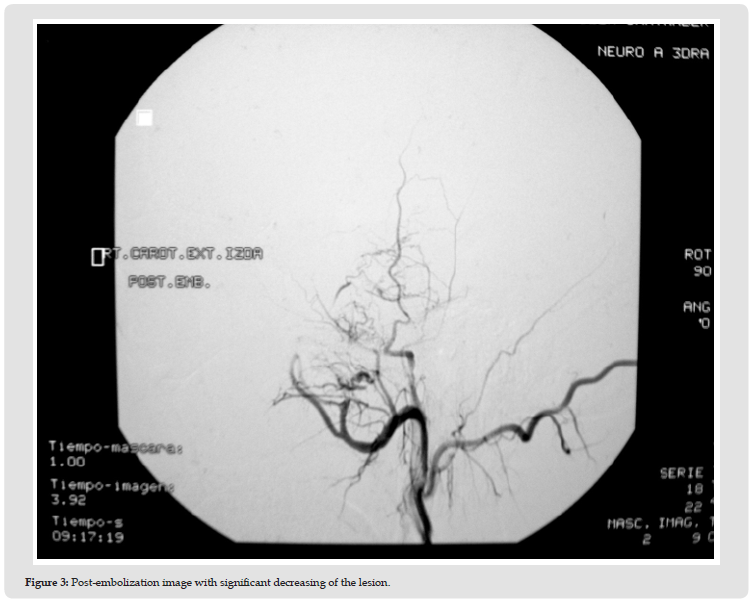
Due to aesthetic concerns and continuous growth, surgical excision was recommended. Before the surgery, a subselective arteriography was performed. In the pre-embolization images, a hypervascularized mass depending on branches of the left internal maxillary artery was identified (Figure 2). The tumor was embolized using polyvinyl alcohol microparticles, and liquid coils in the left internal maxillary artery’s pedicle, showing significant decrease of the lesion in the post-embolization images (Figure 3). One day following embolization, the patient underwent surgical removal of the hemangioma using a hemicoronal approach with preauricular and submandibular incisions. External carotid artery was temporally clamped due to the possible intraoperative bleeding. The left temporalis muscle within the angiomatous mass was then totally excised to the coronoid process, after removal of the zygomatic arch and ligation of the left maxillary artery at the liquid coil’s level. The zygomatic arch was then replaced, and the defect filled with a temporal polyethylene implant. On the histological examination, the tumor was composed of a large number of interconnecting endothelial-lined vascular spaces in skeletal muscle, consistent with an intramuscular haemangioma of the capillary type. The patient had an uncomplicated postoperative recovery, achieving favorable functional and cosmetic outcomes. Nine years after the surgery, there are no signs of recurrence
Figure 2
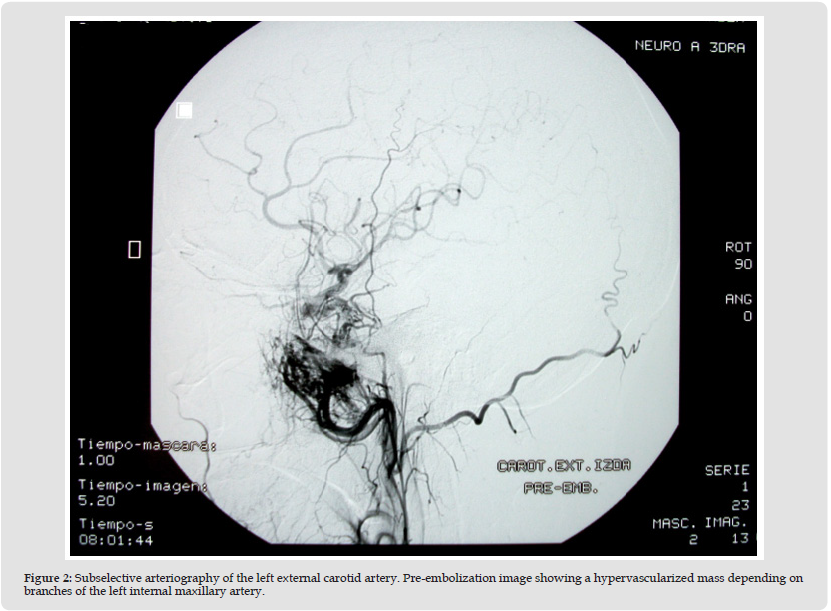
Figure 3
Case 2
A 35-year-old woman with a 3-month history of a slow growing mass in the left temporal fossa. There was no pain, but the patient felt itches occasionally during night. On the physical examination there was a soft and tender swelling in the left temporal region, with a slight pulsation palpable. No bruits were detected, and the overlying skin was also normal. Imaging workup included ultrasonography (US) and MRI. US showed a 6x17mm solid, ovoid mass in the left temporal region with intense vasculature. On MRI, the tumor appeared as a mass within the left temporalis muscle, isointense on T1 images and markedly hyperintense on T2 sequences, with vigorous enhancement after gadolinium administration (Figure 4). The preliminary diagnosis was of hemangioma of the temporalis muscle, and surgical excision under general anesthesia after embolization was planned. Subselective arteriography showed two vascular masses depending on the left deep temporal artery, one with a high-flow arterio-venous fistula (Figure 5). After embolization of the lesion and the fistula with biologic glue and microparticles, and occlusion with coils of the deep temporal, superficial temporal and internal maxillary arteries, the hemangioma virtually disappeared (Figure 6). Surgical approach to the temporalis muscle was achieved through a hemicoronal incision 24 hours after the embolization. The muscle within the hemangioma was totally excised after deep temporal branches localization and zygomatic arch osteotomy, which was later replaced (Figure 7). The defect was filled with a temporal polyethylene implant. The biopsy results confirmed a diagnosis of capillary hemangioma in the temporalis muscle. The patient was asymptomatic after the procedure, with good functional and cosmetics results. The 5-years-follow-up didn’t show signs of recurrence.
Figure 4

Figure 5
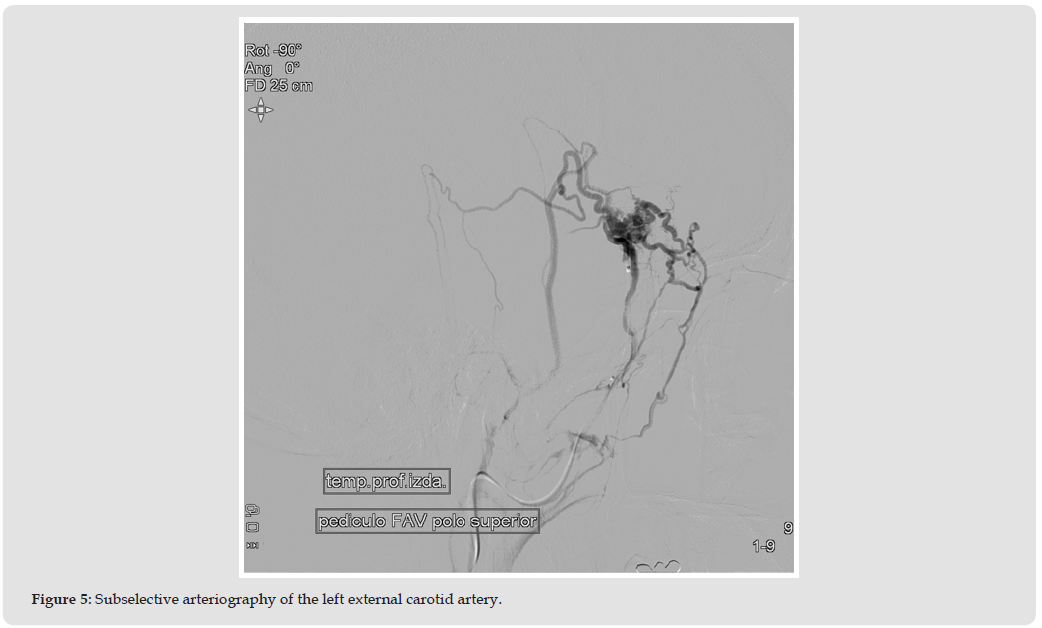
Figure 6
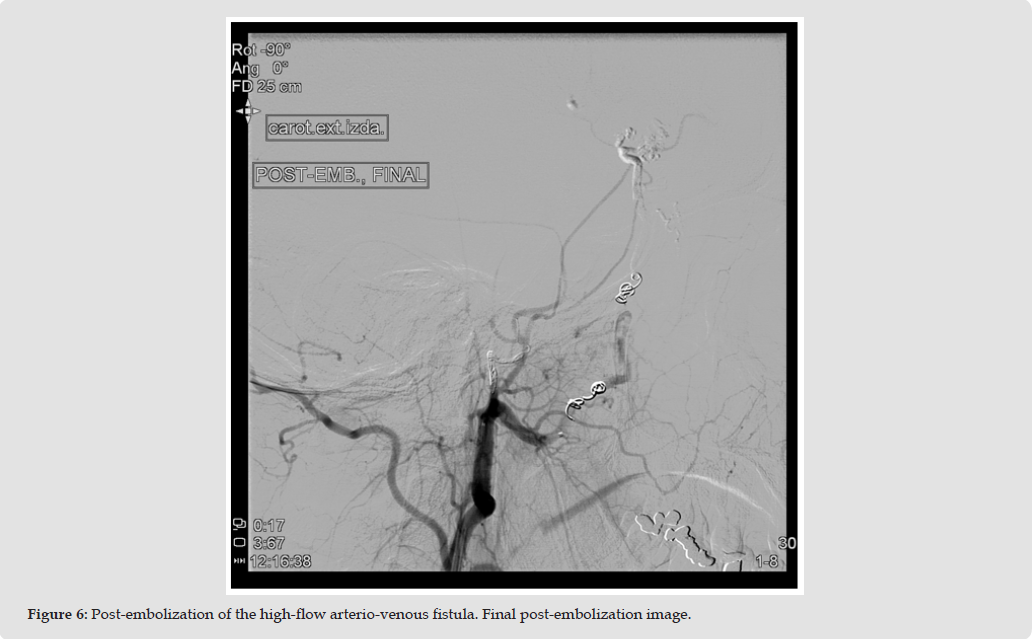
Figure 7

Intramuscular hemangiomas (IMH) are uncommon tumors, accounting for about 0.8% of all hemangiomas. Approximately 14% of IMH cases are found in the muscles of the head and neck[1]. The most commonly affected muscles in this region include the masseter (36%), trapezius (24%), periorbital muscles (12%), and sternocleidomastoid (10%) [2-4]. However, the temporalis muscle is an extremely uncommon site for these tumors, with only 41 cases documented in the literature to date. Of these, only 37 cases have been thoroughly described in detail [5-40]. IMH were initially described by Liston in 1843, [42] and later classified by Allen and Enzinger in 1972 according to vessel size. Three types are recognized: small vessel or capillary type (diameter < 1.40 μm), large vessel or cavernous type (diameter >140 μm); and mixed type, which includes both [41]. In the head and neck region, small-vessel hemangiomas represent approximately 30% of IMH, while large-vessel and mixed types account for 19% and 5%, respectively. However, within the temporal muscle, cavernous hemangioma is reported as the most common type according to the literature. Interestingly, both of our cases were diagnosed as capillary-type hemangiomas.
Approximately 50% of intramuscular hemangiomas (IMH) develop during the first decade of life, with 94% occurring before the age of 30 [43]. There is no distinct gender preference, as the literature reports 18 males and 19 females, with ages ranging from 1 to 69 years (mean age: 38.4 years).”The etiology of these lesions remains unknown. They are believed to result from abnormal embryonic sequestrations, which often go undetected for extended periods until triggering factors lead to sudden growth, resulting in pain or cosmetic deformity. Muscular trauma is thought to play a key role in the proliferation of pre-existing embryonic vascular malformations, which may help explain why most cases occur in younger populations. Localized vascular injury can result in the formation of granulation tissue, and when exacerbated by muscle activity, this proliferation may predispose to the development of a hemangioma. Hormonal changes have also been proposed as potential initiating factors [5]. A cosmetic deformity resulting from facial asymmetry is the most common reason for seeking treatment [18]. IMH usually present as slow-growing masses without symptoms or signs such as thrills, bruits, or pulsations, which would suggest their vascular origin. The surrounding muscular fibrosis may explain the absence of these signs and contribute to the mass’s rubbery, firm textura [44]. Skin discoloration over the lesion is also uncommon. Pain at presentation is often associated with rapid growth and compression of nearby structures [45]. Clinically recognizable hemorrhage in IMH is considered rare. In 1997, Itosaka et al. reported a temporalis muscle hemangioma with a peculiar course of appearance and regression, which was believed to be caused by hemorrhage [15]. The differential diagnosis includes lipoma, neurofibroma, dermoid cyst, enlarged lymph nodes, soft tissue sarcoma, temporal arteritis, and myositis ossificans [19]. Nowadays, MRI is the most accurate noninvasive method for diagnosing IMH. It offers superior soft tissue contrast resolution compared to CT without contrast agents and allows for both sagittal and coronal imaging. IMH typically appear with low signal intensity, similar to muscle, on T1-weighted images, and high signal intensity, greater than fat, on T2-weighted images. Despite contrast enhancement, CT images may not always clearly differentiate hemangiomas from surrounding tissues. Ultrasound can be helpful for assessing superficial lesions, but both CT and ultrasound can detect the presence of phleboliths within IMH, which are calcified thrombi, a characteristic feature of this type of hemangioma [46].
Arteriography images do not offer adequate information regarding the relationship between hemangiomas and adjacent structures for precise surgical planning and are typically limited to high-flow lesions. However, arteriography remains important to evaluate the tumor’s vascular supply and to facilitate preoperative embolization. Fine-needle aspiration is often inconclusive and may carry a risk of significant blood loss during the procedure, especially in cases of high-flow hemangiomas.Although the management of IMH should be individualized, surgical excision, including a rim of normal surrounding tissue, is the preferred first-line treatment according to several authors. This approach allows for histological evaluation of the mass and reduces the rate of local recurrence [19,20]. Other proposed treatment modalities include cryotherapy, steroid and sclerosing agent injections, arterial embolization, arterial ligation, and radiotherapy. Complete surgical resection is indicated in cases of tumor growth, pain, cosmetic deformity, thrombocytopenia, or suspicion of malignancy [47]. Heckl [20] and Uralogu [24] advocate for strict clinical and radiological follow-up for at least two years. Surgical intervention is typically reserved for capillary hemangiomas (due to their more aggressive behavior), progression of the lesion, or when quality of life is significantly affected by intractable pain, aesthetic concerns, or functional impairment[20]. Subselective arteriography is widely used for diagnosing and treating high-flow vascular malformations and hemangiomas. The complication rate associated with this technique has decreased, and severe adverse events such as stroke, cranial nerve ischemia, blindness, and significant hemodynamic changes have become less common. However, skin and mucosal necrosis remain recognized side effects of embolization [48-50].
Preoperative embolization through the lesion’s arterial supply reduces blood flow within the angiomatous mass and minimizes blood loss during surgery, with a low complication rate. If surgery is performed immediately after embolization, proximal occlusion of blood vessels near the lesion can be done, as collateral blood supply is unlikely to develop within 72 hours [51] Embolization as a standalone treatment may have limitations, such as blood vessel recanalization and collateral vessel growth over time, which could allow for tumor regrowth and recurrence. Thus, a combined approach of embolization and surgical resection is recommended for IMH [48-50]. Local recurrence, primarily associated with incomplete resection, varies among the three pathological subtypes of IMH. Recurrence rates of 28%, 20%, and 9% have been reported for mixed-type, capillary, and cavernous IMH, respectively [14]. No one of our cases, nine and five years after treatment respectively, has shown any sign of recurrence.
Hemangiomas of the temporalis muscle are exceptionally rare, with only 37 well-documented cases in the international literature. Local recurrences have been reported, and are more frequent in the mixed and capillary types. Preoperative embolization and surgical excision including normal surrounding tissue seem to be the best choice of treatment for capillary and mixed hemangiomas, so that they reduce blood lost during surgery and local recurrences.

International Association of Landscape Archaeology, Czech Glass Society, Czech Republic

Department of Chemistry, Semenov Institute of Chemical Physics, USSR Academy of Sciences, Moscow, Russia

Department of Educational Sciences, Research Centre Qualities of Teachers, School of Education – HAN, Nijmegen, Netherlands

Associate Professor at Department of Breast and Thyorid Surgey, Chongqing General Hospital, China

Neurology, LA BioMed Research Institute, USA





 Abstract
 PDF
PDF



























