info@biomedres.us
+1 (502) 904-2126
One Westbrook Corporate Center, Suite 300, Westchester, IL 60154, USA
Site Map
 ISSN: 2574 -1241
ISSN: 2574 -1241
ISSN: 2574 -1241
Received: January 17, 2025; Published: January 28, 2025
*Corresponding author: Mahmoud M Ismail, Professor Al-Azhar University Cairo, Egypt
DOI: 10.26717/BJSTR.2025.60.009444
Corneal injuries are a significant cause of visual impairment worldwide, often leading to complications such as scarring, neovascularization, and persistent inflammation. Recent studies suggest that losartan, an angiotensin Il receptor type 1 (ATIR) antagonist widely used as an antihypertensive drug, holds promise as a therapeutic agent for enhancing corneal healing. This review explores the mechanisms by which losartan promotes corneal repair, evaluates preclinical and clinical findings, and discusses its potential as a novel therapy for corneal healing. Additionally, we highlight an additional risk of complications associated with corneal injuries and the need for innovative treatment strategies.
Keywords: Losartan; Corneal Healing; Fibrosis; Neovascularization; TGF-ß; Eye Drops
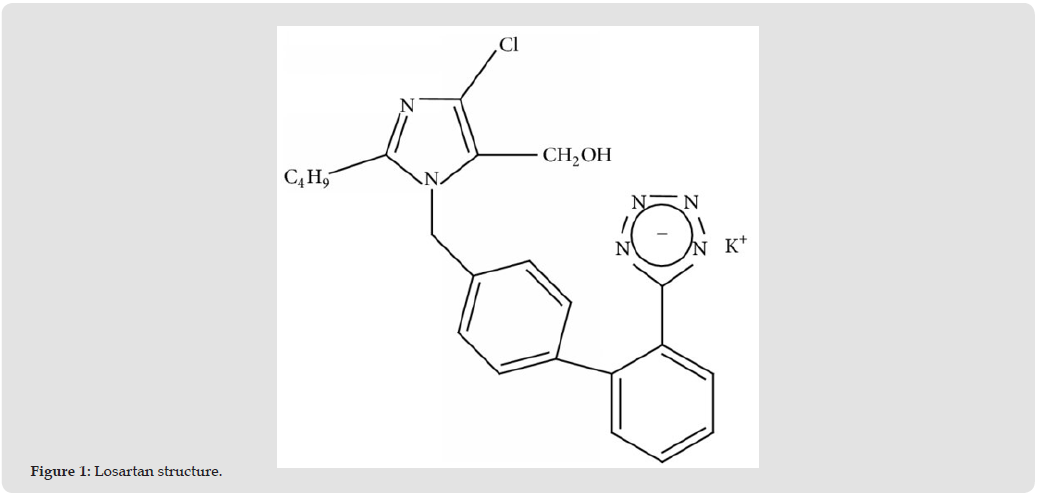
Corneal healing is a complex process involving epithelial regeneration, stromal remodeling, and modulation of inflammation. While many approaches to promote corneal healing exist, persistent complications such as stromal haze, delayed ulcer healing, and neovascularization often impair visual outcomes. Emerging evidence indicates that targeting the renin-angiotensin system (RAS) using losartan can attenuate fibrosis, inhibit angiogenesis, and modulate inflammatory responses. Losartan’s role in corneal healing is being increasingly recognized due to its ability to block TGF-ß signaling, a key driver of fibrosis and inflammation (Figure 1).
Figure 1
Losartan’s therapeutic effects on corneal healing are attributed to its multifaceted actions:
• Anti-fibrotic Activity: Losartan inhibits TGF-ß signaling, a pathway critical in the development of corneal fibrosis. By preventing the differentiation of fibroblasts into myofibroblasts, losartan reduces extracellular matrix deposition and scar formation [1-3].
• Anti-inflammatory Properties: Losartan modulates inflammatory responses by reducing cytokine production and leukocyte infiltration, creating a conducive environment for tissue repair.
• Anti-angiogenic Effects: By blocking ATIR, losartan reduces vascular endothelial growth factor (VEGF) expression, thereby inhibiting corneal neovascularization.
• Promotion of Epithelial Regeneration: Losartan enhances epithelial cell proliferation and migration, accelerating wound closure.
Several animal models have demonstrated the efficacy of losartan in promoting corneal healing:
• Corneal Alkali Burns: Studies in rodent models showed that topical losartan reduces fibrosis and neovascularization, leading to improved corneal transparency and decreased inflammation.
• Mechanical Injuries: Losartan-treated eyes exhibited faster epithelial wound closure and reduced scarring compared to controls.
• Diabetic Corneal Wounds: In models of delayed corneal healing due to diabetes, losartan restored normal healing dynamics by mitigating oxidative stress and inflammation [4-6].
Although clinical data on losartan eye drops remain limited, early- phase studies and case reports suggest promising results:
• Pilot Studies: A small trial involving patients with corneal scarring demonstrated that losartan eye drops significantly improved visual acuity and corneal clarity over a 6-week treatment period.
• Safety Profile: Topical losartan has been well-tolerated in preclinical and preliminary human studies, with minimal adverse effects such as transient irritation.
• Targeted Delivery: Topical application allows for localized drug delivery, minimizing systemic exposure and associated side effects.
• Multi-modal Action: A Triple-Threat Approach: By tackling fibrosis, inflammation, and angiogenesis, losartan offers a comprehensive approach to corneal healing.
• Repurposing Potential: As an FDA-approved drug, losartan has a well-established safety profile, facilitating faster translation to clinical use.
Despite its potential, the application of losartan eye drops faces several challenges:
• Lack of Large-scale Clinical Trials: More Clinical Based Evidence is required to confirm efficacy and safety in diverse patient populations.
• Formulation Optimization: Ensuring adequate bioavailability and stability of losartan in topical formulations remains a critical hurdle.
• Cost-effectiveness: The cost of production and accessibility in low-resource settings must be considered.
To fully realize the potential of losartan for corneal healing, future research should focus on:
1. Conducting randomized controlled trials to evaluate its efficacy across various corneal pathologies.
2. Observing its effects in combination with conventional treatments, such as corticosteroids or topical antibiotics.
3. Developing sustained-release formulations for prolonged therapeutic effects.
4. Investigating its role in mitigating other ocular complications, such as dry eye and keratoconus progression.
Losartan eye drops represent a promising therapeutic avenue for corneal healing, offering anti-fibrotic, anti-inflammatory, and anti-angiogenic benefits. While preclinical studies and initial clinical findings are encouraging, further research is required to establish their role in standard ophthalmic practice. If validated, losartan could significantly enhance outcomes for patients with corneal injuries and related disorders.

International Association of Landscape Archaeology, Czech Glass Society, Czech Republic

Department of Chemistry, Semenov Institute of Chemical Physics, USSR Academy of Sciences, Moscow, Russia

Pharmaco-kinetics, dynamics and Drug Metabolism, Touro College of Pharmacy, USA

Professor of Nuclear Medicine, Faculty of Medicine and Surgery, University of Milan, Milan, Italy

Clinical Radiologist (MD) - Department of RADIOLOGY, Cosenza Hospital, Cosenza, Italy





 Abstract
 PDF
PDF



























