info@biomedres.us
+1 (502) 904-2126
One Westbrook Corporate Center, Suite 300, Westchester, IL 60154, USA
Site Map
 ISSN: 2574 -1241
ISSN: 2574 -1241
ISSN: 2574 -1241
Received: January 17, 2025; Published: January 22, 2025
*Corresponding author: Chukwubuike Kevin Emeka, Department of Surgery, Enugu State University Teaching Hospital, Enugu, Nigeria
DOI: 10.26717/BJSTR.2025.60.009432
Objective: Repair of inguinal hernia in children is a common pediatric surgical procedure. The objective of this
study is to prospectively compare the outcome of ligation and non-ligation of the processus vaginalis in terms of
post-operative complications, following inguinal hernia repair.
Materials and Methods: This was a prospective randomized study conducted at pediatric surgery unit of Enugu
State University Teaching Hospital (ESUTH), Enugu, Nigeria between January 2018 and December 2019. Patients
were randomized into 2 groups. Group A represented those who had herniotomy without ligation of the
processus vaginalis while group B represented those who had herniotomy with ligation of processus vaginalis.
Group A and group B were compared in terms of post-operative complications and duration of surgery, to determine
if there is any difference in outcome.
Results: A total of 142 children were assessed. There were 72 patients in group and 70 patients in group B. They
were all males. There were no significant difference in the patients’ demographic profiles, side of the hernia and
mean duration of surgery between the 2 groups of patients.
Conclusion: High ligation of the processus vaginalis is not a prerequisite for herniotomy in children since there
is no difference in post-operative complications including hernia recurrence.
Keywords: Children; Complications; Inguinal Hernia; Processus Vaginalis; Recurrence
Inguinal hernias are among the most frequent pathologies in the pediatric population and constitute one of the most common surgical conditions for which parents present a child to the surgeon [1]. Inguinal hernias are more common in males, occur in 1-4% of the children and repair of inguinal hernia in children is a common pediatric surgical procedure. [2,3] Hundreds of inguinal hernia repairs are performed each year by pediatric surgeons all over the world and this surgery (herniotomy) basically involves ligation of the hernia sac (processus vaginalis) which was described as far back as 1871 by Marcy [4]. In the conventional method of inguinal hernia repair, there is high ligation of the sac and avoidance of injury to the floor of the inguinal hernia [5]. Most pediatric surgeons believe that this step is mandatory. However, others believe that this hernia sac (processus vaginalis) ligation is not necessary. Some series on inguinal hernia repair have investigated the necessity, or otherwise, of high ligation of the patient processus in children. One report from United States of America reported the needlessness of hernia sac ligation and low incidence of complications when the hernia sac is not ligated [6]. Kumari. et al. [7] reported that there was no need to ligate the processus: this method saves time and prevents unnecessary destruction of the spermatic cord structures [7]. Mohta, et al. [8] reported the advantages of non-ligation in terms of time-saving, safety and prevention of peritoneal tearing when the peritoneum is thin. The objective of this study was to prospectively compare the outcome of ligation and non- -ligation of the processus vaginalis in terms of post-operative complications and duration of surgery.
Patients and Setting
This was a prospective randomized study conducted at the pediatric surgery unit of Enugu State University Teaching Hospital (ESUTH), Enugu, Nigeria between January 2018 and December 2019. Children under the age of 15 years with inguinal hernia were recruited into the study. Children with incarcerated, obstructed or strangulated inguinal hernia were excluded from this study. Patients older than 15 years of age were also excluded. Informed consent was obtained from the patients’ parents/caregivers. Ethical approval was obtained from the research and ethics committee of ESUTH.
Interventions
Patients were randomized into 2 groups. Group A represented those who had herniotomy without hernia sac ligation while group B represented those who had herniotomy with hernia sac ligation. Both groups of patients had herniotomy under general anesthesia with endotracheal intubation. Access was through an inguinal incision with cutting of the Camper and Scarpa fasciae. The hernia sac (processus vaginalis) was identified by separating the cremasteric muscles and spermatic cord structures. Group A patients and group B patients underwent herniotomy without ligation (the sac remained open at the level of internal ring) and with ligation of the hernia sac respectively. The inguinal wounds were closed in layers and dressing applied. The wound was inspected on the 6th day post-op and is subsequently left exposed. All the herniotomies were performed by a single surgeon.
Assessments
Following herniotomy, the patients were seen on first, sixthand thirteenth weeks post-op. The following complications were assessed: scrotal edema, hematoma, surgical site infection and hernia recurrence. The evaluations of the complications were performed by a senior registrar in pediatric surgery who was blinded to the method of herniotomy. The duration of surgery was also documented. The duration of surgery was calculated from time of knife on skin to the time of closure of the skin incision.
Data collection and Analysis
The following data were collected: age of the patient, gender, side of the inguinal hernia, type of complication, duration of operation of the 2 groups of patients. Statistical Package for Social Science (SPSS) version 21 (manufactured by IBM Corporation Chicago Illinois) was used for data entry and analysis. Data were expressed as percentages, median, mean, and range. Data were compared between the 2 groups of patients using independent t-test and Chi-square test. P-value of less than 0.05 was considered as significant.
ResultsPatients’ Demographics
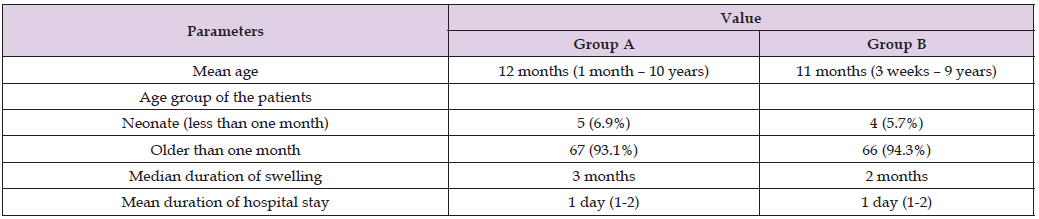
A total of 142 patients with inguinal hernia were assessed during the study period. There were 72 patients in group A and 70 patients in group B. They were all males. Details of the demographics of the 2 groups of patients are shown in Table 1.
Table 1: Demographic profile of the patients (N=142).
1. Side of the hernia (N=142)
Amongst the 142 patients, 33 (23.2%) patients had left inguinal hernia [group A 16; group B 17], 90 (63.4%) patients had right inguinal hernia [group A 46; group B 44] and 19 (13.4%) had bilateral inguinal hernia [group A 10; group B 9].
2. Types of complication (N=142)
The post-operative complications recorded in the patients are shown in Table 2.
3. Mean duration of surgery
The mean duration of operation for group A was 20.2 minutes whereas the mean duration for group B was 21.4 minutes (p value = 0.125).
Mortality
There was no mortality in the 2 groups of patients.
Table 2: Complications.

Unlike in adults where hernia is a result of muscular weakness, inguinal hernia in children is due to failure of the processus vaginalis to obliterate [9]. Inguinal hernia in children is treated by herniotomy, which is the standard procedure. Conventionally, herniotomy entails ligation of the patent processus vaginalis and division of the sac distal to the ligature. Some authors believe that this ligation was mandatory to avoid hernia recurrence while other authors have reported that ligation of the sac is not necessary [2]. In the present study, all the patients were males. However, one study from Iran recruited both males and females [2]. The predominance of inguinal hernias in males may explain why only males were recruited into the present study. The mean ages of the patients in group A and group B were 12 months and 11 months respectively. The high incidence of inguinal hernia in infants has been reported by other authors. [10,11] Only a few neonates were involved in the current study. The time of detection of the inguinal hernias by the parents/caregivers may determine the age at which they presentation. However, in preterm neonates there is increased incidence of inguinal hernia [12]. The parents of the children may not have presented them immediately to the hospital when the inguinal swellings were noticed. This lag period before presentation may be due to lack of awareness, low level of enlightenment and poverty. Majority of the herniotomies were handled as day cases. Howbeit, when there are problems concerning recovering from anesthesia and co-morbidities, the patients were admitted and observed overnight. Basically, there was no significant difference in demographics of the 2 groups of patients. Rafiei and Jazini also did not find any significant difference their patients’ demographics [2].
About two-thirds of the hernias were right sided and only about one-tenth were bilateral. This finding is consistent with the report of other researchers [2,13] Majority of the patients did not develop any post-operative complications. However, among the patients that had complications, scrotal hematoma was the most common complication. In the current study, statistical analysis of the complications between the 2 groups of patients revealed no statistical significance. A study from Asia also reported no complications in herniotomy with or without ligation of the processus vaginalis [2]. Mohta et al also did not report any untoward effects on complications when there is non- -ligation of the hernia sac during herniotomy in children [8]. In terms of operation time, there was no statistical difference between the 2 groups of patients. Howbeit, Rafiei et al reported a time difference between the ligation and the non-ligation groups [2]. The skill, experience and speed of the different surgeons may explain these discrepancies in operation time. In conclusion, herniotomy, a common surgical procedure in children, is conventionally performed by high ligation of the hernia sac (processus vaginalis) followed by sac transection distal to the ligation. However, this study has shown that this high ligation of the processus vaginalis is not a prerequisite for herniotomy in children since there is no difference in post-operative complications including hernia recurrence.
Limitations of the Study
1. This is a single centre study and a single centre experience. A multicenter study in the future may be required to buttress or refute the findings of this study.
2. Those with bilateral inguinal hernias would have had the patent processus on one side ligated and the contralateral side not ligated.

International Association of Landscape Archaeology, Czech Glass Society, Czech Republic

Department of Chemistry, Semenov Institute of Chemical Physics, USSR Academy of Sciences, Moscow, Russia

Department of Educational Sciences, Research Centre Qualities of Teachers, School of Education – HAN, Nijmegen, Netherlands

Associate Professor at Department of Breast and Thyorid Surgey, Chongqing General Hospital, China

Neurology, LA BioMed Research Institute, USA





 Abstract
 PDF
PDF



























