info@biomedres.us
+1 (502) 904-2126
One Westbrook Corporate Center, Suite 300, Westchester, IL 60154, USA
Site Map
 ISSN: 2574 -1241
ISSN: 2574 -1241
ISSN: 2574 -1241
Received: December 23, 2024; Published: January 07, 2025
*Corresponding author: Gilberto Cruz Arteaga, Admission: Family Medicine Specialist, Family Medicine Unit No. 20, Calzada Vallejo No. 675, Col. Nueva Vallejo, CP 07750, Gustavo A. Madero Delegation, Mexico
DOI: 10.26717/BJSTR.2025.60.009411
Prediabetes is considered an asymptomatic state with a high prevalence at the worldwide and national level. Its diagnosis is with preprandial (fasting) glycemia and a glucose tolerance test. Prediabetes has non-pharmacological treatments such as lifestyle changes, physical activity, healthy eating, modifications in psychosocial skills, etc. Modifications in psychological skills are focused on stress management in the face of events such as prediabetes, such as the theory referred to by Lazarus R.S. (1990) on stress management (coping); there are several instruments to measure coping, some consist of 11 dimensions, such as positive thoughts, blaming others, seeking social support, emotional repression, religiosity, resignation, escape. Active coping is considered significant in diabetes mellitus.
Objective: The objective was to measure the validation and reliability of the coping instrument in patients with prediabetes at the Family Medicine Unit (U.M.F.) 20 Vallejo of the Mexican Social Security Institute (I.M.S.S.).
Material and Methods: An instrument was applied to a sample of 98 members of the IMSS UMF No. 20 OOAD Norte in Mexico City, who agreed to answer the instrument after giving their informed consent. Content validity was assessed by four experts, construct validity was assessed by exploratory factor analysis (Kaiser-Meyer-Olkin (KMO) sampling adequacy test and Bartlet’s sphericity test) and reliability was assessed with Cronbach’s alpha coefficient.
Results: A 27-item coping instrument for Prediabetes was obtained after an item analysis, with a Cronbach’s alpha of 0.89, KMO of 0.802 and Bartlett’s test of sphericity < 0.05, with an explained variance of 64.6%; obtaining seven dimensions with a measurement from 0 to 100. The domains were Healthy Self-Management and Strategic Alliance, with 4 items each; Resilient Wisdom and Comprehensive Management with 5 items each; Accompaniment, Calm and Guilt; with 3 items each.
Conclusions: The instrument presented good validity, with domains of active coping predominance to be applied in UMF in patients with Prediabetes.
Keywords: Prediabetes; Coping; Validation; Reliability
Abbrivations: KMO: Kaiser-Meyer-Olkin; UMF: Family Medicine Unit; WHO: World Health Organization; ADA: American Diabetes Association; ICD: international disease code; OOAD: Deconcentrated Administrative Operation Organ; AI: Artificial Intelligence
Prediabetes is typically defined as the presence of blood glucose concentrations higher than those established as normal, but lower than the thresholds established to diagnose Diabetes. Its importance lies in the fact that it is a high-risk state for the development of diabetes. Authors report that the WHO (World Health Organization) prefers the term intermediate hyperglycemia, in the same way the ADA (American Diabetes Association) defines it as a state of very high risk for developing diabetes [1,2]. The clinical definition of prediabetes as a morbid state has not been universally accepted by the research and medical communities, thus the diagnostic criteria used for the identification of prediabetes are not uniform internationally [3]. The screening test used and the diagnostic criteria used in Prediabetes are those of the ADA with a glycated hemoglobin value of 5.7-6.4% and fasting plasma glucose of 100-126 mg/dl [4]. The prevalence of prediabetes in the U.S. is 32%, with the Hispanic population having the highest prevalence at 37.8%, and men are more likely to have prediabetes [5]. The National Health and Nutrition Survey reports a prevalence of prediabetes of 22.1%, equivalent to 17.6 million people, predominantly in women (24.9%) aged 60 years or older at 32.8% and in the 40-59 age group at 27.1% [6]. People with prediabetes have approximately 10 years to develop type 2 diabetes mellitus, characterized by the presence of insulin resistance and hyperinsulinemia, identified primarily in postprandial glycemia levels [7]. The main treatment options that should be provided and informed to patients diagnosed with prediabetes are lifestyle changes, such as weight loss, increased physical activity and improving a healthy diet, demonstrating that with 3 years of follow-up, a 58% decrease in risk was achieved with lifestyle changes [8]. Facilitators for making lifestyle changes are specifically mentioned in diabetes mellitus [9-11] and generally in patients with prediabetes, commenting on coping mechanisms interpreted as positive reframing directed towards lifestyles [12]. This is supported by the stress coping theory by Lazarus and Folkman, which states that stress is anchored to resistance, meaning that the organism has the capacity to adapt to stimuli, understood as the modification of the environment, as in the dynamic adjustment of the structure itself [13,14]. Coping instruments such as that of Rodríguez-Marín have been developed in the Hispanic population, with a total explained variance of 62% with 11 domains and 50 items [15]. The CAPS instrument in short version with a Cronbach’s alpha of 0.94 [16]. Gutiérrez-López developed a coping instrument with a Cronbach’s alpha of 0.88 [17]. Several versions of the COPE-28 instrument have been carried out, reporting alpha coefficients between 0.74 and 0.82 [18,19]. Studies carried out in patients with diabetes mellitus on coping refer to active coping, domains of seeking social and family support, as common strategies that they adopt, presenting relevant perceptions of the disease with significant changes [20-22]. The objective of the study is to measure the validation and reliability of the coping instrument in patients with prediabetes in the Family Medicine Unit (U.M.F.) 20 Vallejo of the Mexican Social Security Institute (I.M.S.S.).
Participants
A cross-sectional, protective, analytical study was carried out, with validation of a prediabetes instrument. In beneficiaries of the U.M.F. No. 20, belonging to the Deconcentrated Administrative Operation Organ (OOAD) D.F. North of the IMSS in Mexico City. The eligible population was of both sexes, from 20 to 69 years of age, with the diagnosis Abnormalities in the glucose tolerance test, with the international disease code (ICD) ICD-10 R73.03, with voluntary participation in answering the instrument, after accepting informed consent. Personnel entitled to the instrument who did not wish to participate in the research and/or did not have time to complete the instrument and patients being treated with medications for diabetes mellitus and/or prediabetes were excluded.
Instrument
An instrument was created using as a first part a distillation of variables using Artificial Intelligence (AI), starting with the complex variable called coping, until reaching attributes to be measured (simple variable). For the complex variable called coping, the 11 dimensions considered by Rodriguez Marin (1992) were taken as follows:
1. Positive Thoughts (interpreting the problem in an advantageous
way).
2. Blaming Others (blaming other people for the problem and/
or for its consequences not having occurred).
3. Desiderative Thinking (expressing wishes for the problem
and/or its consequences).
4. Search for Social Support (asking for help).
5. Search for Solutions (obtaining information about the disease,
planning and proposing solution possibilities).
6. Emotional Repression (rejection or avoidance of the expression
of feelings or thoughts).
7. Accounting for Advantages (comparing the current situation
with a worse possibility).
8. Religiosity (performing religious practices).
9. Self-blame (taking responsibility for the illness on oneself).
10. Resignation (accepting the situation as something unchangeable).
11. Escape (fleeing from the problem).
The AI was asked to give 100 words for each of the 11 domains described previously. A word purification was carried out for each domain, eliminating repeated or synonymous words. Finally, 140 words corresponding to each domain remained. Each of the words in the instrument was rated with a measurement from 0 to 100 when questioning the patient, who designated a number with this numerical interval. A non-probabilistic sampling was carried out determined by the number of patients who attended outpatient consultation at the UMF 20 with the inclusion criteria previously described, within the time period from September to October 2024.
Data analysis
Descriptive statistics were performed to obtain frequencies and percentages in the demographic characteristics (sex, age, education, marital status) of the participants who were beneficiaries of U.M.F. No. 20 Vallejo. In content validity, the agreement of the evaluation of the item under review reported by each of the experts was carried out through the judgment of 4 experts. The degree of agreement between the experts will be determined by the Fleiss Kappa coefficient, where: <0 poor agreement, 0.01-0.20 slight agreement, 0.21-0.40 acceptable agreement, 0.41-0.60 moderate agreement, 0.61-0.80 considerable agreement, 0.81-1.00 almost perfect agreement. Reliability is assessed by the result of Cronbach’s alpha coefficient where results less than 0.5: unacceptable, 0.5- <0.6: poor, 0.6- <0.7 questionable, 0.7 to <0.8 acceptable, 0.8- <0-9 good and greater than or equal to. 0.9 is excellent. The construct validity is analyzed through the existence of high correlations between the variables through Bartlett’s sphericity: with values returned by x2 (chi-square) obtaining significant values when less than 0.05 and a confidence level of 95%, and the Kaiser- -Meyer-Olkin (KMO) index, taking into account values that fluctuate between 0 and 1, being an acceptable value > 0.5, if KMO ≥ 0.9, the test is very good; remarkable KMO ≥ 0.8; median for KMO ≥ 0.7; low for KMO ≥ 0.6; and very low for KMO < 0.5. Therefore, it is considered that factor analysis should be performed if it is greater than 0.5; Bartlett’s sphericity test (acceptable value less than 0.05).
Likewise, the extraction of the factors was obtained through the orthogonal rotation method, varimax if it has low correlations < .7 and/or oblique, direct oblimin if it has high correlations > 0.7. The procedure was repeated as many times as necessary until a stable factor structure was obtained. Items that had a factor loading less than 0.50 or that were not theoretically related to the factor were eliminated.
Validation: The Prediabetes Coping Instrument was applied to 98 members of the U.M.F. No. 20 Vallejo, with a predominance of females 54.1% (n=53), average age 48.9 years, with SD 16.4 years, high school education with 31.6% (n=31), occupation service or sales employee and unemployed with 29.6% (n=29), respectively; marital status married 57.1% (n=56) (Table 1). Description of the process of validity of criterion and content. Regarding the reliability of experts, the 4 experts obtained a clarity in the wording with an answer of agreement from one expert (25%) and disagreement from three experts (75%); in the internal coherence three commented disagreement (75%) and one disagreement (25%); in the induction to the answer two experts disagreed (50%) and two agreed (50%); in language appropriate to the level of the informant, the four (100%) answered disagreement; Measuring what is intended disagreement in two experts (50%) and two disagreed (50%); when asking the experts if the instrument contains clear and precise instructions to answer the questionnaire one expert agreed (25%) and 3 disagreed (75%); in the question of whether the items allow the achievement of the objective of the research and are distributed in a logical and sequential way, four experts answered disagreement (100%); When asked if the number of items is sufficient to collect information, one expert agreed (25%) and 3 disagreed (75%).
Table 1: Demographic characteristics of participants in the Prediabetes Coping Instrument of U.M.F. 20 Vallejo.

Note: *mean, **standard deviation (SD).
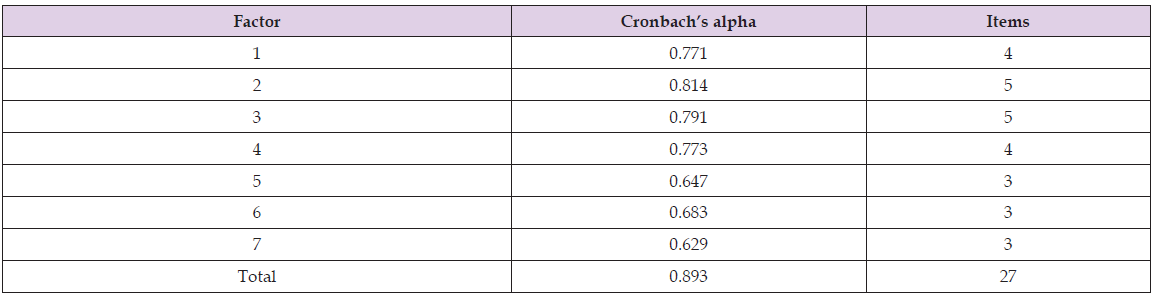
Description and observations found in the pilot test. By performing the primary analysis of the simple variables, it is deduced that it is necessary to perform the scale if the variable element (item analysis) is eliminated, given that the result of the instrument of 140 variables presented a Cronbach alpha result of 0.993. Analysis of total reliability of the scale and by items. After the analysis of items, of the 98 people surveyed with the diagnosis of Prediabetes, a total Cronbach Alpha of 0.900 was presented with 42 items in total, with excellent internal consistency; acceptable internal consistency was presented in the domains Search for solutions 0.791 and Positive thinking 0.747; questionable internal consistency for the domains Accounting for advantages 0.610 and Blaming others. Unacceptable internal consistency was for Religiosity, Emotional Repression and Resignation (Tables 2 & 3). Description of the factorial validity process of the developed scale. Bartlett’s sphericity test was significant, acceptable (1418.804, gl = 435, sig < 0.001); and the Kaiser-Meyer-Olkin (KMO) sample size adequacy indicator was notable (.802). Finally, 7 factors were obtained with a total explained variance of 64.66% (Table 4). The Cronbach’s Alpha of the post-assessment factor analysis instrument presented good internal consistency with a value of 0.893, presenting 27 variables in total and 7 factors with internal consistency ranging from questionable to good (Table 5, Appendix Table 1).
Table 2: Analysis of total reliability of the scale and by items in patients with Prediabetes from UMF 20 Vallejo.

Note: Own elaboration.
Table 3: Prediabetes Coping Instrument with 42 items.

Note: Own elaboration.
Table 4: Factor weightings for exploratory factor analysis of the 27-item coping instrument in prediabetes.

Table 5: Analysis of total reliability of the scale and by factor with items in patients with Prediabetes from the UMF20 Vallejo.
Appendix Table 1: Final version of the Prediabetes Coping Instrument.

Note: Own elaboration.
These 7 factors of the Prediabetes Coping Instrument were given
a name per factor, with the support of artificial intelligence, the word
or words that best came close to the present factor were assigned,
with the phrase “Give me a word or pair of words that refers to ........”, it
was assigned from the 2 or 3 phrases found for factor number
1. Healthy self-management; made up of the words self-care,
exercise, adherence and follow-up.
2. Resilient wisdom; made up of the word’s patience, analysis,
discernment, awareness and strength.
3. Comprehensive management; made up of words control, understanding,
follow-up, advice and prevention.
4. Strategic alliance; made up of the words planning, diet, association
and empowerment.
5. Accompaniment; made up of the word’s acceptance, containment
and empathy.
6. Calm; made up of the word’s meekness, serenity and tolerance.
7. Guilt; made up of the word’s responsibility, reproach, attribution.
A measurement scale from 0 to 100 is considered for
each factor performed.
The prediabetes coping instrument was consistent with the experts’ response that the number of items is sufficient to collect information, with 75% (3/4). Regarding reliability, an adequate language is observed with the informant’s level of 100% (4 experts), 75% of the experts affirm that the instrument contains clear and precise instructions to answer the questionnaire. On the contrary, 75% of the experts (3/4) affirm that there is little clarity in the wording and in the internal coherence. The prediabetes coping instrument developed in this study has a factor called guilt, considered as passive coping [15]. The other 6 factors are considered as active coping. Active coping under other health conditions and in patients with diabetes mellitus is one of the first significant strategies identified [23,24]. The religiosity domain in our study resulted with low reliability, without being able to enter the exploratory analysis due to the number of items considered (two); the religiosity domain is controversial given that in some studies it presents significance and positive impact [20,25,26]. The denial domain presents a determination coefficient of 41% [20]. Domains used in coping such as positive reframing and seeking social support in patients with diabetes mellitus who have low blood glucose levels after insulin treatment (hypoglycemia) are used by nursing staff as a coping strategy. There are also studies where nursing staff have used the domain of seeking social support in coping [27,28].
The results of the “Prediabetes Coping Instrument” carried out on members of the Family Medicine Unit (UMF) No. 20, demonstrated good validity and reliability in its exploratory analysis, which allows a confirmatory analysis to be carried out as a second step and in turn implement it as a coping instrument in other Family Medicine Units that present similar characteristics to the present study to identify the factors/domains that influence patients with prediabetes, taking into account that the present Prediabetes coping instrument contains more active coping domains than passive ones.
To the Director of the Family Medicine Unit No. 20 of the I.M.S.S. and all the medical staff who contributed to the work team to produce this article and to complete this research study.
To all the researchers of the original article for obtaining the data source that allowed the successful completion of this research study. All authors of this study approve of the publication of this paper.
The researchers of this article’s information declare that there is no economic interest or conflict of interest.

International Association of Landscape Archaeology, Czech Glass Society, Czech Republic

Department of Chemistry, Semenov Institute of Chemical Physics, USSR Academy of Sciences, Moscow, Russia

Neurology, LA BioMed Research Institute, USA

Associate Professor at Department of Breast and Thyorid Surgey, Chongqing General Hospital, China

Clinical Radiologist (MD) - Department of RADIOLOGY, Cosenza Hospital, Cosenza, Italy





 Abstract
 PDF
PDF



























