info@biomedres.us
+1 (502) 904-2126
One Westbrook Corporate Center, Suite 300, Westchester, IL 60154, USA
Site Map
 ISSN: 2574 -1241
ISSN: 2574 -1241
ISSN: 2574 -1241
Received: December 15, 2024; Published: December 27, 2024
*Corresponding author: Topete-Jiménez Jorge, Grupo Oftalmológico San Jorge, CUTONALA, Universidad de Guadalajara, Mexico
DOI: 10.26717/BJSTR.2024.60.009399
Abbreviations: PI: Perfusion Index; SBP: Systolic Blood Pressure; DBP: Diastolic Blood Pressure; MAP: Mean Arterial Pressure; NTG: Normal Tension Glaucomas; POAG: Primary Open Angle Glaucomas; IOP: Intraocular Pressure
Pulse oximeters measure three parameters through photoplethysmographic signal analysis: oxygen saturation, pulse rate, and perfusion index (PI). The PI is an indirect measure of peripheral perfusion expressed as the percentage of pulsatile signals compared to non-pulsatile signals. The PI can vary when measured on different fingers. A low PI indicates vasoconstriction and therefore low blood flow, while a high PI suggests vasodilation and consequently better blood flow. (He HW, et al. [1,2]). Both the ACC/AHA recommend achieving blood pressures <130/80 mmHg to prevent cerebrovascular events (Vemu, et al. [3]).
To observe the difference in the variation of the Perfusion Index (PI), Systolic Blood Pressure (SBP), Diastolic Blood Pressure (DBP), and Mean Arterial Pressure (MAP) between healthy adult men and women (Table 1).
Table 1: Gender and number of patients.

Observational, nonexperimental cross-sectional study. Convenience sample recruited from a private tertiary care hospital in western Mexico (from February 10 to March 10, 2024). Measurements of SBP and DBP were taken on the left arm while seated (after 5 minutes of rest and forearm support on a table) with informed consent for each patient. MAP was calculated for each patient. Additionally, portable pulse oximetry (with 100% battery) was performed on the third finger of the right hand (middle finger) in healthy adults (18 to 90 years), and PI was measured for 1 minute. All these measurements were carried out from 9 a.m. to 12 p.m. from Monday to Saturday. The ambient temperature was 23°C with 40% humidity. Shapiro-Wilk tests were performed to compare PI between both genders.
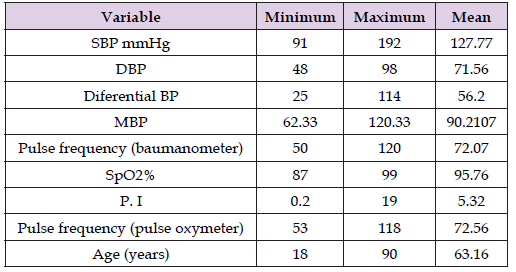
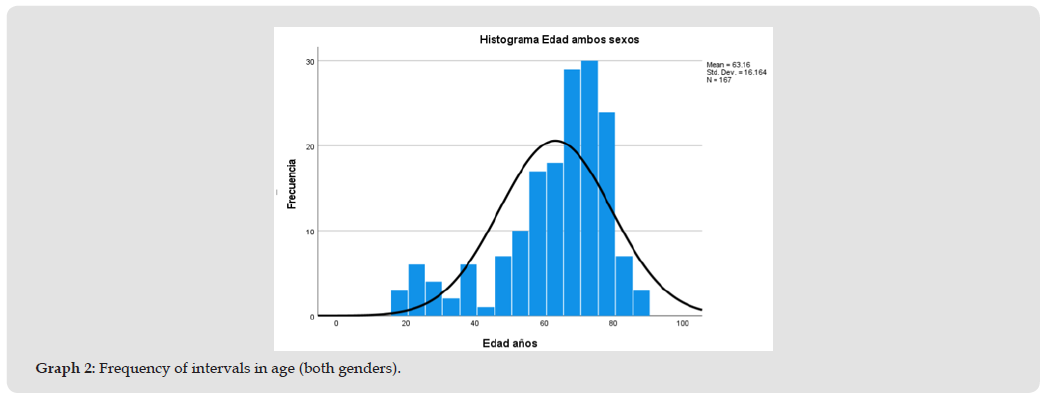
Data from 167 adult individuals (121 women [72.5%] and 46 men [27.5%]) were collected and analyzed. The mean age was 63.16 years (minimum age 18 years, maximum age 90 years). A large percentage of patients (both genders) had a PI < 5.0% (n both genders = 69/167 [41.31%]; women 49/121 [40.49%]; men 20/46 [43.47%]) versus PI > 5.1% (n both sexes = 98/167 [58.69%]; women 72/121 [59.50%]; men 26/46 [43.47%]). A PI > 5.1% was observed in women (72/167 [43.11%]) versus men (26/167 [15.52%]). Shapiro-Wilk tests for normal versus low PI values were performed for both men and women (p < 0.001) (Tables 2 & 3) (Graphs 1-7).
Table 2: Measure of central tendency and dispersion according to age.

Table 3: Study Variables.
Graph 1

Graph 2
Graph 3

Graph 4

Graph 5

Graph 6
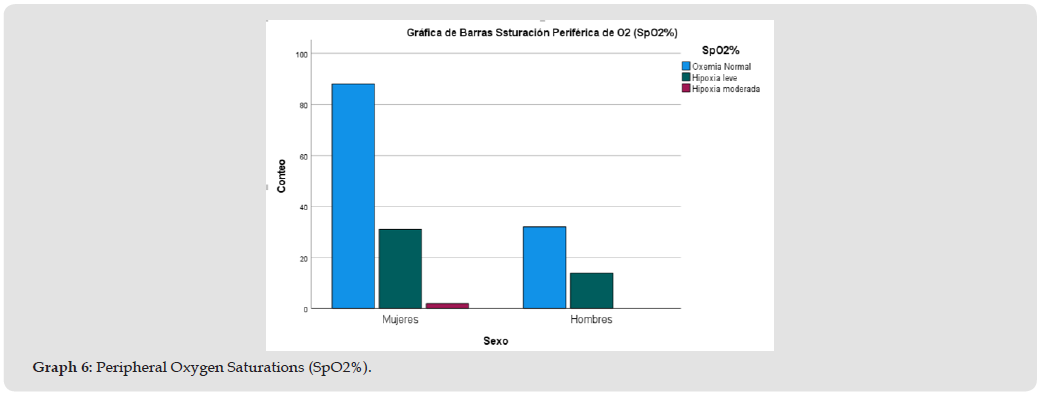
Graph 7
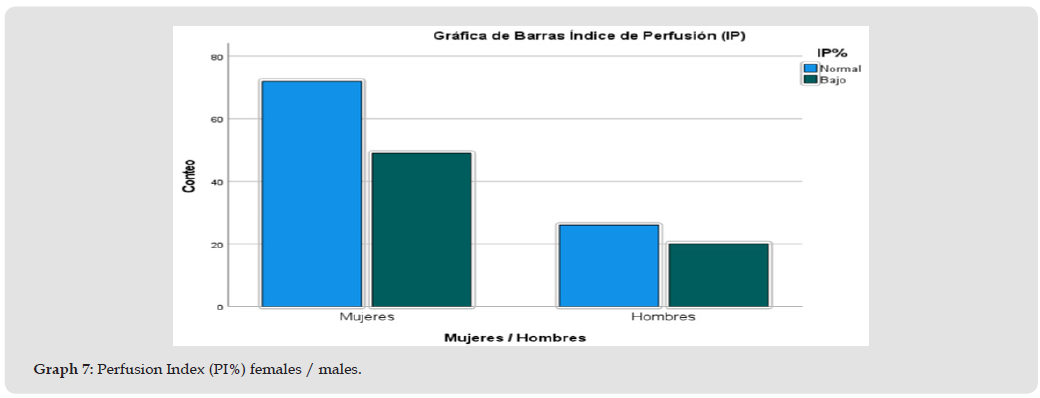
PI values lower than < 5.0% are associated with hypotension or hypertension (systolic or diastolic) and can alter the nutrition of the nerve fiber layer and the optic nerve, which could explain the occurrence of normal-tension glaucomas (NTG) and/or the progression of primary open-angle glaucomas (POAG) despite optimal control of intraocular pressure (IOP). However, further studies are needed to strengthen our results.
San Jorge Ophthalmological Group, LAE Silvia Alejandra Rivera Espinoza, and Tec. Opt. Areli Solorio for their support in carrying out this work.
Protection of People and Animals
The authors declare that the procedures followed conformed to the ethical standards of the responsible human experimentation committee and in accordance with the World Medical Association and the Declaration of Helsinki.
The authors declare that they have followed the protocols of their work center regarding the publication of patient data.
The authors have obtained informed consent from the patients and/or subjects referred to in this paper. This document is in the possession of the corresponding author.
The authors did not receive sponsorship to carry out this article.
The authors declare that they have no conflicts of interest.

International Association of Landscape Archaeology, Czech Glass Society, Czech Republic

Department of Chemistry, Semenov Institute of Chemical Physics, USSR Academy of Sciences, Moscow, Russia

Department of Educational Sciences, Research Centre Qualities of Teachers, School of Education – HAN, Nijmegen, Netherlands

Associate Professor at Department of Breast and Thyorid Surgey, Chongqing General Hospital, China

Neurology, LA BioMed Research Institute, USA





 Abstract
 PDF
PDF



























