info@biomedres.us
+1 (502) 904-2126
One Westbrook Corporate Center, Suite 300, Westchester, IL 60154, USA
Site Map
 ISSN: 2574 -1241
ISSN: 2574 -1241
ISSN: 2574 -1241
Received: December 13, 2024; Published: December 19, 2024
*Corresponding author: Faming Jiang, Faculty of Modern Agriculture, Yibin Vocational and Technical College, Engineering Center of Agricultural Biosafety Assessment and Biotechnology, School of Advanced Agricultural Sciences, Yibin Vocational and Technical College, Yibin, Sichuan 644100, People’s Republic of China
DOI: 10.26717/BJSTR.2024.60.009388
This article aimed to provide an overview of the promising potentials of essential oils derived from plants as a natural strategy based on their antioxidative properties to enhance animal productive performance and reproductive function, prevent parasite infection, reduce transport stress, hypoxia stress, and heat stress, as well as the underlying mechanism. It highlighted the potential of essential oils to improve productivity while promoting animal welfare and environmental sustainability.
Keywords: Essential Oils; Productive Performance; Reproductive Function; Stress
Abbreviations: ADG: Average Daily Gain; CRP: C-Reactive Protein; BW: Body Weight; ETEC: Enterotoxigenic Escherichia Coli; T-SOD: Total Superoxide Dismutase; TLR: Toll-Like Receptor; PEO: Peppermint Essential Oil; TTO: Tea Tree Oil; AWMA: Adult Worm’s Motility Assay; CLE: Curcuma Longa Essential Oil; HPI: Hypothalamic- Pituitary-Interrenal; LP: Lipid Peroxidation; TAN: Total Ammonia Nitrogen; CEO: Clove Essential Oil
Essential oils, volatile compounds extracted from plants, have gained significant attention in animal nutrition due to their potential to enhance animal performance and overall health [1]. These natural substances are rich in bioactive compounds such as terpenes, phenolics, and aldehydes, which exhibit versatile biological properties, such as antioxidant, antimicrobial, and anti-inflammatory effects [2]. Research has demonstrated that essential oils can improve feed efficiency, growth rates, and immune function in various animal species [3-5]. They achieve these benefits through several mechanisms, including modulating gut microbiota, enhancing nutrient absorption, and reducing oxidative stress. This article provides an overview of the growing interest in essential oils as a natural strategy based on their antioxidative properties to enhance animal productive performance and reproductive function, prevent parasite infection, reduce transport stress, hypoxia stress, and heat stress, highlighting their potential to improve productivity while promoting animal welfare and environmental sustainability.
Oxidative stress is a harmful process associated with decreased nutrient absorption and growth performance [6]. Maintaining gastrointestinal health is crucial for animal growth and production. Research has shown that dietary supplementation with essential oil including carvacrol positively impacts the gut flora, leading to improved growth performance in broilers [7]. Additionally, preincubation of intestinal epithelial cells (Caco-2 cells) with citral, cinnamaldehyde, or a combination of both compounds could attenuate LPS-induced LP and restore GSH and SOD activities [6,8]. These findings suggest that essential oils can act as growth promoters by existing beneficial effect against oxidative stress-induced gut injury in animals. Sows experience elevated systemic oxidative stress during early lactation and late gestation [9]. Weaning is a critical period in pig production that impacts the productivity commercial farms. Origanum vulgare L. (oregano) EO could significantly reduce TBARS and 8-OHdG levels in sow on day 1 of lactation [9]. By the third week of lactation, administration of this EO could enhance sow’s feed intake, resulting in a higher average daily gain (ADG) in piglets, suggesting that OEO supplementation in sows’ diet could improve piglet performance, likely due to reduce oxidative stress [9]. Supplementation with OEO and garlic (Allium sativum) powder at 0.4% yielded better ADG, higher C-reactive protein (CRP) levels, and better overall productive performance compared to the control group [10].
Additionally, dietary supplementation with a mixed EO blend, primarily consisting of cinnamaldehyde (aliphatic aldehyde, from cinnamon) and thymol (phenolic compound from oregano and thyme), increased ADG and body weight (BW), while decreasing the feed conversion ratio (F:G) in weaning piglets [11]. This improvement is associated with enhanced global antioxidative capacity and reduced systemic inflammation [11]. Further, this mixed EO blend could improve growth performance and protect gut health against Enterotoxigenic Escherichia coli (ETEC) infection in weanling pigs through modulating intestinal integrity, as evidenced by a reduction in gut permeability, an improvement in villus morphology, an enhancement in tight junction proteins expression, a modulation in oxidative stress such as increasing total superoxide dismutase (T-SOD) activities, reducing MDA levels in the serum and jejunal mucosa [11]. This EO blend also alleviated ETEC-induced inflammatory response through diminishing pro-inflammatory cytokine contents (IL-6, IL-8, TNF-α) and inhibiting the activation of toll-like receptor (TLR)4/NF-κB signaling pathway [11]. Furthermore, it modulated immune function by elevating serum immunoglobulin (Ig) M, lgG and jejunal slgA concentrations, and improved gut microbiota by increasing the abundance of beneficial bacteria (e.g., Lactobacillus) and reducing pathogenic bacteria (e.g., Proteobacteria) [11]. The effects of EOs on growth performance provide new insights into improving the health of weanling pigs.
In laying hens, treatment with 200 mg/kg of OEO significantly improved performance, egg weight, feed intake, and intestinal morphology while reducing oxidative stress [12]. Similarly, dietary supplementation with Prosopis Africana essential oils (PAOs) tended to stimulate appetite, improve digestive enzyme generation and weight gain, and reduce free radicals in broiler chickens [13]. With the rapid development of intensive aquaculture, several factors contribute to enteritis, including increased aquaculture density, pathogenic microorganism invasion, nutrient deficiencies in feed, and the aquaculture environmental deterioration, all of which impact the growth of aquaculture [14,15]. Artemisia vulgaris essential oil could effectively alleviate enteritis in zebrafish. This action might be involved in improving intestinal function and architecture including diminishing oxidative damage and histopathological lesions, repairing immune system, and regulating IL-1β, IL-10 and other gene expressions through the MyD88/TRAF6/NF-κB pathway [16]. Additionally, this EO showed greater protective action against enteritis in male zebrafish compared to females [16]. Digestive issues and stress negatively impact productivity in Nile tilapia (Oreochromis niloticus) [17]. Peppermint essential oil (PEO) in the diet could improve feed intake, weight gain, and feed conversion by increasing SOD and CAT activities, while reducing MDA and NO production in the liver of juvenile Nile tilapia [17].
The findings clarify the benefits of EOs on health and growth in aquaculture, providing an advantageous theoretical foundation for delving into the feasibility of using EO as a replacement for feed antibiotics. The effects of OEs on productive performance were listed in Table 1.
Table 1: Essential oils plant name and their antioxidative effects on productive performance.

Note: AWMA, adult worm’s motility assays; b. w., body weight.
Table 2: Essential oils plant name and their antioxidative effects on parasite infection and stress.
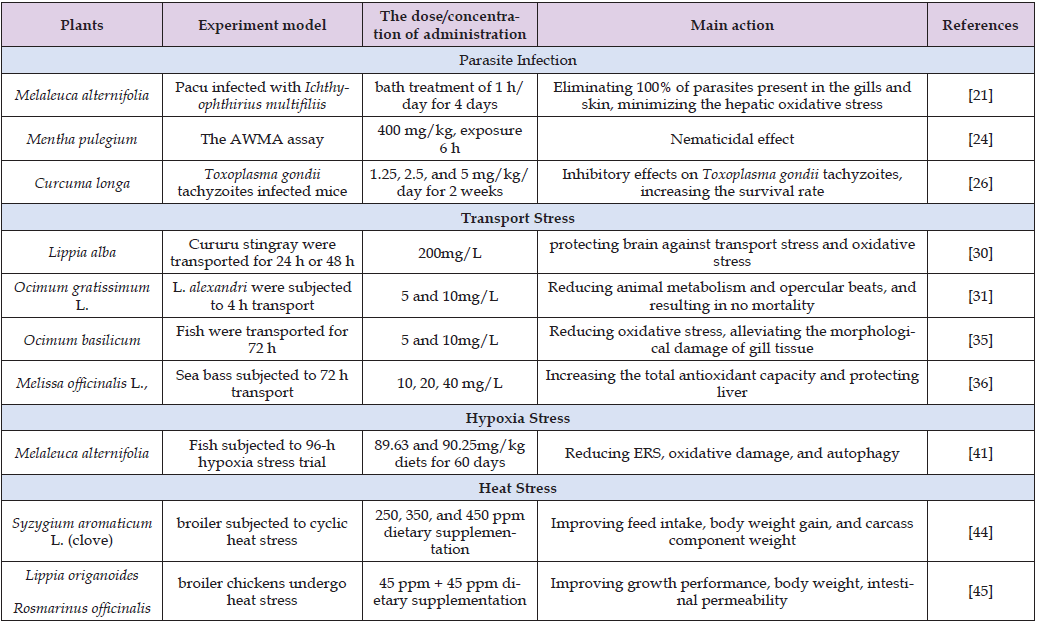
Note: ERS, endoplasmic reticulum stress; ppm, parts per million.
Animal experiments have shown the positive effects of EOs on protecting reproductive function in both male and female models (Table 1). Animal experiments have shown the positive effects of EOs on protecting reproductive function in both male and female models. In normal male rats, Satureja Khuzestanica essential oil (SKEO) SKEO has demonstrated an obvious elevation in serum testosterone level, spermatozoa, and Leydig cells [18]. Furthermore, pre-treatment with this EO played an important role in diminishing genotoxicity, cytotoxicity, apoptosis and oxidative stress in sperm and testes, indicated by increased activities of SOD and GPx, along with significantly decreased TBA and LDH levels in the G4 compared with the G3 and G2, via the regulation of Bcl-2 family gene expressions in busulfan-treated genotoxicity mice [18]. In addition, prescribing Satureja khozestanica essential oil protected oocytes maturity against nanophenol. It presented its androgenic and antioxidative benefits, resulting in an obvious elevated number and quality of oocytes, thus preventing reproductive toxicity and significantly increasing the fertilization rate in nonophenol-treated female mice models [19]. It could be concluded that the beneficial properties of EOs, whether used as pretreatment or co-treatment, may prevent reproductive damage.
Ichthyophthirius multifiliis is a widespread holotrichous obligate parasite that causes ichthyophthiriasis or “white spot disease”, a major parasitic disease affecting freshwater fish species [20]. During Ichthyophthirius multifiliis infection, oxidative stress is one of the underlying mechanisms involved in the onset and development of liver damage [21]. EO from Melaleuca alternifolia, usually well-known as tea tree oil (TTO) has proven effective in eliminating all I. multifiliis existing in the skin and gills of Pacu following a TTO bath treatment for one hour per day over four days [21]. Furthermore, TTO offered a therapeutic alternative for silver catfish during I. multifiliis infection, helping to avoid or minimize hepatic oxidative stress. It was indicated by the reduction of trophonts on the skin, decreased protein carbonylation content and hepatic TBARS, along with an enhanced antioxidant system and preservation of hepatocytes morphology in infected fish [21]. Furthermore, the research results explored that TTO could be a new method for preventing or treating liver injury in fish infected by bacteria, including Aeromonas hydrophila [22] and Pseudomonas aeruginosa [23]. Mentha pulegium essential oil has shown its antioxidant potential by total antioxidant capacity, DPPH quenching effect, ABTS activity, and FRAP effect in vitro [24]. In the adult worm’s motility assay (AWMA), worms exposured to M. pulegium EO showed paralysis after six hours [24].
Regarding in vivo studies, this essential oil presented a nematicidal through elevating endogenous antioxidant activities (GPx, CAT, SOD), thus reducing morpchological damages during Haemonchus. contortus. polygyrus infection in a rodent model [24]. Toxoplasmosis affects human and warm-blooded animal infected with the Toxoplasma gondii parasite [25]. Curcuma longa essential oil (CLE) demonstrated an inhibitory effect on Toxoplasma gondii tachyzoites, evidenced by an elevated survival, apoptosis, NO level, activity of antioxidant enzymes and proinflammatory cytokines, and a reduced mean number of peritoneal tachyzoites [26]. CLE also decreased hepatic oxidative stress markers without significant toxicity to vital organs in infected mice [26]. The findings reveal the significant in vivo and vitro inhibitory effects of EOs on parasite infections, improving survival rate and minimizing hepatic oxidative stress. The protective effects of OEs on parasite infection were listed in Table 2.
Transport Stress
Transport is considered a stressful situation. Transporting live fish plays an important role in the aquaculture supply chain and commonly involves placing fish in bags or containers, which can cause metabolic disorder, mechanical damage, and elevated mortality, resulting in a significant economic loss for the aquaculture industry [27]. Transport could stimulate the hypothalamic-pituitary-interrenal (HPI) axis, activating catecholamines releasing into the bloodstream, and causing changes in blood components [28,29]. Moreover, transport stress leads to elevated lactate levels in the brain and plasma upon arrival and triggers GSH oxidation and lipid peroxidation (LP), as indicated by increased levels of H2O2 and superoxide anion (O2 •-), elevated HSP70 levels, and decreased activities of GR, GPx 1, CAT, SOD 1 and SOD 2 in the brain though the activation of NF-κB [30]. Juveniles transported with Ocimum gratissimum L. essential oil (EOOG) appeared to reduce metabolism, opercular beats, hemoglobin levels, blood AST, Glu, lipid and protein oxidation concentrations in tissues [31]. This ensured lower ammonia and higher dissolved oxygen levels, prevented LP and the formation of carbonyl protein, and resulted in no mortality 24 hours after transport [31]. The essential oil extracted from basil (Ocimum gratissimum L.) (EOOG) presented various chemotypes (geraniol, thymol, eugenol) and had promise as an anesthetic in fish [32,33]. During transport, an increased GST in the brain and liver of fish treated with EOOG appeared its efficiency in mitigating stress [34].
It has been recommended to add essential oils into transport water as a good method to reduce stress. Treatment with EO from Lippia alba, principally the linalool chemotype, protected the brain against transportation and oxidative stress upon arrival, as evidenced by reduced levels of HSP70, lactate, H2O2 and O2 •-, activation of NF-κB, elevated GR, GPx1, CAT, and SOD, reduced oxidized GSH ratio, and regulated physiological responses to stress, thus avoiding the elevation of TBARS in the brain [30]. It was found that adding Ocimum basilicum EO to transport water resulted in a decrease in water pH, dissolved oxygen (DO), and total ammonia nitrogen (TAN) levels, as well as reductions in serum GLU and cortisol (COR), and liver GPX, MDA, CAT, and SOD levels [35]. It also increased serum LDH, AST, and ALT, muscle total free amino acid (TFAA) levels, and alleviated morphological damage to gill tissue [35]. Melissa officinalis L., treatment decreased levels of cortisol, urea nitrogen (BUN), UA, GSH-Px, MPO, CAT, HSPs, lactic acid (LD), and Glu in live fish after 72 hours transport, and increased total antioxidant capacity (T-AOC) [36]. These findings indicate appropriate addition of EOs to transport water is helpful to improve water quality, relieve stress, lower energy metabolism, reduce oxidative damage, and improve survival rate even for long-term transport, thus decreasing economic losses in the fishery industry.
Hypoxia Stress
Intensive aquaculture tends to increase the risk of hypoxia for fish, causing reduced quantity and quality of fish. Hypoxia stress will induce gill ROS overexpression, leading to autophagy, endoplasmic reticulum stress (ERS), apoptosis, and oxidative stress [37-39]. Baldissera, et al. [21] showed that TTO, obtained from Melaleuca alternifolia, could ameliorate silver catfish (Rhamdia quelen)’s antioxidative ability [40]. Hu et al. [41] elaborated on TTO’s protective effects against hypoxia stress in grass carp (Ctenopharyngodon idellu), as reflected in mending serum biomarkers (lactic acid, lactic dehydrogenase, Glu, and cortisol) and suppressing apoptosis [41]. This suppression is likely related to the hypoxia-inducible factor (HIF)/Bcl-2/adenovirus E1B 19-kDa interacting protein (BNIP3) pathway, as evidenced by decreased LC3-II protein and ATG gene expressions, reducing oxidative damage to the gills, relieved gill ERS by reducing glucose-regulated protein 78 (GRP78) protein expression and stimulating the related signaling cascade reaction, thereby improving the structural integrity of the gills [41]. Thus, EOs are capable of mitigating hypoxia stress-induced damage, and the possible mechanism may involve reducing ERS, oxidative damage, and autophagy in fish.
Heat Stress
Animals under heat stress exhibit simultaneously metabolic alterations and oxidative/nitrosative stress, causing further cellular damage and negatively influencing their performance, growth and production [42-44]. Heat stress is an inevitable challenge for the poultry industry, particularly in tropical and subtropical countries, due to the global increase in environmental temperature. Treatments with orange peel EO in Japanese quails exposed to acute heat stress indicated that supplementation could decrease MDA level and prevent tissues from lipid peroxidation [43]. Clove essential oil (CEO) contributed to the normalization of oxidative/nitrosative biomarkers, significantly improving body weight gain, feed intake, and carcass component weight in broiler subjected to cyclic heat stress [44]. In addition, in broiler chickens under heat stress, EOs from Rosmarinus officinalis, Lippia origanoides, and natural betaine or either beetroot in diet improved intestinal permeability, body weight, growth performance, antioxidative and anti-inflammatory activities [45]. These findings indicate that supplementing natural EOs as antioxidants could mitigate heat stress. The effects of OEs on transport stress, hypoxia stress and heat stress were listed in Table 2.
Essential oils have shown their promising potentials on enhancing animal productive performance and reproductive function, preventing parasite infection, reducing transport stress, hypoxia stress, and heat stress, due to their remarkable antioxidative properties. Future studies should focus on understanding the specific mechanisms through which different essential oils exert their effects, as well as the optimal dosages and combinations for various animal species and production systems. Additionally, long-term research is necessary for assessing the sustainability and economic viability of incorporating essential oils into animal diets on a larger scale. Further research should also explore the potential interactions between essential oils and other dietary components to optimize their efficacy.
This work was supported by Yibin Vocational and Technical College, Initial funding for doctor (ybzysc23bk01), Natural Science Funds of Yibin Vocational and Technical College (ZRYB24-03 & ZRYB24-05), Research Project from Key Laboratory of Sichuan Province for Bamboo Pests Control and Resource Development (ZLKF202302), Professional Committee for the Integration of Industry and Education in Chinese Society for Educational Development Strategy (CJRHZWH2024-87).

International Association of Landscape Archaeology, Czech Glass Society, Czech Republic

Department of Chemistry, Semenov Institute of Chemical Physics, USSR Academy of Sciences, Moscow, Russia

Department of Educational Sciences, Research Centre Qualities of Teachers, School of Education – HAN, Nijmegen, Netherlands

Associate Professor at Department of Breast and Thyorid Surgey, Chongqing General Hospital, China

Neurology, LA BioMed Research Institute, USA





 Abstract
 PDF
PDF



























