info@biomedres.us
+1 (502) 904-2126
One Westbrook Corporate Center, Suite 300, Westchester, IL 60154, USA
Site Map
 ISSN: 2574 -1241
ISSN: 2574 -1241
ISSN: 2574 -1241
Received: November 18, 2024; Published: November 27, 2024
*Corresponding author: Oyedeji OE, Department of obstetrics and gynecology, Ladoke Akintola University of Technology, Ogbomoso, Nigeria
DOI: 10.26717/BJSTR.2024.59.009337
Introduction: According to global estimates from 2010-2014, 45% of all induced abortions are unsafe. Onethird
of all unsafe abortions are performed by untrained individuals using dangerous and invasive methods with
attendant complications. This case is reported due to the unusual presentation of intestinal injury, prolapse of
the bowel through the cervix from a perforating wound through the fundus, and extensive bowel resection.
Case Summary: A case of unsafe abortion complicated by uterine perforation, with injury to the small bowel is
presented. The patient presented with small bowel protrusion through the cervix via a perforation in the fundus
of the uterus. She had exploratory laparotomy with uterine repair, partial jejuno-ileal resection with end-to-end
anastomosis.
Outcome: The patient was managed successfully.
Conclusion: Comprehensive abortion care, which includes information provision, abortion management, and
post-abortion care, is a safe, simple health-care intervention alongside a non-restrictive abortion law that is
needed to prevent an unsafe abortion.
Keywords: Unsafe Abortion; Abortion Mortality; Induced Abortion; Complicated Abortion; Abortion Morbidity; Acute Abdomen; Uterine Perforation
Every year, around 73 million induced abortions occur throughout the world. Six out of ten (61%) undesired pregnancies and three out of ten (29%) pregnancies end in an induced abortion [1]. Global estimates from 2010 to 2014 show that 45% of induced abortions are dangerous. One-third of all unsafe abortions were conducted in the least safe conditions, i.e. by untrained individuals utilising harmful and invasive techniques. More than half of all unsafe abortions happened in Asia, with the majority taking place in South and Central Asia. In Latin America and Africa, almost three out of every four abortions were unsafe. In Africa, over half of all abortions took place under the least safe conditions [2]. In Africa, 99% of abortions are unsafe resulting in one maternal death per 150 cases. The prevalence of unsafe abortion is associated with restricted abortion law, poor quality of health service, and low community awareness [3]. Only when a woman’s life is in danger can an induced abortion be performed legally in Nigeria. However, abortion is widespread. According to a recent Performance Monitoring for Action PMA research, 4.6% of women who are of reproductive age have an abortion annually, which equates to around 2 million abortions [4,5]. A majority of these abortions are considered unsafe. Such unsafe procedures contribute to 10% of maternal deaths, equivalent to approximately 6,000 women dying each year [6]. Unsafe abortion is defined as the termination of an unwanted pregnancy either by persons lacking the necessary skills in an environment lacking minimal medical standards, or both [7].
Abortion-related complications and death are usually preventable, but in an environment where restrictive abortion laws exist, overt complications such as uterine perforation with haemorrhage, bowel injury with gangrene, and tetanus infection are common [8]. An unusual presentation of ileojejunal protrusion through the cervix via a perforating wound on the uterine fundus following unsafe abortion and the resultant extensive bowel resection is to be reported.
A 24-year-old undergraduate P0+3 presented at gynaecological emergency unit of the LAUTECH teaching hospital, Ogbomoso following a period of amenorrhea of 17 weeks with presumptive pregnancy symptoms which was confirmed by a positive urine pregnancy test and by a pelvic scan which was said to have revealed a singleton intrauterine gestation at? estimated gestational age. Bleeding per vaginam started about a month before presentation following 13 weeks history of amenorrhea after ingestion of some medications procured at a chemist shop to terminate the pregnancy. Bleeding was bright red, profuse, with passage of clot and fleshy material. No passage of vesicles per vaginam. Following the bleeding, she presented to the nearby private hospital where she was offered dilatation and curettage on two occasions. However, bleeding persisted for about a month, with associated purulent vaginal discharge. Abdominal pain started 5 hours following the last dilation and curettage procedure, sudden in onset, sharp and later became colicky in nature, mild initially and localized to the suprapubic region, but later became generalized and worsened in severity, with no known relieving factor. There was progressive abdominal swelling, had about 6 episodes of vomiting with constipation. Following all these, she was taken to another private hospital where she was referred to our facility. On examination she was acutely ill looking, febrile (38.8 0C), pale, mildly dehydrated. Pulse rate and blood pressure were normal. The abdomen was distended with marked fullness in the lower abdomen.
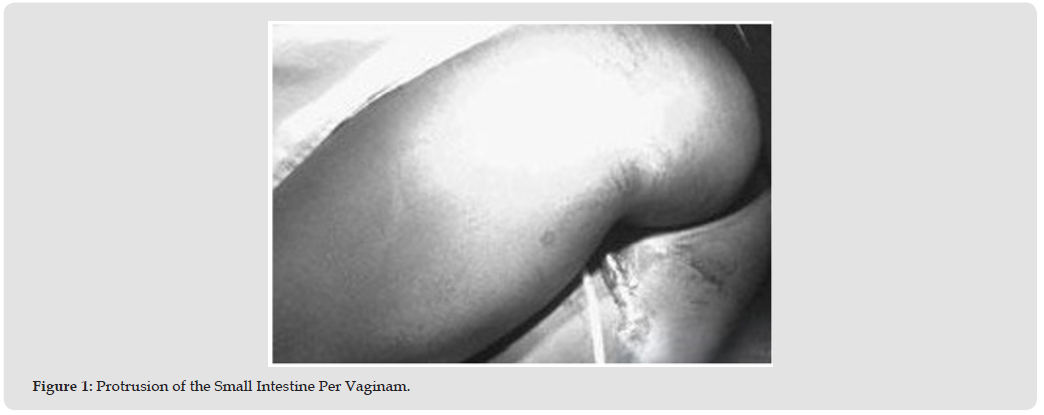
It did not move with respiration. There was generalized tenderness, with guarding and rebound tenderness, which prevented palpation of intra-abdominal organs. Bowel sounds were absent. The vulva and vagina were smeared with dark foul-smelling discharge. The cervix appeared hyperemic with intestine-like viscus protruding through the cervical os into the vaginal. (Figure 1) The pouch of Douglas was full. Finding on rectal examination were not remarkable.
Figure 1
Management
She was admitted into the emergency ward on nil per oris. Nasogastric tube was passed. She was rehydrated. An abdominopelvic scan done revealed a bulky uterus with coarse myometrial echoes and irregular ill-defined endometrial plate. There was echogenic structure extending through the posterior uterine wall into the uterine cavity through the cervical os. Cervix was about 3.5cm dilated. Hyperechoic fluid was present in the pouch of Douglas. A conclusion of pelvic collection and uterine perforation with herniation of intestinal loop. Chest x-ray (PA) revealed a normal finding and Abdominal x-ray (erect and supine) revealed a ground-glass appearance in the upper half of the abdomen. This was associated with multiple air fluid levels, relative gas lessness within the rectum. Electrolyte, urea and creatinine values were within normal limits. Packed cell volume was 33%. High vaginal swab yielded profuse growth of coliforms sensitive to Unasyn, Cefuroxime, Ceftriaxone and Ciprofloxacin. Intravenous ceftriaxone/ sulbactam 1.5g 12 hourly and metronidazole 500mg every 8 hours were commenced, intramuscular 0.5ml of tetanus toxoid and 1500 IU of anti-tetanus sera were also administered subcutaneously. Two units of blood were crossmatched for her A written informed consent was obtained and the patient had an exploratory laparotomy, resection of gangrenous bowel, jejuno-ileal anastomosis, and repair of uterine perforation with peritoneal lavage under general anaesthesia after stabilization on 11th November 2023 (9:05am).
Intra-operative findings were uterus was bulky and covered with thick fibrinous exudates posteriorly, a complete posterior uterine wall perforation about 4cm by 5cm with bowel loop herniating through it, about 30cm of small bowel (gangrenous) trapped in the perforated uterus. Append [9] with faecolith adhered to the old area of posterior uterine wall perforation. Haemoperitoneum about 200mls. Other abdominal organs were normal.
Procedure
The uterus was delivered into the wound following peritoneal entry, the trapped bowel was released, peritoneal contamination was prevented and the gut packed out of the operating field and inspected carefully. The portion of the bowel were identified and a non-crushing intestinal clamp applied on the healthy part, with the gangrenous portion resected. End-to-end anastomosis was done in two layers with Vicryl 2/0. The pelvic hemoperitoneum was suctioned. The uterine perforation was identified and rough edges were freshened, repaired in 2 layers with interrupted Vicryl size 2 sutures. The abdominal cavity was lavaged copiously with warm normal saline and was suctioned. A drain was placed in the Douglas’s pouch The abdominal wound was closed back in layers with interrupted nylon to the rectus sheath and skin. Her post-operative period was uneventful and was discharged on post-operative day 8 with an appointment at the gynaecology outpatient clinic in 1 week. At presentation at the clinic the abdominal wound had healed well, no abdominal or pelvic collection was demonstrable. She was thereafter followed up in the clinic and referred to the family planning clinic for contraception.
She had an unsafe abortion, which led to uterine perforation, bowel injury and pelvic hematoma collection. Unsafe abortion is the procedure of termination of an unwanted pregnancy by an individual lacking the minimum skill or in a place lacking the minimum medical requirement or both [9]. It remains a major cause of maternal morbidity and or mortality in developing countries like ours [9]. This problem not only poses a high cost in the treatment of the acute symptoms but is also responsible for long-term complications such as pelvic inflammatory disease, damage to the reproductive organs, and or secondary infertility [10,11]. According to estimates by the World Health Organization (WHO), approximately 1.25 million induced abortions occur annually in Nigeria, and a significant proportion of these are unsafe [11]. The case presented was among the estimated 5 million women who are hospitalized each year on account of abortion-related complications like sepsis and haemorrhage [9,11]. Unsafe abortion and its attendant complications are common in adolescents with no knowledge of contraception [12]. Other studies have however shown that grand multipara belonging to the low socioeconomic group and do not use contraception, as the most affected group [13]. The history of abortion in a place lacking the minimum requirement and by a person lacking minimum skill, with subsequent development of fever, bowel perforation, passage of bowel loop per vaginam and the aspiration of frank blood/pus on culdocentesis all pointed to hemoperitoneum/ pelvic abscess complicating the induced abortion as seen in in the case presented [14].
Other clinical features of constipation, lower abdominal pain with generalized tenderness all buttressed the diagnosis [14,15]. Chest and abdominal radiographs were used to rule out attendant bowel perforation which is also a common complication [16]. The goal of treatment is to halt progression of the disease process, so as to reduce morbidity and prevent mortality [9]. The case was adequately resuscitated and had broad spectrum antibiotics. Surgical intervention in the form of exploratory laparotomy was instituted due to presence of haemoperitoneum, passage of bowel loop per vaginam and perforation of the uterus [9]. It also afforded opportunity to explore the abdomen to localize any form of other injury not obvious from the investigations. Ultrasound guided abscess drainage, posterior colpotomy can be offered to women who are not physically fit for extensive surgery in patient with pelvic abscess with no bowel injury [9,11].
Prevention of unwanted pregnancy by improving on the existing contraceptive prevalence and awareness and providing safe abortion practices with liberalization of abortion law in this sub-region will go a long way in reducing morbidity and mortality associated with unsafe abortion.
No financial conflict of interest. I have no affiliation to any drug or pharmaceutical company.

International Association of Landscape Archaeology, Czech Glass Society, Czech Republic

Department of Chemistry, Semenov Institute of Chemical Physics, USSR Academy of Sciences, Moscow, Russia

Associate Professor at Department of Breast and Thyorid Surgey, Chongqing General Hospital, China

Professor of Nuclear Medicine, Faculty of Medicine and Surgery, University of Milan, Milan, Italy

Department of Pharmaceutical Sciences, South University School of Pharmacy, USA





 Abstract
 PDF
PDF



























