info@biomedres.us
+1 (502) 904-2126
One Westbrook Corporate Center, Suite 300, Westchester, IL 60154, USA
Site Map
 ISSN: 2574 -1241
ISSN: 2574 -1241
ISSN: 2574 -1241
Received: November 15, 2024; Published: November 25, 2024
*Corresponding author: Anwarul Islam, Clinical Associate Professor of Medicine, State University at New York at Buffalo, Attending Physician, Division of Hematology/Oncology, Department of Medicine, Buffalo General Medical Center, Buffalo, New York 14203, USA
DOI: 10.26717/BJSTR.2024.59.009328
We describe a biopsy needle to obtain solid cylindrical biopsy specimens from an abdominal fat pad for the investigation and diagnosis of amyloidosis. The abdominal fat pad biopsy is widely accepted for establishing or confirming the diagnosis of patients with systemic amyloidosis. However, unlike conventional biopsy where a solid tissue sample is obtained, in this case the tissue is obtained by multiple aspirations of the fat pad with a 10 or 20-ml syringe attached to a 16 or 18-gauge needle. Such fine needle aspiration biopsy of fat pad can be quite unsatisfactory, particularly with regard to the quality and quantity of the samples collected.
Keywords: Abdominal Fat Pad Biopsy; Amyloidosis; Histology; Congo Red Stain
Minimally invasive surgical techniques such as needle aspiration are the most common method of taking abdominal wall fat pad biopsy. Conventionally the skin on the lower quadrant area of the abdomen lateral to the midline and below the umbilicus is chosen. A rhomboid shaped area is marked, and the skin is cleaned and numbed with local anesthetic [1]. Following this a 16 or 18G needle attached to a 10- or 20-ml syringe is passed through the skin and into the fat pad under the skin and aspiration is performed. This process is usually repeated multiple times and at different angles to obtain enough materials for cell block preparation of aspirated materials and Congo red stain. The fat pad aspiration biopsy is simple, inexpensive, non-invasive, and the preferred screening test for amyloidosis [2]. However, studies indicate that fat pad aspiration by needle does not yield enough tissue for evaluation in some cases [3]. Furthermore, the sensitivity of this test depends on several factors, including the extent of organ involvement, operator skill, amount of fat tissue obtained and submitted for microscopic evaluation [4]. The technique is cumbersome and harvesting aspirated fat tissue for the preparation of tissue block can be time-consuming and unlike punch biopsy, no stitch with suture to close the wound is required. We describe a practical, and effective method of sampling a sufficient amount of abdominal fat pad using a new core retention biopsy needle. This needle was originally designed for obtaining bone marrow trephine (core) biopsy specimens [5] but it can also be used for obtaining abdominal fat pad and other soft tissue biopsies and can be done at an outpatient clinic and requires no technical expertise.
The Needle (Figure 1) Consists of Five Parts:
The needle (Figure 1A) which has an overall length of 100 mm, a uniform external diameter of 3.25 mm, and a constant internal diameter of 2.5 mm except for the 3.5 mm distal portion where it is narrowed and has multiple surface serrations/flutes (Figure 2). The terminus of the needle has six sharp cutting facets (Figure 2). The internal diameter of the needle’s distal portion is less than the overall internal diameter of the needle and begins with a short, slanted step of 0.2 mm (Figure 3). This specially designed distal portion (Figures 2 & 3) not only cuts the tissue cleanly and retains the biopsy specimen captured within the lumen of the needle so that it does not slip out of the needle during the process of its withdrawal. The larger internal diameter of the needle at its proximal segment provides free space (Figures 3 & 4) within the interior of the instrument thus avoiding crushing and compression of the tissue as well as plugging the lumen of the needle. It also facilitates easy delivery of the biopsy sample through the proximal end of the needle.
The stiletto (Figure 1B) is a solid steel shaft of 2.0 mm in diameter. It ends with a 3.0 mm long three-faceted, sharply pointed tip (Figure 4 arrow) which projects beyond the cutting edge of the needle. It provides a means of easy penetration of the skin. The proximal end of the stiletto is fitted with a round knurled plastic knob (head) (Figure 1C) which fits into the proximal (top) end of the needle. The large white plastic cap (Figure 1D) fits over and covers the top of the plastic T-bar handle (Figure 1E). It also fits snugly in the palm of the operator’s hand and fosters comfortable manipulation during the biopsy procedure. It is not necessary to use the cap if an operator feels comfortable without it. The insertion aid (Figure 1F) is a tubular segment of plastic 30 mm long and 5 mm wide except at the end that fits the mouth of the needle where it is flat and 10 mm in diameter. It is centrally hollowed out to receive and permit the passage of the pusher during the removal of the biopsy specimen through the proximal end of the needle. The pusher (Figure 1G) is a solid steel rod of 2.0 mm in diameter attached to a knurled, flat plastic disk. The pusher rod is used to expel the biopsy specimen from within the lumen of the biopsy needle with the help of the insertion aid which guides the pusher rod into the mouth needle.
Figure 1

Figure 2
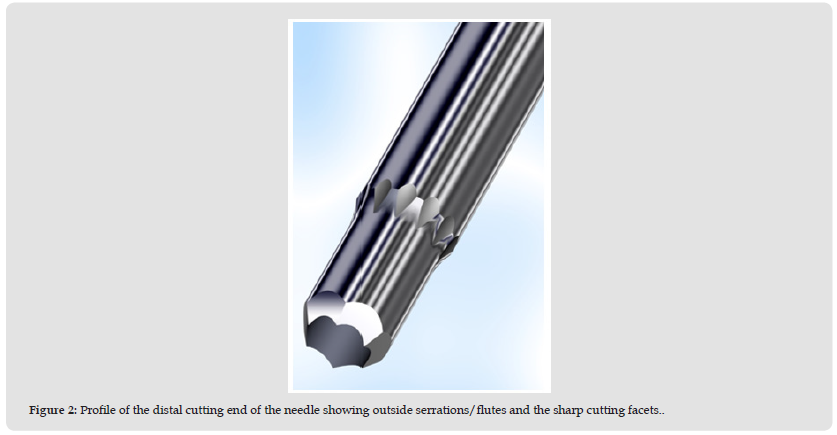
Figure 3
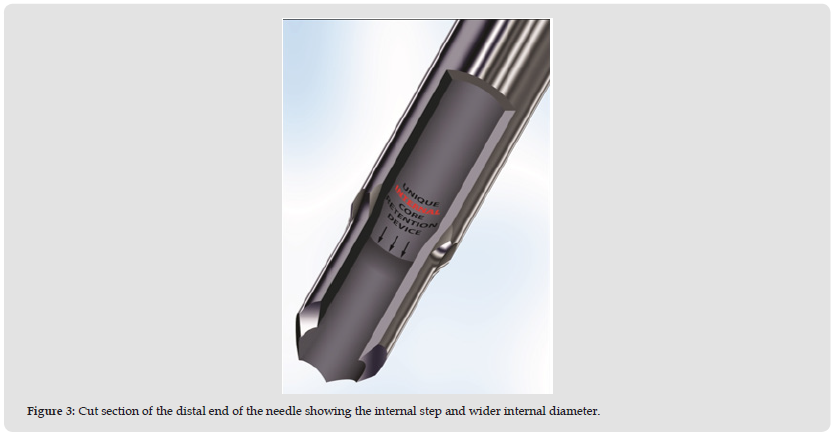
Figure 4

The skin over the predetermined site around the umbilicus (as stated earlier) should be cleaned with alcohol swabs or the skin cleansing agent preferred by a particular institution. Following this the dermis at the biopsy site and the superficial layers of adipose tissue immediately below the skin is infiltrated with a local anesthetic (1 or 2% lidocaine) and the area is surgically draped. Following local anesthesia: the skin over the biopsy site is grasped by the thumb and index finger of one hand while holding the needle with the other hand (Figure 5). The needle with the trocar in place is then introduced through the skin and once the skin is penetrated the trocar is withdrawn. The biopsy needle is then advanced into the fat pad with slow, steady and controlled clockwise-counter-clockwise rotary motions until an adequate length is reached (about 20-25 mm). The needle is then pulled back by a few millimetres, direct its tip at a slightly different angle and then advanced (forward) a few millimetres further. The needle is then rotated completely several times to cut the base of the core completely before it is withdrawn with a straight pull accompanied by gentle alternating rotary motion. This maneuver makes it possible to sever/cut the base of the core and help capture the severed biopsy specimen within the lumen of the needle. Once the needle is completely withdrawn, the insertion aid is attached to the distal cutting end (mouth) of the needle (Figure 6). The biopsy specimen is then gently pushed out of the needle with the pusher rod, which is introduced through the opposite end of the insertion aid (Figure 7). If the skin needs to be included in the biopsy specimen, then the needle can be used without the trocar in place. The biopsy site can be closed with a band-aid or a gauge dressing.
Figure 5
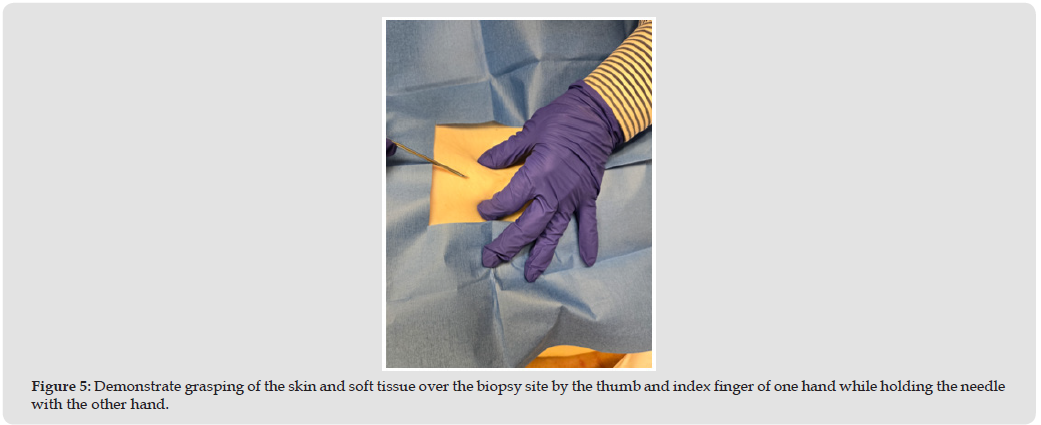
Figure 6

Figure 7

The needle has been tested on multiple cadavers, obtaining at least 3-4 samples from each cadaver. The sites used for obtaining the fat pad samples were the lower quadrant area of the abdomen lateral to the midline and below the umbilicus. Adequate samples (although the length of the samples varied) were obtained at each attempt (Figure 8).
Figure 8

Amyloidosis is a heterogeneous group of diseases that share the deposition of amyloid fibrils in organs such as the heart, liver, and kidneys. Historically, these organs are biopsied to demonstrate amyloid deposits, but the associated risks of these biopsies are considerable for the diagnostic yield [1] and can be prohibitory. Fat pad aspiration biopsies are less expensive, can be performed with minimal morbidity, and have been shown to provide a reliable and non-invasive method for the detection of amyloid in systemic amyloidosis [1]. But unlike conventional solid tissue biopsies where the structure of the tissue is well preserved, these biopsies contain unorganized dispersed fat tissue and do not always provide sufficient materials containing amyloid deposits to establish or confirm a diagnosis. In addition, during anterior fat pad aspiration, the cohesive fibroadipose tissue does not aspirate well with finer needles [1]. Furthermore, patients presenting in an early stage of amyloidosis may have minimal amounts of amyloid which greatly reduces the sensitivity of Congo red stained cell block sections of fat pad aspirates [1]. Therefore, a solid core fat pad biopsy with a biopsy needle may be desirable given its increased volume of tissue obtained, histologically well-preserved fat tissue structure and possible increased sensitivity for amyloid detection. This article describes one such needle that can be utilized to obtain a solid, usually cylindrical core of fat pad biopsy specimen for light microscopic evaluation of Congo red staining. The needle described here has an internal core retention device that helps in capturing the biopsy specimen. Fat tissue being soft in consistency, a fat pad biopsy with this needle may not always provide a cylindrical core but a mass of fat tissue is obtained which is still better than the amount fat tissue obtained by fine needle aspiration biopsy. If necessary, this needle can also be used to obtain multiple samples from different areas through the same puncture wound by pointing the needle in a different direction.

International Association of Landscape Archaeology, Czech Glass Society, Czech Republic

Department of Chemistry, Semenov Institute of Chemical Physics, USSR Academy of Sciences, Moscow, Russia

Department of Educational Sciences, Research Centre Qualities of Teachers, School of Education – HAN, Nijmegen, Netherlands

Associate Professor at Department of Breast and Thyorid Surgey, Chongqing General Hospital, China

Neurology, LA BioMed Research Institute, USA





 Abstract
 PDF
PDF



























