info@biomedres.us
+1 (502) 904-2126
One Westbrook Corporate Center, Suite 300, Westchester, IL 60154, USA
Site Map
 ISSN: 2574 -1241
ISSN: 2574 -1241
ISSN: 2574 -1241
Received: November 04, 2024; Published: November 15, 2024
*Corresponding author: Saurabh Shanu, School of Computer Science, UPES, Dehradun 248007, Uttarakhand, India
DOI: 10.26717/BJSTR.2024.59.009311
The work of designing wildlife corridors for any focal species is quite complex and scientific (Hilty, et al. [1]). It incorporates a vast array of elements and components. Additionally, the approach does not ensure that the species would disperse in the designated direction; rather, it also depends on a variety of internal factors. These internal factors may be the cause of the focal species’ dispersal from one habitat patch to another (TJB, et al. [2]). The concepts covered in this proposed model centre on the use of computational methods, artificial intelligence and GIS data to gather information of the landscape and identify a set of paths that may serve as possible wildlife corridors in a landscape (Shanu [3]). The first objective is to identify the crucial factors that influence how species disperse. Recently many researchers working in the said area have done ample work using a variety of tools, including literature reviews, field reports, GIS, and remote sensing (Shanu, et al. [4]). Equation (i) shows how a factor set “” is created using “” different detected factors. The opinion proposed in this work assesses the spatial-temporal dependence of the focal species on these parameters for dispersal.

The opinion suggests using machine intelligence’s computational methods to study the interactions amongst the parameters and with the focal species. To do this, a cost surface over the focal landscape is developed using a mathematical framework. A cost matrix “”, representing the cost incurred by the focal species when dispersing across each grid of the landscape matrix, is computed to lay a cost surface on the landscape (Shanu [5]). Equation (ii) shows how the cost of each grid would be calculated depending on how much each factor in the grid is present or absent.

here, αi indicates the coefficient of factor Fi and ai represents the order of factor in the equation, where Cij is the value of the ith and jth column of matrix “”. The operation that must be performed within the equation’s constituent parts is denoted by. The equation has to have several different components identified, and the suggested approach makes use of training datasets to do this (Uijlings, et al. [6]). Previous datasets from survey reports, studies of species abundance, studies of species dispersion, GIS datasets, maps from species reports, etc. would be included in these training datasets. After utilising the training dataset to train the model, Algorithm 1 of dependency existence will be used to determine whether or not species dispersion depends on the parameter, and if so, how much.
Algorithm Dependency_Exist ( )
//Input: (i) Set of factors “P”
(ii) training dataset
//Output: Coefficients to evaluate grid cost
Declaration Section
n, i, p, q, count, z as integer
T, L, Pi as double
Procedure Section
n = |P|
For i = 0 to n
If change in Pi changes Cpq //Cpq is the focal grid cost
“Dependency exists”
Else
Func_recheck (Pi)
End If
Result Section:
Dependency coefficients αi found.
Func_recheck (T)
Do while (δT = δL)
δT = δL
δL = Ti+1 - Ti //calculates error
count = count + 1 // no. of iterations
Loop
z = count //z is no. of iterations when error repeats
Output: The constant error gives level of dependency of species dispersal on the parameters
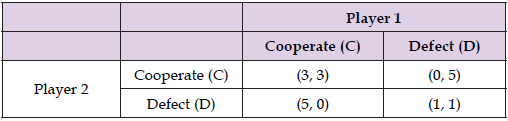
Understanding the degree of dependence provides insight into the coefficients of each parameter in the equation (ii). After obtaining the coefficients, a 2-person game of the prisoner’s dilemma would be modelled to determine the parameter values i F (Wang, et al. [7]). The parameter is designated as the second player, with the focal species as the first. As a result, a score is (will be) determined for each parameter using the game’s payoff matrix. This score is based on how each player strategizes in terms of cooperation or defection (Hertwig [8]). The score matrix for the game is displayed in Table 1. As aforementioned, the model suggests a method for determining the coefficients and values for each factor. Getting the order of each factor in the equation (ii) is a crucial next step. The idea of area occupancy by each element in a focal grid is (will be) used to determine the order. The method used by the proposed model to determine the order of each factor is represented by equation (iii).
Table 1: Payoff Matrix of 2-Person’s Prisoner Dilemma Game.
In order to generate a cost surface over the focal landscape, the suggested approach assesses the significance of each factor (Best [9]). Finding the operator to examine the internal interactions of the parameters is another task the model does. The model suggests using a Recurrent Neural Network (RNN) for the purpose using the training data sets (Sherstinsky [10]). Figure 1 illustrates how the RNN may be utilized and visualized.
Figure 1


International Association of Landscape Archaeology, Czech Glass Society, Czech Republic

Department of Chemistry, Semenov Institute of Chemical Physics, USSR Academy of Sciences, Moscow, Russia

Department of Educational Sciences, Research Centre Qualities of Teachers, School of Education – HAN, Nijmegen, Netherlands

Associate Professor at Department of Breast and Thyorid Surgey, Chongqing General Hospital, China

Neurology, LA BioMed Research Institute, USA





 Abstract
 PDF
PDF



























