info@biomedres.us
+1 (502) 904-2126
One Westbrook Corporate Center, Suite 300, Westchester, IL 60154, USA
Site Map
 ISSN: 2574 -1241
ISSN: 2574 -1241
ISSN: 2574 -1241
Received: October 17, 2024; Published: October 29, 2024
*Corresponding author: Angelique Rijpert-Duvivier, Elanco Animal Health Benelux – BU Ruminants & Swine – Generaal Lemanstraat 55/3, 2018 Antwerp, Belgium
DOI: 10.26717/BJSTR.2024.59.009273
Dutch veal calves face significant health challenges early in life due to stress, varying immunity, and high infection pressure, leading to high rates of bovine respiratory disease (BRD) and antimicrobial use. Bovine respiratory disease results in welfare concerns, as well as economic losses from reduced performance and mortality, highlighting the need for effective prevention and fast recovery strategies. Adjunctive treatment in diseased animals with a combination of butaphosphan 100 mg/ml and cyanocobalamin 50 μg/ml (Catosal®; Elanco AH, Indianapolis, IN, USA) has shown benefits for recovery in dairy cows with metabolic diseases and improved antibody responses in vaccinated calves, however impact on BRD recovery in calves remains unknown. The aim of this study is to assess hematological and biochemical changes indicative for quicker recovery in male Holstein- Friesian white veal calves affected by BRD between 3 and 8 weeks of age, following adjunctive treatment with a combination of butaphosphan and cyanocobalamin (Catosal® Elanco AH, Indianapolis, IN, USA) to a single injection of florfenicol (Nuflor®; MSD) (NCM) in comparison with calves receiving florfenicol only (N) in a Dutch commercial white veal farm. In the blinded longitudinal cohort field study, sixty calves between 3 and 8 weeks old, diagnosed with moderate BRD (score 5 up until 8) according to the BRD score card modified from McGuirck by Pardon were randomly assigned into either the treatment group (NCM) or the control group (N). The NCM group received a single antimicrobial treatment with florfenicol 40 mg/kg (Nuflor®, MSD) subcutaneously and 12 ml of a combination of butaphosphan 100 mg/ml and cyanocobalamin 50 μg/ml (Catosal®; Elanco) via intramuscular injection for 3 consecutive days (SD0, SD1 and SD2). The N group received only a single antimicrobial treatment with florfenicol 40 mg/kg (Nuflor®) subcutaneously. Blood serum samples were collected and BRD symptoms scored on days 0, 3, and 8 after enrolment. Sixteen blood biomarkers were analyzed to assess the impact of the treatments. Data was analyzed using ANOVA and Student’s t-tests to compare the two groups.
Of the 60 enrolled calves, 11 were excluded based on the BRD severity score criteria and 3 for receiving concomitant treatment, leaving 46 calves for analysis (22 N, 24 NCM). Initially, on study day 0, no significant differences were observed between groups in BRD scores or blood parameters. In accordance with other studies BRD severity negatively correlated with serum concentrations of calcium, magnesium, phosphate, while correlating positively with serum concentrations of CPK, haptoglobin, and urea. The NCM group showed significantly higher serum concentrations of calcium on day 8 and magnesium on day 3 in comparison with N. Changes in serum concentrations of calcium, magnesium and creatinine between time points also differed significantly between groups. Similar to other studies with butaphosphan supplementation, no differences were found in plasma P concentration. While overall BRD scores remained similar, the relative risk for post-study antimicrobial and NSAID retreatments of the NCM group was 0.41 versus N. The observed improvements in the evolution of various blood parameters and the reduced disease occurrence may be explained with the enhancing effect of the combination of cyanocobalamin and butaphosphan on immune function by supporting liver metabolism and energy supply as demonstrated in previous studies. These results indicate that adjunctive treatment with cyanocobalamin and butaphosphan alongside florfenicol for BRD in calves is beneficial for recovery, potentially improving feed and milk intake, hydration, and reducing BRD recurrence, thus offering a strategy to improve welfare and reduce antimicrobial use.
Keywords: BRD; Butaphosphan-Cyanocobalamin; Clinical & Biochemical Parameters; Veal Calves
The Dutch white veal sector is considered highly specialized in raising calves. However, veal calves undergo serious challenges at a young age. Animals originate from different locations, differ in passive immune status and experience several stressful events. This often results in situations of high infection pressure and high disease susceptibility. Veal farms still struggle with high morbidity rates including bovine respiratory disease (BRD) and subsequent antimicrobial use. Clinical BRD may require the application of antimicrobial drugs, increased labor, and decreased welfare [1-3]. Additionally, reduced profitability due to decreased performance and death is frequent [4]. In veal production, calves that experienced a BRD episode showed significant short-term weight loss, reduction in hot carcass weight, and lower fat cover at slaughter.5 Assuming weight loss leads to a febrile response, anorexia, depression, and inflammation, this results in concerns towards animal welfare in addition to the economic aspects. These circumstances emphasize the need for a fast recovery from a BRD infection and prevention of recurrent infections [5].
Adjunctive treatment in diseased animals with a combination of butaphosphan 100 mg/ml and cyanocobalamin 50 µg/ml (Catosal®; Elanco AH, Indianapolis, IN, USA) improved the feed intake and recovery in dairy cows suffering from metabolic diseases [6]. Furthermore, increased antibody titers were found in calves receiving adjunctive treatment at vaccination [7]. To our knowledge, no studies are available that show the effect on recovery of adjunctive treatment of calves experiencing acute BRD infection. Therefore, this study aimed to assess hematological and biochemical changes indicative for quicker recovery in male Holstein-Friesian white veal calves affected by BRD between 3 and 8 weeks of age, following adjunctive treatment with Catosal® for 3 consecutive days to a single injection of florfenicol (Nuflor®; MSD) (NCM) in comparison with calves receiving florfenicol only (N) in a Dutch commercial white veal farm. In addition, evolution in clinical recovery was monitored by assessing BRD score on study day 0 (SD0), on study day 3 (SD3) and on study day 8 (SD8) according to the BRD score card modified from McGuirck by Pardon B [8]. Furthermore, individual treatment records of the post-study fattening phase were evaluated.
Farm
The trial farm was a commercial white veal farm with housing according to standard farm management and husbandry practices in the Netherlands. The farm located in the Netherlands, raised 1,400 calves per batch for white veal meat production, which arrived at the age of at least 2 weeks. The calves originated from Dutch, German and Luxembourg herds. The farm predominantly raised male Holstein-Friesian calves and had an all-in/all-out regimen. The farmer executed the necessary herd treatments during the first weeks after arrival of the calves and prior to the start of the study period according to normal disease occurrence.
Animals
Enrolled animals were male Holstein-Friesian calves with no previous individual treatment in their record. Calves were between 3 and 8 weeks of age and were housed in group pens of 6-8 calves. Calves did not receive antimicrobial herd treatment on the day(s) of enrollment.
Enrollment
Based on the experience of the study site investigator (i.e. farm veterinarian) and the farmer, the third week after arrival was identified as a high-risk period of BRD spreading within the herd. Therefore, selecting for enrollment started on Monday of the third week after animals arrived on farm. Calves were selected for enrollment by the study site investigator when BRD score yielded higher than 4 according to the BRD scoring system modified from McGuirck by Pardon B [8] (Table 1). As soon as the first calf was enrolled, the study period started. The study site investigator visited the farm two days in a row to select calves for enrollment until a total of 60 calves was reached. Enrolled animals were identified by using their ear tag number and assigned to a number on the randomized list in order of enrollment. The unique identification of the calf consists of (order number) (pen number) (complete ear tag number). To allow for quick and easy recognition, the animals were given a color mark to be able to consistently identify them throughout the study until SD8. The unique identification of the calf was registered on the study files, blood samples and blood sample forms.
Table 1: Dutch BRD Score table for veal calves modified from McGuirck by Pardon B [8].

Inclusion and Exclusion Criteria
Inclusion criteria included gender, age, breed (male Holstein-Friesian calves between 3 and 8 weeks of age), and clinical BRD score according to the BRD scoring system > 4 up to and including [8]. Exclusion criteria were concomitant diseases (other than BRD), individual treatment with antimicrobials preceding SD0, and herd treatment with antimicrobials at SD0. Post-inclusion removal criteria were any animal welfare reasons at the discretion of the study site investigator, serious adverse events, no treatment administration (NCM or N), concomitant treatment for BRD, or other disease or death of the animal during the study period.
Sampling and Data Recording
A serum blood sample was collected of each enrolled calf from the jugular vein at SD0, SD3 and SD8 in a 9.5 ml blood serum tubes (Sarstedt; V-Monovette® Veter. 9.5ml Z-Gel). The study order number, calf identification, pen number and study day number were noted on the serum tubes. Each calf that entered the study was rated according to the BRD score system (Table 1) for body temperature, coughing, nasal discharge and behavior, and recorded on the related data capture form on SD0, SD3 and SD8. Treatment records of enrolled calves were kept by the farmer according to the Dutch regulation and handed to the study investigator after slaughter.
Treatment
After enrollment, calves were randomly assigned to either the treatment group (NCM) or the control group (N). The NCM group receives a single antimicrobial treatment with florfenicol 40 mg/kg (Nuflor®, MSD) subcutaneously and 12 ml of a combination of butaphosphan 100 mg/ml and cyanocobalamin 50µg/ml (Catosal®; Elanco) via intramuscular injection for 3 consecutive days (SD0, SD1 and SD2) by the farmer. The N group received only a single antimicrobial treatment with florfenicol 40 mg/kg (Nuflor®) subcutaneously. Prior to the start of the study, the farmer received proper training for correct execution of all treatments. Since the study aimed to seek beneficial biochemical effects of adjunctive treatment with Catosal® under commercial circumstances, no placebo was administered to the N group.
Study Design
In the blinded longitudinal cohort field study, serum blood samples were collected and BRD signs were scored at enrollment (SD0), on day 3 (SD3) and 8 (SD8) after enrollment by the study site investigator. Serum blood samples were collected from the jugular vein by the study site investigator on SD0, SD3 and SD8.
Blood Analysis and Data Collection
The analysis panel included 16 biomarkers: albumin; urea; creatinine, calcium; phosphate; magnesium, creatinine phosphate kinase, alkaline phosphatase, aspartate transferase, gamma glutamyl transferase, glutamate dehydrogenase, bilirubin, non-esterified fatty acids, beta-hydroxy-butyrate (BHBA), total protein, and haptoglobin. Blood samples were stored cool (between 2-7 °C) and sent under cooled conditions to the veterinary laboratory of Royal GD (Deventer, the Netherlands) within 48 hours. Clinical-chemical parameters in serum were assessed using a clinical-chemical analyzer and results were evaluated according to the quality control procedures of the laboratory (meeting NEN-EN-ISO 9001:2015 requirements). Colorimetric methods were used to analyze serum concentrations of calcium, phosphate (ammonium-molybdate method), magnesium, haptoglobin, total bilirubin, total protein (Biuret method), and albumin concentrations (Bromocresol Green method). Enzymatic methods were used to analyze serum concentrations of urea (urease method), creatinine, NEFA, and BHBA. Concentration of serum AST, ALP, CPK, and GGT were analyzed using enzymatic methods according to the IFCC reference procedures. Serum concentrations of GLDH were analyzed using an enzymatic method according to the DGKC.
Data Analysis
Statistical analysis was performed using JMP computational software (version 16.0, SAS Institute Inc.). Mean study day results and mean deltas between study day results of NCM were evaluated in comparison with N using one-way ANOVA and Student’s t-tests. Significance was defined at P < 0.05, tendency for significance at P = 0.05 - 0.10.
Eleven animals were excluded from the initially 60 selected animals based on a BRD score of 4, which did not meet the pre-defined enrollment criteria. Concomitant treatment during the study period led to post-enrollment exclusion of 3 animals (1 in N and 2 in NCM). Final analysis included 22 and 24 calves for N and NCM group, respectively (resp.). No significant differences were found at SD0 in mean temperature score (2.77; SEM = 0.09 and 2.75; SEM = 0.09 for N and NCM, respectively; P = 0.86); in mean coughing score (0.24; s = 0.15 and 0.54; SEM = 0.15 for N and NCM, resp.; P = 0.21); in mean nasal discharge score (1.18; SEM = 0.09 and 1.21; SEM = 0.09 for N and NCM, resp.; P = 0.83); in mean behavior score (1.18; s = 0.10 and 1.25; SEM = 0.10 for N and NCM, resp.; P = 0.63); and in mean total BRD score (5.40; SEM = 0.18 and 5.75; SEM = 0.17 for N and NCM, resp.; P = 0.18). Furthermore, blood serum analysis yielded no significant difference between N and NCM at SD0 (Table 2). Correlation analysis of BRD severity score shows negative correlation with blood concentration of macro-minerals: calcium (-0.19; P = 0.02), magnesium (-0.18; P = 0.03), phosphate (-0.47, P < 0.001), and GLDH ( -0.18; P = 0.03). Positive correlation was found for CPK (0.19; P = 0.03); haptoglobin (0.20; P = 0.02) and urea (0.18; P = 0.04). Calcium concentration was significantly higher in NCM versus N group at SD8. Furthermore, magnesium concentration was significantly higher at SD3 in NCM versus N (Table 3).
Table 2: Mean value and standard error of mean of 16 blood plasma parameters in BRD affected calves randomly assigned to a single antimicrobial treatment with florfenicol 40 mg/kg subcutaneously (N) (N = 22) or a single antimicrobial treatment with florfenicol 40 mg/kg subcutaneously and an adjunctive intramuscular injection with 12 ml of a combination of butaphosphan 100 mg/ml and cyanocobalamin 50 μg/ml (Catosal®; Elanco) for 3 consecutive days (NCM) (N = 24) at the day of enrolment.
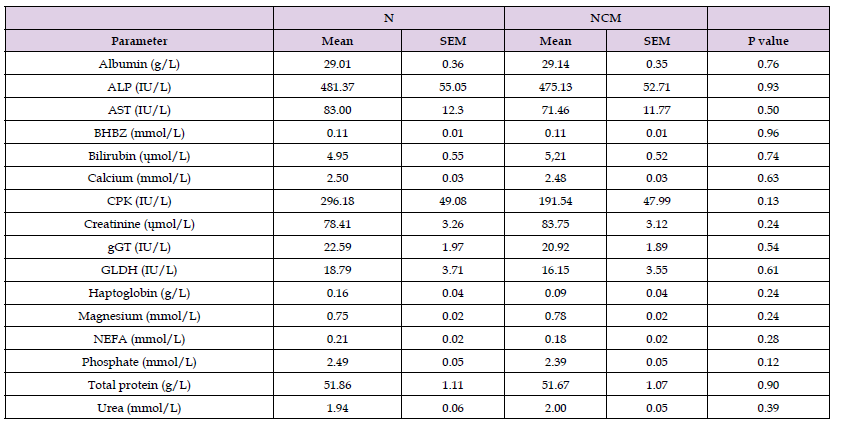
Table 3: Comparison of means of 16 blood plasma parameters between BRD affected calves receiving a single antimicrobial treatment with florfenicol 40 mg/kg subcutaneously (N) (N = 22) or a single antimicrobial treatment with florfenicol 40 mg/kg subcutaneously and an adjunctive intramuscular injection with 12 ml of a combination of butaphosphan 100 mg/ml and cyanocobalamin 50 μg/ml (Catosal®; Elanco) for 3 consecutive days (NCM) (N = 24) using Student’s t-test on study day 3 (SD3) and study day 8 (SD8). Significance at P < 0.05 is indicated by **.

The delta in blood serum concentration in CPK between SD0 and SD3 tended to be smaller in NCM versus N (P = 0.07) (Table 4). The delta of calcium, magnesium, and creatinine concentration between SD3 and SD8 show significant differences between NCM and N (P < 0.05) (Table 4). The delta of blood serum concentration in bilirubin between SD3 and SD8 shows a trend to be smaller in the NCM versus N (P = 0.10) (Table 4). Finally, the delta of calcium and creatinine concentration between SD0 and SD8 differs significantly between N and NCM (P < 0.05), whereas the delta of CPK concentration shows a trend to be bigger in the NCM group (P = 0.08). No significant differences were found in total BRD scores between N and NCM during the study. In the N group 18 % of the calves got a treatment with antibiotics and non-steroidal inflammatory drugs in the post-study phase, whereas in the NCM group 8 % of the calves received an additional treatment. The average number of retreatments was 0.36 versus 0.17 per calf in the N and NCM group, respectively (Table 5). The relative risk of retreatment was 0.41 in NCM versus N.
Table 4: The evolution of blood plasma parameter results between study day 0 (SD0) and SD3 ( ΔSD0-SD3), SD3 and SD8 (Δ SD3-SD8) and SD0 and SD8 Δ (SD0-SD8) for BRD affected calves that received a single antimicrobial treatment with florfenicol 40 mg/kg subcutaneously (N) (N = 22) or a single antimicrobial treatment with florfenicol 40 mg/kg subcutaneously and an adjunctive intramuscular injection with 12 ml of a combination of butaphosphan 100 mg/ml and cyanocobalamin 50 μg/ml (Catosal®; Elanco) for 3 consecutive days (NCM) (N = 24). Trends in significance (P = 0.05-0.10) are indicated by *. Significance at P < 0.05 is indicated by **.
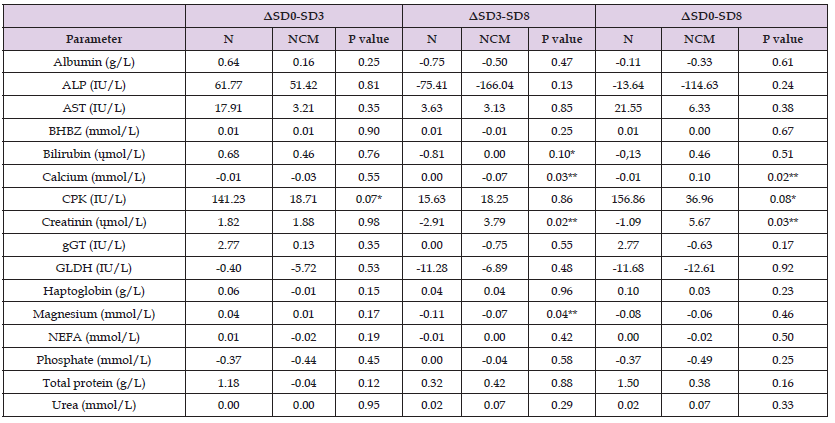
Table 5: Recurring individual treatments of BRD affected calves during the fattening phase between study day 8 and slaughter. Calves received either a single antimicrobial treatment with florfenicol 40 mg/kg subcutaneously (N) (N = 22) or a single antimicrobial treatment with florfenicol 40 mg/kg subcutaneously and an adjunctive intramuscular injection with 12 ml of a combination of butaphosphan 100 mg/ml and cyanocobalamin 50 μg/ml (Catosal®; Elanco) for 3 consecutive days (NCM) (N = 24).

In the current study, more severe symptoms of BRD correlated with higher concentrations of CPK, urea and haptoglobin. Higher concentrations of CPK, urea and haptoglobin were also found in BRD affected calves in other studies in comparison to healthy animals [9,10]. Other studies found increased plasma concentrations of total protein in combination with decreased plasma albumin concentrations [9,10]. In the current study similar results were found, although not significantly different. We found elevated concentrations of haptoglobin in some calves only at SD0, which is in accordance with expectations since haptoglobin is an acute phase protein. Plasma concentrations of haptoglobin were relatively low in this study, and not all calves showed elevated concentrations. This could possibly be related to the fact that only moderate diseased calves were enrolled (BRD score 5 up to 8), or it could be related to an earlier onset of disease (earlier than SD0) in some of the enrolled animals. More severe symptoms of BRD correlated with lower concentrations of macrominerals (Ca, Mg and P). This is in accordance with other studies [11]. Calcium is important for activation of numerous enzymes and hormones. Calcium collaborates in processes of blood coagulation, nerve stimulation and muscles contraction. In blood serum approximately 55% of Ca is in active ionized biologically form. The most of Ca molecules is absorbed in small intestine [12]. The negative correlation of calcium concentration with more severe BRD symptoms is possibly driven by a combination of lower intake of feed and milk, and an increased use due to the systemic inflammation [13,14]. The negative correlation with Mg and P is expected to be driven by lower feed and milk intake. Magnesium is not stored in the body and needs to be ingested daily [13].
Hypophosphatemia is a common finding in cattle that have been off-feed for several days [14]. The absorption of P is taking place in the forestomaches and in the front part of the small intestine [11]. GLDH is an enzyme that is often elevated in diseased animals and is specifically associated to liver damage [15]. In our study the level of GLDH was negatively correlated to the BRD score, which could indicate that liver damage is not so much contributing to the BRD-associated illness in calves. Furthermore, few calves showed values beyond the upper limit that the veterinary laboratory Royal GD set at 115 IU /L. If we take the lower limit into consideration (15 IU/L) many calves showed even lower levels, more specifically at SD0 and SD3. It is difficult to interpret these results, and they may be of no significance at all. Since most calves are within the normal range, the negative correlation with BRD scores could also be indicative of restoring normal metabolism after a period of being (partly) off-feed.
The higher concentration of Ca and Mg that NCM calves showed versus N on SD8 and SD3, respectively, were indicative for a higher feed and milk uptake during recovery. Further indication of better feed intake can be found in the differences in the delta of Ca concentration from SD0 to SD3, and S0 to SD8 in between NCM and N calves. The current study did not find differences concerning plasma P concentration. Although NCM group received butaphosphan for 3 consecutive days. This is similar to other studies with butaphosphan supplementation.6 The delta of creatinine plasma concentration between SD3 and SD8 was found to differ significantly between NCM and N. Creatinine increase is related to dehydration and intense muscle activation [16]. In this study, the NCM group was showing numerically higher plasma concentration of creatinine at SD0 most probably indicating more severe dehydration at enrollment due to lower water and milk intake. However, the NCM group showed a decrease and a positive delta between SD3 and SD8 whereas the N group showed an increase. This development in NCM calves was indicative of a bigger increase in milk and water intake as compared to the N calves [17].
The relative risk for repetitive treatment of 0.41 of NCM compared to N could be indicative for a better functioning immune system. This is in line with the confirmed effect of the combination of cyanocobalamin and butaphosphan on selected clinical cases, especially on blood NEFA, BHBA, triglyceride, immune indicators, glucose, tissue ATP, ADP, glycogen concentrations, and stress marker cortisone [6]. The support of the NCM calves with cyanocobalamin and butaphosphan could have helped to supply energy to the immune system via direct support of the liver metabolism as well as via supporting the intake of feed and milk. A previous study observed increased numbers of immunoglobulins after concurrent treatment of calves with a combination of cyanocobalamin and butaphosphan at the time of vaccination against respiratory diseases [7].
This study showed that concurrent therapy of calves with a combination of cyanocobalamin and butaphosphan in the dose of 12 ml per calf per day for 3 consecutive days, adjunctive to florfenicol treatment for BRD infection can be beneficial for recovery. Plasma profiles showed indication of better feed and milk intake, and better hydration up until 6 days after the last treatment. The adjunctive treatment seems to lead to less calves with recurring BRD symptoms in the further fattening phase. Support of the metabolism of the calves during BRD infections using the combination of cyanocobalamin and butaphosphan could therefore be interesting to help farmers and veterinarians in their efforts decrease the animal welfare impact of BRD infections and to lower the antimicrobial use in veal calves.

International Association of Landscape Archaeology, Czech Glass Society, Czech Republic

Department of Chemistry, Semenov Institute of Chemical Physics, USSR Academy of Sciences, Moscow, Russia

Department of Educational Sciences, Research Centre Qualities of Teachers, School of Education – HAN, Nijmegen, Netherlands

Associate Professor at Department of Breast and Thyorid Surgey, Chongqing General Hospital, China

Neurology, LA BioMed Research Institute, USA





 Abstract
 PDF
PDF



























