info@biomedres.us
+1 (502) 904-2126
One Westbrook Corporate Center, Suite 300, Westchester, IL 60154, USA
Site Map
 ISSN: 2574 -1241
ISSN: 2574 -1241
ISSN: 2574 -1241
Received: October 14, 2024; Published: October 22, 2024
*Corresponding author: Stephen Hsu, Camellix Research Laboratory, Augusta, GA 30912, USA, Department of Oral Biology & Diagnostic Sciences, Dental College of Georgia, Augusta University, Augusta, GA 30912, USA
DOI: 10.26717/BJSTR.2024.59.009260
Green tea catechins, especially epigallocatechin-3gallate (EGCG), have been widely studied for their antiviral activities against a long list of pathogenic viruses. However, the water-soluble EGCG is unstable and undergoes auto-oxidation rapidly. To address this issue, lipid-soluble EGCG was developed such as EGCG-palmitates (EC16) to be formulated in a variety of stable and effective products such as hand hygiene and surface disinfectant products. Recently, we developed an unconventional method to prepare EC16 nanoparticles and successfully formulated them in saline-based nasal applications. This novel nanotechnology allows EC16 nanoparticles to be used in aqueous nanosuspensions targeting viral gastroenteritis. The goal of the current study is to determine the stability and antiviral activity of water-based EC16 nanosuspensions against murine norovirus S99 as a surrogate for human norovirus and a future viral strain for animal studies.
Methods: EC16 nanoparticles were prepared using a facilitated self-assembling method. The antiviral activity of the nanosuspensions of EC16 was assessed by TCID50 assays using RAW 264.7 cells. The stability of the nanosuspensions was determined by Zeta View evaluation following incubation in simulated gastric acid at pH 2. The morphology of the nanoparticles was captured by transmission electron microscopy.
Results: EC16 nanoparticles in water-based and cell culture medium-based suspensions reduced S99 viral infectivity by >99% either in direct contact of the virus or applied before or after viral challenges of the cells. The particle size and Zeta Potential of the nanosuspension remain consistent before and after HCl treatment for 60 min at 37 oC at pH 2. However, the number of particles was reduced by approximately 50%. The electron microscopy image of the nanoparticles is consistent with Zeta View data in particle size range.
Conclusion: EC16 nanoparticles have the potential to be used as a novel approach to prevent and treat viral gastroenteritis, pending mechanism and in vivo
Keywords: Norovirus; Green Tea Catechins; EGCG-Palmitate (EC16); Nanoparticles; Antiviral
Abbreviations: CDC: Center of Disease Control and Prevention; EGCG: Epigallocatechin-3-Gallate; MNV: Murine Norovirus; PBS: Phosphate Buffer Saline; EAOPs: EGCG Auto Oxidation Products; EPA: Environmental Protection Agency; ATCC: American Type Culture Collection; DMEM: Dulbecco’s Modified Eagle’s Medium; FBS: Fetal Bovine Serum; CPE: Cytopathic Effect; SD: Standard Deviation; NIDCD: National Institute on Deafness and Other Communication Disorders; NTA: Nanoparticle Tracking Analysis
According to the Center of Disease Control and Prevention (CDC) of the United States, the leading pathogen that causes acute gastroenteritis is norovirus. Norovirus is also responsible for 58% of foodborne illness in the United States [1]. Globally, it is estimated that 685 million cases of norovirus associated illness were reported and 200 million cases are reported among children under five years of age each year, leading to 50,000 deaths from this age group, mainly from developing countries [2]. The total global norovirus associated deaths is estimated as 200,000 [3]. In addition to children, norovirus poses a life-threatening risk to immunocompromised population, causing chronic illnesses lasting weeks to years [4]. The current therapeutic approaches remain on symptomatic relief due to the lack of effective medication to rapidly mitigate viral replication in gastrointestinal systems [5]. A large number of compounds have been studied as candidates for new drugs against norovirus infection, including antivirals, monoclonal antibodies, and naturally occurring compounds such as vitamin A, curcumin, and citrate [6]. Among the candidates, nitazoxanide, a broad-spectrum antimicrobial drug for treatment of parasite-induced gastroenteritis, was one of the few hopefuls for immuno-compromised patients. However, recently published ex vivo studies suggest that nitazoxanide exhibits poor antiviral activity against human norovirus [7]. Epigallocatechin-3-gallate (EGCG), a major green tea catechin, is another naturally occurring compound with a wide spectrum of antiviral property [8-15].
It is known that both human and murine norovirus (MNV) can be inhibited by green tea extract [16,17]. EGCG also demonstrated antiviral activity against norovirus. For example, Raw 264.7 cell pre-treated with 100 µM EGCG reduced murine norovirus infectivity by >50% [18]. However, as a strong antioxidant, the water-soluble EGCG is quickly self-oxidized (auto-oxidation). In fact, EGCG dissolved in phosphate buffer saline (PBS) at 37oC completely converts to unstable EGCG auto-oxidation products (EAOPs) within 4 hours [19]. Our group also confirmed that it is impossible to maintain EGCG’s stability in a liquid formulation [20]. In addition to the instability, EGCG also forms insoluble aggregated precipitation under intestinal conditions, which could result in further reduction of antiviral effect in vivo [21]. We reported previously that epigallocatechin-3-gallate-palmitate (EGCG-palmitate or EC16), a chemically stable lipid-soluble form of EGCG, is able to effectively inhibit influenza virus, norovirus, and herpes simplex virus. The antiviral activity of EC16 is significantly higher than that of EGCG [20,22-25]. Other advantages include that EC16 is an FDA categorized generally recognized as a safe (GRAS) compound (GRAS Notice 772) [26] and an Environmental Protection Agency (EPA)-approved safe inert. Despite the potent antiviral activity of EC16 against a wide range of pathogenic viruses, the lipid-soluble EC16 may not exert its antiviral activity in the hydrophilic environment in the gastrointestinal tract. This obstacle could be overcome by nanotechnology.
Indeed, EGCG nanoparticles have been developed through nanoparticle engineering. Previous studies demonstrated that EGCG in nanoparticle forms increased bioavailability and retention time in the small intestine environment [27,28]. However, the stability and antiviral activity of nanoparticle-delivered EGCG in the gastrointestinal tract remain unknown. We hypothesize that EGCG-palmitate (EC16), in a unique nanoparticle form, has potential to become a new drug agent to treat and prevent viral gastroenteritis such as norovirus and rotavirus infections (both are nonenveloped viruses). Recently, our group developed a method, referred to as “Facilitated Self-Assembling Method”, to prepare nanoparticles of EC16 for human coronavirus inactivation [29-31]. The current study utilizes this technology to prepare specific nanosuspensions to determine the stability and antiviral activity of EC16 nanoparticles against murine norovirus S99 to obtain initial data toward novel approaches to treat and prevent viral gastroenteritis.
Virus and Cell Line
Murine norovirus S99 strain was obtained from Nelson Laboratories, Bozeman, MT. The RAW264.7 (ATCC# TIB-71) cell line was purchased from American Type Culture Collection (ATCC, Manassas, VA).
Epigallocatechin-3-Gallate-Palmitates (EC16) and Other Supplies
EC16 was obtained from Camellix, LLC, Evans, Georgia, USA. Dulbecco’s Modified Eagle’s Medium (DMEM) was purchased from ATCC (30-2002). Fetal bovine serum (FBS) was obtained from Neuromics (Edina, MN, USA). Penicillin, streptomycin, and amphotericin B solution (100×) was obtained from Corning (Glendale, AR, USA).
Preparation of EC16 Nanoparticles
The EC16 nanoparticles were prepared using the facilitated self-assembling method (proprietary, patent pending). EC16 nanoparticle stocks at 1% and 2% stabilized in pure glycerol for further dilution and use.
Determine the Antiviral Activities of EC16 Nanoparticles
1. Two types of EC16 formulations were prepared. Formulation containing 33% ethanol was made by dilution of EC16 nanoparticle stock with water and a food-grade dispersing agent (proprietary) before addition of 100% ethanol to the final concentration of 33%. Formulations without ethanol were prepared by diluting the EC16 nanoparticle stock with water and the dispersing agent (for contact inhibition reaction only) or diluting the stock with plain DMEM, with or without the dispersing agent, for pre- and post-infection incubation.
2. Contact inhibition assay using water-based EC16 nanoparticles at 0.2%. RAW 264.7 cells were cultured in DMEM supplemented with 10% FBS and 1% penicillin, streptomycin, and amphotericin B. The viral infection assay and viral titer were performed in 96 well cell culture plates when the cells had reached 90% confluency. S99 virus was incubated with EC16 nanoparticles with 33% ethanol or without ethanol at 1:9 for 5 and 10 minutes prior to a series of 10 X dilution using DMEM containing 2% FBS (MM) to 10-9. The dilutions, as well as control (dilutions from water, or water and ethanol) were loaded into the designated wells in quadruplets. After a one-hour absorption, the viral dilutions were removed and 100 µl MM was added, followed by incubation at 37 oC with 5% CO2 for >4 days to allow a CPE (cytopathic effect) to become visible. Viral titer was calculated by a TCID50 protocol and software [32]. Three independent experiments were performed, and results were calculated using TCID50 software.
3. To test whether EC16 nanoparticles possess a post-infection antiviral effect, RAW 264.7 cells were allowed to form a monolayer (90% confluent) in a 96-well cell culture plate prior to a 60 min infection of S99 virus in a series 10 X dilutions to 10–9 before removal of free virus. Then, 100 µL of EC16 nanoparticles were applied to the designated wells for 10 or 30 min before being replaced by MM. The cytopathic effect (CPE) was captured after incubation for at least 4 days, followed by TCID50 calculations.
4. To test whether EC16 nanoparticles possess a pre-infection antiviral effect, RAW 264.7 cells were allowed to form a monolayer (90% confluent) in a 96-well cell culture plate prior to a 20 min incubation of 0.02% EC16 nanosuspension or 0.05% EC16 nanosuspension, followed by infection of S99 virus in a series 10 X dilutions to 10–9 for 60 min and 5 hours, respectively. Then, the virus was removed and 100 µL of MM was added to each well. The cytopathic effect (CPE) was captured after incubation for at least 4 days, followed by TCID50 calculations.
Incubation of EC16 Nanoparticles in Acidic Conditions
To test the stability of EC16 nanoparticles in acidic conditions similar to stomach acid (pH 2), EC16 nanoparticles were prepared from the 2% stock by a 10 X dilution with phosphate buffer saline (PBS) as a 0.2% EC16 nanoparticle suspension. The 0.2% EC16 nanoparticles suspension was then added to the HCl/water solution with pH 1.93 at 1:9 ratio, and incubated at 37 oC for 0, 30 and 60 min before neutralization with 10 X PBS. The resulting 0.002% EC16 nanosuspensions and untreated 0.002% EC16 nanoparticles in PBS were subjected to ZetaView evaluation.
Evaluation of Particle Size Distribution
Zeta View nanoparticle tracking analysis was performed according to a method de-scribed previously [12,43]. The particle size distribution and concentration were measured using the ZetaView ×20 (Particle Metrix, Meerbusch, Germany) and corresponding software. The measuring range for particle diameter is 10–2000 nm. The four samples were diluted by the same volume of 1× PBS and then loaded into the cell. Particle information was collected from the instrument at 11 different positions across the cell, with two cycles of readings. Standard operating procedure was set to a temperature of 23 °C, a sensitivity of 70, a frame rate of 30 frames per second, and a shutter speed of 100. The post-acquisition parameters were set to a minimum brightness of 20, a maximum area of 1000, a minimum area of 10, and a trace length of 15 [30].
Electron Microscopy Imaging of EC16 Nanoparticles
The 1% EC16 nanoparticle stock was diluted with PBS to 0.01% and fixed in 4% paraformaldehyde and 2% glutaraldehyde. 5 µl of the sample was removed and transfer to a Formvar/Copper 200 mesh grid and allowed to dry for 15 minutes. Excess solution was then removed using filter paper particles and was negatively stained by addition of 5 µl of 2% aqueous uranyl acetate. Multiple images were captured from each sample in a JEM 1400Flash Transmission Electron Microscope (JEOL, Peabody, MA) at 120kV, using a Gatan OneView Digital Camera (Gatan Inc., Pleasanton, CA).
Statistical Analysis
The primary statistical tests were parametric one-way ANOVA based on three or more repeated test points. Alpha was 0.05. GraphPad Prism version 6.0 software (www.graphpad.com) was used for most analyses. Reported errors are given as standard deviation (SD).
Antiviral Activity of EC16 Nanoparticles.
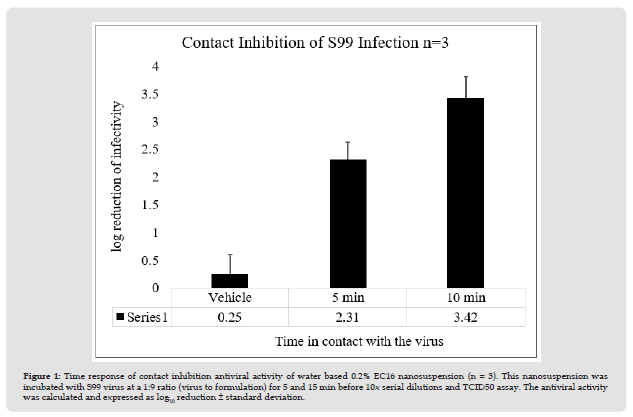
Direct Contact Inhibition: As shown in Figure 1, at 0.2%, EC16 nanoparticles in water-based suspension reduced S99 viral infectivity by more than >99% (log10 2.31 + 0.31) after 5 min contact with the virus. After 30 min contact time, the infectivity of S99 virus was reduced by >99.9% (log10 3.42 + 0.38), which is significantly higher than 5 min contact (One-way ANOVA, p=0.008). The water/ethanol-based suspension reduced S99 viral infectivity by log10 2.63 + 0.14 (>99%) after 5 min contact, which has no statistical difference compared to water-based suspension (p=0.12, n=4).
Figure 1
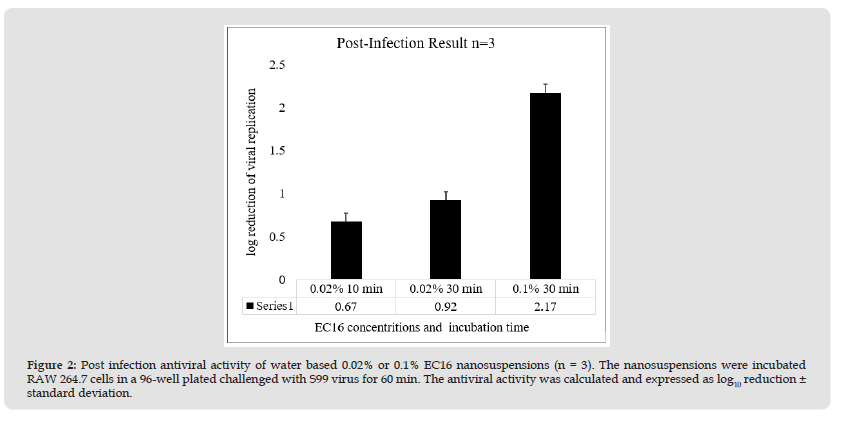
Post-Infection Inhibition of S99 Viral Replication: The EC16 concentrations in these experiments are 0.02% and 0.1%, as shown in Figure 2. The 0.02% nanosuspension was incubated with RAW264.7 cells for 10 and 30 min after the cells were infected by S99 virus. At this concentration and time points, EC16 nanosuspension reduced the viral replication by log10 0.67 + 0.38 (approximately 66%, 10 min) and log10 0.92 + 0.14 (close to 90%, 30 min). When the concentration increases to 0.1%, 30 min incubation of EC16 nanosuspension reduced the viral replication by log10 2.17 + 0.14 (>99%), which is significant increase compared to 0.02% (One-way ANOVA, p=0.0004).
Figure 2
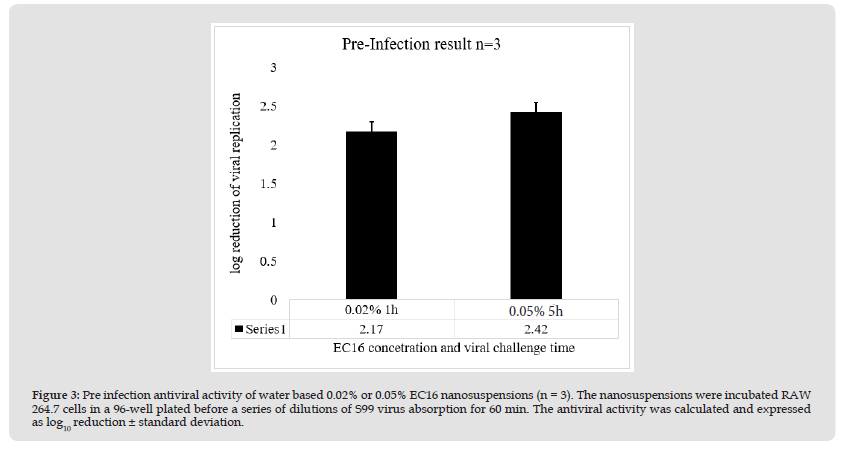
Pre- Infection Inhibition of S99 Viral Replication: The EC16 concentrations in these experiments are 0.02% and 0.05%, and the S99 viral infection time was 60 min and 5 hours, respectively. As shown in Figure 3. The 0.02% nanosuspension was incubated with RAW264.7 cells for 20 min before viral infection. This concentration resulted in a log10 2.17 + 0.29 reduction of viral replication. At 0.05%, the EC16 nanosuspension reduced the viral replication by log10 2.42 + 0.29.
Figure 3
Nanoparticle Test in HCl Solution at pH 2 (Actual Reading1.93).
With consideration for oral administration, EC16 nanoparticle stock at 2% was directly suspended in PBS 1:9 to form a 0.2% suspension containing 10% glycerol. This suspension was incubated with HCl solution at pH 2 (1:9 ratio) at 37 oC. Samples collected at 0, 30 and 60 min were neutralized by 10 X PBS, the resulting neutralized suspensions showed pH values of 6.09, 6.01 and 6.08, respectively, indicating the acidic incubation was terminated. The untreated EC16 nanoparticle suspension in PBS had a pH of 6.30. These samples were then subjected to ZetaView analysis.
Evaluation of Particle Size and Zeta Potential of HCl-Treated Samples
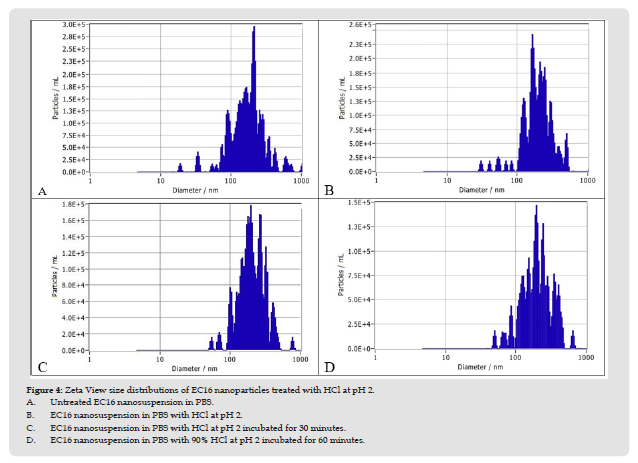
As shown in Figure 4A, the untreated EC16 nanoparticle size distribution was evaluated by nanoparticle tracking analysis (NTA) of 10-fold dilutions. The particles showed high polydispersity, with sizes ranging from 90.6 nm to 603.8 μm. The median size was 173.1 ± 182.3 nm (SD), and the cutoff size for 90% of the particles was <324.5 nm. The undiluted concentration was measured at 6.0E + 8 (108.8) particles/ml. Under acidic conditions but without incubation, the EC16 nanoparticle suspension also showed high polydispersity, with sizes ranging from 54.1 nm to 300.5 μm. The median size was 194.0 ± 129.6 nm (SD), and the cutoff size for 90% of the particles was <334.0 nm. The undiluted concentration was measured at 5.0E + 8 (108.7) particles/ml (Figure 4B). The Zeta Potential at 25°C was -42.01 ± 0.88 mV. After 30 min incubation in HCl solution at 37 oC, the EC16 nanoparticle suspension demonstrated sizes ranging from 100.5 nm to 410.3 μm. The median size was 195.5 ± 103.7 nm (SD), and the cutoff size for 90% of the particles was <330.8 nm. The undiluted concentration was measured at 4.3E + 8 (108.6) particles/ml (Figure 4C). The Zeta Potential at 25 °C was -41.80 ± 0.94 mV. After 60 min incubation in HCl solution at 37 oC, the EC16 nanoparticle suspension demonstrated sizes ranging from 125.0 nm to 354.7 μm. The median size was 194.9 ± 109.7 nm (SD), and the cutoff size for 90% of the particles was <362.8 nm. The undiluted concentration was measured at 3.3E + 8 (108.5) particles/ml (Figure 4D). The Zeta Potential at 25°C was -42.89 ± 0.62 mV.
Figure 4
Transmission Electron Microscopy
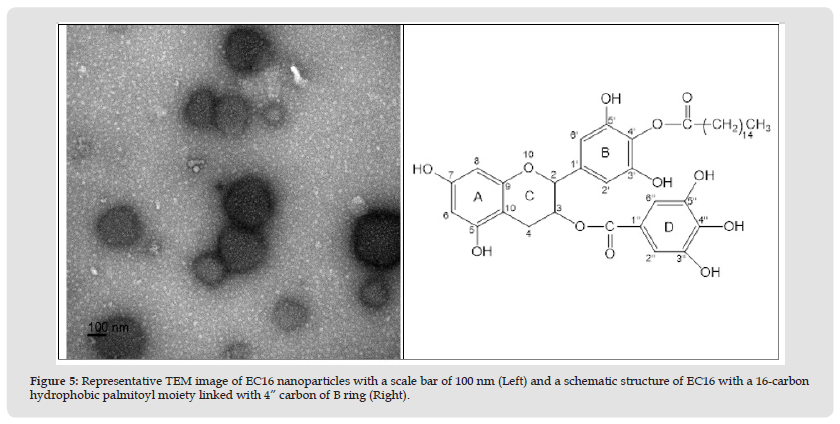
Figure 5 shows a representative TEM image of EC16 nanoparticle suspension fixed in 4% paraformaldehyde and 2% glutaraldehyde. The right panel shows a schematic chemical structure of EC16.
Figure 5
The goal of the current study is to test our hypothesis that EC16 in nanoparticle form could be used as a novel approach to prevent and treat norovirus infection. We previously reported that EC16 in alcohol-based hand sanitizer and surface disinfectant formulations are sufficient to rapidly inactivate norovirus (feline calicivirus and murine norovirus) [32]. However, elevated levels of alcohol content are not feasible for oral administration. The other obstacle to overcome is that EC16 is not water-soluble, therefore it may not be suitable for oral delivery to reach the intestinal lumen, an aqueous environment. Recently, we invented a facilitated self-assembling method to prepare EC16 nanoparticles [29-31]. This nanotechnology was used to develop a nasal spray with strong antiviral activity against human coronavirus [29-31]. This novel approach enabled us to formulate either water-based or alcohol-based EC16 suspensions against non-enveloped murine norovirus S99 to collect initial efficacy and stability information. As shown in Figure 1, the 0.2% EC16 suspension demonstrated potent antiviral activity, with >99% and >99.9% inactivation of the virus in 5 and 10 min, respectively, the 10-min data is similar to the antiviral activity of the ethanol-based (33%) EC16 nanosuspension on S99 virus (2.63 + 0.14 log10 reduction, 10 min incubation), but without statistical significance (p=0.12). Another water-based EC16 nano formulation with 0.02% EC16 and 0.2% chlorohexidine gluconate also reduced S99 infectivity by 99% (data not shown).
This observation suggests that EC16 nanoparticles, even in aqueous suspensions without ethanol, are able to efficiently inactivate the S99 virus. This result could be due to the large surface of the nanoparticles and substantial number of the nanoparticles reacting with the viral surface proteins to alter the viral structure. Due to the wide spectrum of antiviral activity [8-15,20,22-25], the EC16 nanosuspension could be active against rotavirus, another major virus responsible for gastroenteritis and 200,000 deaths each year globally [33]. The second discovery from the current study is that EC16 nanoparticles are stable under acidic environment (HCl at pH 2). The median particle size remains stable after 60 min incubation at 37 oC. There is no significant difference in particle size among the untreated and treated samples. On the other hand, the number of particles was reduced from untreated (6.0E + 8 particles/ml.) to HCl-treated samples (5.0E, 4.3E and 3.0E + 8 particles/ml of 0, 30, and 60 min, respectively). This decline from 108.8 (602,559,586) particles/ml to 108.5 (316,227,766) particles/ml, represents an approximately 50% reduction in nanoparticle numbers after 60 min incubation in HCl (pH 2) at 37 oC. It is not clear what mechanism is associated with the reduction of particle numbers. There are multiple options to improve the durability of the particles. On the other hand, 50% loss of the nanoparticles through 60 min incubation with HCl at pH 2, a corrosive environment at 37 oC, is considered acceptable for a drug directly targeting the gastrointestinal system.
It is necessary to test the stability of EC16 nanoparticles under small intestinal fluid conditions in future investigations. It is crucial to consider the differences between in vitro studies and in vivo studies, which could be designed for multiple doses, or continued feeding in drinking water with EC16 nanoparticles, during the entire norovirus infection episode, rather than a single application in the current cell-based study. An important observation is that the Zeta Potential of all suspensions exposed to HCl remains consistent at approximately -42 mV, indicating the nanoparticles in the suspensions are stable during the 60 min incubation period (A Zeta Potential value above +30 mV or below −30 mV is generally considered stable). It also confirms that the EC16 nanoparticles are negatively charged, which is consistent with the EC16 nanoparticle structure, with the hydrophobic palmitoyl moiety in the center and the negatively charge EGCG moiety facing the aqueous phase [34]. It was reported that the antiviral activity of EGCG is partially due to the negative charge of the compound, which is in contact with the viral proteins, leading to protein structure alterations [35]. This information would help to evaluate the dosage range in future in vivo studies. Accordingly, the subsequent post-infection and pre-infection antiviral assays were based on reduced EC16 concentrations. For the post-infection assay, a single application EC16 nanoparticles at 0.02% or 0.1% in DMEM medium suspension were incubated with RAW 264.7 cells for 20 or 30 min after 60 min S99 viral infection of the cells.
Without direct contact with S99 virus, EC16 nanoparticles at 0.1% reduced the viral replication by log10 2.17 + 0.14 (>99%) after a single 20 min post-infection incubation (Figure 2), suggesting a potential therapeutic effect at the 0.1% concentration during the 6-day observation period for CPE. When the dose and time were decreased, the viral inhibitory activity was less than 10% of that from 0.1% as shown in Figure 2. This result suggests that sufficient number of EC16 nanoparticles is necessary for the efficacy against S99 virus. We chose a concentration between 0.02% and 0.05% to test the potential prevention effect of EC16 nanoparticles. As shown in Figure 3, DMEM suspension with 0.05% EC16 nanoparticles was incubated with RAW 264.7 cells for 20 min to allow the nanoparticles to attach the cells before aspiration. After the free nanoparticles were removed, the cells were infected with S99 virus for 5 hours prior to media change and observation. EC16 nanoparticles at 0.05% led to a 2.42 log10 2.42 + 0.29 (>99%) reduction of S99 viral replication, while 0.02% EC16 nanoparticles resulted in log10 2.17 + 0.29 (>99%) (Figure 3). That is, EC16 nanoparticles in 0.02% to 0.05% significantly reduced the infectivity of S99 virus (>99%). Interestingly, there is no statistical difference between the two concentrations (One-way ANOVA, p=0.35, n=3). One of the reasons to test 0.02% of EC16 is that this concentration was tested extensively in our previous studies [29-31] and ongoing animal studies. This information will be useful for the future in vivo study design for treating viral gastroenteritis.
Regarding the potential toxicity of EC16 nanoparticles, cytotoxicity data from human primary epithelial cells indicates EC16 nanoparticle concentration at 0.1% is not associated with reduction of cell viability [30,31]. The TEM images demonstrated a unique feature of EC16 nanoparticles with EC16 structure (Figure 5). The nanoparticles appear with a high polydispersity, consistent with ZetaView evaluation of the size distribution. It is noted that particles are not in round/sphere shape, and the contents appear packed in an organized manner, without an apparant membrane-like structure. This structure is consistent with the hydrophilic negatively charged surface from the EGCG moiety of the particles (data not shown, manuscript in preparation), which could enhance the antiviral activity by exposing stronger negative charge in the solution than free EGCG molecules [35]. As shown in Figure 5, each EC16 nanoparticle (100 to >200 nm in diameter) presents a large surface of packed EGCG moiety with powerful negative charge to a viral particle with 23-40 nm in diameter, leading to rapid destruction of the virus [35]. On the other hand, the mechanisms of forming stable nanoparticles without engineering warrant further studies. Based on the results, we report here for the first time that aqueous nanosuspension of EC16, an FDA classified GRAS food additive, possesses strong antiviral activities against murine norovirus S99 either in direct contact, or applied before or after viral infection. The nanoparticles remain stable in size and charge after 60 min incubation with HCl solution at pH 2 in 37 oC, with nearly 50% loss of particle number. [36] The limitations of this study include only single applications of the nanosuspensions without repeated treatments in the design of the experiments; and simulated small intestinal fluid was not assessed. In conclusion, EC16 nanoparticles have the potential to be used as a new approach to prevent and treat viral gastroenteritis, pending mechanism and in vivo studies.
This work was funded by a grant from the National Institute on Deafness and Other Communication Disorders (NIDCD) (1R41DC020678-01). The content is solely the responsibility of the authors and does not necessarily represent the official views of the National Institutes of Health.

International Association of Landscape Archaeology, Czech Glass Society, Czech Republic

Department of Chemistry, Semenov Institute of Chemical Physics, USSR Academy of Sciences, Moscow, Russia

Department of Educational Sciences, Research Centre Qualities of Teachers, School of Education – HAN, Nijmegen, Netherlands

Associate Professor at Department of Breast and Thyorid Surgey, Chongqing General Hospital, China

Neurology, LA BioMed Research Institute, USA





 Abstract
 PDF
PDF



























