info@biomedres.us
+1 (502) 904-2126
One Westbrook Corporate Center, Suite 300, Westchester, IL 60154, USA
Site Map
 ISSN: 2574 -1241
ISSN: 2574 -1241
ISSN: 2574 -1241
Received: September 30, 2024; Published: October 21, 2024
*Corresponding author: Shou kat Hussain, Department of Biochemistry, Government College University Faisalabad, Faisalabad, Pakistan
DOI: 10.26717/BJSTR.2024.59.009258
Hepatocellular carcinoma (HCC) is a leading cause of cancer-related deaths worldwide, with limited treatment options and poor prognosis. The use of artificial intelligence (AI) with clinical and omics data provides transformative potential to design a drug that could improve patient outcomes and clinical trials in HCC. AI has emerged as a powerful tool in predicting drug responses, identifying biomarkers, and optimizing treatment strategies by using advanced techniques such as single-cell RNA sequencing (scRNA-seq), spatial transcriptomics, and proteomics. This paper aims to explore the evolving role of AI in the drug discovery for clinical management of HCC, focusing on its application in predicting drug sensitivity, optimizing clinical trials. Additionally, we assess the challenges faced by AI models, such as limited explainability, data quality, and regulatory acceptance. Our analysis highlights several case studies where AI-driven models were employed to predict treatment responses and survival outcomes in HCC patients. AI has demonstrated efficacy in streamlining patient selection for clinical trials, improving trial design, and identifying drug resistance mechanisms. Moreover, AI tools have been instrumental in drug repurposing efforts, identifying novel therapeutic candidates, and optimizing the efficacy of existing drugs such as immune checkpoint inhibitors and multikinase inhibitors like sorafenib and regorafenib. AI-driven advancements are significantly enhancing the understanding and treatment of HCC.
However, challenges such as model explainability, data standardization, and the need for large prospective trials remain controversial. As AI technologies evolve and collaborations between academia and pharma companies increase day by day, these innovations hold immense potential for improving patient outcomes and reshaping the future of HCC treatment. Further research is essential to validate AI algorithms and ensure their integration into clinical practice.
Keywords: Hepatocellular Carcinoma; Artificial Intelligence; Multi-Omics; Drug Sensitivity Prediction; Clinical Trials, Machine Learning
Abbreviations: HCC: Hepatocellular Carcinoma; HCV: Hepatitis C Virus; HBV: Hepatitis B Virus; MASLD: Metabolic- Associated Steatotic Liver Disease; TACE: Transarterial Chemoembolization; ICIS: Immune Checkpoint Inhibitors; RFA: Radiofrequency Ablation; ITH: Intratumoral Heterogeneity; TME: Tumor Microenvironment; CSCS: Cancer Stem Cells; ML: Machine Learning; ANN: Artificial Neural Networks
Hepatocellular carcinoma (HCC) is the most prevalent form of liver cancer, accounting for approximately 90% of primary liver tumors. Its ranks as the fifth most common cancer worldwide and is the second leading cause of cancer-related deaths [1]. HCC represents about 6% of all cancers with an estimated 500,000 to 1 million new cases diagnosed each year [2]. Its incidence is notably higher in Southeast Asia and sub-Saharan Africa, while it remains lower in resource-rich countries, although rates have been rising in places such as the United States, Japan, and parts of Europe. For instance, the incidence in the United States has tripled over the past two decades, closely linked to the rise in obesity and metabolic syndrome, with current rates at approximately 4.8 per 100,000 people [3]. The disease is often associated with chronic liver conditions, especially cirrhosis, which affects about 80-90% of HCC patients [4]. Key risk factors for developing HCC include chronic infections with hepatitis B virus (HBV) and hepatitis C virus (HCV), alcoholic liver disease, and metabolic-associated steatotic liver disease (MASLD) [5]. Treatment options for HCC vary based on the stage of the disease and the patient's liver function [6]. Surgical resection and liver transplantation are recommended for patients with localized tumors and preserved liver function. Transplantation is considered particularly effective for patients with cirrhosis and small tumors [7]. Techniques include radiofrequency ablation (RFA) and microwave ablation are effective for small tumors and are performed percutaneously.
Transarterial chemoembolization (TACE) is recommended for intermediate-stage HCC, delivering chemotherapy directly to the tumor while restricting its blood supply [8]. Targeted therapies and immunotherapies are increasingly used for advanced HCC. Notably advancements include the use of sorafenib, lenvatinib, and immune checkpoint inhibitors (ICIs), which have led to improved outcomes for patients with advanced disease [9]. HCC is characterized by a high degree of intratumoral heterogeneity (ITH), meaning that within a single tumor, there are diverse populations of cancer cells with distinct genetic and phenotypic profiles. This diversity complicates diagnosis and significantly affects treatment effectiveness. Different subpopulations respond differently to therapies, which result in treatment failures and recurrence [10,11]. For instance, the presence of cancer stem cells (CSCs) within HCC contribute to intrinsic resistance to therapies, as these cells often exhibit enhanced survival capabilities and regenerate the tumor after treatment [12]. Mutations and epigenetic changes lead to the activation of alternative signaling pathways that bypass the effects of targeted therapies. Overexpression of drug efflux transporters diminishes the intracellular concentration of chemotherapeutic drugs, rendering them less effective [13]. The tumor microenvironment (TME) create conditions that encourage resistance, such as hypoxia and immune evasion, which further complicate treatment responses [12].
Cancer cells adapt to therapeutic pressures through mechanisms including autophagy and enhanced DNA repair, allowing them to survive despite treatment [14]. The heterogeneous nature of HCC necessitates the development of more advanced therapeutic strategies. Current approaches, such as targeted therapies have demonstrated some effectiveness but are often met with resistance, highlighting the need for combination therapies that block the diverse mechanisms of resistance [11]. Artificial Intelligence (AI) is increasingly transforming the landscape of biomedicine, particularly in drug discovery and development [15]. These technologies use vast amounts of data to improve various processes in biomedical research, leading to more efficient and innovative solutions. AI algorithms process and analyze large datasets from multiple sources, including genomic data, clinical trials, and electronic health records. This potential enables researchers to identify potential drug candidates and better understand disease mechanisms [16]. AI predict the efficacy and safety of drug compounds by modeling their interactions with biological systems. This predictive ability helps prioritize which compounds are advance through the drug development pipeline, significantly reducing the time and costs typically associated with traditional methods [17]. AI-driven virtual screening techniques enable researchers to evaluate thousands of compounds quickly, identifying those most likely to succeed in clinical trials.
This process accelerates the identification of promising drug candidates and optimizes their chemical structures for better performance [18]. By analyzing patient data, AI help in treatments to individual patients based on their genetic profiles and other factors, aiming to increase the effectiveness of therapies while minimizing their side effects [16]. This review explores that AI significantly enhance the drug discovery process and clinical management of HCC by integrating multi-omics data and advanced computational techniques. AI-driven models have the potential to predict drug responses, optimize treatment strategies, and improve clinical trial designs, ultimately revealing the challenges of intratumoral heterogeneity and treatment resistance in HCC.
The use of AI in the early stages of drug discovery is revolutionizing the pharmaceutical industry by enhancing efficiency, reducing costs, and speeding up the identification of promising drug candidates [19]. This section explores how AI is utilized in the initial phases of drug discovery, highlighting its potency and the advantages they provide over traditional methods. AI-driven approaches including genomics, transcriptomics, and proteomics, are becoming increasingly important for discovering novel druggable targets in HCC. These advanced technologies use large datasets and complex biological networks to improve the drug discovery process. Genomic studies have mapped molecular alterations in HCC, revealing potentially actionable mutations. AI tools analyze these alterations to discover novel targets for therapy. For instance, machine learning (ML) algorithms use extensive genetic data to identify mutations critical for HCC progression, leading to the discovery innovative therapeutic targets. Proteomic analyses allow researchers to investigate protein expressions and interactions within cancer cells. AI algorithms merge protein and gene data to discover essential targets for HCC cell survival and growth which might be unnoticed when examining each data type in isolation. Additionally, deep learning (DL) techniques applied to medical imaging (radiomics) have shown potential in characterizing tumors and predicting patient outcomes.
By extracting high-dimensional features from imaging data, AI help identify unique tumor characteristics associated with specific molecular targets, helping in the selection of personalized targeted therapies for individual patients [20,21]. AI approaches that use network biology model to identify interactions between various biological components involved in HCC. By analyzing these networks, researchers identify key targets that play significant roles in tumorigenesis, facilitating the exploration of relationships within biological systems and leading to the discovery of novel anticancer targets [22]. Integrating data from genomics, transcriptomics, and proteomics through AI-driven sources identify druggable targets. For instance, platforms such as PandaOmics utilize AI to analyze multimodal omics data, facilitating the identification of therapeutic targets and biomarkers relevant to HCC [23]. The identification of potential targets through AI must be followed by experimental validation. Recent studies have successfully validated AI-identified targets such as CDK20, demonstrating the efficacy of deep learning methods in discovering novel therapeutic options for HCC [24]. The discovery of lead compounds in drug development has been significantly enhanced by the application of AI algorithms, particularly in virtual screening, structure-based drug design, and ligand-based models. Virtual screening is essential component of drug discovery, allowing researchers to discover potential lead compounds. AI algorithms, particularly ML and DL, have revolutionized this process by improving the speed and accuracy of screening methods. These algorithms learn from last data to predict the binding affinities of compounds to target proteins, significantly reducing the time required for traditional screening methods [25-27].
Structure-based virtual screening involve the use of three-dimensional structures of target proteins to predict how small molecules (ligands) interact with them. AI-enhanced platforms, such as the deep docking (DD) system speed up the docking process by focusing computational resources on a subset of the chemical library, allowing for the efficient screening of billions of compounds. This approach has proven effective to retrieve a high percentage of promising candidates while extremely reducing the number of compounds that require physical docking [28,29]. In contrast, ligand-based methods depend on the known activity of active compounds to predict the potential activity of new ones. AI tools like PyRMD power the training of models using bioactivity data, facilitating the rapid screening of extensive compound libraries. These tools classify compounds as active or inactive and utilize this information to efficiently identify new lead candidates [30]. AI algorithms also perform a vital role in structure-based drug design, where the focus is on optimizing the interaction between a drug and its target. AI techniques enhance traditional docking simulations by employing ML models to predict binding affinities more accurately. This provide information about better prioritization of compounds for experimental validation, saving time and resources during the drug development process [28,31]. Active learning techniques are employed to successively improve the selection of compounds for screening, assuring that the most promising candidates are prioritized based on existing results. This approach enhance the efficiency of the screening process by focusing efforts on areas of the chemical space that are more likely to yield successful leads [29].
The application of AI in the discovery of natural compounds and the repurposing of existing drugs for HCC is a rapidly evolving area of research. ML algorithms are particularly effective in analyzing extensive datasets of natural compounds. Through cheminformatics, researchers identify potential bioactive compounds from natural sources. These algorithms predict the biological activity of these compounds based on their chemical structures, helping in the discovery of new therapeutic agents for HCC [32]. The integration of multi-omics data (genomics, proteomics, metabolomics) with AI allows for a comprehensive analysis of how natural compounds interact with biological systems. This approach leads to the identification of novel targets and pathways relevant to HCC, enhancing the understanding of disease mechanisms and potential therapeutic strategies [33]. AI-driven network pharmacology methods further clarify the interactions between natural compounds and their biological targets. By mapping these interactions within biological networks, researchers better understand the complex mechanisms of action of natural products and their potential applications in HCC treatment [22].AI enhances the repurposing of existing drugs by utilizing computational methods to screen extensive libraries of approved medications. Techniques such as molecular docking, ligand similarity analysis, and deep learning models are used to predict new therapeutic applications for these drugs in HCC. This strategies significantly reduce the time and cost associated with traditional drug development [34].
AI algorithms analyze electronic health records and clinical trial data to identify correlations between existing medications and patient outcomes. For instance, AI has revealed that certain drugs initially developed for other conditions have positive effects on HCC patients, thereby creating opportunities for repurposing these agents [35]. Advanced ML models integrate diverse data types, including drug response data and molecular profiles, to predict the efficacy of existing drugs against HCC. For example, AI models trained on large datasets identify drugs that may be effective against specific HCC subtypes, guiding personalized treatment approaches [27,33]. While AI predict potential repurposing candidates, experimental validation remains essential. AI-driven predictions streamline the selection of compounds for further testing, enabling researchers to focus on the most promising candidates for HCC treatment [22,34]. Table 1 summarizes various AI, DL and ML approaches used for detecting and characterizing focal liver lesions (FLLs) and HCC using imaging techniques such as ultrasound, CT, MRI, and histopathology slides. Each study employs different models, including CNNs, SVMs, and ANNs, to improve diagnostic accuracy. The models demonstrated high precision in distinguishing benign from malignant lesions, with mean area under the receiver operating characteristic curve (ROC-AUC) scores often exceeding 0.9, reflecting their strong diagnostic potential. For instance, the CNN model used for HCC detection from histopathology slides achieved a mean ROC-AUC score of 0.949, while a deep convolutional dense network (CDN) attained 0.925 for FLL characterization.
Table 1: The application of various AI models in detecting and diagnosing HCC.
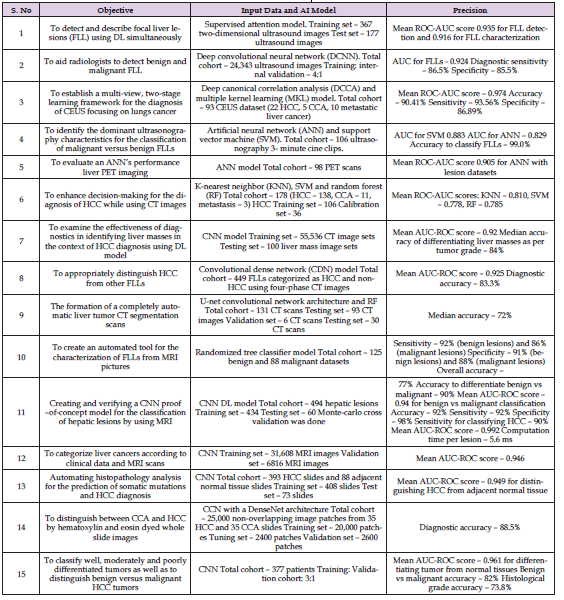
These AI and DL models are also used to assist radiologists in real-time decision-making by automating the classification and segmentation of liver tumors from different imaging modalities. In particular, models like U-net convolutional architecture showed significant progress in automating CT scan segmentation, while CNN-based models for MRI analysis demonstrated robust performance with high accuracy, sensitivity, and specificity values. Such automated tools not only enhance diagnostic efficiency but also reduce the variability associated with manual interpretation, offering a promising avenue for improving the early detection and prognosis of liver cancer, particularly in complex cases involving HCC.
AI is transforming drug optimization and development by improving various stages of the pharmaceutical process, from drug discovery to clinical trials. AI models are showing an essential role in predicting the efficacy, toxicity, and pharmacokinetics of drug candidates, enabling researchers to prioritize safer and more efficient compounds for future development. ML algorithms analyze large datasets of drug structures, biological assays, and clinical outcomes to discover patterns and predict the efficacy of new compounds [36]. Web-based tools including Lim Tox, pk CSM, ad met SAR, and Tox tree use AI to predict toxicity and reduce the need for costly in vitro and animal studies [37]. The Tox21 Data Challenge evaluated various computational approaches to estimate the toxicity of thousands of compounds [38]. ML models have been developed to discover drug absorption, distribution, metabolism, and excretion (ADME) properties [39]. Random forest and deep neural network models have demonstrated high accuracy in predicting human intestinal absorption of chemical compounds [40]. AI-driven PBPK (physiologically based pharmacokinetic) models learn the governing equations directly from data minimizing the need of extensive existing knowledge [41]. AI involve in revolutionizing personalized drug discovery by incorporating a variety of patient data to develop targeted treatments depends on tumor properties. AI algorithms process and analyze extensive patient data from various source. AI helps identify genetic variations that affect disease susceptibility or drug response [37].
AI integrate electronic medical records, lab tests, and other clinical information to develop comprehensive patient profiles [42]. AI considers environmental exposures and lifestyle choices that influence health and treatment outcomes [43]. AI reveal a crucial role in discovering and validating biomarkers linked to HCC progression, prognosis, and treatment response. By analyzing genomic, proteomic, and clinical data, AI helps identify potential drug targets and evaluate their feasibility [44]. AI-powered tools further the drug discovery process by rapidly screening large chemical libraries to identify promising drug candidates. AI algorithms also optimize drug structures and predict their effectiveness and toxicity [37]. AI enhance the design and achievement of clinical trials by identifying suitable patient populations based on their genetic and clinical characteristics, ensuring participants are more likely to benefit from the interventions being tested which leads to more efficient and effective trials [15] (Figure 1).
Figure 1
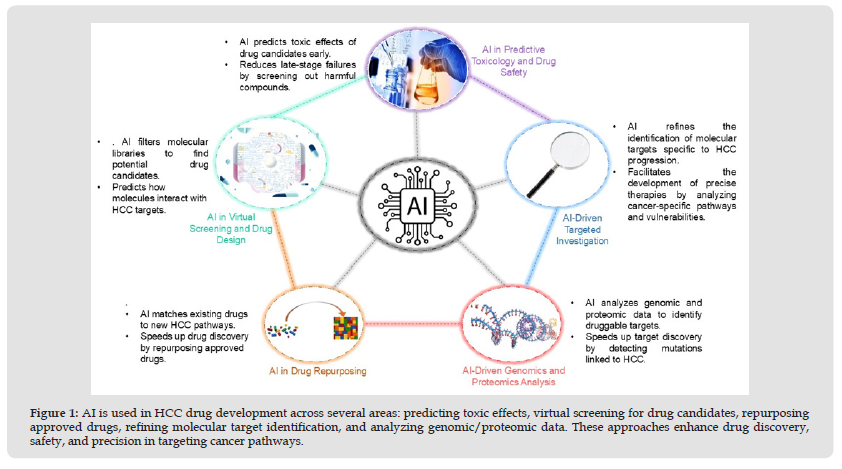
AI-based optimization techniques are enables physicians to enhance drug delivery systems, dosage forms, and bioavailability, especially for treatments related to HCC. ML and artificial neural networks (ANN), are facilitate to predict the physicochemical properties of active pharmaceutical ingredients (APIs) and formulation strategies. This predictive capability enables researchers to discover a vast formulation space efficiently, developing optimal combinations of drugs and improve bioavailability and stability [39]. Bayesian optimization techniques are used to optimize the formulation process. Starting with a limited number of experiments, AI models recommend new formulations based on previous outcomes, significantly reducing the number of experiments needed compared to traditional methods. This strategy improves the efficiency of developing formulations that align with specific therapeutic goals [45]. AI tools are predominantly effective in resolving solubility issues, which are mostly found in drug development. For instance, AI predict compatible co-formers for crystallization processes that increases the solubility of poorly soluble drugs, enabling their formulation to be effective in suitable dosage forms [39]. AI systems evaluate real-time data from manufacturing processes to categorize trends and variations that influence product quality. Historical data and current process parameters are integrated, these systems predict potential deviations and recommend corrective actions, assuring consistent quality in drug production [37].
AI modifies drug delivery systems to individual patient profiles by analyzing genomic and clinical data, particularly in HCC treatments. This approach optimizes dosage forms and improves therapeutic potential while reducing side effects [15]. MaL models involve in the simulation and optimization of drug release kinetics from various formulations, allowing for the development of controlled-release systems that improve patient adherence and treatment outcomes [45].AI is rapidly being utilized to identify biomarkers from various sources such as HCC biopsies, circulating tumor DNA (ctDNA), and liquid biopsies, significantly advancing precision medicine for HCC. AI tools, especially ML and DL, are utilized to evaluate multi-omics data, including genomic, transcriptomic, and epigenomic information. This integrative strategy enables the identification of specific biomarkers that indicate the presence and progression of HCC. For instance, researchers have successfully utilized AI to evaluate RNA-seq and miRNA-seq data to categorize HCC subpopulations with unpredictable survival results [46]. ctDNA from blood samples evaluate through AI techniques, providing a non-invasive method to detect genetic alterations related to HCC. AI identify mutations and other genomic signatures through extensive datasets that serve as biomarkers for preliminary detection and monitoring of therapeutic responses [47]. Liquid biopsies allow researchers to collect biomarkers from body fluids, which AI evaluate to detect HCC earlier as compared to traditional methods. AI-driven techniques enhance the sensitivity and specificity of identifying tumor-derived markers in plasma samples, enabling appropriate interventions [48].
AI tools automate the screening of main databases to expose potential biomarker candidates. This capability identifies the novel biomarkers by incorporating results across various studies and datasets [47].AI excels in processing large volumes of data from imaging modalities and clinical records, leading to enhanced detection rates of HCC. For example, convolutional neural networks (CNNs) have demonstrated high efficacy in differentiating between benign and malignant liver lesions based on imaging data [48]. Imaging studies and pathology reports are analyzed through which AI minimizes variability among different observers, thus improving diagnostic consistency and reliability in identifying biomarkers related to HCC. AI tools have been developed to predict patient outcomes based on identified biomarkers. These tools evaluate overall survival rates and treatment responses, administrating clinical decision-making for personalized therapy in HCC patients [46]. Incorporation of AI with clinical and omics data, especially in the context of HCC, is a rapidly developing field that holds potential for improving drug response predictions and patient conditions. This incorporation involves the use of high-dimensional data sources such as single-cell RNA sequencing (scRNA-seq), spatial transcriptomics, and proteomics. Current studies have demonstrated that ML models efficiently predict treatment responses in HCC patients [49]. AI strategies are being used to integrate various omics data, such as genomic, transcriptomic, and proteomic profiles, to predict drug sensitivity.
For example, researchers have utilized the TIDE algorithm to evaluate immune checkpoint blockade responses in HCC samples and employed the pRRophetic package in R to predict drug sensitivity based on gene expression profiles [50]. AI models have also been developed to predict overall survival in HCC patients by evaluating clinical data over extended follow-up periods. These models utilize various algorithms, such as gradient boosting, achieving high predictive accuracy across different survival time intervals [51]. Many AI models, particularly DL systems, suffer from limited explainability, which stops their acceptance in clinical settings. Enhancing the interpretability of these models is crucial for clinician trust and adoption [47]. Ongoing research is necessary to validate AI-driven predictions against conventional clinical staging systems and to conduct large prospective trials that assure the efficacy of these technologies in real-world settings [46].
AI-Driven Trial Design
AI-driven trial design is transforming the landscape of clinical research by optimizing patient selection and enhancing trial methodologies. Incorporation of real-world data (RWD) and predictive analytics through AI technologies is proving to changee in improving clinical trial efficiency and success rates.
Patient Selection and Recruitment: AI is transforming patient selection and recruitment in clinical trials. Automated matching systems exploit AI tools, particularly those employing natural language processing (NLP), to evaluate clinical trial protocols in conjunction with RWD. These systems efficiently match patients to suitable trials based on their eligibility criteria, significantly streamlining the recruitment process. This approach not only improves the effectiveness of trial enrollment but also assures that patients are matched with the most appropriate trials for their specific conditions [52]. Moreover, AI involve in enhancing the diversity of clinical trials. Data based on patient’s tumor are analyzed through which AI tools identify underrepresented populations and ensure their inclusion in clinical trials. This improved representation plays a vital role in the generalizability of trial outcomes, as it helps to ensure that findings are applicable across a broader spectrum of the population. Like this, AI not only optimizes patient recruitment but also contributes to more inclusive and equitable research practices [53].
Trial Design Optimization: AI is transforming trial design optimization through protocol simplification and predictive analytics. Protocol simplification includes using AI to improve eligibility criteria and streamline trial protocols, thereby reducing complexity and making trials less troublesome for both participants and research sites. This minimization in complexity lead to shorter enrollment periods and improved participant retention, as simplified protocols often require fewer procedural hurdles and minimize participant fatigue [54]. Furthermore, predictive analytics powered by AI is utilized in optimizing trial designs. By analyzing historical data from existing trials, AI tools estimate potential outcomes and help refine trial methodologies [55]. These AI-driven insights enable more informed decision-making, ultimately leading to more effective and efficient trial designs [56].
Real-World Data Utilization: AI is advancing the use of RWD in clinical trials through innovative approaches such as external control arms and data integration. AI generate external control arms that enhance the statistical power of trials while reducing the requirement of large patient cohorts through RWD. More patient-centric trial designs are available that better reflect real-world conditions and enhance the significance of trial results [52]. Furthermore, trial designs are improved by utilizing generative AI, capable of incorporating massive volumes of both public and proprietary data. Efficacy of HCC treatments can be enhanced through the identification of relevant biomarkers and patient characteristics with the help of AI. This comprehensive data incorporation assures that trial designs are informed by a broader understanding of real-world factors, potentially leading to more precise and actionable outcomes [57].
AI for Adaptive Clinical Trials in HCC
Incorporation of AI in clinical trials for HCC utilizes real-time data monitoring and advanced endpoint analysis to enhance trial efficiency and outcomes. AI tools continuously evaluate data collected during trials, allowing for dynamic adjustments to trial protocols based on interim results. This capability enables researchers to modify treatment regimens, patient cohorts, or endpoints as new information becomes available, thereby optimizing trial outcomes and resource allocation [58]. AI-driven clinical trial matching systems have shown the capacity to improve patient recruitment by automatically extracting relevant medical data from electronic health records (EHRs). These systems coordinate patients to appropriate trials based on predefined eligibility criteria, significantly minimizing the time required for manual reviews. For instance, a study demonstrated that an AI-based matching system achieved high accuracy (92.9% to 98.0%) in identifying eligible patients for HCC trials, while also minimizing the workload of clinical staff [59].
ML models are utilized to predict treatment responses and survival outcomes in HCC patients. These models evaluate complex relationships among imaging features, clinical data, and treatment responses, providing information that inform endpoint selection and evaluation. For example, AI can help determine which endpoints are most likely to reflect meaningful clinical benefits based on historical data and predictive analytics [60]. AI facilitates are used for the implementation of adaptive trial designs, which allow for modifications based on collecting data without trailing the integrity of the study. This adaptability is significantly beneficial in oncology, where patient responses vary widely. AI models guide decisions regarding dose adjustments or changes in treatment arms based on real-time efficacy and safety data [52]. While the potential for AI in adaptive clinical trials for HCC is substantial, several challenges must be addressed. Data quality and standardization are paramount, as inconsistencies in data collection methods across different sites introduce biases and impact the reliability of AI predictions. Additionally, the integration of AI into clinical trials presents regulatory challenges, including issues related to validation, transparency, and ethical considerations, necessitating the development of clear guidelines to facilitate the acceptance and use of AI tools in research. Furthermore, the successful deployment of AI solutions requires interdisciplinary collaboration among clinicians, data scientists, and regulatory bodies to assure that AI applications are clinically relevant and aligned with patient care objectives.
Predicting Drug Resistance
Tumors are mostly resistant to treatments due to increasing genomic heterogeneity over time, arises from both the clonal evolution of cancer cells and the selective pressures exerted by therapies, such as immunotherapy [61]. As tumors progress, they develop mechanisms to evade immune detection, includes alterations in the TME, such as reduced T cell recruitment and defects in antigen presentation machinery. These changes contribute to a less effective immune response against the tumor [62]. The interactions between tumor cells and the immune system are not static, they evolve as the disease progresses. This dynamic nature necessitates continuous monitoring of both tumor and immune cell properties for the better comprehension of resistance mechanisms [63]. Advanced techniques such as scRNA-seq have provided information into the cellular heterogeneity of the TME at various stages of tumor development. This high-resolution profiling helps evaluate specific immune cell populations and their roles in tumor progression and response to therapy [64]. Integrating multi-omic data through ML enhances the prediction of treatment responses and resistance patterns. By analyzing genomic, transcriptomic, and immunological data together, researchers develop more precise models for patient stratification and treatment planning [62].
AI has emerged as a powerful tool in drug repurposing efforts for HCC, particularly in identifying new therapeutic uses for existing drugs such as ICIs and kinase inhibitors. Nivolumab and pembrolizumab are PD-1 inhibitors have shown promise in clinical trials for HCC. AI techniques evaluate extensive datasets to identify patient subgroups that respond better to these therapies, optimizing treatment strategies. For instance, AI help to identify biomarkers that predict responses to these ICIs, enhancing personalized treatment approaches. Sorafenib and regorafenib are initially developed for other cancers, these multikinase inhibitors are now standard treatments for advanced HCC. AI models evaluate the efficacy of these drugs in HCC by using genomic data from patients, potentially leading to the identification of new indications or combinations that improve outcomes [33]. AI has been utilized to identify small molecules that inhibit fibroblast growth factor receptor (FGFR), which are implicated in various malignancies, including HCC. Drugs like AZD4547 and BGJ398 are being explored through AI-driven drug repurposing strategies to assess their potential in treating HCC [35]. The convergence of multi-omics data (genomics, transcriptomics, proteomics) with AI methodologies allows researchers to explore novel drug targets and therapeutic pathways. This integration facilitates the identification of existing drugs that could be effective against HCC by analyzing their interactions within biological networks. Various machine learning algorithms are employed to predict drug interactions and efficacy based on historical data and biological pathways associated with HCC.
These models significantly reduce the time and cost associated with traditional drug discovery processes by utilizing existing clinical data [22]. Recent advancements in AI-driven drug development for HCC have demonstrated significant collaborations and successful applications. Insilico medicine has been at the lead of using AI in drug discovery [65]. Various academic institutions are increasingly collaborating with biotech companies to improve AI applications in drug discovery. These partnerships objective to coordinate academic research capabilities with industry resources to accelerate the development of new treatments for HCC [66]. While specific recent FDA approvals directly led to AI-driven discoveries in HCC are currently limited, the following highlights demonstrate the ongoing efforts. Potential drug candidates are novel small molecule inhibitor identified by insilico medicine and the University of Toronto is currently in early stages but shows promise as a candidate for further development in clinical trials [67]. AI techniques are also being explored to optimize clinical trial designs, improving patient stratification and treatment regimens based on predictive modeling. This leads to more effective trials for drugs targeting HCC. Companies like insilico medicine are actively working on multiple candidates within their pipelines that utilize AI for various stages of drug discovery, including target identification and lead optimization [22].
AI algorithms prescribe accurate predictions with the help of high-quality data. However, obtaining comprehensive and reliable datasets from clinical trials, genomics, and other sources is complex. Many datasets suffer from poor quality, which lead to misleading outcomes when used to train AI models. The lack of standardized data formats further complicates integration efforts across different platforms. The "black box" nature of many AI models poses a challenge for interpretability. Understanding the reasoning behind AI-generated predictions is crucial for regulatory approval and gaining trust from stakeholders. Without clear information into how decisions are made, it becomes difficult to validate models and ensure their reliability. There is a lack of established protocols for validating AI-driven approaches in drug discovery. Regulatory agencies have yet to provide clear guidelines for the approval of AI applications in this field, leading to uncertainty in adoption and implementation. Additionally, the scarcity of negative data (failures) in published literature limits the training of robust machine learning models. Implementing AI technologies is financially demanding, particularly for smaller pharmaceutical companies and research institutions that lack the necessary resources or expertise. This economic barrier hinders widespread adoption and innovation within the industry. Continued advancements in deep learning techniques are expected to enhance predictive modeling capabilities, allowing for better identification of drug-target interactions and optimization of lead compounds.
The reinforcement learning approach is utilized to improve decision-making processes in drug design by learning from trial-and-error interactions with complex biological systems, potentially leading to more effective drug candidates. The potential integration of quantum computing with AI revolutionize drug discovery by enabling the simulation of molecular interactions at unprecedented speeds and accuracy, thereby expanding the scope of possible drug candidates. Automation through robotics streamline experimental processes, allowing for faster validation of AI-generated hypotheses and accelerating the overall drug development timeline. Future trends will likely focus on improving data management practices, including better data curation, validation, and interoperability across platforms, facilitate more effective use of AI tools by ensuring that high-quality data is available for model training. The establishment of collaborative networks among academia, industry, and regulatory bodies will be vital step for addressing current challenges. Such partnerships foster innovation while ensuring compliance with regulatory standards, ultimately enhancing the efficiency of drug discovery processes.
The integration of AI with clinical and omics data, particularly in HCC, is renewing the landscape of drug development, clinical trials, and patient care. AI-driven models significantly predict drug responses, optimize patient selection, and improve trial design by integrating high-dimensional data such as scRNA-seq and spatial transcriptomics. These approaches involve in advancing precision medicine for HCC, allowing for better identification of patient subgroups, enhanced drug repurposing, and the development of targeted therapies. However, challenges such as limited explainability and data standardization remain. In clinical trials, AI is revolutionizing patient recruitment and optimizing trial protocols by consuming real-world data and predictive analytics. The use of adaptive trial designs, where AI dynamically adjusts parameters based on real-time data, is particularly beneficial in HCC. Furthermore, AI models demonstrate to involve in predicting drug resistance by incorporating genomic, transcriptomic, and immunological data. While the application of AI in HCC drug discovery is still evolving, current associations between academic institutions and biotech companies are quickening the identification of novel therapeutic targets. As AI continues to advance, further validation and large-scale studies are needed to fully integrate these technologies into clinical practice and realize their potential in improving HCC patient outcomes.
Y.Z: collected data, drafted initial manuscript, and designed figure; T.: writing and conceptualization; R.H.: editing, designed table; S.H.: review, edit, and supervised.
This review paper did not receive any specific financial support or funding from external sources.

International Association of Landscape Archaeology, Czech Glass Society, Czech Republic

Department of Chemistry, Semenov Institute of Chemical Physics, USSR Academy of Sciences, Moscow, Russia

Neurology, LA BioMed Research Institute, USA

Associate Professor at Department of Breast and Thyorid Surgey, Chongqing General Hospital, China

Clinical Radiologist (MD) - Department of RADIOLOGY, Cosenza Hospital, Cosenza, Italy





 Abstract
 PDF
PDF



























