info@biomedres.us
+1 (502) 904-2126
One Westbrook Corporate Center, Suite 300, Westchester, IL 60154, USA
Site Map
 ISSN: 2574 -1241
ISSN: 2574 -1241
ISSN: 2574 -1241
Received: October 08, 2024; Published: October 18, 2024
*Corresponding author: Babatope IO, Department of Haematology and Blood Transfusion Science Faculty of Medical Laboratory Science, Ambrose Alli University, Ekpoma, Edo State, Nigeria
DOI: 10.26717/BJSTR.2024.59.009257
Background of Study: HIV remains a public health issue in Nigeria, despite the reduction in its prevalence in the last decade. The study was aimed at determining the seroprevalence of HIV I & II antibiotics among the students of a state-owned university in South-South Nigeria.
Method: A total of two thousand and four hundred (2400) apparently healthy students aged 16 to 35 years and of both sexes were recruited for this study. HIV I & II serostatus was determined according to the Centre for Disease Control and prevention rapid testing serial algorithm guideline.
Result: In this study, the seroprevalence of HIV I & II antibodies was 0.6%. Sex wise distribution revealed HIV I & II seropositivity rates of 0.2% and 0.4% for the male and female subjects respectively. The subjects that belonged to the age group of 21 – 25 years recorded the highest prevalence rate of 0.4% followed by 16-20 years (0.08%), 26-30 years (0.08%) and 31-35 years (0.04%).
Conclusion: In conclusion, HIV I & II prevalence in the study area was low. Nonetheless, we recommend the establishment of ART services in the study area in other to minimize the burden of the disease.
Keywords: HIV I & II; Seroprevalence; State-Owned University; Nigeria
Human Immunodeficiency Virus (HIV) infection is a pandemic and remains a public health concern for many decades [1]. HIV and AIDS are global catastrophe, the biggest plague and the worst Tsunami in human history [2]. Today, according to UNAIDS, the virus has spread to all continents and about 34.2 million people are infected, with the most affected part of the being sub-Saharan Africa [3,4]. By December, 2015, there was an estimated 36.7 million (34.0 – 39.8 million) people living with HIV/AIDS globally. Adults constituted 34.9 (32.4 – 37.9) million and children under 15 years constituted 1.8 (1.5 – 2.0) million of the global total [5]. Estimates from United Nations Children’s Fund (UNICEF) in 2016 show that about 2.1 million adolescents between the ages of 10 and 19 were living with HIV worldwide [6]. Also in 2015, of 2.1 million persons that were newly infected with HIV, 67,000 were young people between the ages of 15 to 27years and 37% of these were adolescents between the age of 15 to 19 [6]. Sub-Saharan Africa (divided now in UNAIDS reports into Eastern/South Africa and Western/Central Africa) continues to bear the brunt of this epidemic with 25.5 million adults and children (69% of global total) living with HIV in 2015 [5].
The World Health Organization [7] defined adolescents and young people as persons between 10 and 24 years of age. Undergraduate students in higher institutions fall within the age range of 15 to 24 years. This age is characterized by rapid physical growth and development as well as sexual maturation. This period is marked by the need to try out new things such as sex, experiment with injectable drugs as well as other drug types. Universities in developing countries present a high risk environment for the spread of HIV due to the high population of young people. The situation is especially serious in countries with a high incidence of HIV, such as Nigeria, where one out of 14 people are HIV positive [4]. Adolescents and young people make up 31% of the entire population of Nigeria. Data from the Nigeria AIDS Control Agency (NACA) put the prevalence at 4.2% for young people aged 15 to 24 [8]. A lot of work has been done in various parts of Nigeria on the seroprevalence of HIV I & II viruses among university undergraduates [9]. However, there is scarcity of information on HIV infection rate among undergraduate students of Ambrose Alli University, Ekpoma, Edo State, Nigeria. Hence, this present was carried out to determine the seroprevalence of HIV I & II antibodies among students of a state-owned university in South-South Nigeria.
Study Area
This study was carried out in Ekpoma. Ekpoma is the capital of Esan West Local Government Area of Edo State, Nigeria. The area lies between latitudes 60 431 and 60 451 North of the Equator and longitudes 60 51 and 60 81 East of the Greenwich Meridian. It has a population of 170, 123 people as at the 2006 Census [10]. The town has an official post office and it is the home of Ambrose Alli University.
Study Population
A total of two thousand and four hundred (2,400) apparently healthy students aged 16 to 35 years and of both sexes were recruited for this study.
Ethical Approval
Ethical approval was obtained from the Health Research Ethics Committee of Ambrose Alli University, Ekpoma (NHREC registration number: NHREC/12/06/2013). Informed consent was obtained from all the participants.
Sample Collection
Whole blood collection was performed by fingerstick. The fingertip of choice was cleansed with alcohol and allowed to air dry. A new lancet was firmly pressed against the finger to puncture the skin. The first drop of blood was wiped off with a sterile gauze pad before whole blood was collected into a capillary tube.
Analytical Methods
HIV 1&11 serostatus was determined according to the Centre for Disease Control and prevention (CDC-UMD) HIV rapid testing serial algorithm II guideline [11]. Determine HIV-1/2 kit, an immunochromatographic technique, was the first line test kit used. Reactive results by Determine HIV –1/2 kit (Abbot Diagnostics Medical Co., Ltd., Chiba, Japan) was confirmed with Uni-Gold HIV test kit (Trinity Biotech Plc., Bray, Ireland), while negative results by Determine HIV – 1/2 ended the testing. Discordant results were repeated and finally tested with a tie-breaker test kit, Stat-Pak. The final results were then considered positive or negative on the basis of the tie-breaker result. Positive and Negative controls accompanied every set of tests done.
Statistical Analysis
The results obtained in this study were analyzed using simple proportion and presented in tables. Statistical significant was determined using Chi square and ANOVA with values of p<0.05 considered significant.
Socio-Demographic Characteristics of the Study Population
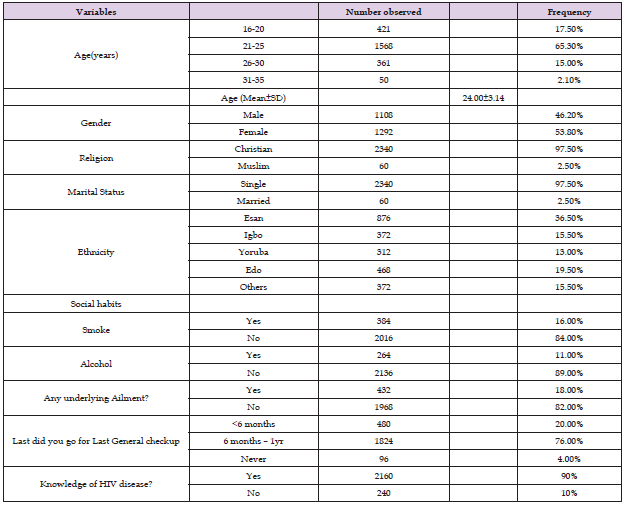
Socio-demographic characteristics of the study population is revealed in Table 1. The subjects were categorized into four age groups of 16-20 years, 21-25 years, 26-30 years and 31-35 years. The age distribution showed that majority of the subjects were within the age range of 21-25 years (65.3%), followed by 16-20 years (17.5%) and 26-30 years (15.0%) with 31-35 years been the least (2.1%). The Age (Mean ± SD) of the subjects was (24.00 ± 3.14). With respect to gender, majority (53.8%) of the subjects were females while the remainder (46.2%) were males. According to the religion, most of the subjects were Christians (97.5%) and 2.5% were Muslims. According to the marital status of the subjects, the result showed that most of the subjects were single (97.5%) while married subjects constituted 2.5%. In relation to ethnicity, majority (36.5%) of the subjects are Esan, followed by Edo (19.5%), with Igbo and others being 15.5% and Yoruba accounted for 13.0%. According to social habits, 84.0% of the subjects do not smoke and 89.0% do not take alcohol while 16.0% of the subjects smoke and 11.0% take alcohol. According to underlying sickness, 82.0% of the subjects do not have any underlying sickness while subjects with illness accounted for 18.0%. With respect to last general check-up, most of the subjects (76.0%) went for general check-up in the last 6 months to 1 year, followed by <6 months (20.0%) and 4.0% never went for general check-up. According to knowledge of HIV disease, 90% had HIV knowledge while 10% did not have.
Table 1: Socio-Demographic Characteristics of the Study Population (n=2400)t.
Seroprevalence of HIV I & II Antibodies in the Study Area
Table 2 shows the seroprevalence of HIV I & II antibodies in the study area. The overall seroprevalence of 0.6% was recorded in the study area.
Table 2: Seroprevalence of HIV I & II antibodies in the Study Area.

Seroprevalence of HIV I & II Antibodies with Respect to Gender
The seroprevalence of HIV I & II antibodies with respect to gender is presented in Table 3. HIV I & II seropositivity rates of 0.2% and 0.4% were obtained for the male and female subjects respectively. Statistical comparison revealed that there was no significant difference (p>0.05) between HIV I & II seroprevalence and gender.
Table 3: Seroprevalence of HIV I & II antibodies in the Study population with respect to gender.

Seroprevalence HIV I & II Antibodies in Relation to Age
Table 4 reveals the seroprevalence of HIV I & II antibodies in relation to age. The subjects that belonged to the age range of 21-25 years recorded the highest seroprevalence rate of 0.4% for HIV I & II antibodies, followed by 16-20 years (0.08%), 26-30 years (0.08%) and 31-35 years (0.04%). However, statistical comparison among the various age groups did not show any significance (P>0.05) between HIV I & II seropositivity and age.
Table 4: Seroprevalence of HIV I & II antibodies in the Study population in relation to age.

HIV remains a public health issue in Nigeria, despite the reduction in its prevalence in the last decade [12,13]. In this study, the seroprevalence rate of HIV I & II antibodies in the study area was 0.6%. This is close to the 0.4% seroprevalence rate reported by Daramola, et al. [14] in a study among students of selected tertiary schools in two Southwest states in Nigeria. Other authors such as Ojerinde, et al. [15] and Gayle et al. [16] have reported slightly lower prevalence rates. For example, Ojerinde, et al. [15] found the overall prevalence rate of HIV to be 0.13% in a study among students of a tertiary institution in Ekiti State, Southwest Nigeria. In a similar vein, Gayle, et al. [16] reported a seroprevalence rate of 0.2% in a study done among university students in the United States. In contrast, our finding disagreed with the previous reports of Emeka-Nwabunnia, et al. [17] who reported a seroprevalence rate of 3.69% among some students of higher education in South Eastern Nigeria. Similarly, White, et al. [18] noted an HIV prevalence of 3.1% amongst Malian students. In a corresponding manner, Mengistu, et al. [19] reported a prevalence rate of 2.5% among the students of Dire Dawa University in Eastern Ethiopia. Furthermore, De Beer, et al. [20] established a seroprevalence rate of 1.8% among the students of a federal university in Namibia. The low prevalence of HIV I & II viruses recorded in our study may be attributed to the increased level of awareness of HIV/AIDS among the students studied. Unadike, et al. [21] and Otokpa, et al. [22] both reported that increased level of awareness and knowledge of HIV/AIDS among the general populace and particularly among the youths has in no small measure contributed to the low prevalence. Similarly, Harding, et al. [23] in their survey carried out in a Nigerian university drawn from five different faculties of the university reported a high level of awareness about HIV/AIDS among undergraduates.
From the standpoint of gender, the HIV I & II seropositivity rate of 0.4% was obtained for the female subjects studied compared to their male counterparts (0.2%). Our findings is in tandem with the previous research of Emeka-Nwabunnia, et al. [17] who reported that female students had higher rate of infection. Similarly, Sinku, et al. [24] reported that a higher rate of HIV positivity was observed among female clients (20.4%) than in male clients (14.0%). Furthermore, Gayle, et al. [16] reported that all but 2 out of 30 infected students were men. According to Mahathir [25] the reason for the female preponderance may be attributed to the fact that biologically women are more vulnerable than men to HIV infection because of the greater mucus area exposed to HIV during penile penetration. Other reasons include poverty, earlier sexual debut among females, child marriage, transactional sex, multiple partners, gender-based violence, low condom use and sexually transmitted infections all contribute to women vulnerabilities to HIV [26-29]. On the contrary, Gayle, et al. [16] reported an HIV seropositivity rate of 0.5% in favour of male subjects compared to 0.02% for females. According to NACA [8], heterosexual intercourse accounted for 80% of HIV infection in the country but transmission through intravenous drug use and same-sex intercourse are increasing in Nigeria and contribute to 40% of new infections.
According to age, the highest HIV I & II seroprevalence rate of 0.4% was recorded in the subjects belonging to the age bracket of 21-25 years. This is similar to the findings of Eghafona, et al. [30] who reported that the age group of 20-29 years recorded the highest HIV I & II antibodies with 3.77%. Furthermore, the previous research of Gayle, et al. [16] reported that positive specimens were found at 9 out of the 19 schools and also noted that all the subjects were from students over 18 years old and 19 representing 63% were from students over 24 years of age. Gayle, et al. [16] also observed that the seroprevalence of HIV I & II viruses increased with age for students 18-24 years old to 1.0 percent for those 40 and older. World Health Organization indicated that over 30 percent of new infections worldwide are projected to occur amongst the youth aged 15 to 25 years [31]. Internationally, an approximated 11.8 million youngsters are living with HIV/AIDS in the age group of 15 to 24. Every day, in the world, nearly 6,000 youngsters between 15- and 24-years contract HIV [31]. In the United States (US), the Centre for Disease Control and Prevention (CDC) indicated that in 2017, the young people aged between 13 and 24 years experienced 21% (8,164) of HIV diagnoses out of the total of 38,739 in the country [32]. Additionally, below one percent (25) of the youth who had an HIV diagnosis were between 13 and 14 years, 21 percent (1,723) were 15 to 19 years old while 79% (6,416) were 20 to 24 years old [33]. In sub-Saharan Africa, twelve nations have eight percent incidence amongst 15 to 24 age group. Estimates further indicate that most new infections affect this age. Over and above that, Kenbo [34] established that women aged 15 to 24 years had a significantly increased risk of contracting HIV I & II infection in relation to young males. He also established that youth in the same age bracket who were unmarried had significantly lesser risk of contracting HIV relative to those who were co-habiting, widowed or divorced. On top of that, Ibrahim, et al. [35] observed that the age above 19 years was related with high likelihood of HIV infection in the areas that had high HIV prevalence. According to Awotidebe, et al. [36], lacking HIV information of HIV/AIDS was regarded as one of the key factors influencing adolescents’ sexual risk behaviours and increasing the risk of new HIV infection. Their study established that sexual activity was prevalent in most adolescents attending school.
In conclusion, the seropositivity rate obtained in this study though low emphasizes the need for ART programs/services to be institutionalized in the study area in other to sustain efforts at reducing the prevalence of HIV 1 & 11 viruses among the students’ population with the view of ending the HIV/AIDS pandemic by 2030.
The authors declare no conflicts of interest. The authors alone are responsible for the content and the writing of the paper.
This research did not receive any grant from funding agencies in the public, commercial, or not-for-profit sectors.
The entire study procedure was conducted with the involvement of all writers.

International Association of Landscape Archaeology, Czech Glass Society, Czech Republic

Department of Chemistry, Semenov Institute of Chemical Physics, USSR Academy of Sciences, Moscow, Russia

Department of Educational Sciences, Research Centre Qualities of Teachers, School of Education – HAN, Nijmegen, Netherlands

Associate Professor at Department of Breast and Thyorid Surgey, Chongqing General Hospital, China

Neurology, LA BioMed Research Institute, USA





 Abstract
 PDF
PDF



























