info@biomedres.us
+1 (502) 904-2126
One Westbrook Corporate Center, Suite 300, Westchester, IL 60154, USA
Site Map
 ISSN: 2574 -1241
ISSN: 2574 -1241
ISSN: 2574 -1241
Received: October 08, 2024; Published: October 22, 2024
*Corresponding author: Khadija M Alshehabi, Nephrology Department, Salmaniya Medical Complex, Government Hospitals, Manama, Bahrain
DOI: 10.26717/BJSTR.2024.59.009253
Arteriovenous fistulas (AVFs) are essential for effective hemodialysis in patients with end-stage renal disease. Surgical arteriovenous fistulas (AVFs) are generally considered superior to central venous catheters and arteriovenous grafts due to their lower rates of infection and thrombosis. However, surgical AVFs may not be suitable for all patients, as they are associated with various challenges, including a high primary failure rate attributed to neointimal hyperplasia. Endovascular arteriovenous fistulas have emerged as a less invasive alternative with the potential to mitigate these challenges. This article presents our clinical experience with endovascular AVFs for hemodialysis access and conducts a comprehensive literature review to evaluate their efficacy and safety in comparison to surgical AVFs. While both approaches offer viable options, endovascular AVFs demonstrate several advantages, including reduced complications, shorter procedure times, and potential cost-effectiveness. However, they require specific anatomical considerations, and long-term data are limited. Further research is necessary to optimize endovascular AVF techniques and identify optimal patient candidates to ensure successful outcomes and maximize the benefits of this promising technology.
Keywords: Percutaneous Arteriovenous Fistula (PAVF); Endovascular AVF; Surgical AVF; Hemodialysis; Vascular Access
Abbreviations: AVFs: Arteriovenous Fistulas; PAVF: Percutaneous Arteriovenous Fistula; CKD: Chronic Kidney Disease; ESRD: End-Stage Renal Disease; CVID: common Variable Immunodeficiency; IVIG: Intravenous Immunoglobulin; CVCs: Central Venous Catheters; AVGs: Arteriovenous Grafts
Chronic kidney disease (CKD) is a global health concern affecting millions worldwide. As CKD progresses, patients may require kidney replacement therapy, with hemodialysis being the most common modality. Hemodialysis necessitates reliable vascular access, typically achieved through arteriovenous fistulas (AVFs). The prevalence of end-stage renal disease (ESKD) has been steadily increasing in recent years. In Saudi Arabia, the number of patients undergoing chronic hemodialysis reached 20,534 in 2021, with arteriovenous fistulas (AVFs) being the most common vascular access site, accounting for 61% of the total dialysis population [1]. While surgical AVFs have traditionally been the gold standard, they are associated with significant challenges, including neointimal hyperplasia leading to primary failure, distal ischemia, wound complications and infection [2]. These limitations have prompted the exploration of alternative approaches. Endovascular AVFs, created using minimally invasive techniques, offer a potential solution to the drawbacks of surgical AVFs [2].
The underlying principle of endovascular AVF procedures is that they may reduce trauma to the blood vessels during surgery, thereby minimizing neointimal hyperplasia and promoting better AVF maturation [3]. These procedures involve creating an anastomosis between the artery and vein using specialized devices. The available devices, such as the WavelinQ system and Ellipsys device, employ radiofrequency energy or thermal energy respectively to achieve this connection [4]. Both devices are exclusively used in the upper extremities and necessitate careful anatomical consideration for the procedure. This article presents our clinical experience with endovascular arteriovenous fistulas (AVFs) and delves into the existing literature to compare their efficacy and safety to surgical AVFs for hemodialysis access. By examining the available evidence, we aim to provide healthcare providers with valuable insights to inform their decision-making regarding the most suitable vascular access option for their patients.
Case 1
A 43-year-old Asian male with end-stage kidney disease secondary to IgA nephropathy had a failed kidney transplant (2015 -2020) due to disease recurrence. He started hemodialysis through a tunneled dialysis catheter in 2020. The patient has a history of other comorbidities including hypertension, gout, obesity with BMI 37 kg/m2, atrial fibrillation (CHA2DS2-VASc score is 1) and maintained on metoprolol and apixaban.
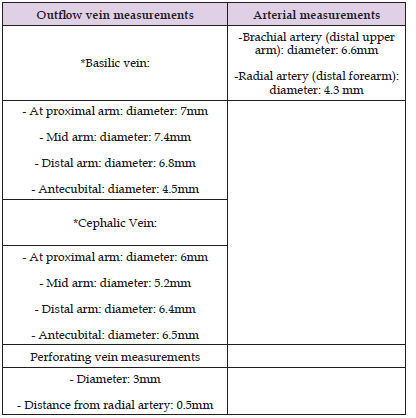
Intervention and Findings: To establish a more durable and accessible vascular access for hemodialysis, a percutaneous arteriovenous fistula (AVF) was planned in the left upper arm. Preoperative ultrasound mapping was conducted to identify suitable vessels for the procedure and revealed the following: (Table 1)
Table 1: Illustrates the arterial and venous mapping.
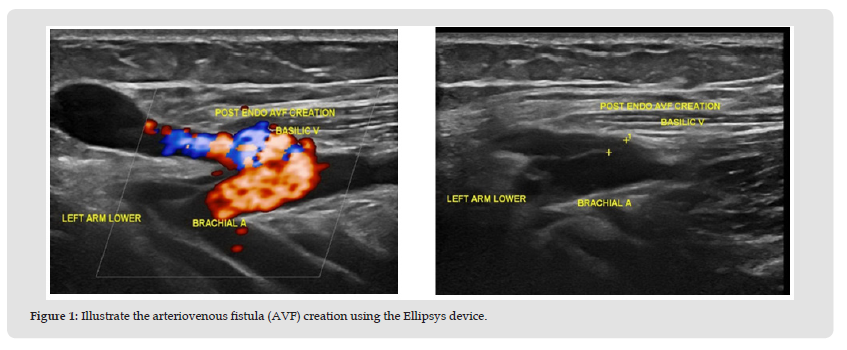
Procedure: The patient underwent a successful arteriovenous fistula (AVF) creation on May 23, 2022. The procedure was performed under regional anesthesia by a specialized team in a dedicated operating room. Antibiotic prophylaxis with cephalosporin was administered to minimize the risk of infection. The median cubital vein was accessed using a micro puncture needle, which advanced through the perforator vein into the proximal radial artery. A sheath was placed followed by a 6 Fr Ellipsys device. The device was deployed successfully, activating thermal energy to create the fistula. The anastomosis site was angioplasted using a 5mm balloon to ensure optimal blood flow. A thrill was palpable, indicating successful blood flow through the fistula. Brachial artery volume flow reached 450 cc/m after creation, confirming adequate blood flow. The sheath was removed, and hemostasis was successfully achieved. No complications noted during or immediately post procedure (Figure 1).
Figure 1
Postoperative Follow-up & Management: Close follow-up was instituted to monitor the maturation of the endovascular AVF. Initial measurements revealed a flow rate below 400 ml/min, necessitating balloon angioplasty of the anastomosis within a week of the procedure. Weekly Doppler ultrasound examinations were conducted to assess the AVF's maturation.
Cannulation and Outcome: After two months, cannulation of the AVF was successfully achieved by an expert hemodialysis nurse under ultrasound guidance using a 17-gauge fistula needle. Initially, the arterial side was cannulated, while the venous side remained connected to the patient's tunneled dialysis catheter. To date, the endovascular AVF has continued to function with adequate flow for approximately two years, providing a reliable and long-lasting vascular access for hemodialysis.
Case 2
A 26-year-old male with end-stage renal disease secondary to lupus nephritis had a failed kidney transplant in 2016 due to chronic allograft nephropathy. Non-adherence to immunosuppressive therapy and recurrent urinary tract infections contributed to the graft failure. The patient subsequently commenced dialysis in September 2022 via an endovascular arteriovenous fistula. His medical history includes hypertension, systemic lupus erythematosus since childhood, common variable immunodeficiency (CVID) treated with monthly intravenous immunoglobulin (IVIG), and a recent seizure attributed to electrolyte imbalance.
Intervention and Findings: A doppler ultrasound of the left upper extremity veins was conducted and showed the following findings: The left internal jugular and subclavian veins were patent, exhibiting a triphasic flow pattern. The axillary and brachial veins were also patent and compressible, with no evidence of thrombosis. The cephalic and basilic veins were patent. However, the lower segments of both the cephalic and basilic veins in the forearm demonstrated a reduced diameter and attenuated lumen. The basilic vein in the mid and lower forearm appeared narrowed. The brachial, radial, and ulnar arteries were patent, and exhibited a triphasic flow pattern. The peak systolic velocity in the radial artery was approximately 60 cm/s, while the ulnar artery's peak systolic velocity was approximately 53 cm/s (Table 2).
Table 2: Illustrates the arterial and venous mapping.

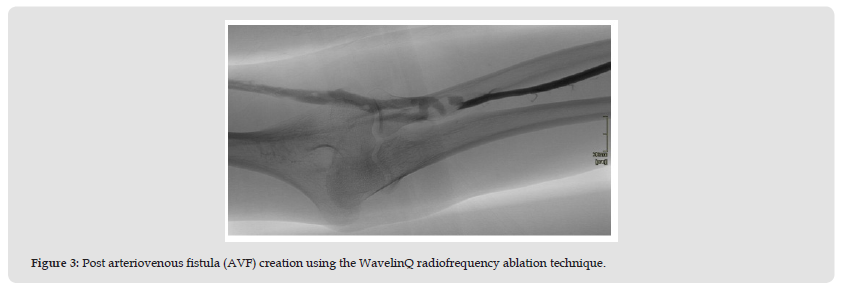
Procedure: The arteriovenous fistula (AVF) was created in September 2022 under regional anesthesia in a specialized operating room. Antibiotic prophylaxis with cephalosporin was administered prior to the incision. The patient was prepared and draped using sterile technique. A bedside ultrasound was performed to confirm the optimal vein location prior to the procedure. The patient was positioned supine and underwent a brachial plexus nerve block. The patient underwent a successful left forearm arteriovenous fistula (AVF) creation using the WavelinQ radiofrequency ablation technique. The procedure involved the following steps:
• A micropuncture needle was inserted into the distal left medial radial vein in an antegrade direction, followed by a standard wire. The needle was then replaced with a 4F sheath, and a venogram confirmed vein patency. A 0.18 wire was inserted through the sheath, and a 4F WavelinQ catheter was advanced over it.
• A similar procedure was performed on the distal radial artery, using a radial access needle and inserting a standard wire followed by a 4F sheath. An angiogram confirmed arterial patency, and a 0.18 wire and 4F WavelinQ catheter were inserted. A cocktail of (3000U heparin, 100 nitroglycerine) was injected.
• Under fluoroscopic guidance, a venogram was performed to assess the optimal site for AVF creation. The catheters were positioned approximately 4 cm distal to the elbow and connected to a radiofrequency generator. After removing the microwires, radiofrequency ablation was initiated at 60 watts for 0.7 seconds. Both catheters were then removed, and a post-procedural venogram confirmed successful AVF creation. The lateral brachial vein was embolized using a 10 mm concerto coil.
• Hemostasis was achieved through compression. The patient tolerated the procedure well and had no immediate complications. An excellent thrill was noted immediately post-procedure, indicating adequate blood flow through the fistula (Figures 2 & 3).
Figure 2

Figure 3
Postoperative Follow-up & Management: A follow-up Doppler ultrasound of the endovascular arteriovenous fistula (AVF) in the upper forearm was performed on November 14, 2022. The fistula site was patent without any detectable thrombosis. The radial vein-radial artery anastomosis was prominent with a diameter of 7 mm. A perforating vein connecting the radial vein to the cephalic vein was also observed, and the cephalic vein was prominent with a diameter of 6 mm, positioned 1 mm beneath the skin surface. The flow volume of the cephalic vein in the lower arm at the antecubital fossa was approximately 1023 ml/min, while the flow volume of the brachial artery was 809 ml/min. Both the cephalic and brachial veins were patent.
Cannulation and Outcome: The first cannulation of the left endovascular brachiocephalic arteriovenous fistula (AVF) was successfully performed on January 5, 2023, by a skilled hemodialysis nurse using ultrasound guidance and a 16-gauge fistula needle. Initially, the arterial side of the AVF was cannulated, while the venous side remained connected to the patient's tunneled dialysis catheter. To date, the endovascular AVF has functioned effectively for approximately two years, providing reliable and long-lasting vascular access for hemodialysis.
Chronic kidney disease (CKD) is a global health concern, affecting over 843 million people worldwide [5]. While only a fraction of these patients will progress to end-stage kidney failure, the number of individuals requiring kidney replacement therapy continues to rise at an alarming rate, and it's estimated to reach 5.4 million by 2030 [6]. Hemodialysis is the most common form of kidney replacement and necessitates vascular access [7]. Hemodialysis access options include central venous catheters (CVCs), arteriovenous grafts (AVGs) and arteriovenous fistulas (AVFs). Among those, arteriovenous fistulas (AVFs) are surgically created in the wrist or elbow to provide reliable access for hemodialysis. Compared to central catheters, AVFs offer superior outcomes, a safer profile, and reduced complication rates. Therefore, creating a peripheral AVF is the preferred approach for managing patients with kidney failure [8-10]. Although AVFs are generally superior to catheters, complications are not uncommon. Surgical AVFs (s-AVFs) have reported primary failure rates ranging from 23% to 60% [11]. Despite the implementation of venous mapping and risk stratification protocols, the primary failure rate for s-AVFs remains as high as 25% [12]. Furthermore, hemodialysis access-related distal ischemia (HAIDI) reported as great as 28% in surgical brachial-based fistulas [13]. Additionally, the incidence of wound dehiscence and infection rates in brachiobasilic AVFs can reach 13% [14].
The surgical AVF failure can be attributed to three main categories: pre-existing lesions, acquired lesions arising from the surgical procedure itself and suboptimal remodeling. Pre-existing venous and arterial stenosis can be readily identified through pre-operative imaging. However, de novo stenosis can develop post-operatively due to increased shear stress at the anastomosis site, surgical technique, or excessive vessel manipulation during fistula insertion. These factors trigger a pro-inflammatory cascade leading to adventitial fibroblast activation, smooth muscle cell migration, and ultimately, vessel remodeling. The most detrimental consequence of this process is neointimal hyperplasia, which causes luminal narrowing and primary AVF maturation failure [15]. The rationale behind developing percutaneous endovascular AVF creation lies in minimizing surgical trauma to the vessels. By minimizing this trauma, the hypothesis is that the incidence of de novo stenosis and subsequent primary failure rates can be significantly reduced [3]. This approach has the potential to improve AVF patency and function, ultimately leading to better patient outcomes for hemodialysis access. Percutaneous endovascular devices (Ellipsys, WavelinQ system) establish a connection between a forearm artery (ulnar or radial) and a perforating or named vein corresponding to the artery (ulnar or radial). This shunts arterial blood into the deep and superficial venous systems via the perforating vein. Both devices require specific anatomical criteria, including:
• A perforating vein (deep communicating vein) in the proximal forearm with a minimum diameter of 2 mm.
• The proposed arterial inflow and the primary superficial venous outflow (cephalic or basilic vein) arising from the communicating vein, each with a minimum diameter of 2 mm.
• A suitable distance between the inflow artery and its corresponding vein where the percutaneous arteriovenous fistula (AVF) is created, with slight variations between the WavelinQ system and the Ellipsys system [16,17].
The Ellipsys Vascular Access System is a single 6 Fr catheter device that utilizes thermal energy and pressure to establish an arteriovenous fistula [18]. It offers a minimally invasive percutaneous alternative when a radiocephalic AVF at the wrist is not feasible or unlikely to mature. This device creates a permanent anastomosis between the proximal radial artery and the perforating vein of the elbow using thermal resistance technology. The reported results for percutaneous AVFs (p-AVFs) created using the Ellipsys device have been encouraging [19-25]. A recent systemic review by Malik et al. compared the efficacy and safety of surgical and percutaneous arteriovenous fistulas (AVFs) for hemodialysis access. The study found comparable outcomes between the two approaches, with high success rates [4]. Among percutaneous techniques, the Ellipsys endovascular device has been extensively studied. This minimally invasive, ultrasound-guided system creates an anastomosis between two vessels with ease. Studies have reported excellent overall outcomes [23,26]. These studies also showed that fistulas created at the wrist level using Ellipsys perform better in long-term owing to low flow volume and multiple venous outflow channels [27].
This leads to decreased risk of hemodynamic complications such as high output heart failure and aneurysm formation, which are commonly seen when constructing elbow level fistulas [28,29]. The WavelinQ Endovascular System is another percutaneous technique utilizing a bidirectional approach, with arterial access at the wrist and venous access at the elbow. Assisted by magnetic catheters and contrast angiography, this dual-catheter system, comprising a magnetic 4 Fr venous catheter and a 4 Fr arterial catheter, has demonstrated superior outcomes compared to the Ellipsys Vascular Access System. However, the use of contrast carries the risk of adverse reactions, which should be considered when choosing between the two techniques [18,30,31].
Moreover, in the systemic review by Malik et al. both two-needle cannulation success and the time to physiological maturity were comparable between surgical and endovascular fistula creation methods in the studies reviewed. The average time for successful cannulation was similar in both groups, with the endovascular group slightly faster at 133 days compared to 138 days for the surgical group. Some studies reported higher success rates for surgically created fistulas. This may be attributed to the more stringent requirements for a successful percutaneous AVF, which can make the procedure more challenging [4]. The procedural success of arteriovenous fistulas can also be influenced by the operator's experience. Previous studies have shown that involving experts from various fields, such as vascular surgery, interventional radiology, and nephrology, can enhance outcomes. While this collaborative approach may not be feasible in all hospitals, the Ellipsys and WavelinQ devices offer potential advantages [4]. A study by Isaak et al. demonstrated the effectiveness of virtual learning for first-time users of the Ellipsys device. Participants quickly acquired the necessary skills and achieved positive results [32].
The endovascular approach, with minimal scarring and shorter procedure times, offers significant advantages over traditional surgery. Experienced operators can typically complete the procedure in 30 to 40 minutes, using local anesthesia and an outpatient setting. Although some patients were lost to follow-up, those who attended regular checkups exhibited similar outcomes to the surgery group [4]. The endovascular AVF group generally experienced fewer complications compared to the surgical group in the studies reviewed. Osofsky et al. reported complications within the first 30 days in only one study [33,34]. Analysis by Malik et al. revealed a significantly higher rate of overall complications in the surgery group, including rebleeding, thrombosis, and high-flow AVFs. While the failure rates were similar in their study, some reports have indicated a higher failure rate for surgical fistulas. These varying results may be attributed to factors such as the limited adoption of these devices in all hospitals and the initial learning curve associated with new technology, not only for operators but also for the entire care team [4].
Certain limitations in the recent meta-analysis by Malik et al. showed higher patency rates for surgical fistulas, as endovascular fistulas often required transluminal angioplasty to maintain patency due to their smaller size [4]. However, Beathard et al.'s study demonstrated excellent long-term patency outcomes (92.7%) for endovascular fistulas after two years. Additionally, the meta-analysis revealed a higher frequency of interventions for fistula maturation in the percutaneous group. Angioplasty was the most common intervention for endovascular fistulas, followed by basilic vein embolization and transposition [4]. However, the Novel Endovascular Access Trial found that over half of endovascular AVFs functioned without requiring additional interventions [30]. Another significant limitation of endovascular fistulas is their restricted anatomical options. Surgical fistulas can be created in various locations, but endovascular fistulas are typically limited to the forearm. This limitation may hinder the suitability of endovascular fistulas for certain patients, potentially leading to surgical procedures that may not be ideal. Expanding the anatomical options for endovascular fistulas could improve accessibility and reduce failure rates [4].
A study by Yang et al. comparing endovascular and surgical AVFs, reveled that patient with endovascular AVFs required fewer post-creation procedures and had lower associated mean costs within the first year p [35]. A similar finding was identified in another study concluding that patients with endovascular AVFs required fewer interventions and had lower costs within the first year compared with matched patients with surgical AVFs [36]. While endovascular AVFs present a promising alternative to surgical AVFs, further research is needed to optimize their performance in real-world settings. Careful patient selection is crucial for successful outcomes. Both procedures have advantages and potential drawbacks, and informed decision-making is essential for both healthcare providers and patients.
With advancements in technology, endovascular AVFs, such as those created using the Ellipsys and WavelinQ systems, are becoming increasingly viable options for hemodialysis patients. Despite the promising results, further research is necessary to optimize endovascular AVF techniques and identify the most suitable patients for each approach. Careful patient selection and informed decision-making remain crucial for ensuring the best possible outcomes.
The authors have no conflicts of interest to disclose regarding this case series, its authorship, or its publication.

International Association of Landscape Archaeology, Czech Glass Society, Czech Republic

Department of Chemistry, Semenov Institute of Chemical Physics, USSR Academy of Sciences, Moscow, Russia

Department of Educational Sciences, Research Centre Qualities of Teachers, School of Education – HAN, Nijmegen, Netherlands

Associate Professor at Department of Breast and Thyorid Surgey, Chongqing General Hospital, China

Neurology, LA BioMed Research Institute, USA





 Abstract
 PDF
PDF



























