info@biomedres.us
+1 (502) 904-2126
One Westbrook Corporate Center, Suite 300, Westchester, IL 60154, USA
Site Map
 ISSN: 2574 -1241
ISSN: 2574 -1241
ISSN: 2574 -1241
Received: September 18, 2024; Published: September 26, 2024
*Corresponding author: Omolola Omole, Elderly ward, St Richard hospital, Chichester, GBR, UK
DOI: 10.26717/BJSTR.2024.58.009213
Purple Urine Bag Syndrome [PUBS] is a rare but striking phenomenon observed in patients with long-term urinary catheterization. Despite its generally benign nature, PUBS can be an indicator of underlying urinary tract infections and other health issues. This systematic review aims to synthesize current evidence on the etiology, epidemiology, clinical presentation, and management of PUBS.A comprehensive literature search was conducted in multiple databases including PubMed, Embase, and Cochrane Library for studies published between 2013 and 2023. Both observational studies and case reports were included. Data extraction and quality assessment were performed independently by two reviewers. The review included 12 studies [1 literature review, 1 observational study and 10 case reports/series]. PUBS was found to result from a complex interaction of dietary factors, gut microbiota, liver metabolism, and urinary tract bacteria. While traditionally associated with elderly females, recent evidence suggests a more diverse patient profile. Key risk factors identified include longterm catheterization, chronic constipation, alkaline urine, and certain comorbidities. Management strategies primarily focus on addressing underlying factors, with catheter change and appropriate antibiotic therapy being the mainstays of treatment. This review provides a comprehensive update on PUBS, highlighting the need for increased awareness among healthcare providers and emphasizing the importance of considering PUBS as a potential indicator of underlying health issues in catheterized patients. Future research directions, including large-scale epidemiological studies and investigations into preventive strategies, are proposed.
Purple Urine Bag Syndrome [PUBS] is a rare but visually striking phenomenon that has intrigued clinicians and researchers since its first description by Barlow and Dickson in 1978 [1]. Characterized by the distinctive purple discoloration of urinary catheter bags and tubing, PUBS represents a unique intersection of dietary factors, gut microbiology, liver metabolism, and urinary tract bacteriology [2]. While often benign, its appearance can be alarming to patients, caregivers, and healthcare providers unfamiliar with the condition [3].
The pathophysiology of PUBS involves a complex chain of events. Dietary tryptophan is metabolized by gut bacteria into indole, which is subsequently absorbed and converted to indoxyl sulfate in the liver [4]. In the presence of certain bacteria possessing indoxyl phosphatase/ sulfatase enzymes, indoxyl sulfate is further metabolized into indoxyl in the urine. Oxidation of indoxyl leads to the formation of indigo [blue] and indirubin [red] pigments, which combine to create the characteristic purple hue [5,6]. Traditionally, PUBS has been associated with elderly, catheterized female patients, particularly those in long-term care facilities [7]. However, recent evidence suggests a more diverse patient profile, with cases reported in younger individuals and males [8,9]. Key risk factors identified in the literature include long-term urinary catheterization, chronic constipation, alkaline urine, urinary tract infections, and certain comorbidities such as chronic kidney disease and cognitive impairment [10-13].
The clinical significance of PUBS extends beyond its striking visual presentation. While generally considered benign, PUBS can serve as an important indicator of underlying urinary tract infections or other health issues, particularly in high-risk patients [14,15]. Moreover, the presence of PUBS may impact catheter longevity and function, potentially necessitating more frequent catheter changes [16]. Management strategies for PUBS primarily focus on addressing underlying factors and typically include catheter change, treatment of constipation, appropriate antibiotic therapy for confirmed urinary tract infections, and improved catheter care practices [17,18]. However, the effectiveness of these interventions and the long-term outcomes for patients with recurrent PUBS remain areas of ongoing research [19]. Despite a growing body of literature on PUBS, several knowledge gaps persist. The true prevalence of PUBS across different healthcare settings and geographic regions remains unclear, with potential underreporting due to its oftenbenign nature [20]. The specific bacterial profiles associated with PUBS and their potential impact on clinical outcomes are not fully elucidated. Furthermore, the long-term implications of recurrent PUBS episodes on patient health and healthcare resource utilization have not been thoroughly investigated [21] As mentioned that PUBS is a relatively uncommon phenomenon, making large-scale epidemiological studies challenging thus case reports should also be considered for the systematic reviews.
The case reports often provide the first descriptions of rare presentations or complications associated with PUBS [22]. Along with it the case reports offer in-depth information about patient histories, comorbidities, and treatment responses, which is particularly valuable for understanding a complex condition like PUBS [23]. Furthermore, unusual cases reported in the literature often lead to new research questions and hypotheses generation, driving further investigation into the etiology and management of PUBS [24]. Additionally, data from a diverse patient populations could be attained as the case reports can highlight PUBS occurrences in atypical patient groups, challenging existing assumptions about risk factors and epidemiology [24]. More importantly some case reports potentially provide valuable long-term follow-up data, offering insights into the natural history and recurrence patterns of PUBS [16]. Along with the understanding of novel management strategies, as individual case reports may describe innovative approaches to managing PUBS, providing insights that could inform larger studies or clinical practice [25]. By integrating data from both larger observational studies and detailed case reports, this systematic review aims to provide a comprehensive and nuanced understanding of Purple Urine Bag Syndrome, its clinical implications, and optimal management strategies. This systematic review aims to synthesize and critically appraise the current evidence on PUBS, focusing on its etiology, epidemiology, and management strategies. By comprehensively analyzing the available literature, including both observational studies and case reports, we seek to provide an updated understanding of PUBS that can inform clinical practice and guide future research directions.
The aim of this study is to synthesize and critically appraise the current evidence on Purple Urine Bag Syndrome [PUBS], focusing on its etiology, epidemiology, and management strategies. Following the aim the objectives of this study are to elucidate the pathophysiological mechanisms underlying PUBS and to analyze the risk factors associated with the development of PUBS. Furthermore, to evaluate the epidemiological trends of PUBS across different patient populations and geographic region. Additionally, to assess the effectiveness of the various management strategies and to explore potential complications associated with PUBS.
Research Question [PICO format]
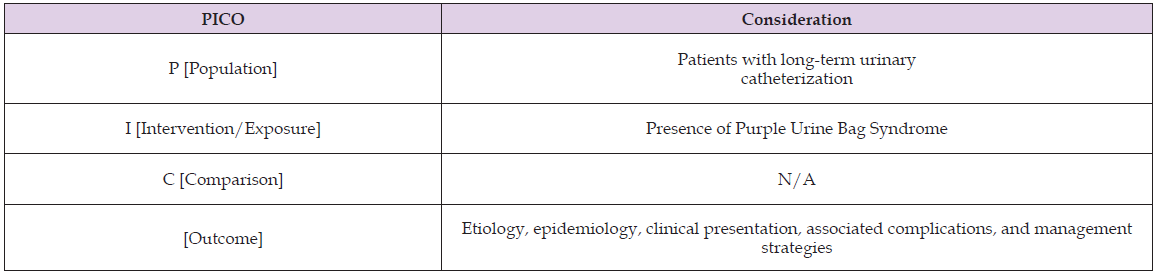
Question: In patients with long-term urinary catheterization, what are the etiology, epidemiology, clinical presentation, associated complications, and effective management strategies of Purple Urine Bag Syndrome compared to those without the condition? The PICO framework is given in the following Table 1.
Table 1: PICO Framework.
Protocol
To systematically review and synthesize current evidence on the etiology, epidemiology, clinical presentation, associated complications, and management strategies of Purple Urine Bag Syndrome, the observational studies [cohort, case-control, cross-sectional] and case reports/series were considered. Patients with long-term urinary catheterization were included with the presence of Purple Urine Bag Syndrome as the outcome. Only English language published literature were considered, published between 2013 to 2023.PubMed, Embase, Cochrane Library, Web of Science, and grey literature sources were the primary information sources. A comprehensive search strategy was followed using MeSH terms and keywords related to “Purple Urine Bag Syndrome”, “urinary catheterization”, and “urinary tract infections”. EndNote was used for reference management, while excel for data extraction. Two independent reviewers will screen titles/abstracts and full texts, with disagreements resolved by a third reviewer. To extract the data a standardized form was used including study characteristics, patient demographics, risk factors, bacterial profile, clinical presentation, management strategies, and outcomes Newcastle- Ottawa Scale for observational studies, and Joanna Briggs Institute checklist for case reports were used to assess quality of the studies. While the data was synthesis by reporting the narrative synthesis of findings. This protocol provides a structured approach to conducting a comprehensive systematic review on Purple Urine Bag Syndrome, ensuring a thorough and unbiased synthesis of the current evidence.
Criteria
The studies involving patients with long-term urinary catheterization were included reporting on PUBS etiology, epidemiology, or management. Studies with availability of full-text articles were considered including observational studies [cohort, case-control, cross-sectional], case series, and case reports published in English between January 2013 and December 2023.The studies not focused on PUBS were not considered along with editorials, and opinion pieces. Studies with insufficient data on PUBS characteristics or management were also not considered along with duplicate publications or overlapping patient populations.
Search Strategy
Electronic databases were searched including, PubMed/MEDLINE, Embase, Cochrane Library, Web of Science and CINAHL. Grey literature sources will also be searched, including, ClinicalTrials.gov, WHO International Clinical Trials Registry Platform, Open Grey and open conference proceedings of major urology and infectious disease conferences. The search strategy will use a combination of MeSH terms and keywords related to PUBS, urinary catheterization, and urinary tract infections, given with PICO components in Table 2. The search was adapted for each database as necessary.
Table 2: MeSH Terms Table with PICO.

Study Selection
Two independent reviewers screened the titles and abstracts of identified studies. Full texts of potentially eligible studies were then assessed against the inclusion/exclusion criteria. Any disagreements were resolved through discussion or consultation with a third reviewer. The selection process is documented using a PRISMA flow diagram (Figure 1).
Figure 1

Outcome Measures
Primary outcomes of the study include the incidence and prevalence of PUBS, risk factors associated with PUBS and bacterial profiles in PUBS cases. While, secondary outcomes include the clinical presentation and symptoms, effectiveness of management strategies, complications associated with PUBS and the recurrence rates of PUBS.
Data Extraction and Quality of Studies
Data was extracted independently by two reviewers using a standardized, pre-piloted form. Extracted data include the study characteristics [design, setting, duration], patient demographics, risk factors, bacterial profiles, clinical presentation, management strategies, outcomes and complications. The quality of included studies will be assessed using the Newcastle-Ottawa Scale for cohort and case-control studies and Joanna Briggs Institute checklist for case series and case reports [26,27].The NOS is designed to assess the quality of nonrandomized studies, including case-control and cohort studies. It uses a star system to evaluate studies on three broad perspectives
a) Selection of the study groups [0-4 stars]
b) Comparability of the groups [0-2 stars]
c) Ascertainment of either the exposure or outcome of interest
[0-3 stars]. A study can be awarded a maximum of one star for each
numbered item within the Selection and Outcome categories. Generally
studies with ≥7 stars are considered high quality, 5-6 stars as
moderate quality, and ≤4 stars as low quality [27]. The Joanna Briggs
Institute [JBI] provides separate checklists for case series and case
reports. For case series 10 items are considered including, clear criteria
for inclusion, reliable measurement of condition, valid methods
for identification of condition, consecutive inclusion of participants,
complete inclusion of participants, clear reporting of demographics,
clear reporting of clinical information, clear reporting of outcomes
or follow-up results, clear reporting of presenting site demographics
and statistical analysis appropriate.
While, for case reports 8 items are considered, and case report become acceptable if, patient’s demographic characteristics clearly described, patient’s history clearly described and presented as a timeline, current clinical condition clearly described, diagnostic tests or assessment methods and results clearly described, intervention[s] or treatment procedure[s] clearly described, post-intervention clinical condition clearly described, adverse events [harms] or unanticipated events identified and described and takeaway lessons, implications for clinical practice clearly described. Each item is scored as Yes, No, Unclear, or Not Applicable, more ‘Yes’ responses indicate higher quality. There’s no established cut-off for high or low quality, but the proportion of ‘Yes’ responses can be used to compare studies [26]. These tools provide a structured approach to assessing the quality and potential biases in different types of studies. They help in interpreting the strength of evidence provided by each study and inform the overall confidence in the findings of the systematic review. When reporting results, it’s important to consider how the quality of individual studies might influence the reliability and generalizability of the conclusions drawn from the review. Any discrepancies in data extraction or quality assessment will be resolved through discussion or involvement of a third reviewer. This methodology provides a comprehensive approach to conducting the systematic review on Purple Urine Bag Syndrome, ensuring a thorough and unbiased synthesis of the current evidence. The MeSH terms table given above helped in constructing a robust search strategy across different databases.
Details and Quality of the Studies
The details of the studies are given in below Table 3. The included case reports were reported to be of high quality following the Joanna Briggs Institute checklist for case series and case reports, and good quality of observational studies using NOS given in column 4 of Table 3.
Table 3: Details of the included studies.

Synthesis of Results
Pathophysiology and Etiology: Purple Urine Bag Syndrome [PUBS] is a rare clinical phenomenon characterized by purple discoloration of urine bags and catheters. The condition results from a complex biochemical process involving the metabolism of dietary tryptophan. Bacteria with indoxyl sulphatase activity metabolize indoxyl sulphate to produce indigo [blue] and indirubin [red] pigments, which combine to create the characteristic purple color [28,29]. Epidemiology and Risk Factors: Traditionally, PUBS has been associated with elderly female patients [30,31]. However, recent research suggests that it may also be common in males [9] and can occur in younger patients with neurological deficits [8]. Key risk factors include, long-term catheterization, chronic constipation, alkaline urine, urinary tract infections [UTIs], immobility or bedridden status and renal dysfunction [30,32,33].
Microbiological Aspects: The most common bacteria associated with PUBS are Gram-negative species, particularly Escherichia coli and Pseudomonas aeruginosa [9]. However, a range of other bacteria can also be involved. Su et al. [2021] found that different bacteria were associated with varying urine pH levels as pseudomonas aeruginosa are associated with less alkaline urine, proteus species are associated with more alkaline urine. Interestingly, fever was more commonly associated with Gram-positive bacterial infections in PUBS cases [34]. Clinical Presentation and Diagnosis: PUBS is often asymptomatic, with the purple discoloration of the urine bag being the primary clinical sign [31]. Diagnosis is primarily based on visual observation of the purple discoloration, along with consideration of the patient’s risk factors and medical history. Urine culture is typically performed to identify the causative bacteria [35].
Management and Treatment: The management of PUBS generally focuses on addressing underlying factors and includes. changing the urinary catheter and drainage bag, treating constipation, administering appropriate antibiotics for UTIs and improving overall catheter care [30,35]. While PUBS is generally considered benign, prompt and appropriate management is crucial due to the risk of complications such as urosepsis [8].
Clinical Significance: Although alarming in appearance, PUBS is generally benign. However, it can serve as an important clinical indicator of underlying UTIs, particularly in high-risk patients [2]. Healthcare providers, especially those in geriatric settings, should be aware of this condition to ensure proper management and to provide appropriate education to patients and caregivers [31]. The following Table 4 summarizes the key components of PUBS management, providing a quick reference guide for healthcare providers. It encapsulates the essential knowledge, potential complications, and recommended management strategies derived from the synthesis of the reviewed studies.
Table 4: Essential awareness, Complications and Management strategies of PUBS.

Purple Urine Bag Syndrome [PUBS] represents a fascinating intersection of microbiology, biochemistry, and clinical medicine. This rare but striking phenomenon has garnered increasing attention in recent years, with a growing body of literature exploring its etiology, epidemiology, and clinical significance. Thus, to explore these factors this systematic review was conducted on 12 high quality studies including the case reports and case series as well. The inclusion of case studies in PUBS research proved to be crucial for several reasons, foremost is the rarity of this condition, as PUBS is relatively uncommon, making large-scale studies challenging. Case studies provide valuable insights into individual presentations and management strategies [36]. one more important reason was the diverse presentations, as demonstrated by cases like Tirtayasa et al. [2023], PUBS can present in unexpected patient populations [8] and help identify the atypical presentations. Moreover, detailed clinical context can be attained as the case studies offer in-depth information about patient histories, comorbidities, and treatment responses, which is crucial for understanding a complex condition like PUBS [37]. Also, the unusual cases often lead to new research questions and hypotheses generation, driving further investigation [22].
Etiology and Pathophysiology
The biochemical pathway leading to PUBS is now well-established. Dietary tryptophan is metabolized in the gut to indole, which is absorbed and converted to indoxyl sulfate in the liver. In the presence of certain bacteria with indoxyl phosphatase/sulfatase activity, indoxyl sulfate is further metabolized to indoxyl, which oxidizes to indigo [blue] and indirubin [red], creating the characteristic purple color [3,29]. This process typically occurs in alkaline urine, which is common in patients with urinary tract infections [UTIs] caused by urease-producing bacteria [4].
Epidemiology and Risk Factors
Traditionally, PUBS has been associated with elderly female patients, particularly those in long-term care facilities [7]. However, recent studies have challenged this notion. Neniwal et al. [20,23] found a higher prevalence in males, while Tirtayasa et al. [2023] reported a case in a younger patient with neurological deficits. These findings suggest that the epidemiology of PUBS may be more complex than initially thought [8,9]. Key risk factors for PUBS include long-term catheterization, chronic constipation, alkaline urine, urinary tract infections, immobility or bedridden status, and renal dysfunction [30,32,34].
Microbiology
The microbiology of PUBS is diverse, with both gram-negative and gram-positive bacteria implicated. Su et al. [2021] found that different bacteria were associated with varying urine pH levels, with Pseudomonas aeruginosa linked to less alkaline urine and Proteus species to more alkaline urine [33]. A meta-analysis by Llenas-García, J et al. [2017] suggested that the bacterial profile in PUBS may differ geographically, potentially due to variations in antibiotic use and healthcare practices [38].
Clinical Presentation and Diagnosis
PUBS is typically asymptomatic, with the purple discoloration of the urine bag being the primary clinical sign [31]. However, Traynor et al. [2017] emphasized its potential as an important clinical indicator of underlying UTIs, particularly in high-risk patients [2]. Diagnosis is primarily based on visual observation, but urine culture is essential to identify the causative bacteria and guide treatment [35].
Management and Treatment
Management of PUBS generally focuses on addressing underlying factors, including changing the urinary catheter and drainage bag, treating constipation, administering appropriate antibiotics for UTIs, and improving overall catheter care [30,35]. Limitations of the Study: Despite the growing body of research, several limitations persist in our understanding of PUBS, including lack of large-scale epidemiological studies as the most research consists of case reports or small case series, limiting our ability to draw broad conclusions about prevalence and risk factors. Moreover, potential underreporting because the benign nature of PUBS may lead to underreporting, skewing our understanding of its true prevalence. Additionally, limited long-term follow-up were the limiting factor of this study as only a few studies have examined the long-term outcomes of patients with PUBS, leaving questions about recurrence rates and potential long-term complications. Furthermore, geographical bias also effect the generisability of study,as most studies come from specific regions, potentially limiting the generalizability of findings to other populations.
Several key areas warrant further investigation including largescale epidemiological studies to better understand the true prevalence and risk factors of PUBS across diverse populations. Furthermore, longitudinal studies are required to examine long-term outcomes and recurrence rates, and investigation into potential genetic factors that may predispose individuals to PUBS. Moreover, exploration of novel diagnostic techniques, such as rapid molecular testing for PUBS-associated bacteria. Additionally, research into preventive strategies, particularly for high-risk patients. The studies on the potential impact of PUBS on catheter lifespan and function.
PUBS, while generally benign, represents a complex interplay of host factors, microbiology, and biochemistry. Its striking presentation belies its potential as an indicator of underlying urinary tract infections and other health issues. As our population ages and long-term catheterization becomes more common, understanding and recognizing PUBS will be increasingly important for healthcare providers across various settings. The synthesis of current research highlights the need for increased awareness among healthcare providers, prompt recognition and management of potential complications, and tailored treatment strategies. While our understanding of PUBS has grown significantly, many questions remain. Future research, particularly large-scale epidemiological studies and investigations into preventive strategies, will be crucial in further elucidating this fascinating clinical phenomenon.

International Association of Landscape Archaeology, Czech Glass Society, Czech Republic

Department of Chemistry, Semenov Institute of Chemical Physics, USSR Academy of Sciences, Moscow, Russia

Department of Educational Sciences, Research Centre Qualities of Teachers, School of Education – HAN, Nijmegen, Netherlands

Associate Professor at Department of Breast and Thyorid Surgey, Chongqing General Hospital, China

Neurology, LA BioMed Research Institute, USA





 Abstract
 PDF
PDF



























