info@biomedres.us
+1 (502) 904-2126
One Westbrook Corporate Center, Suite 300, Westchester, IL 60154, USA
Site Map
 ISSN: 2574 -1241
ISSN: 2574 -1241
ISSN: 2574 -1241
Received: September 09, 2024; Published: September 26, 2024
*Corresponding author: Aftimichuk Olga, Department of Combat Sports and Gymnastics, State University of Physical Education and Sports, Moldova
DOI: 10.26717/BJSTR.2024.58.009212
High-performance sports require special physical training, both general and specialized. At the same time, physical education is enriched with new programs using various means, including fitness programs. Fitness programs are very popular not only among ordinary people, but also among athletes. In this regard, the given article presents a methodology for the physical training of young karatekas by means of various fitness programs. The effectiveness of the developed methodology is substantiated by the results obtained.
Keywords: Karate; Physical Training; Fitness
Currently, the interest in high-performance sports is very high. This is due to its spectacular nature and accessibility to all comers. At the same time, radical changes have recently been observed in the methods of sports training, associated with increased competition at major tournaments and the promotion of training and competition loads that significantly exceed the adaptive capabilities of the human body [1]. The tendency to increase the main parameters of the specified loads continues to this day. At the same time, the practice of training teams in various countries has shown that this direction of improving sports training in most sports and individual disciplines has practically exhausted its potential. Many athletes and entire teams that excessively increased training loads did not achieve the expected results. The number of overstraining cases of the functional systems of the body and injuries has increased sharply. The time of performance at the level of the highest achievements has been reduced because of exceptionally high physical and mental loads, exhaustion of the adaptive capabilities of the athletes' bodies. The number of important competitions in various sports has increased significantly.
In these conditions, there are ignored the need for an organic linkage of the system of sports competitions with the objectively existing patterns of the development of sports skills, the principles of building sports training [2,3].To achieve high results, it is necessary to search for and implement new, modern means. Introducing innovations into the classical training process contributes to the growth of athletes' skills. Any new direction in the training process allows athletes to develop their physical qualities more widely. In this regard, fitness represents one of the areas of physical culture, the potential of which, in our opinion, is quite high, which can be traced back to a number of conducted researches [4,5]. However, an analysis of specialized methodological literature did not reveal sufficient information on the methodology for introducing fitness programs into the educational and training process in karate.
Modern karate represents an inseparable fusion of four components. These are the following [6]:
• Spiritual and moral development,
• Physical culture and health improvement,
• Sports,
• The art of self-defence.
Figure 1

The Japanese denote the word "karate" with three hieroglyphs (Figure 1). Each of them has a deep meaning. The hieroglyph "kara" is emptiness, the hieroglyph "te" is a hand. A special philosophical meaning is contained in the hieroglyph "do", meaning the path.Karate traces its origins to the martial arts and military traditions of the Ancient East, India, China and Japan. It is believed that the ancient fighting techniques of India and China, having arrived on the island of Okinawa in the Middle Ages, were rapidly developed there. The five Chinese styles (tiger, leopard, dragon, crane and snake) were replaced by three Okinawan styles of hand-to-hand combat: Shuri-te, Tomari-te and Naha-te. The birth of karate as we know it should be considered the beginning of the 20s of the last century, when the Japanese master Gichin Funakoshi (1869-1957) held a public presentation of this type of martial arts. Currently, there are several dozen different styles of karate, of which five are considered the main ones [6]:
• Goju-ryu (founder Gogen Yamaguchi).
• Kyokushinkai (founder Masutatsu Oyama).
• Shitoryu (founder Kenwa Mabuni).
• Shotokan (founder Gichin Funakoshi).
• Wado-ryu (founder Hironori Otsuka).
To this day, the division into Okinawan schools and Japanese styles remains. Despite the diversity of schools and styles, they have much more in common than differences. It is the multiplicity of karate schools that today guarantees the preservation and development of the traditions of this type of martial arts. Karate and other martial arts have always paid special attention to the spiritual and moral development of a person. It is not for nothing that it is believed that the philosophy of goodness, peace and tranquility lies at the heart of all martial arts. In the traditions of martial arts, there was a strict code of honor everywhere, to violate which was the greatest shame [7]. Strengthening the body, karate also affects the mind. By mastering martial arts, a person gains calm, begins to think soberly and rationally, clearly sees the essence of things, becomes less aggressive. Martial arts develop character, temper the will and lead a person to further self-improvement. At first, this happens on a subconscious level, but then the changes quickly become visible to others. Martial arts classes, as a rule, lead to decent behavior in society, the ability to properly behave in any conditions and observe ethical standards. It is also worth noting such a feature of karate as the indispensable respect for elders and mentors.
Modern karate has another feature: practicing it should not be turned into an end in itself. It is only a means of achieving other, greater goals and an effective tool for self-improvement. What a person gets from martial arts should not only be directed inward, but also be useful for the whole society. It is generally accepted that one of the best ways to prolong life is to practice martial arts. If earlier these exercises simply increased the chances in the struggle for survival, today regular karate practice has become an effective way to strengthen physical and mental health. Karate helps to develop four basic qualities inherent in a healthy person [8]:
• Flexibility,
• Muscle strength,
• Balanced breathing,
• Precise coordination of movements.
For this purpose, unique exercises, complexes and methods are used. The basis of the entire system of physical development of karate is the well-known principle of contrast, struggle and unity of two opposite principles, the famous eastern "yang" and "yin". This is the alternation of soft and hard, slow and fast, weak and strong, calm and tense, intuitive and rational, passive and active, external and internal. A special section in karate is the art of correct breathing. Such breathing prolongs life, improves well-being, strengthens nerves. And vice versa, incorrect breathing leads to illnesses, stress, uncontrolled aggression. Breathing is unconscious and natural, but it can be influenced by special exercises and techniques. When a person is worried, breathing quickens. But if you learn to control it, then a feedback will arise: you can always calm down, extinguish anger, relieve tension. Each exercise in karate is, first of all, breathing. When practicing them, you need to consciously control your breathing and at the same time allow it to be natural. The result usually exceeds all expectations. In Japanese, the concept of "ki" is used to denote the vital force and internal energy of a human being. Regular practice of any type of martial arts helps to increase this force, but karate is the most effective here. In addition, the methods and exercises developed in karate allow not only to develop endurance, lightning-fast reaction and combat skills, but also to maintain all this for a long time, to be constantly ready for a fight. You can practice the art of karate every day. And you don't even need much time for this.
Age, qualification, gender, health status does not matter here. The main thing is a constant desire to improve [9]. From this position, we formulated the following hypothesis: it was assumed that the introduction of fitness programs into the system of educational and training classes in karate will increase the level of general physical and special physical training of athletes, which will contribute to the improvement of their technical skills.
The Objective of the study is to optimize the educational and training process in the system of sports training of karatekas. To achieve the formulated goal, it was necessary to solve the following problems: to identify fitness tools adequate for conducting the educational and training process in karate, to determine the level of development of physical abilities of karatekas, to develop and experimentally substantiate the methodology of physical training in karate by means of fitness. The Methodology of the study included the analysis of the educational process, the experience of trainers, documentation of the educational and training process; pedagogical observations; methods of testing physical abilities; pedagogical experiment; methods of mathematical processing and interpretation of statistical data.
In the educational and training process in karate, it is necessary to develop such important qualities as: speed, agility, flexibility, coordination, endurance. In this regard, we have developed a methodology for conducting educational and training sessions in karate using fitness means. In the preparatory part of the karate training process, it has been used aerobics means, which contribute to increasing the athlete's body's ability to work, and prepare him for further physical exertion. At the same time, the performance of aerobic exercise complexes assumed the improvement of coordination abilities and speed. In particular, from Basic aerobics it was used the basic steps (basic step, v-step, step touch) performed both in low-impact mode and on jumps; various hand movements and their combinations. Small compositions were composed for 4-8 counts. Aerobic complexes alternated with Rope skipping exercises. With their help, not only motor coordination, spatial orientation, sense of rhythm and tempo were improved, but also speed-strength training for the muscles of the arms and legs of the trainee took place. At the end of the preparatory part, it was carried out the Flex-training for large muscle groups. In the main part of the training process in karate, it was solved technical and tactical tasks: improving the quality of throws, sweeps, accuracy of blows, practicing technical and tactical fighting techniques, developing strength and speed-strength abilities, coordination, orientation in space.
Training sparring was conducted to consolidate and improve the wrestling technique and skills of athletes. In the final part of the training sessions in karate, it was used exercises from such fitness programs as Total Body, Pilates and Flex, which is necessary to be used after speed-strength classes. To carry out the final part it has been used moderate and slow music. The first one was intended for performing strength exercises, the other – for stretching and breathing exercises, which contributed to the calming and relaxation of the entire body. The method of using fitness tools in the process of sports training that we presented was tested on a training group of guys doing karate in the Samurai club. The experiment involved 15 boys aged 13-14, having the sports category of 4 kyu.
As a result of the pedagogical experiment, nine parameters were studied, five of which relate to general physical training, and four to special physical training, where the Mawashi-ren-geri test was determined separately for each stance (right and left). After mathematical and statistical processing of the obtained results, it was revealed that all indicators demonstrated statistical reliability of the initial and final results. Table 1 shows the dynamics of the level formation of the general physical training of the examined athletes. The tests for determining the level of general physical fitness were selected taking into account the fitness programs used in the training sessions. All indicators were statistically reliable, covering the following three levels: explosive strength and agility at the reliability level of ρ < 0.05; speed and flexibility of the shoulder joints at the level of ρ < 0.01; spinal flexibility at the level of ρ < 0.001. The results obtained confirm the correct selection of non-traditional means of physical training for this type of martial arts. Here it is worth paying attention to The Total Body method, which involves a combination of strength training and aerobic exercises.
Table 1: Dynamics of formation of average group indicators of the level of general physical training of karatekas.

Note: n = 15 (f = 14) at р < 0.05, t = 2.1448; р < 0.01, t = 2.976; р < 0.001, t = 4.140
During the session, all parts of the body are fully worked out. The Total Body program helps to strengthen muscles, increase endurance, strength and, at the same time, speed up metabolism and reduce stress levels. In addition, Flex-training improved the elasticity of the tendons and ligaments surrounding the joints of the limbs and spine. A similar picture is observed with the parameters of special physical training (Table 2). All five parameters confirm the statistical reliability of the initial and final data. Of particular note are observed the results of special endurance of the arm and leg muscles, the reliability level of which is ρ < 0.001. Probably, fitness programs with a strength focus have great potential for developing strength abilities in young karatekas. It should be noted that the means used had also influenced the improvement of special motor abilities: Gyaki-tsuki-chudan, Mawashi-ren-geri (right stance) and Mawashi-ren-geri (left stance) at the reliability level of ρ < 0.01.Therefore, it can be concluded that the proposed methodology for introducing exercises from various fitness programs into training sessions has a place in the framework of sports training of karatekas. At the same time, we note that the use of fitness means in the practice of karate classes not only does not have a negative impact on the training process, but on the contrary, demonstrates a positive effect, since it contributes to the improvement of both the general physical training of athletes and specifically physical training.
Table 2: Dynamics of formation of average group indicators of the level of special physical training of karatekas.
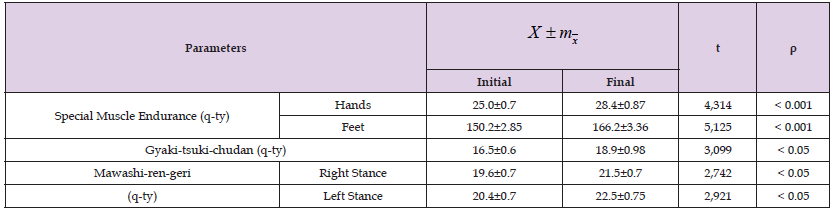
Note: n = 15 (f = 14) at р < 0.05, t = 2.1448; р < 0.01, t = 2.976; р < 0.001, t = 4.140.
The methodology of conducting karate classes by means of fitness can be introduced into the educational process of sports schools and clubs. The experimental methodology of conducting educational and training classes in karate by means of fitness can be proposed for training martial artists. The proposed fitness programs will help to enrich the educational process in martial arts not only for young athletes, but also for high-category athletes.

International Association of Landscape Archaeology, Czech Glass Society, Czech Republic

Department of Chemistry, Semenov Institute of Chemical Physics, USSR Academy of Sciences, Moscow, Russia

Neurology, LA BioMed Research Institute, USA

Associate Professor at Department of Breast and Thyorid Surgey, Chongqing General Hospital, China

Clinical Radiologist (MD) - Department of RADIOLOGY, Cosenza Hospital, Cosenza, Italy





 Abstract
 PDF
PDF



























