info@biomedres.us
+1 (502) 904-2126
One Westbrook Corporate Center, Suite 300, Westchester, IL 60154, USA
Site Map
 ISSN: 2574 -1241
ISSN: 2574 -1241
ISSN: 2574 -1241
Received: September 14, 2024; Published: September 24, 2024
*Corresponding author: Florin Gaiseanu, Information Science and Technology, Bucharest, Romania and Barcelona, Spain
DOI: 10.26717/BJSTR.2024.58.009209
In this paper it is approached the decision making concept in humans and living organisms, from informational point of view. It is shown that the classical/currently considered Pavlovian, Deliberative and Habit decision making/action-selection systems in mammals can be used as a guidance to show that actually all other living organisms dispose of a similarly structured informational system, defined as the Informational System of Human and Living Structures (ISHLS), so they are decision making structures. While the current view relates the decision making/action-selections only to memory/judgment/emotional systems, granting to the striatum in brain an important role, within the frame of the Informational Model of Human and Living Structures (IMHLS) recently elaborated, the decision making is correlated with Attitude, as an informational output of the ISHLS. This is influenced also by other cognitive centers like reproduction, health status/vivacity and inherited/ acquired experience. Taking into account the common/similar characteristics of the ISHLS of the living organisms, independently if these are driven or not by a nervous system, it is shown that the decision making/ action- selection is actually a universal property of the living organisms, necessary for their adaptation to the environmental changes, assuring their survival.
Keywords: Informational System; Decision Making Action-Selection System; Information Model of Human and Living Structures; Cognitive Centers; Adaptation for Survival
Abbreviations: EEs: Execution Elements; IMHLS: Informational Model of Human and Living Structures; ISHLS: Informational System of Human and Living Structures; CASI: Center of Acquirement and Storing of Information; CDC: Center of Decision and Command; IES: Info-Emotional System; IRSS: Info-Reactive Sentient System; MIS: Maintenance Informational System; GTS: Genetic Transmission System; IGG: Info-Genetic Generator; IC: Info- Connection
Information is a largely used concept nowadays in communication/ mass-media systems (Gaiseanu [1,2]), in industry, medicine and decision making operations (Filip [3]), but little is known about information in living organisms and about their operability and informationally determined functions, although recently it was shown that information is one of their essential component (Gaiseanu [4,5]). The knowledge in terms of decision making on the operability/reactivity at information of the living organisms is generally limited to the superior living organisms on the organization scale, in particular to mammals and vertebrates (van der Meer, et al. [6]), because the general belief is that only the living beings endowed with nervous systems dispose of such a capability. More than that, besides the question ‘what us life’, launched in the first half of the last century by a famous physicist (Schrödinger [7]), the question ‘what is consciousness’ and ‘how works the mind’ at human is still an incognito item, so a revolution in neurosciences would be necessary to understand them, as it was recognized in a recent famous international conference on consciousness (Gaiseanu [8]).
Such a revolution came: the introduction of new concepts of matter- related information, info- transduction in living organisms (Gaiseanu [8,9]), and their use to understand their operability in human (Gaiseanu [9,10]) and living cells (Gaiseanu [11,12]), allowed to show that life (Gaiseanu [2]) and consciousness (Gaiseanu [9]) are actually information-based phenomena. On the basis of such previous results, as revolutionary contribution to life science, neurosciences and even in the science of information (Gaiseanu [11,13]), in this paper is presented and discussed the decision making process in living structures, independently if they are or not endowed with a nervous system.
Decision Making Systems in Mammals
Decision making is a process of making choices between various variants in order to identify an opportune/optimal option, satisfying best or better a goal or a task. Such a process is fully informational, because involves the gathering of information, analysis of data on the basis of own experience, and imagining/elaboration/planning of possible scenarios and assessing alternative resolutions. This is therefore a complex process, the degree of complexity depending on the complexity of the goal/task objective and on the own capacity to develop such an adequate analysis and choice. The living systems are not only a sum of their body components (living/informed matter), they are functional systems, working by means of rules and instructions: starting from a single fertilized cell (zygote), they are able to structure themselves, according to well- established “blueprint”/”knowhow” norms/instructions, and to function adequately under the existing surrounding conditions, adapting to them (Gaiseanu [13]), so making decisions for survival. In human, the initial egg cell produces about 37 trillions cells with more than 1000 different types, structured in over 50 organs, working together in organism as a whole (Coulombe, et al. [14]).
In the living systems, the decision drives the organism to action/ execution (Exe) state – by a command addressed therefore to execution elements (EEs) – motor/mobile components of the body (Gaiseanu [12,15]). The living organisms should dispose therefore of an operative/decision making system (Gaiseanu [12]), so they are thus composed complex systems of matter, energy and information (Gaiseanu [4,16]). In human and mammals organism, as well as in animals in general, the brain is the central information processor, evolved to make decisions: indeed, the brain can receive information from sensors and can store it in memory as a comparative basis for new information, for further decisional making processes and action improvement, for adaptation. Almost all animals have brain, excepting the sponge, which survive on the sea floor by taking nutrients directly into their porous bodies (Swanson [17]). As the survival conditions are therefore conveniently fulfilled, no necessary any additional decision/ action process and “hardware” info-processing material support. Decision is therefore recognizable by the corresponding action to making something for the fulfillment of a goal, so within the experimental studies, the decision was highlighted by the action itself. According to the experimental evidences (van der Meer, et al. [6]), at least three distinct decision making/action-selection systems have been identified at mammals:
(i) A Pavlovian,
(ii) A Deliberative,
(iii) A Habit decision making/action- selection system.
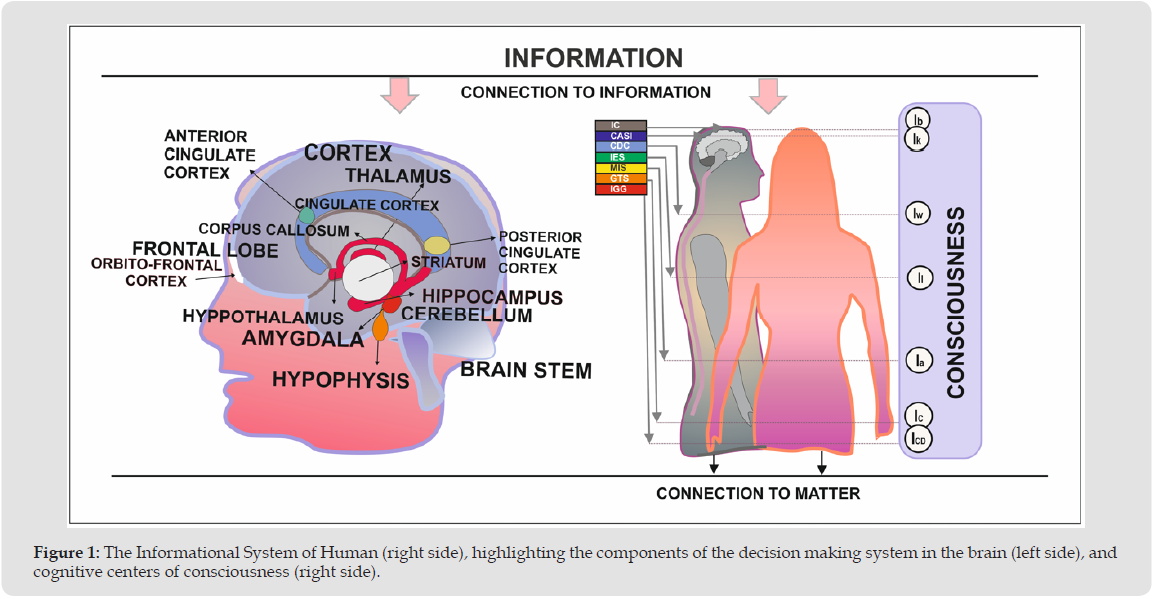
The Pavlovian decision making/action-selection system arises from unconditioned/physiologic (automatic) response to an exterior event stimulus (information), but can be also conditioned/acquired by repetitive experiences. This system is distinguished by the associative relation between a stimulus (for instance a bell sound) and the delivery of a food source, producing a salivation, as it was shown in experiments with dogs. This system is therefore based on a learning process during repetitive experimental conditions, so that the subject organism will come to act finally in a certain way (for instance by salivation), when only the stimulus is triggered. Such a stimulus that predicts motivationally relevant outcomes, after a repetitive learning process, triggers a decision making mechanism, recognizable by an action-selection reaction. In human/mammalian organisms, this process is managed by the brain, specifically by ventral striatum (Figure 1), amygdala, and their connections to motor circuits (van der Meer, et al. [6]).
In primates (a mammalian order including the most close species to human), the striatum (a cluster of neurons with a striated appearance of grey/white matter), is divided into ventral and dorsal striatum, each of them with differentiated functions and structures (Anonymous [18]): the ventral striatum is involved primarily into reward, cognition, reinforcement, and motivational salience, while the dorsal striatum primarily in cognition, which includes the motor function, certain executive functions (like inhibitory control and impulsivity), and stimulus- response learning. Pavlovian type of reactions depends on the associated stimuli, so the available reactions remain relatively limited. For example, pigeons peck at a cue light predictive of food delivery, even without a real reward there, and similarly, the rats associate a certain port of food delivery with a light signal, motivated by learned expectancy (van der Meer [6]), as a stereotype mechanism.
Such a stereotype behavior becomes a preliminary form of further integration/”embodiment” of information into the genetic system itself, by means of epigenetic mechanisms (Gaiseanu [19,20]). In contrast with Pavlovian decision making/action-selection system, the Deliberative system is much more complex, because involves own searches among multiple possibilities and expected consequences, based on own life experience, by means of a deliberative comparative analysis. As such a process involves complex informational analysis, this should be supported by a corresponding complex informational “hardware” with a powerful/high capacity of info-processing, offering a sufficient flexibility to imagine and planning future possibilities, including novel situations, and to select accordingly the optimal actions for the maximization of the expected rewards. Therefore, the Deliberative decision making/action-selection system is expensive and correspondingly slow from informational point of view. This system is specific to human, but also is active in subhuman (mammalian) organisms, with proportionally lower results, depending on the (lower) capacity of the info-processing support. For instance, experiments with rats, shown that they can deliberate over various options under certain conditions: they pause at a choice point, turn back and forth, alternately toward the multiple options, before making a final decision (van der Meer, et al. [6]).
Lesion studies show that the dorsolateral and dorsomedial striatum are involved in different distinct functions: while dorsomedial striatum is involved in the deliberative action performances (goal-directed action), the dorsolateral striatum is rather involved in the performance of habitual (Habit) actions (van der Meer, et al. [6]). According to such experiential/observational studies, the connection with hippocampus – the area of memory and with the orbitofrontal area for analysis/future representation (Figure 1), is fundamental for the planning/imagining the options on the prediction of new routes or outcomes, that have rarely or not yet been experienced, in order to make a Deliberative final decision, because this offers the necessary comparative map/field of data, according to own life experience. Instead, the dorsolateral striatal cells encode the information needed to get reward. The Deliberative system is involved therefore both in the learned and in the lessons which should be learned under the circumstantial conditions of the environment, which are not yet well known. The Habit decision making/action-selection system works on a level of comfortable state, taking into account the already acquired experiences, which were converted and are used as typical model decision criteria for the new ones, even these are actually different. Therefore, the Habit system can be fast, because is based on habitual/typical associative decision making chains, which exclude an additional effort of searching and planning, but such a system can fall into routine and erroneous/obsolete types of decisions, difficulty to be changed.
The activity of the Habit decision making is mainly related to the activity of the dorsal/dorsolateral striatum system (van der Meer, et al. [6]), which include both go (increase likelihood of taking an action – so YES from informational point of view) and no-go (decrease likelihood of taking an action, corresponding to the alternative NO in a Bittype informational unit (Gaiseanu [8]). Each of which is influenced by the presence or absence of a dopamine related signal (van der Meer, et al. [6]). The dorsal striatal neurons are involved in situation-action associations, and the ventral striatum, encompassing the core and shell of the nucleus accumbens, the ventral caudate/putamen and the olfactory tubercle, is a gateway from limbic structures, which is interconnected to action-selection mechanisms (Mogenson [21]), maintaining value representations for all three systems. It computes the value of situations, which includes rewards actually received, as well as discounted future rewards expected (van der Meer, et al. [6]).
Informational Model of Human and Living Structures: All Living Organisms are Decision Making Structures
The informational activity of human and living structures in general, is much more complex, as this is described by the recently elaborated (Gaiseanu [11,19]) Informational Model of Human and Living Structures (IMHLS) (Figure 1), but one of the central item of this system is the decision making processing (Gaiseanu [12]), assuring the adaptation for survival. As it was shown earlier (Gaiseanu [11,19]), all living organisms are managed by an Informational System, with common similar functions on the entire evolution/organization scale, defined therefore as the Informational System of Human and Living Structures (ISHLS). This consists in the following informational components:
(I) The Center of Acquirement and Storing of Information (CASI), consisting in a sensors network and memory, supported by prefrontal cortex for short-time memory (1-2 min.) and hippocampus (Gaiseanu [19]). The equivalent structure in the eukaryotic cell, the basic elementary unit of human, animals and plants, consists in the cell nucleus, including the genes, where is stored the necessary codified information of the entire living organism, and in the associated network of surface and internal/cytoplasmic sensors (Gaiseanu [15,22]).
(II) The Center of Decision and Command (CDC), connected to the prefrontal cortex and cortex for judgment (Gaiseanu [19]): the brain structures discussed above driving the action-selection processes, and to EEs. In the eukaryotic cell, the equivalent system is the cell nucleus, as a dynamic/processing structure, responding to the external stimuli according to circumstances. by genes activation/ inhibition (genes expression), which represents actually a YES/NO – Bit-type informational process (Gaiseanu [11]).
(III) The Info-Emotional System (IES), managing emotions, connected with the limbic system. In the eukaryotic cell, this is represented by the Info-Reactive Sentient System (IRSS) (Gaiseanu [11,19]).
(IV) The Maintenance Informational System (MIS), assuring the digestion management, supported by the brain stem. In the eukaryotic cell, similar organelles like human, process the digestion (Gaiseanu [5]).
(V) The Genetic Transmission System (GTS), managing the reproduction, is supported in the brain by the activity of hypophysis and hypothalamus, which control the sexual development and response. In cell, the replication is the corresponding process (Gaiseanu [5]).
(VI) The Info-Genetic Generator (IGG), manages the body evolution/ development according to the age, and its functions are supported also by hypophysis and hypothalamus, known to regulate important processes like growth, development, metabolism and aging (Gaiseanu [19]). In cell, this is represented by the replication- translation process, producing the necessary proteins (Gaiseanu [11]).
(VII) The Info-Connection (IC) assures the informational connection to the right range and type of information, according to the hereditary and/or acquired experience – taken as reference, and is supported by anterior and posterior cingulate cortex (Gaiseanu [15]). At human, this is reflected in the preferential social relations and/or in the selection of certain type of information. At cell, this is referred to the connection to the inherited/duty tasks, according to the differentiation/ belonging to specific organs/tissues and their functions. Each of these components are connected and related to the corresponding organs and systems of organs in the body (Gaiseanu [23]), represented by vertical arrows and horizontal dashed lines in the Figure 1 right side. The ISHLS can be therefore written as:

Figure 1
The basic transport of information consists in successive interactions between the body micro/macro-components, which include/”embody” and release/”disembody” information by associative/ dissociative types of reactions, typically between complementary structures, operating as a YES/NO Bit-type informational unit: (A+B)+I<=>(AB) (I), where A and B are interacting components, (AB) the resulting compound, and (I) is the hidden/”embodied” information, which can be released as I by a dissociative reaction. Such a mechanism carries out thus a matter-related information, as defined by IMHLS (Gaiseanu [11,12]). According to this model, the transduction of an input information INFO into a sensor structure, typically following a trajectory/circuit through successive internal living modules of micro/macro structures of the organism, is governed by such a specific mechanism of info-“embodiment”/”disembodiment” during the consecutive reaction chains with these mobile/static micro/macro components of a multicellular organism or of a cell, which act as operators of information (Gaiseanu [12]). This process can be schematically described by the following relation:

where C, F are composing components and Terminal represents the process goal. In particular, if the Terminal is the nucleus of a cell, this can activate/deactivate genes by a Decision Making (irreversible forward) process. If the Terminal is the operator Mind, then the activity of ISHLS in human is detected/projected as virtual/conceptual information in the cognitive centers. As the result of such a process, the self (Iself) is thus perceived as a result of the activity of ISHLS, schematically written as:

where InfoChain is a series of transduction processes as described above by the relation (2), M|(ISHLS) symbolizes the activity of Mind as an informational operator on ISHLS, the symbol → indicates the transduction from the carried information in the human body circuits into information itself, perceived by means of the corresponding cognitive centers: Iknow (memory, Iwant (decision), Ilove (emotions/feelings), Iam (self status/vivacity/health), Icreate (biocreation, expressed by sociability/family relations), Icreated (biogeneration – inherited talents/ predispositions/abilities), Ibelieve (mentality/decision criteria, duty/task). The extension to other subhuman organisms is possible introducing the concept of Self as Individual (In) with respect to te rest, with the following cognitive centers: In_m (memo-experience), In_d (decision), In_s (sentience), In_v (vitality), In_r (reproduction), In_i (instinct/impulses), In_o (info-orientation) (Gaiseanu [24]). Iwant is the decision, expressed by Attitude, a function of all other cognitive centers (Gaiseanu [31]), and can be evaluated accordingly (Gaiseanu [25]). The Operative Informational System (OIS), defined as OIS=CASI+CDC+IES/IRSS+IC, manages practically the adaptation, because emotions/sentience could determine also a decision, but MIS (detected as power/health by Iam), GTS (detected as sexual activity in Icreate), IGG (as inherited predispositions/talents by Icreated), within the Programmed Informational System (PIS=MIS+GTS+IGG), can also influence it. The performances of each component of ISHLS, so of each cognitive center, depends on the development/complexity degree of each species, and of each individual of a certain species. According to IMHLS, the decision making/action-selection (CDC)→Iwant is a more complex system, depending on informational state/ operability of organism, expressed by Attitude, as a function of the info- activity of the other components of ISHLS. The IMHLS is the unique model of the living organisms, which allows:
1) To distinguish between various informational functions of the organisms, among which CDC determines the adaptation for survival (i.e. the access to foods, defense, reproduction);
2) To reveal the common/similar informational structure/organization in seven characteristic components on the entire range of evolution/organization scale (Gaiseanu [11]);
3) To offers a complete dependence of Attitude (as an expression of the decision making/action-selection) of the reactive contribution of the living organisms. The experimental evidences for animals were commented above and elsewhere (Gaiseanu [11,22,26]).
Endowed with a nervous system like human, which permits a rapid reaction, but with different levels of complexity, animals (sponges, worms, insects, fish, amphibians, reptiles, birds and mammals) are action readiness, expressed by their Attitude, evident at the domestic animals and by the training of wild animals. At the social animals, IC is manifested by the compliance with appropriate competences within the group, according to distinct functions on their social scale, evident at insects like bees and ants, at schools of fishes and primate, elephants, dolphins and monkeys, to name only a few of them. The prokaryotic cell, living independently as bacterium, is the most simple living organisms (no defined organelles), but sufficiently complex to be characterized by the same informational structure as described above (relation (1)). This is endowed with cilia for mobility in fluids, used as EEs after the decision and command (CDC)|=> Exe, like also protozoa – independent eukaryotic unicellular organisms, or like spermatozoa in human and mammals, behaving/acting like “intelligent” specimens, even if they do not posses nervous system (Gaiseanu [15]). They demonstrate cognitive/decisional operability (CASI/IC/ IRSS/CDC)=>EE), as a function of circumstances.
This was demonstrated also at other species of bacteria (involving IC for the connection to a specific information), which decide to move toward more oxygenated locations, along Earth magnetic field orientation, or toward/against the light sources (Gaiseanu [11]). Remarkably in human and mammals, the immune cells act as cognitive informational agents, able of decision making and execution (Exe) under local and time-scale conditions, involving even a plastic reconfiguration of their body (MIS/IGG) during the macrophage behavior, according to their tasks/competence given by (IC) (Gaiseanu [26]). The need to develop the ability to process information and to be able to make appropriate decisions in a timely manner, determined the development/evolution of animals brain, from the lower structures to the highly developed cortex at human (Gaiseanu [27]). The variety is large, depending on the conditions of adaptation: some spiders have very large brains for their size, up 80% of their body, spread not only in the head, but extending into other body cavities and legs, necessary for their web building and hunting (Swanson [17]). A really strange/“bizarre” example of adaptation is given by the sea squirt larvae, which start developing a small brain, primitive spine and eye, but after they find a place suitable to spend the rest of its life on the sea floor, the sea squirts absorb/eat their spine, eye and small brain, which become already not necessary for their existence, developing instead their stomach (Swanson [17]).
The lack of decision making at such animals in a period of their life, is not an exception from the general rule, but an extension of this rule to zero action, when this is not necessary, and such a behavior highlights rather the power of decision making, for adaptation. Pants react for their defense against the attack of the herbivores or pathogens, initiated and driven by a complex signaling network, which involves the communication of the danger signal (IRSS) by chemical agents inside of the whole organism, for a rapid decision making response (CDC), by toxic emanations (Gaiseanu [11]). Roots are able to decide (CDC) on the future trajectory of their extremities with anticipation (IC), searching and discovering (by their info-sensitivity elements) the obstacles, even before to meet them (Gaiseanu [28]). The carnivore plants show a remarkable ability to catch their victims rapidly and to devour them adequately, with suitable tools (Gaiseanu [29]).
Taking into account the classical/currently considered Pavlovian, Deliberative and Habit decision making activity, expressed by action-selection in mammals, it was shown that within the IMHLS, (Gaiseanu [30]) based on new concepts of matter-related information and info- transduction operability between the micro/macro components of the body, the decision making, expressed by Attitude, is the central/crucial informational process for the interaction with the environment (Gaiseanu [31]), which depends on: the accumulated life info-experience in memory (CASI → Iknow at human or In_m at subhuman organisms), the emotional/sentience reactivity (IES/IRSS → Ilove/feel or In_s), the organism health/power/vivacity (MIS → Iam or In_v), sociability for reproduction (GTS → Ic or In_r), inherited/ epigenetically acquired virtues (IGG → Icd or In_i), and the specific endowed/ acquired info-conn+ecting capabilities (IC→ Ibelieve or In_o). The decision making is a universal property of the living structures for adaptation to the environmental conditions. The search of the food resources mainly/frequently determines/activates the decision making/action-selection process, but also danger/defense (IES/IRSS – involving emotions/fear), and reproduction impulses (GTS – attachment/ sociability), could become important motivations. On the evolution/ organization scale of the living organisms, the performances of the decision and of the contribution of each component of ISHLS for a decision making process, depends on the development/complexity degree of the informational system of each species.

International Association of Landscape Archaeology, Czech Glass Society, Czech Republic

Department of Chemistry, Semenov Institute of Chemical Physics, USSR Academy of Sciences, Moscow, Russia

Neurology, LA BioMed Research Institute, USA

Associate Professor at Department of Breast and Thyorid Surgey, Chongqing General Hospital, China

Clinical Radiologist (MD) - Department of RADIOLOGY, Cosenza Hospital, Cosenza, Italy





 Abstract
 PDF
PDF



























