info@biomedres.us
+1 (502) 904-2126
One Westbrook Corporate Center, Suite 300, Westchester, IL 60154, USA
Site Map
 ISSN: 2574 -1241
ISSN: 2574 -1241
ISSN: 2574 -1241
Received: September 12, 2024; Published: September 23, 2024
*Corresponding author: Chukwubuike Kevin Emeka, Department of Surgery, Enugu State University Teaching Hospital, Enugu, Nigeria
DOI: 10.26717/BJSTR.2024.58.009206
Background: Intussusception is a frequent cause of intestinal obstruction in children and it can be treated non-operatively (hydrostatic reduction) or operatively (surgery). The aim of study was to evaluate our experience with respect to the effectiveness of hydrostatic reduction of intussusception in children.
Materials and Methods: This was a retrospective study of children who were treated non-operatively (by hydrostatic reduction) for intussusception at the pediatric surgery unit of Enugu State University Teaching Hospital (ESUTH), Enugu, Nigeria. This study covered a 2-year period. Only children whose intussusception were treated by hydrostatic reduction were enrolled into the study. Children who had surgery for intussusception were excluded.
Results: A total of 54 cases of childhood intussusception were managed during the study period. Out of this number, 32 (59.3%) patients were treated non-operatively by hydrostatic reduction. Among the group of patients treated non-operatively (n=32), 22 (68.8%) cases were successful whereas 10 (31.2%) cases were unsuccessful and had to be operated upon. All the intussusceptions were of idiopathic type. The mean age of the patients was 6 months and more males were affected. All the patients except one had abdominal pain as the presenting symptom. Two (6.3%) patients sustained intestinal perforation during the hydrostatic reduction that necessitated surgical exploration. There was no mortality.
Conclusion: In low income/developing country like Nigeria where all the funds, equipment, facilities and surgical expertise may not be available at all times for the surgical treatment of paediatric intussusception, hydrostatic reduction could be considered a life saver for children.
Keywords: Children; Hydrostatic Reduction; Intussusception; Life-Saver; Non-Operative
Intussusception is the invagination of one segment of the bowel into another. The proximal or distal bowel could herniate into the adjacent bowel and any part of the bowel could be involved. The segment that invaginates is called intussusceptum and the segment that receives the invaginating segment is termed intussuscipiens [1]. Intussusception is a frequent cause of intestinal obstruction in children particularly in infants and is a pediatric abdominal surgical emergency [1,2]. Worldwide, 1-4 per 2000 children is the documented incidence of intussusception and most often, the etiology of intussusception in children is idiopathic [3]. The symptoms of intussusception may vary from one patient to the other. Several types of intussusception have been mentioned with the ileocolic type being the most frequent [3]. The symptoms of intussusception may include abdominal pain, passage of red currant jelly stool and vomiting which are the classical symptoms of intussusception [4]. Howbeit, these classical symptoms of intussusception are not present in all children [5].
One study from Lebanon reported that the clinical presentation of intussusception is variable [6]. It is pertinent to note that some patients with intussusception may be asymptomatic [7]. The exact cause of intussusception may not be known. However, it is believed that an imbalance in the longitudinal and radial smooth muscle forces of the intestine is believed to causes a segment of the intestine to invaginates into another segment [8]. There are non-operative and operative options for the treatment of intussusception. The non-operative treatment includes hydrostatic and pneumatic reduction of intussusception. The aim of study was to evaluate our experience with respect to the effectiveness of hydrostatic reduction of intussusception in children.
This was a retrospective study of children who were treated non-operatively for intussusception at the pediatric surgery unit of Enugu State University Teaching Hospital (ESUTH), Enugu, Nigeria. The study covered a 2-year period, from September 2022 to September 2024. Only infants whose intussusception were treated non-operatively (without surgery) were enrolled into the study. Patients who were referred from peripheral hospitals and those who presented primarily to ESUTH were recruited into study. Children who have had non-operative interventions elsewhere were also included in this study. However, patients who had operative (surgical) intervention were excluded. Patients older than 10 years of age were also excluded. ESUTH is a teaching hospital located in Enugu, in the southern part of Nigeria. The hospital offers specialist medical services to the people of Enugu State and the neighboring states. Data for this study were generated from the patients’ medical, admission-discharge and ward records. The information extracted included the age, gender, principal presenting symptoms, interval between presentation and intervention, complications of treatment, duration of hospitalization and outcome of treatment.
Diagnosis of intussusception was made based on the clinical features and ultrasound reports. For the purposes of this study, the patients were followed up for 2 months. Informed consent was not obtained from the patients’ caregivers prospectively, due to retrospective nature of the study and the identities of the patients were not disclosed. However, a retrospective consent was gotten from the patients’ caregivers through phone calls and text messages. Data entry, review and analysis were carried out on Statistical Package for Social Science (SPSS) version 21 (manufactured by IBM Corporation Chicago Illinois). Data variables were expressed as percentages, mean, and range.
Patients’ Demographics
A total of 54 cases of childhood intussusception were managed during the study period. Out of this number, 32 (59.3%) patients were treated non-operatively by hydrostatic reduction and form the basis of this report. The remaining patients, 22 (40.7%) patients were treated operatively. Among the group of patients treated non-operatively (n=32), 22 (68.8%) cases were successful whereas 10 (31.2%) cases were unsuccessful and had to be operated upon. All the intussusceptions were of idiopathic type. The mean age of the patients was 6 months, with a range of 4 to 36 months. There were 21 (65.6%) males and 11 (34.4%) females. The median duration of symptoms prior to presentation to the hospital was 4 days (range: 1-8 days) and the mean duration from presentation to intervention was 1 day (range: 0 – 2 days). The mean duration of hospital stay was 3 days (1-5 days).
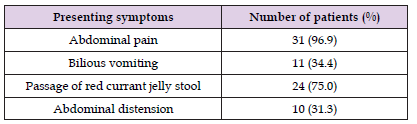
Principal Presenting Symptoms (n=32)
The principal presenting symptoms are depicted in Table 1.
Table 1:
Complications of Treatment
Among the patients that had hydrostatic reduction, two (6.3%) patients sustained intestinal perforation during the procedure that necessitated surgical exploration. These 2 patients are part of the 10 cases that had laparotomy.
Outcome of Treatment
Thirty-two (59.3%) patients had successful treatment of their intussusception through hydrostatic reduction. The patients were discharged home alive and well. There was no mortality.
The first ever report of intussusception was in 1674 by Paul Barbette of Amsterdam. John Hunter described a classic case of what he called “introsusception”. Cornelius Velse operated on a patient with intussusception successfully in 1742 [9]. In developing countries like Nigeria, intussusception is regarded as the commonest cause of intestinal obstruction in children [10]. Early presentation and prompt treatment of intussusception before gangrene sets in is considered key to successful management of paediatric intussusception. Early presentation of children with intussusception is of utmost importance because all that may be required is non-operative treatment, such as hydrostatic or pneumatic reduction, for the successful treatment of these children. In the index study, about two-third of the children with intussusception were treated by hydrostatic reduction successfully. This was unlike in the past years when majority of the children with intussusception were treated operatively (surgically) [11]. The reason for this change in trends could be due to early presentation, availability of the required manpower and prompt referrals to tertiary hospitals. The simplicity and the availability of the materials needed to carry out hydrostatic reduction may also explain this increased numbers.
The technique of hydrostatic reduction is easily taught, learnt and performed by resident doctors. However, late presentation of some of our patients is a drawback to hydrostatic reduction. It is worthy to note that hydrostatic reduction for intussusception is indicated only for uncomplicated intussusception when there is no clinical or radiological evidence of bowel perforation or shock. Children that have complicated intussusception are treated surgically. In the current series, our success rate is close to seventy percent. Other series in paediatric intussusception also recorded high success rates [12]. Improvements in hydrostatic reduction techniques, prompt presentation and adequate resuscitation may account for this good success rate. One study from Asia reported the use of drugs such as atropine to improve the success rate of hydrostatic reduction [13]. It is pertinent to state here that there are reports of occasional spontaneous reduction of intussusception [6,14]. The mean age of our patients was 6 months. This is consistent with the report of other studies on childhood intussusception [15].
Most cases of intussusception occur in infants who are less than 12 months of age. However, no age is exempted from intussusception: It can occur at any age. There was no pathological lead point in any of our patients. Most of the intussusceptions in children have no pathologic lead point. Hence, the description of the intussusception as idiopathic. The weaning age of the infants from breast milk and the introduction of artificial milk at about the age of 6 months may explain this peak age of intussusception. These was male predominance in the current series. This predominance of males is in line with the report of other researches on paediatric intussusception [6,16]. However, there is a report of female predominance with regard to children with intussusception [17]. The reason for the gender difference is not known. Relatively, there is delayed presentation of the patients. In developing countries, patients do not present early to the hospital. Lack of enlightenment and poverty may account for the delayed presentation to the hospital. Interventions were prompt in the course of treatment of the patients. This could be explained by the availability, accessibility and affordability of the materials required for the hydrostatic reduction. The duration of hospital stay is short due to the fact that hydrostatic reduction is minimally invasive with little disruption in the physiologic status of the patients.
Recovery is quick following hydrostatic reduction. Abdominal pain is a consistent symptom of intussusception. In children who cannot vocalize, abdominal pain is evidenced by flexing the knees and drawing the lower limb towards the chest. Almost all our patients manifested this feature. The abdominal pain of intussusception has been described as colicky. However, painless intussusception has been reported in children who are less than 3 months of age [18]. Other symptoms of intussusception for instance vomiting, passage of red currant jelly stool etc can also occur but in no particular order. The symptomatology of paediatric intussusception may vary from one child to another. The procedure of hydrostatic reduction of intussusception is not complication free. Two of our patients had bowel perforation during the course of the procedure in the current research. Intestinal perforation during hydrostatic reduction is an absolute indication for laparotomy. In the course of the present study, we did not record any mortality. Howbeit, mortality can occur in intussusception in a background of overwhelming sepsis from peritonitis resulting from bowel perforation.
In low income/developing country like Nigeria where all the funds, equipment, facilities and surgical expertise may not be available at all times for the treatment of paediatric intussusception, hydrostatic reduction could be considered a life saver for children.

International Association of Landscape Archaeology, Czech Glass Society, Czech Republic

Department of Chemistry, Semenov Institute of Chemical Physics, USSR Academy of Sciences, Moscow, Russia

Department of Educational Sciences, Research Centre Qualities of Teachers, School of Education – HAN, Nijmegen, Netherlands

Associate Professor at Department of Breast and Thyorid Surgey, Chongqing General Hospital, China

Neurology, LA BioMed Research Institute, USA





 Abstract
 PDF
PDF



























