info@biomedres.us
+1 (502) 904-2126
One Westbrook Corporate Center, Suite 300, Westchester, IL 60154, USA
Site Map
 ISSN: 2574 -1241
ISSN: 2574 -1241
ISSN: 2574 -1241
Received: September 10, 2024; Published: September 23, 2024
*Corresponding author: Arjuna Aluwihare, Emeritus Professor of Surgery, University of Peradeniya, Sri Lanka
DOI: 10.26717/BJSTR.2024.58.009204
From time immemorial people have fought and injured each other, and some of the injuries needed repair (surgery); people have also developed lumps needing removal, and intestines needing unblocking and other problems where the body had to be cut open and closed after repair- surgery. Thus SURGERY was a necessary help for people and had to be done by them on each other- a universal requirement. Documentation supports this- Surgery in known to have flourished in the Indian Subcontinent from before the onset of the Christian Era [1,2]. Surgery is known to have existed as a science in Greek times, and in many parts of the world [1] Surgical type instruments have been described in texts and found in several places [3-6]. In Taxila, in what is now Pakistan, instruments, at least some of which are surgical, were found in and around Srikat [6-8] without any hospital like building, but not at Mohendajaro. Models on Arab instruments are on display in Kuwait [9]. In the heyday of the Roman Empire surgery was done, and instruments were found in Pompeii in Italy and a house called a surgeons house as the instruments (presently in the Museum in Naples) were there, but there is no other evidence of the real occupation of the householder [10]; In Britain there are examples of Roman era instruments [11]. Surgery was known in China but surprisingly there were no instruments in one of the best sites in that country [12].
In the old Hotel Dieu hospital in Lyon in France surgery is said to have been done but although remains of that hospital form part of the present hospital complex there are no instruments extant from that time [13]. SriLanka has a very long written history and long Kingdoms based on Anuradhapura and then Polonnaruwa with lots of people, buildings and fighting- lumps to remove, intestines to repair, and injuries to heal. The best evidence of a healing centre is the Alahana Parivena Hospital at Polonnaruwa in Sri Lanka which was a part of a large Monastic complex. There is independent textual, epigraphic, and archaeological evidence that this building was a hospital- notably the location of a stone medicinal bath used to immerse people in healing oils [14,15] (Figures 1 & 2). This is the only occasion when the purpose for which the instruments listed in this article were used- namely a surgical one- could be deduced from the location of the artefacts in a hospital, and not just from their shape. These were therefore very significant finds- made during routine excavations of the area [14,15]. The then King- Parakramabahu the Great, is said to have been a ‘surgeon’. The artefacts and instruments with a comment on each (similar drawings exist in Indian and other texts [1], and the artefacts and instruments seen in Figures 3-8, [1,2,8,3-5,13-15] resemble very closely items in use now and their use can reasonably be deduced from the present use of similar instruments - accepting the fact that the injuries and lumps (etc.) that people had then must also be similar to the present.
Figure 1

Figure 2

Figure 3

Figure 4

Figure 5
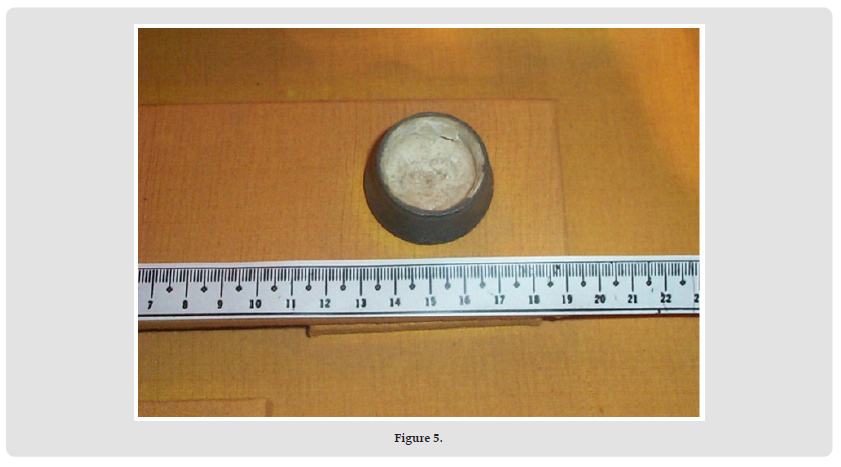
Figure 6
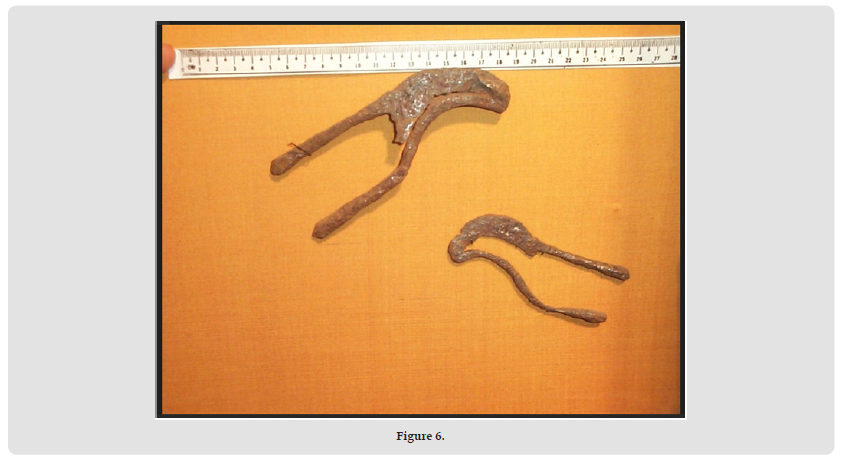
Figure 7
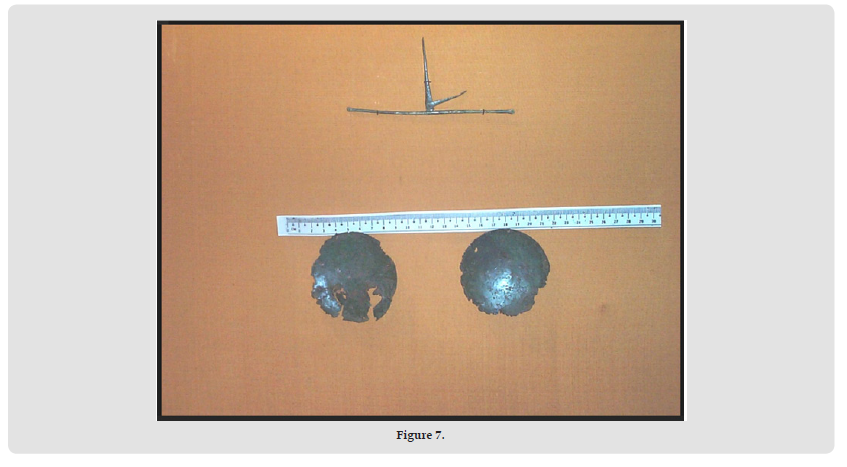
Figure 8

The numbers refer to the pictures, and comments are added to each as relevant. The items displayed very closely resemble modern equivalents- this is a ‘common sense’ remark!
a) The Hospital skeleton- the foundations was stones.
b) The stone medicinal trough that provides archaeological evidence that the building was a hospital and the instruments found in the building ‘surgical’ rather than for carpentry or whatever.
c) A oblong grindstone- used for sharpening instruments and knives then and now
d) A circular grindstone- both 3 and 4 used for making medications- then and now
e) Slaked lime containers and --
f) Areconut cutters - for helping to make the chew with Betel and tobacco for relaxation- then and now
g) A spoon- a very nonspecific object- as now must have had many uses.
h) Weighing scales and pans- large- used for weighing raw material and medications. These and the articles in Figures 9 -11 were made of a copper/bronze. The other instruments seem to be iron The technology was available to make steel several hundred years before this time in Sri Lanka.
i) Weighing scales and case- very small- used perhaps for weighing heavy metals (for medications) or opiate like substances. There were known to be methods of rendering people insensible during surgery and then waking them again [4]
j) Metal applicators for applying medications or cosmetics around the eye?
k) Probes know to have been used to sound cavities and in the delineation of fistulae and sinuses (these are short examples). Very similar instruments were found near St Albans in England. Metal probes are used now for the same purposes.
l) Large scissors of which there are several examples- of the kind used to cut cloth for bandages and dressings now, and presumably then.
m) Smaller scissors- to be fitted with wooden handles- perhaps used for cutting tissue. Now smaller scissors have metal handles and are used for cutting soft tissues (e.g. muscle, vessels, intestine, etc. The blades/scalpels are used for cutting skin.)
n) A lance- a type of instrument used for ‘stabbing’ open tissue very quickly to drain pus from an abscess or cut through the perineum (between the anus and the scrotum) for stones in the urinary bladder. These are known to have been uses then and resemble what is done now.
o) Forceps with very strong jaws as might be used for removing dead bone or extracting teeth-now and then.
p) Forceps with more delicate structure that might be used to handle tissue like skin or intestine- even more delicate forceps were found here and in Taxila, resembling modern forceps.
q) A scalpel to be used with a wooden handle with a hole at one end to take the blunt knob at one end of the blade. Scalpels made entirely of metal exist at Taxila and in Edinburgh from around the same period. The modern scalpel is lighter but of very similar shape. This is the instrument, par excellance, used for starting to cut open the skin in non emergency operations such as the removal of lumps under the skin, problems in the abdomen, and so on. One can presume they could replace the blade more easily than replacing the blade and attached metal/woodeen handle. Now detachable blades are used with metal handles (Figures 12-14).
Figure 9
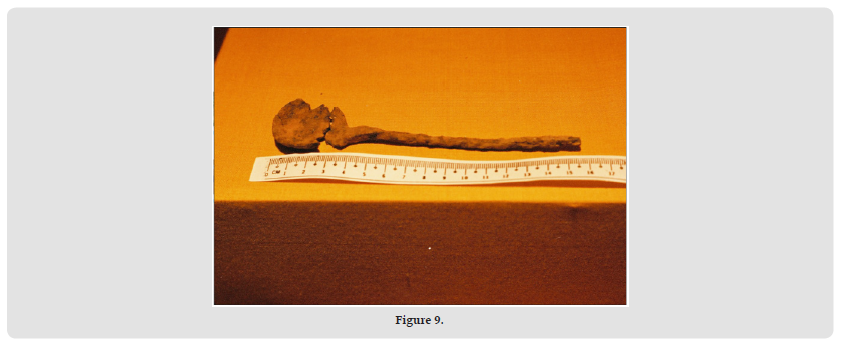
Figure 10
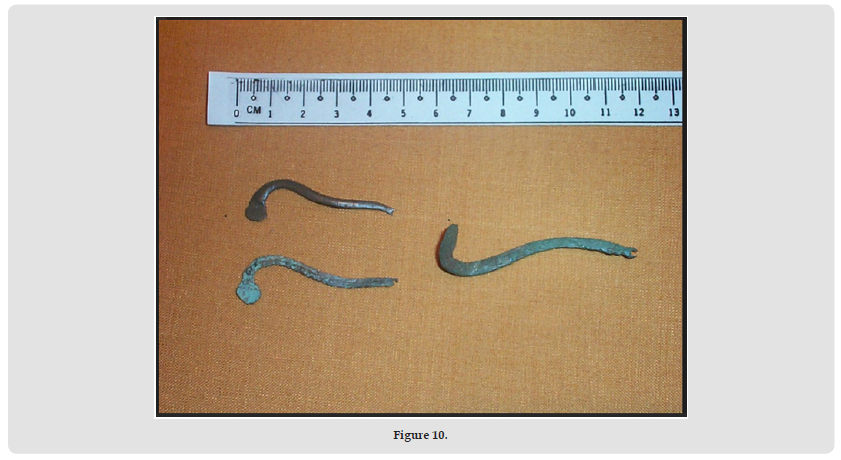
Figure 11
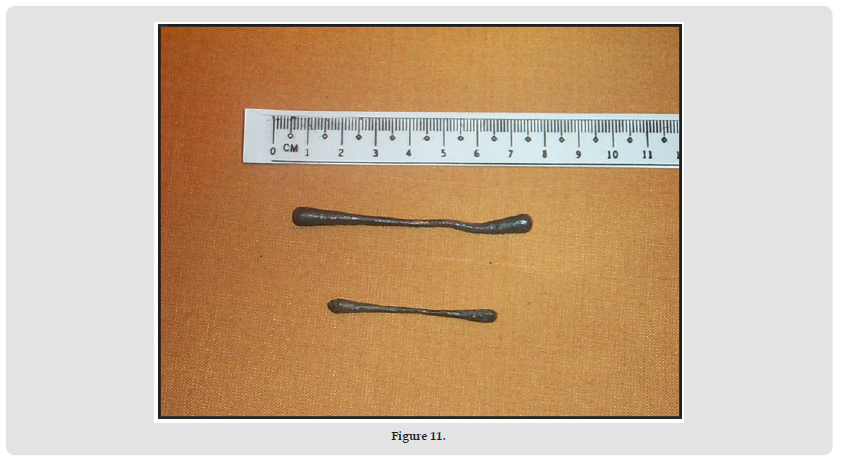
Figure 12

Figure 13
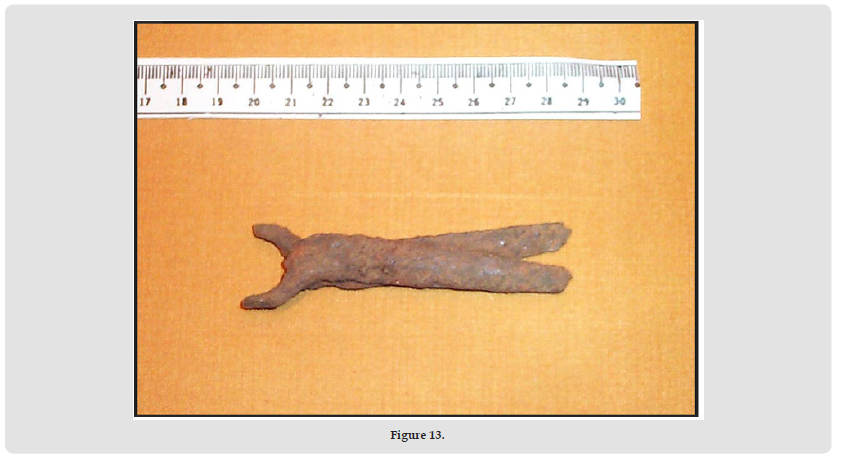
Figure 14

A reference to other finds of instruments is made in the Introduction. The hospital in Polonnaruwa was more fully described in the context of Sri Lanka history by Premathilleke et al [1,8]. The weighing scales, lime containers and areconut cutters are virtually identical with modern equivalents. More important these instruments- particularly the scissors, forceps, lance, and scalpel are almost identical with modern instruments. There are texts of Susrutha and Charaka (see 8) which describe old instruments and the operations done at that time before and just after the beginning of the Christian era. Finding all these in one hospital building instruments at Polonnaruwa is a very great significance as it indicates that operations were actually done- and not just imagined. The finds also ratify the truth of statements about surgery and hospitals in Sri Lankan texts (incidentally Leonardo Da Vinci’s drawings of submarines did not mean that he had one).The find of the hospital building near a capital city (Mihinale near Pollonnaruwa) also supports the high level of civilization of the time- abut 950 years ago- and surgical care available to inpatients.The decline of the surgical skills that existed is blamed variously on a supposed discouraging of animal experiment by Buddhism, colonial occupation, Malaria and so on. A fascinating theory is that the physicians and surgeons argued amongst each other too much to present a united front on any medical policy matter, and also thought themselves too important to attend policy meetings on national finance, agriculture, transport, military, or other policy [4]- with the result that they cut themselves off from major policy making and resource allocation decisions- leading to them losing control of the funding of their profession and facilities and their decline. Perhaps they did not realise that most people are healthy and of those that get ill many get better without medical or surgical help!
The surgical skill of the ancients is well shown and ratified by these finds. The surgical skills would only have been useful in a hospital in which the indications for the surgery and level of postoperative care would have been good enough to make doing the operations worthwhile. Assessment of possible reasons for the decline of the specialty in old Asia may have lessons for the surgical power bases of the present!
The former Professor or Archaeology at the University of Peradeniya, Professor P.L. Prematilleka, deserves the gratitude of the whole country for his pioneering work at Polonnaruwa. His colleagues and students deserve mention, and many have helped me more recently. It is a pleasure to thank the National Department or Archaeology and the Director of the Museum at Polonnaruwa for allowing these photographs to be taken and used.

International Association of Landscape Archaeology, Czech Glass Society, Czech Republic

Department of Chemistry, Semenov Institute of Chemical Physics, USSR Academy of Sciences, Moscow, Russia

Department of Educational Sciences, Research Centre Qualities of Teachers, School of Education – HAN, Nijmegen, Netherlands

Associate Professor at Department of Breast and Thyorid Surgey, Chongqing General Hospital, China

Neurology, LA BioMed Research Institute, USA





 Abstract
 PDF
PDF



























