info@biomedres.us
+1 (502) 904-2126
One Westbrook Corporate Center, Suite 300, Westchester, IL 60154, USA
Site Map
 ISSN: 2574 -1241
ISSN: 2574 -1241
ISSN: 2574 -1241
Received: August 12, 2024; Published: September 18,2024
*Corresponding author: Tasawar Iqbal, Institute of Physiology and Pharmacology, University of Agriculture Faisalabad, Pakistan
DOI: 10.26717/BJSTR.2024.58.009191
Rheumatoid arthritis is a persistent autoimmune disorder distinguished by inflammatory responses, discomfort, and degeneration occurring within the joints. Traditional treatments for rheumatoid arthritis frequently yield adverse effects and may not afford comprehensive alleviation. This paper undertakes an inquiry into the potential efficacy of spinach (Spinacia oleracea) as a supplementary treatment for rheumatoid arthritis. This study investigates the nutritional and bioactive constituents of spinach along with their potential mechanisms of action, elucidating the evidence that currently supports the utilization of spinach in the management of symptoms associated with rheumatoid arthritis.
Keywords: Rheumatoid Arthritis; Spinach; Inflammation; Spinacia Oleracea; Bioactive Compounds
Rheumatoid arthritis is an incapacitating autoimmune disorder that impacts a substantial number of individuals globally. The condition is distinguished by persisting inflammation within the synovial tissue of joints, resulting in the manifestation of pain, swelling, and compromised joint integrity. The prevailing therapeutic modalities for managing rheumatoid arthritis commonly encompass no steroidal anti-inflammatory drugs disease-modifying anti-rheumatic drugs and biologic agents. Although these medications have demonstrated efficacy, they frequently precipitate adverse reactions and may not afford absolute alleviation of symptoms [1]. In recent years, there has been an increasing surge in the curiosity to investigate supplementary and alternative therapeutic approaches in addressing the symptoms related to rheumatoid arthritis (RA), particularly emphasizing dietary interventions [2]. Spinach (Spinacia oleracea), an abundant foliar vegetable endowed with numerous essential nutrients and bioactive constituents, has garnered considerable attention due to its putative anti-inflammatory and antioxidant attributes. This essay endeavors to offer a comprehensive examination of the current body of literature regarding the utilization of spinach in the management and therapy of rheumatoid arthritis [3]. Spinacia oleracea, a widely cultivated plant, holds significant value as a staple in dietary consumption and serves as a prevalent ingredient in the food processing sector on a global scale.
The fresh foliage is prepared through cooking processes and subsequently consumed as sustenance. Spinacia oleracea has historically been utilized as a dietary supplement and alternative medicinal food in India, as well as across the globe [4]. Spinach has been extensively studied and applied as a potential preventative and therapeutic agent for various medical conditions, including diabetes, heart injury, neural disorders, hormone replacement therapy, anti-cancer interventions, and other ailments [5]. The substance is employed as a reputable dietary supplement, recommended by medical professionals as a nourishing aliment that combats various illness states and enhances health supplementation. There is currently a dearth of reports pertaining to the potential osteoarthritis and chondro-protective effects exhibited by the leaves of Spinacia oleracea. In a previous study, we have demonstrated the osteogenic properties of Spinacia oleracea extract in the context of post-menopausal bone loss and the promotion of fracture healing. In the context of a drill hole fracture healing model, the administration of Spinacia oleracea extract yields a dual effect, stimulating both osteoblast cells and promoting chondrocyte prolif-eration at the injury site. This intriguing outcome has inspired our investigation into the extract’s potential contribution to subchondral bone pathology and the consequential degeneration of articular cartilage throughout the course of osteoarthritis progression [6]. According to existing research, the injection of monosodium iodoacetate into the knee joints of rats is a relevant model for studying osteoarthritis and assessing the potential of new agents in protecting cartilage.
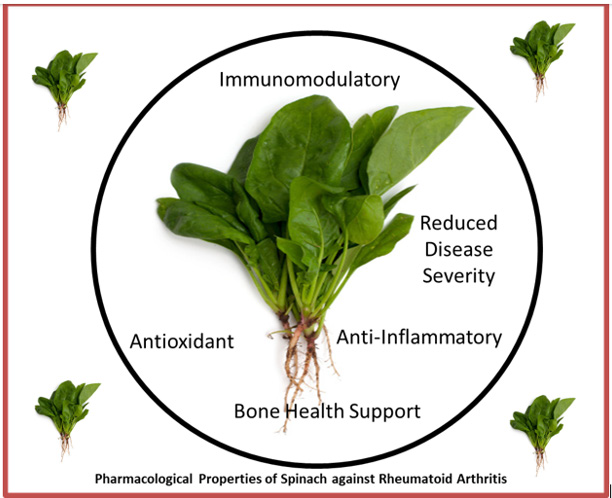
This model also shares similarities with the pathophysiology observed in rheumatoid arthritis in humans [7]. Consequently, the aim of the current study was to examine the impact of Spinacia oleracea extract on cartilage degeneration in the articular cartilage tissue region. The primary objective was to explore and establish new therapeutic options for the prevention and treatment of disorders related to chondrocytes [8]. Figure 1 show the pharmacological properties of spinach against rheumatoid arthritis.
Figure 1: Pharmacological Properties of Spinach against Rheumatoid Arthritis
Spinach is highly esteemed for its nutritional abundance, rendering it a priceless constituent of the diet for enhancing overall well-being. Spinach comprises of a range of vital nutrients, encompassing vitamins, minerals, and dietary fiber. Several significant elements can be observed within the perspective [9].
Spinach possesses advantageous attributes as a rich provider of vitamins A, C, E, and K. Vitamin A fulfills a crucial role in the maintenance of both skin health and vision, whereas vitamins C and E possess antioxidant properties that can effectively mitigate the detrimental effects of oxidative stress, an underlying factor in the development of rheumatoid arthritis. Vitamin K plays a pivotal role in maintaining optimal bone health and has been associated with potential preventive effects against joint damage [10].
Spinach possesses considerable concentrations of minerals, including calcium, magnesium, and potassium. The element calcium is of utmost significance in the preservation of skeletal integrity, whereas magnesium and potassium hold pivotal roles in the facilitation of musculature and nervous system operations [11].
Spinach is characterized by its high content of dietary fiber, a constituent known to contribute to the facilitation of digestion and enhancement of gut health. There is a growing body of research indicating a plausible association between gastrointestinal well-being and autoimmune disorders such as rheumatoid arthritis (RA) [12].
In addition to its macronutrient and vitamin composition, spinach possesses bioactive compounds that have garnered considerable attention due to their potential therapeutic properties, particularly within the domain of rheumatoid arthritis [13].
Spinacia oleracea, commonly known as spinach, is recognized for its rich content of various flavonoids, including quercetin and kaempferol. These specific flavonoids exhibit notable attributes pertaining to their antioxidant and anti-inflammatory properties. These compounds demonstrate potential efficacy in mitigating inflammation and oxidative stress within the joints [14].
Lutein and zeaxanthin are carotenoids that have been identified as constituents present in spinach. These compounds are renowned for their antioxidant properties and their potential in mitigating the incidence of chronic diseases, such as inflammatory conditions [15].
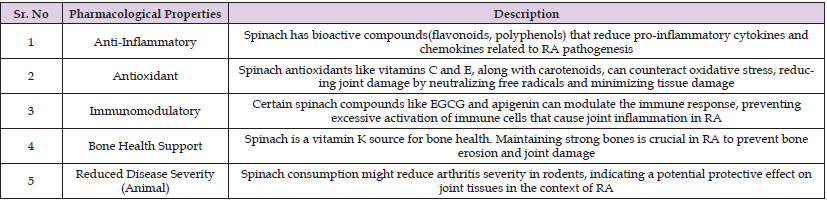
Spinach exhibits the presence of polyphenols, such as epigallocatechin gallate (EGCG) and apigenin, which have exhibited both anti-inflammatory and immunomodulatory properties in scientific studies. These chemical entities possess the potential to modulate the immune response in patients diagnosed with rheumatoid arthritis (RA) [16] (Table 1).
Table 1: Pharmacological Properties of Spinach against Rheumatoid Arthritis.
The advantageous effects of spinach within the realm of Rheumatoid Arthritis (RA) can be ascribed to its nutritional constitution and bioactive compounds. Numerous mechanisms have been postulated (insert citation here) [17].
The bioactive compounds found in spinach, such as flavonoids, carotenoids, and polyphenols, have exhibited noteworthy anti-inflammatory characteristics. These substances have the potential to diminish the synthesis of pro-inflammatory cytokines and chemokine in order to alleviate joint inflammation in individuals diagnosed with rheumatoid arthritis (RA) [18].
Spinach exhibits a notable abundance of antioxidants, thereby possessing the ability to mitigate the detrimental oxidative stress, which serves as a vital factor in the onset of joint damage prevalent in cases of rheumatoid arthritis (RA). Antioxidants play a crucial role in mitigating the detrimental effects generated by free radicals and promoting tissue preservation [19].
Spinach contains specific chemical compounds, namely EGCG and apigenin, which exhibit Immunomodulatory properties. These mechanisms have the potential to regulate the immune response and inhibit the hyperactivation of immune cells implicated in the inflammation of joints observed in rheumatoid arthritis [20].
The vitamin K content present in spinach plays a critical role in promoting and maintaining optimum bone health. The importance of preserving robust and optimal bone health is particularly salient within the context of rheumatoid arthritis, given the disease’s propensity to induce bone erosion and joint impairment [21].
Although the potential of spinach in the treatment of rheumatoid arthritis shows promise, it is crucial to acknowledge that the supporting evidence is still in its nascent stages. There exists limited research pertaining to the specific impacts of spinach consumption on rheumatoid arthritis. Numerous empirical investigations shed light upon the potential advantages of incorporating spinach into one’s dietary routine with regards to mitigating inflammation and effectively managing symptoms associated with rheumatoid arthritis [1]. Several in vitro studies have provided evidence of the anti-inflammatory and antioxidant properties of spinach extracts and specific compounds present in spinach. These findings lend support to the notion that spinach may hold potential for mitigating inflammation in rheumatoid arthritis. Studies conducted on animals have demonstrated that the consumption of spinach presents a potential reduction in the severity of arthritis symptoms in rodent models. The findings from these studies provide evidence indicating that the consumption of spinach may confer a safeguarding effect on joint tissues. There is a limited availability of clinical trials examining the direct impact of spinach on individuals diagnosed with Rheumatoid Arthritis. Nevertheless, recent observational studies have established a correlation between a vegetable-rich diet, particularly one incorporating spinach, and a notable decrease in symptoms related to rheumatoid arthritis as well as an improvement in overall quality of life [22]. Anecdotal accounts provided by rheumatoid arthritis patients, who have integrated spinach consumption into their dietary regimens, have indicated potential amelioration of joint pain and inflammation. Nonetheless, it should be noted that these reports cannot serve as a viable alternative to controlled clinical trials [23].
Spinach presents potential advantages for patients with rheumatoid arthritis however, it is crucial to acknowledge the existence of certain challenges and considerations. It is important to recognize that the effectiveness of dietary interventions can significantly differ among individuals [24]. The efficacy of spinach in managing rheumatoid arthritis may vary between individuals, highlighting the importance of incorporating spinach within a comprehensive approach to RA management. It is crucial to bear in mind that spinach, similar to other dietary constituents, may have potential interactions with medications [7]. It is recommended that patients seek guidance from their healthcare providers prior to making substantial dietary modifications, particularly if they are currently undergoing medication treatment for rheumatoid arthritis [1]. Further investigations through properly conducted clinical trials are necessary to investigate the specific impacts of spinach consumption on RA. In order to augment the reliability and validity of the obtained evidence, it is recommended that these trials be conducted with an increased sample size while also incorporating measures to control for potential confounding factors [25].
Spinach, scientifically called Spinacia oleracea, is a highly nutritious vegetable abundant in bioactive compounds that exhibit properties such as anti-inflammatory, antioxidant, and Immunomodulatory effects. Although there is limited evidence supporting the use of spinach in treating rheumatoid arthritis, it shows potential in managing symptoms and reducing inflammation. Adding spinach to a balanced diet could complement conventional treatments for RA. However, it is not intended to be a substitute for prescribed medications or other recommended therapies. Patients who have RA should seek advice from their healthcare providers before making important changes to their diet. Including spinach in their overall management plan for the condition should be considered. To gain a better understanding of the precise impact of spinach on RA and to establish precise dietary recommendations for patients, further research, such as well-executed clinical trials, is required. In the end, a customized strategy for managing RA that takes into account traditional therapies and dietary interventions could yield the most favorable results for individuals with this long-lasting autoimmune disease.

International Association of Landscape Archaeology, Czech Glass Society, Czech Republic

Department of Chemistry, Semenov Institute of Chemical Physics, USSR Academy of Sciences, Moscow, Russia

Department of Educational Sciences, Research Centre Qualities of Teachers, School of Education – HAN, Nijmegen, Netherlands

Associate Professor at Department of Breast and Thyorid Surgey, Chongqing General Hospital, China

Neurology, LA BioMed Research Institute, USA





 Abstract
 PDF
PDF