info@biomedres.us
+1 (502) 904-2126
One Westbrook Corporate Center, Suite 300, Westchester, IL 60154, USA
Site Map
 ISSN: 2574 -1241
ISSN: 2574 -1241
ISSN: 2574 -1241
Received: September 09, 2024; Published: September 13, 2024
*Corresponding author: Tian Xia, National Clinical Research Center for Chinese Medicine Acupuncture and Moxibustion, Tianjin, China
DOI: 10.26717/BJSTR.2024.58.009185
Nocturnal emission, a gender-specific physiological phenomenon, signifies the onset of male puberty and maturity. The frequent occurrence of involuntary ejaculation during sleep post-puberty, coupled with an inability to control it, can significantly impact the quality of life for men. Notably, there exists a dearth of knowledge and data surrounding this condition. Drawing upon a comprehensive review of existing literature and clinical insights, this article introduces a novel disease entity, delving into its nomenclature, potential underlying mechanisms, clinical manifestations, and, crucially, outlines a proposed treatment approach.
Keywords: Long-Term Nocturnal Emission; Clinical Feature; Potential Mechanism; Serotonin Reuptake Inhibitors
Nocturnal emission (NE), a ubiquitous natural phenomenon in males, typically manifests as spontaneous ejaculation during sleep, devoid of any sexual arousal, often accompanied by wet dreams. This process can include the sensation of orgasm, leaving behind dry seminal stains or traces of semen on underwear in the morning. Early literature has meticulously documented the frequency and duration of NE in young males [1], and a seminal 96-month study in The American Journal of Psychology provides an in-depth time series analysis of a single male’s nocturnal emissions [2].While NE is a physiological marker of male puberty and maturity, its excessive frequency, persisting beyond post-adolescence and exceeding normal physiological bounds, warrants consideration as a pathological condition [3]. However, despite the importance of this issue, our current understanding of NE remains limited, with a scarcity of data and unclear treatment recommendations, as evidenced by bibliographic searches. This article endeavors to introduce a novel disease concept centered on frequent NE, exploring the potential underlying pathological mechanisms, comprehensively summarizing the clinical manifestations, and offering targeted treatment recommendations to address this understudied condition.
Undoubtedly, the use of the term “NE” as a blanket designation for a potential disease state lacks the specificity required to accurately reflect its clinical significance. Given that NE encompasses both normal physiological processes during male puberty and maturity, as well as potentially pathological manifestations [4], it is imperative to adopt a nuanced approach in differentiating between these two distinct entities. By carefully distinguishing between these phenomena, we can enhance the precision of our diagnoses, tailor treatments more effectively, and ultimately, contribute to better health outcomes for those affected. Typically, the nomenclature of diseases adheres to a tripartite structure [5], with each component serving a distinct purpose. The first term encapsulates clinical and pathological data from patients, emphasizing the defining characteristics of the disease for diagnostic clarity. The second term is utilized by health statisticians and registrars for analytical and record-keeping purposes, enabling population-level insights. Lastly, the third term represents a highly specialized, ever-evolving category that biomedical researchers continually refine and expand within their respective technical domains. Given these principles, we argue that adopting a name rooted in the first term is most apt for the disease in question. Hence, we propose “Long-Term Nocturnal Emission” (LTNE) as a more precise and descriptive terminology that aptly captures the clinical essence of this condition. The prefix “Long-Term” underscores the frequent occurrence, while “Nocturnal Emission” denotes the specific manifestation.
This proposed name offers several advantages. Firstly, it clearly delineates between pathological and physiological occurrences, enhancing diagnostic precision. Secondly, it serves as a concise yet informative label that facilitates communication among healthcare professionals and patients alike. Lastly, by providing a focused and well-defined research target, LTNE establishes a solid foundation for further investigations into the underlying mechanisms, risk factors, and potential treatments for this condition. As the patient population seeking treatment for Long-Term Nocturnal Emission (LTNE) grows, the authors have meticulously summarized its clinical characteristics in comparison to spermatorrhea (Table 1). LTNE is characterized not solely by the frequent occurrence of nocturnal ejaculation but also by a diverse array of symptoms that permeate daily life. These systemic manifestations encompass osphyalgia, profound fatigue, diminished concentration abilities, and emotional disturbances such as anxiety, depression, and irritability, all of which may manifest subsequent to persistent nocturnal ejaculation among LTNE patients. The relentless frequency of nocturnal ejaculation, coupled with the post-ejaculatory discomfort, imposes a significant burden on the daily functioning of adult males afflicted with LTNE. Their lives are adversely impacted, and some individuals even report suicidal ideation stemming from the intolerable emotional and physical distress associated with this condition, as evidenced by patient narratives.
Table 1: Comparison of characteristics between LTNE and spermatorrhea.
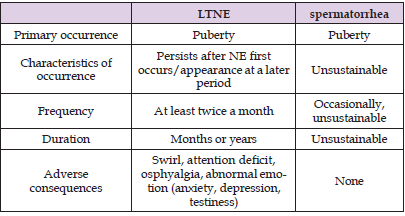
It is noteworthy that a subset of patients present with primary complaints unrelated to frequent nocturnal emission. These individuals seek medical attention primarily due to overt symptoms of discomfort, often overlooking LTNE as the primary underlying cause amidst their daytime symptoms. Consequently, the pathological significance of LTNE merits further exploration and debate. Based on the author’s clinical experience, it is acknowledged that some men experience a fixed frequency of nocturnal ejaculation, and whether or not intervention is warranted for those with lower frequencies hinges on the presence of clinical significance. Additionally, instances of spermatorrhea occurring weekly or monthly may be influenced by physical and age-related factors, with the symptoms outlined in Table 1 not necessarily indicative of a pressing concern. As such, immediate treatment may not be necessary in these cases.
Given the current lack of epidemiological data on Long-Term Nocturnal Emission (LTNE), it is plausible that this stems from a limited comprehension of the disease. The majority of epidemiological studies have predominantly centered on parameters associated with the initial occurrence of spermatorrhea during adolescence, encompassing age, behavioral patterns, psychological transformations, and the presence of varicocele [3,4,6,7]. Previous research investigating the prevalence of spermatorrhea among virgin male adolescents revealed that a notable proportion (17.3%) of 113 male participants had never experienced spermatorrhea [3]. A separate survey conducted among Chinese boys aged 8-15 years reported an average age of first spermatorrhea at 12.15 years [4]. Furthermore, a study among Indonesian teenagers highlighted the rarity of first spermatorrhea before the age of 12, with only 1% of males reporting such an early onset [8]. These findings underscore the need for more comprehensive research, particularly in the realm of LTNE, to fill the existing knowledge gap and inform clinical practice.
As is well established, the human sexual cycle encompasses four sequential phases: sexual impulse, arousal, orgasm, and regression [9]. During the arousal phase, males experience physiological responses such as penile erection and ejaculation, which necessitate adequate sexual stimulation for initiation and maintenance [9,10]. In contrast to normal ejaculation, which necessitates robust sexual stimulation, penile erection, and vaginal contractions to culminate in orgasm, spermatorrhea occurs independently of these prerequisites. Examining the temporal dynamics of spermatorrhea, it becomes evident that the deep sleep state at night does not provide sufficient sexual stimulation to elicit penile erection and ejaculation. This observation hints at an alternative mechanism underlying this specific physiological event. Intriguingly, prior research has demonstrated that sperm with vitality and concentration can be retrieved from the nocturnal emissions of anejaculation patients, reinforcing the notion that spermatorrhea represents a nocturnal ejaculatory activity that transpires without any overt sexual stimulation [11,12]. Ejaculation is intricately governed by a harmonious interplay between the central nervous system (brain) and peripheral nervous system (spinal cord) [13]. Upon receiving ample sensory inputs of sexual stimulation (visual, tactile, olfactory, auditory), the higher neural centers of the brain process these signals through the brainstem, hypothalamus, and preoptic area, subsequently relaying them to the lower ejaculation center located in the spinal cord. This spinal ejaculation generator orchestrates the interplay of sympathetic, parasympathetic, and motor outflows to orchestrate the emission and expulsion of semen [9,13,14].
While the neural underpinnings of ejaculation are relatively well-delineated, the mechanism behind spermatorrhea remains elusive. In the absence of definitive experimental data, hypotheses regarding its occurrence are primarily based on the neurophysiological characteristics of ejaculation and sleep. Given that spermatorrhea represents spontaneous ejaculation devoid of external stimulation, unraveling its origins necessitates a deeper exploration into the neurobiological responses occurring within the brain during nocturnal sleep. It is now well-established that waking and sleeping states involve intricate, orchestrated alterations in neurotransmitter and neuromodulator levels within the brain, notably norepinephrine, dopamine, and serotonin (5-HT) [15]. Notably, these very same neurotransmitters are implicated in the regulation of ejaculation, with serotonin occupying a pivotal role across various neural axes [16,17]. The extensive 5-HT network, densely innervating the spinal nervous system, serves as a conduit for ejaculation signals [18,19]. Furthermore, serotonin secretion fosters wakefulness while inhibiting rapid eye movement (REM) sleep [20]. Conversely, sleep-promoting neurons in the ventrolateral preoptic region release gamma-aminobutyric acid and galanin, projecting these neurotransmitters to the basal forebrain and brainstem to suppress wakefulness-inducing structures [20,21]. Additionally, melatonin, another key regulator of sleep, contributes to REM sleep by inhibiting serotonin secretion [20,22].
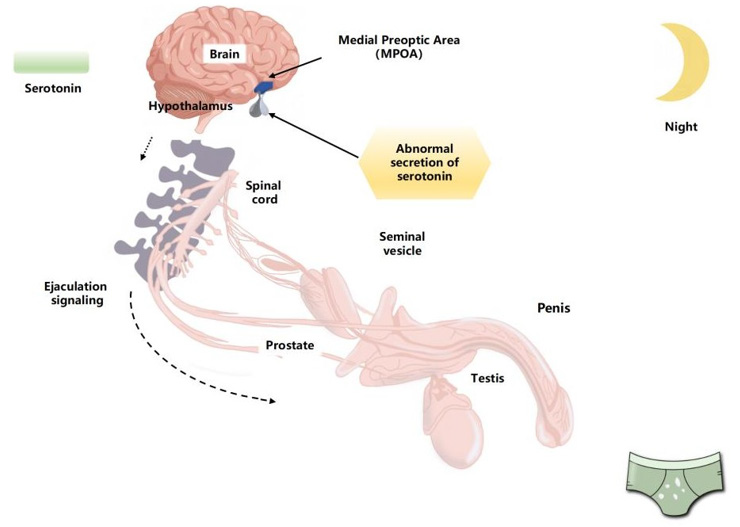
However, in cases where serotonin secretion is aberrant, it can activate the medial preoptic area (MPOA) in the brain, which subsequently transmits ejaculation signals to the spinal ejaculation center, culminating in semen ejaculation [17]. Wakefulness and sleep constitute a cyclic physiological process intricately orchestrated by the interplay of diverse neurons and neurotransmitters within the brain, maintaining the stability of this vital cycle [15]. The author postulates that, during the regulation of sleep-wake patterns, an abnormal accumulation of 5-HT secretion, potentially influenced by several underlying factors such as congenital predisposition, early-life excessive masturbation, anxiety, and fluctuations in physical temperature, may eventually precipitate spermatorrhea. Should patients fail to adopt adequate measures to mitigate this erroneous secretion, the accumulation of these deviations may, over time, solidify into a recurring pattern, occurring with a fixed frequency. This postulated mechanism may underlie the occurrence of Long-Term Nocturnal Emission (LTNE), as depicted in Figure 1.
Figure 1: Schematic diagram of LTNE generation mechanism.
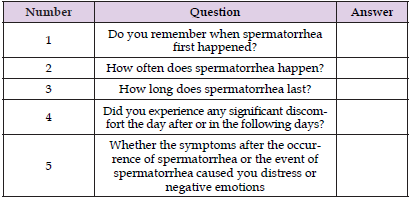
Patients afflicted with Long-Term Nocturnal Emission (LTNE) commonly experience a persistent inability to restrain nocturnal emissions, accompanied by a spectrum of associated syndromes. They grapple with a lack of control over their nocturnal occurrences, often coupled with mild anxiety. To cater to the unique characteristics of these patients, the authors devised a comprehensive questionnaire that encapsulates the essential features of the condition (Table 2). This questionnaire encompasses crucial details such as the initial onset of spermatorrhea, its frequency, the duration of LTNE, the symptoms manifested post-spermatorrhea, and whether these episodes elicit negative emotions. While this questionnaire provides valuable insights into the clinical profile of LTNE, it serves primarily as a reference tool for patients, as further validation through rigorous evidence-based medical research is necessary. Ongoing studies are essential to affirm its efficacy, and the development of a corresponding evaluation system will undoubtedly enhance and streamline its clinical application.
Table 2: A questionnaire for LTNE symptom.
Drawing upon the author’s expertise, selective serotonin reuptake inhibitors (SSRIs) such as paroxetine, sertraline, and citalopram have emerged as effective therapeutic options for managing the symptoms of Long-Term Nocturnal Emission (LTNE). The administration of these SSRIs has demonstrated a marked reduction in the frequency of nocturnal emissions, with some cases even experiencing complete cessation of these occurrences. This therapeutic effect may be attributed to the previously discussed mechanism, where SSRIs inhibit (or delay) ejaculation by modulating serotonin reuptake. However, a quantifiable test to guide the discontinuation of SSRIs in LTNE management remains elusive, necessitating further research into optimal treatment duration. Through regular follow-ups, the author empirically employs a step-down approach to taper medication doses. In doing so, the following scenarios may arise, necessitating specific treatment countermeasures:
1. Should LTNE reemerge during dose reduction, patients are advised to revert to their initial dosage and continue regular follow- ups until symptoms are once again effectively controlled before attempting further dose reduction.
2. The duration of the treatment cycle is individualized and often correlates with the patient’s illness duration; longer illnesses may require more extended medication periods.
3. While LTNE may share some superficial similarities with mental illness, the author emphasizes significant underlying differences between the two conditions.
4. The cornerstone of treatment lies in assessing the impact of LTNE on the patient’s quality of life. For instance, if a patient experiences asolitary spermatorrhea monthly without significant consequences, therapeutic intervention may not be necessary.
5. Notably, even patients falling under the fourth recommendation, who do not require immediate treatment, are considered part of the LTNE-prone population and warrant regular monitoring.
The conception of LTNE (Long-Term Nocturnal Emission) is indeed a valuable contribution aimed at raising awareness and understanding of this potentially debilitating condition. The fact that it significantly impacts patients’ quality of life underscores the importance of recognizing LTNE as a legitimate health concern. Given the scarcity of existing literature on this topic, the author’s empirical summary of LTNE’s characteristics and treatment recommendations serves as a valuable starting point. The observed efficacy of SSRIs (Selective Serotonin Reuptake Inhibitors) in controlling the frequency of LTNE episodes not only provides relief to patients but also serves as a crucial foundation for hypothesizing the underlying mechanisms involved. However, it is crucial to acknowledge that the pathogenic characteristics, precise mechanisms, questionnaire validity, treatment recommendations, and other aspects of LTNE remain largely unexplored and require rigorous basic and clinical research for confirmation and refinement. Furthermore, the long-term efficacy and safety of SSRIs in managing LTNE must be thoroughly evaluated. This includes assessing the optimal duration of treatment, potential side effects, and the development of more targeted therapeutic strategies. Such evaluations will not only enhance our understanding of LTNE but also guide the development of evidence-based treatment protocols that can effectively address this condition and improve patients’ lives. In summary, while the initial findings regarding LTNE and the potential role of SSRIs in its management are promising, there is still much work to be done. Ongoing research efforts are essential to unravel the mysteries of LTNE, optimize treatment strategies, and ultimately improve the health and well-being of those affected by this condition.

International Association of Landscape Archaeology, Czech Glass Society, Czech Republic

Department of Chemistry, Semenov Institute of Chemical Physics, USSR Academy of Sciences, Moscow, Russia

Department of Educational Sciences, Research Centre Qualities of Teachers, School of Education – HAN, Nijmegen, Netherlands

Associate Professor at Department of Breast and Thyorid Surgey, Chongqing General Hospital, China

Neurology, LA BioMed Research Institute, USA





 Abstract
 PDF
PDF



























