info@biomedres.us
+1 (502) 904-2126
One Westbrook Corporate Center, Suite 300, Westchester, IL 60154, USA
Site Map
 ISSN: 2574 -1241
ISSN: 2574 -1241
ISSN: 2574 -1241
Received: August 15, 2024; Published: August 22, 2024
*Corresponding author: Chee Kong Yap, Department of Biology, Faculty of Science, Universiti Putra Malaysia, 43400 UPM Serdang, Selangor, Malaysia
DOI: 10.26717/BJSTR.2024.58.009141
The transition to a green energy bioeconomy is critical for achieving global carbon neutrality. This study explores the alignment of individual talents with the demands of the green energy sector, applying the Holland RIASEC model using the FIKR (facet, insight, knowledge, and resilience) Profiling Assessment Tool. Analyzing the traits of 100 respondents, the study identifies key strengths in Realistic (R), Investigative (I), Artistic (A), Social (S), Enterprising (E), and Conventional (C) dimensions providing insights into their suitability for various roles within the green energy industry. The findings emphasize the importance of strategic talent alignment and targeted development programs to optimize workforce effectiveness in driving sustainability initiatives. By recognizing the diversity of skills and aligning them with sector-specific demands, organizations can build a robust, adaptable workforce capable of leading the charge towards a carbon-neutral future. The findings from this study underscore the importance of targeted talent development strategies in the green energy sector. By identifying key strengths and providing opportunities for skill enhancement, organizations can create a more adaptable and motivated workforce. The study advocates for the adoption of strategic talent alignment practices that not only match individuals with roles that suit their strengths but also support their long-term growth and satisfaction. In doing so, the green energy bioeconomy can build a resilient workforce, reassuring the audience about the adaptability of the workforce in leading the charge towards a sustainable, carbon-neutral future.
Keywords: Green Energy; Talent Alignment; FIKR Profiling; Holland’s RIASEC Model; Carbon Neutrality
The global shift towards a green energy bioeconomy is a pivotal step in the fight against climate change and pursuing of carbon neutrality. As the demand for sustainable energy solutions increases, so does the need for skilled professionals who can lead this transition (Hofmann [1]). The green energy sector, encompassing renewable energy technologies, sustainable practices, and innovative solutions, requires diverse talents to address its multifaceted challenges. Understanding how individual traits align with the specific demands of this sector is crucial for building a workforce capable of driving the green energy transition (Arcelay, et al. [1-4]). One of the key challenges facing the green energy sector is the need for interdisciplinary teams that can approach complex problems from multiple perspectives. The diversity of skills required—from technical engineering to research, design, and leadership—highlights the importance of a holistic approach to talent management (Glen, et al. [4]). In addition to technical and analytical skills, the green energy sector requires creativity, communication, and leadership to drive public engagement and foster stakeholder collaboration (Glen, et al. [4]).
The study explores the role of creativity and leadership in enhancing the effectiveness of the green energy bioeconomy and how these traits can be cultivated and aligned with specific roles (Glen, et al. [1,3,5]). The RIASEC model categorizes individuals into six dimensions—Realistic (R), Investigative (I), Artistic (A), Social (S), Enterprising (E), and Conventional (C)—each representing different work preferences and skill sets (Wiebusch [6-10]). By analyzing these dimensions, the study seeks to provide insights into how individuals can be strategically placed in roles that align with their strengths, thereby optimizing their contributions to the green energy bioeconomy (Glen, et al. [4]). Humanology Sdn. Bhd has used the FIKR (facet, insight, knowledge, and resilience) profiling assessment tool. This study aims to assess the suitability of 100 respondents for evaluating individual traits and identifying their suitability for specific roles within the green energy sector by analyzing their Holland’s RIASEC scores using the FIKR profiling assessment tool. This will explore the role of strategic talent alignment in enhancing the effectiveness of the green energy bioeconomy.
Humanology Sdn Bhd provided us with independent samples of 100 valid participants. Each participant provided a full set of item responses on a 200-item. This is intended for use in a wide range of occupational groups. The questionnaire is quantitative type (dichotomous survey scale) with Yes (1) or No (0) surveys. This allows the respondents to provide quick, straightforward answers by choosing between the two options. The 200-item included the personality traits needed to assess Holland’s codes, namely, Endurance, Variety, and Aggressive; I included Self-criticism, Analytical, and Intellectual; A included Intuition, Emotional, and Perceiver; S included Dependent, Nurturance, and Extrovert; E included Extrovert, Achievement, and Control; and C included Support, Structure, Self-conceptual, and Autonomy. This study applied the Holland’s RIASEC model using the FIKR Profiling Assessment Tool to analyze the traits of 100 respondents, aiming to identify their suitability for various roles within the green energy bioeconomy. The FIKR Profiling Tool was chosen for its comprehensive approach to assessing personality traits, while the Holland RIASEC model provided a framework for categorizing these traits into six dimensions: Realistic (R), Investigative (I), Artistic (A), Social (S), Enterprising (E), and Conventional (C).
Table 1 provides an overview of the respondents' distribution across the RIASEC dimensions, highlighting their key traits and potential roles within the green energy bioeconomy. The Realistic (R) dimension exhibited a significant inclination towards practical, hands-on tasks among the respondents, with an average score of 22.5 and a range of 11 to 30. This broad range indicates that while some individuals have a moderate preference for realistic activities, a substantial portion is highly inclined towards technical and physical tasks. Specifically, 45% of the respondents (45 individuals) scored above 25 in the Realistic dimension, making them well-suited for roles in engineering, construction, and other technical professions that are integral to the green energy sector. These roles require the application of practical skills and the ability to work with tools, machinery, and complex systems—essential components in building and maintaining green energy infrastructure. In the Investigative (I) dimension, the respondents demonstrated strong analytical and problem-solving capabilities, with an average score of 18.9 and a range of 4 to 28. Approximately 30% of the respondents (30 individuals) scored above 21, indicating a high potential for research-oriented roles.
Table 1: An overview of the respondents’ distribution across the RIASEC dimensions, highlighting their key traits and potential roles within the green energy bioeconomy.

These individuals are likely to excel in scientific inquiry, data analysis, and other professions that demand deep cognitive engagement and critical thinking. Their skills are particularly valuable in fields such as academic research, healthcare, and information technology, where innovation and discovery drive progress in developing sustainable technologies and solutions. The Artistic (A) dimension revealed moderate levels of creativity and expressive abilities among the respondents, with an average score of 16.4 and a range of 7 to 29. Despite the lower average, 20% of the respondents (20 individuals) scored above 22, showing a strong affinity for creative professions. These individuals could contribute significantly to the green energy bioeconomy through roles in arts, design, and media, where creativity is key to communicating the importance of sustainability and engaging the public in green initiatives. Their ability to think outside the box and generate innovative ideas could also support product design and development within the green energy sector.
The Social (S) dimension demonstrated a high capacity for interpersonal interactions and community-focused roles, with an average score of 21.5 and a range of 9 to 28. A significant 35% of the respondents (35 individuals) scored above 23, making them well-suited for roles that involve communication, collaboration, and empathy. These traits are essential for positions in counselling, teaching, social work, and leadership roles within the green energy sector. These individuals can drive public support for sustainability initiatives, foster partnerships, and lead community engagement efforts, all of which are crucial for achieving carbon neutrality. The Enterprising (E) dimension revealed a strong potential for leadership and entrepreneurial roles, with an average score of 20.4. About 25% of the respondents (25 individuals) scored above 24, indicating a propensity for taking initiative and driving projects forward. These individuals are likely to excel in management positions within the green energy industry, where their ability to lead teams and make strategic decisions is vital for the sector's growth and success. Their entrepreneurial spirit could also lead to developing new businesses and ventures focused on sustainable energy solutions.
Lastly, the Conventional (C) dimension exhibited the highest average score among the dimensions, at 29.6, reflecting a strong preference for structured environments and organizational tasks. Nearly 60% of the respondents (60 individuals) scored above 27, indicating a high suitability for administrative roles within the green energy sector. These individuals are well-equipped to manage operations, ensure compliance with regulations, and maintain the efficient functioning of organizations. Their attention to detail and adherence to procedures are critical for the reliability and sustainability of green energy operations. Table 2 summarizes the suitability of the 100 respondents for various roles within the green energy bioeconomy, based on the FIKR Profiling Assessment Tool and Holland’s RIASEC model analysis.
Table 2: A summary of the suitability of the 100 respondents for various roles within the green energy bioeconomy, based on the FIKR Profiling Assessment Tool and Holland RIASEC model analysis.
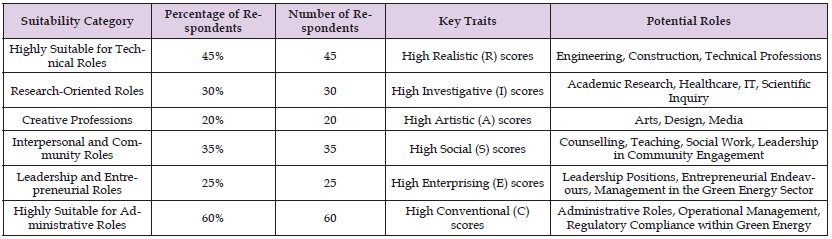
a) Highly Suitable for Technical Roles: Based on their high realistic (R) scores, 45% of respondents (45 individuals) are highly suitable for roles in engineering, construction, and related technical fields.
b) Research-Oriented Roles: Based on their high Investigative (I) scores, 30% of respondents (30 individuals) demonstrate strong suitability for research-oriented roles in fields such as academic research, healthcare, and IT.
c) Creative Professions: 20% of respondents (twenty individuals) are highly suitable for creative roles in the arts, design, and media, as indicated by their high Artistic (A) scores.
d) Interpersonal and Community Roles: 35% of respondents (35 individuals) are well-suited for roles that involve strong interpersonal skills, such as counselling, teaching, and social work, based on their high Social (S) scores.
e) Leadership and Entrepreneurial Roles: 25% of respondents (25 individuals) are highly suitable for leadership and entrepreneurial roles within the green energy sector, as indicated by their high Enterprising (E) scores.
f) Administrative Roles: 60% of respondents (60 individuals) show a strong preference for structured, organizational roles, making them ideal candidates for administrative positions in the green energy bioeconomy, as suggested by their high Conventional (C) scores.
These findings underscore the importance of tailored talent development strategies that align individual strengths with the specific demands of roles within the green energy bioeconomy. Organizations can effectively lead the charge towards carbon neutrality and sustainable development by leveraging the diverse talents identified through the FIKR Profiling Assessment Tool.
Analyzing the 100 respondents through the FIKR Profiling Assessment Tool and the Holland RIASEC model provides significant insights into the alignment of individual traits with the demands of the green energy bioeconomy. This section discusses the implications of the findings in three key areas: the need for diverse skill sets in green energy roles, the importance of aligning talent with sector-specific demands, and the potential for targeted talent development strategies.
The Need for Diverse Skill Sets in Green Energy Roles
The green energy bioeconomy is a multifaceted and complex field that requires a diverse range of expertise, from technical engineering to research and administrative roles. One of the key findings from the research is the evident diversity in skill sets among the respondents, particularly in the Realistic (R), Investigative (I), and Conventional (C) dimensions (Aydoğmuş, et al. [11]) This diversity in skills presents significant advantages for the green energy sector. Individuals with strong Realistic traits, accounting for 45% of the respondents, are well-suited for hands-on, technical roles essential for constructing and maintaining green energy infrastructure. Additionally, the presence of individuals with strong Investigative and Conventional traits allows for developing interdisciplinary teams that can approach complex challenges from multiple angles (Consoli, et al. [8]). Integrating new technologies with existing systems in the green energy sector requires both practical know-how and innovative thinking. By leveraging the full range of skills in the workforce, organizations can enhance their capacity to drive sustainable solutions and achieve carbon neutrality more effectively (IEA [4,12,13]). As the green energy bioeconomy evolves, the need for a diverse and skilled workforce will become increasingly crucial. Initiatives to support education and skills training programs for women, youth, and marginalized communities can help ensure that the future energy workforce is more inclusive and representative of the population (IEA [4]). Overall, the diversity in skills among the respondents highlights the strength and adaptability of the green energy bioeconomy, which is well-positioned to tackle the complex challenges of transitioning to a sustainable future.
Aligning Talent with Sector-Specific Demands
The findings from this study highlight the critical importance of aligning individual talents with the specific demands of the green energy bioeconomy. The data reveals that while a significant portion of respondents (25%) exhibit high Enterprising (E) scores, indicating a propensity for leadership roles, the majority (60%) possess high Conventional (C) scores, suggestive of a preference for structured environments and operational roles (Consoli, et al. [8]). Leveraging this understanding of individual strengths and preferences can substantially benefit both the employees and the organization. Placing individuals with high Investigative and Enterprising traits in roles that require problem-solving, and leadership can catalyze more effective innovation and project management within the green energy sector (Glen, et al. [3,14]). Conversely, aligning those with high Conventional scores in administrative and operational positions where precision and organization are paramount can optimize individual performance and contribute to the organisation's broader strategic goals. This targeted talent alignment enhances job satisfaction and supports the overall objectives of the green energy bioeconomy, ultimately driving progress towards carbon neutrality. The literature on the skills and human capital associated with green jobs provides further insight into this dynamic. Empirical analyses have found that green occupations require more intensive high-level cognitive and interpersonal skills and higher formal education, work experience, and on-the-job training. Effectively harnessing these specialized skills and competencies is crucial for organizations navigating the transition towards sustainable growth (World Economic Forum [1516]). As organizations in the green energy sector continue to evolve, the strategic alignment of talent with sector-specific demands will be essential for driving innovation, optimizing performance, and achieving sustainability objectives (Yafi, et al. [3,5,8,17]).
The Role of Creativity and Interpersonal Skills in Green Energy Leadership
A growing body of research highlights the importance of creativity and interpersonal skills in the green energy sector. While the Artistic (A) dimension had a lower average score (16.4), the presence of 20% of respondents with high Artistic scores indicates that creativity, though less dominant, still plays a vital role (Amabile, et al. [18]). These individuals can contribute significantly to the green energy bioeconomy through arts, design, and media roles, where creativity is key to communicating the importance of sustainability and engaging the public in green initiatives. Furthermore, integrating creativity and interpersonal skills within the green energy sector can lead to more innovative problem-solving and public engagement approaches. Creative individuals can develop compelling narratives and visual representations that make complex green energy concepts more accessible to the public, increasing awareness and support for sustainable practices (Sternberg, et al. [19]). Similarly, those with strong social traits can facilitate collaboration and consensus-building among stakeholders, which is essential for successfully implementing green energy projects (Jia, et al. [20]).
By fostering an environment that values both creativity and interpersonal skills, the green energy sector can enhance its ability to inspire and mobilize communities towards a sustainable future. Research has shown that strategic direction and green human resource management practices can stimulate employees' green creativity through transformational leadership and management (Mansoor, et al. [21]). This alignment of HR practices and organizational strategies is crucial for achieving better environmental outcomes. Additionally, implementing green management initiatives largely depends on the leadership style exhibited by managers, as nurturing green creativity among employees remains a major concern for organizational managers. The importance of green human resource management practices in driving employee's pro-environmental behaviour is also well-documented. The success of organizational initiatives for environmental sustainability hinges upon employees' pro-environmental behaviours, and HR professionals play a key role in integrating environmental sustainability into human resource policies (Saeed, et al. [22]).
Potential for Targeted Talent Development Strategies
The findings from this study highlight the immense potential for organizations in the green energy economy to develop targeted talent strategies that cater to the unique needs and characteristics of this rapidly evolving sector (Glen, et al. [3]). Organizations can create a more effective and motivated workforce by identifying individuals with specific strengths and aligning them with roles that capitalize on these traits (Arcelay, et al. [2]). As noted, the significant number of respondents with high Conventional (C) scores suggests that ample talent is available for roles requiring organization and adherence to protocols, which are critical in maintaining the sustainability and compliance of green energy operations (Tuul [23]). Targeted talent development strategies can also include specialized training programs that enhance the skills needed for specific roles within the green energy sector (Arcelay, et al. [2]). For instance, individuals with high Enterprising traits could benefit from leadership development programs that prepare them for executive roles, while those with strong Investigative traits could be offered opportunities for advanced research training or innovation workshops. By investing in the continuous development of their workforce, organizations can ensure that their teams remain adaptable and capable of meeting the evolving challenges of the green energy transition. This proactive approach to talent management not only strengthens the organization's capacity to achieve its sustainability goals but also supports the long-term career growth and satisfaction of its employees (Tuul [3,17,23,24]). This finding aligns with previous research emphasising the importance of green training and development for enhancing environmental performance by acquiring relevant employee competencies (Yafi, et al. [17]). Additionally, the literature has highlighted the growing demand for eco-friendly employees with specialized knowledge and skills, underscoring the need for strategic talent management practices in the green energy sector (Glen, et al. [17,23,25,26]).
The synthesis of the findings underscores the importance of recognizing and harnessing the diverse talents available within the workforce to meet the multifaceted demands of the green energy bioeconomy. By aligning individual strengths with sector-specific needs and fostering creativity, interpersonal skills, and leadership potential, the green energy sector can build a robust, adaptable workforce capable of leading the charge towards a sustainable and carbon-neutral future.

International Association of Landscape Archaeology, Czech Glass Society, Czech Republic

Department of Chemistry, Semenov Institute of Chemical Physics, USSR Academy of Sciences, Moscow, Russia

Department of Educational Sciences, Research Centre Qualities of Teachers, School of Education – HAN, Nijmegen, Netherlands

Associate Professor at Department of Breast and Thyorid Surgey, Chongqing General Hospital, China

Neurology, LA BioMed Research Institute, USA





 Abstract
 PDF
PDF



























