info@biomedres.us
+1 (502) 904-2126
One Westbrook Corporate Center, Suite 300, Westchester, IL 60154, USA
Site Map
 ISSN: 2574 -1241
ISSN: 2574 -1241
ISSN: 2574 -1241
Received: August 12, 2024; Published: August 22, 2024
*Corresponding author: Jianyang Dong, Department of Rehabilitation, Shenzhen University, Shenzhen University General Hospital, Shenzhen 518000, China
DOI: 10.26717/BJSTR.2024.58.009138
Depression is a chronic and disabling disease that significantly impacts the quality of life for patients. Conventional treatments, such as medication, psychotherapy, and cognitive therapy, are often ineffective for about one third of patients, known as Treatment-Resistant Depression (TRD). As TRD is a complex condition that poses challenges in both diagnosis and successful treatment, there is a pressing need to develop new strategies for addressing this issue within modern pharmacology. In recent years, many studies have shown that Deep Brain Stimulation (DBS) has certain therapeutic effects on TRD. Different neuroanatomical structures can serve as targets for DBS treatment of TRD, but the optimal therapeutic target remains controversial. Therefore, here we describe the potential mechanisms of DBS treatment of TRD and provide a review of related therapeutic target studies. Finally, current challenges and potential development directions were proposed, including closed-loop therapy and combined fiber tracking technology. This contribution can offer unique and valuable insights into the application of DBS in treating TRD.
Keywords: Treatment-Resistant Depression; Deep Brain Stimulation; Neuromodulation; Mood Disorders; Mechanism
Abbreviations: DBS: Deep Brain Stimulation; TRD: Treatment-Resistant Depression; TMS: Transcranial Magnetic Stimulation; VNS: Vagus Nerve Electrical Stimulation; ECS: Electroconvulsive Therapy, Epidural Cortical Stimulation; SCG: Subcortical Cingulate Gyrus; Nacc: Nucleus Accumbens; ALIC: Anterior Limb of the Internal Capsule; BNST: Bed of the Striatum; ITP: Inferior Thalamus; LH: Lateral Habenular; MFB: Medial Forebrain Tract; WKY: Wistar Kyoto; MFB: Medial Forebrain Bundle; VTA: Ventral Tegmental Area; slMFB: Superior Lateral Medial Forebrain Bundle; HPA: Hypothalamic-Pituitary-Adrenal; VC: Ventral Capsule; VS: Ventral Striatum; BA25: Broadman 25; CSTC: Cortical-Striatal-Thalamocortical; CR: Case Report; OLS: Open-Label Trial; RCT: Randomized Controlled Trial
Depression is the most prevalent mental disorder, with patients often experiencing aversion, despair, hallucinations, and suicidal attempts and behaviors, posing a serious threat to their health. The incidence rate can reach 15% to 20%, with a recurrence rate as high as 30% to 40% [1]. According to estimates from the WHO, depression is projected to emerge as the primary cause of disease burden globally by 2030. Among them, Treatment-Resistant Depression (TRD) is defined as depression that does not show significant improvement after at least two different mechanisms of antidepressants have been administered in sufficient amounts and for a standardized treatment course [2]. Even among individuals receiving standard care for depression, approximately 30% develop TRD [3], which not only increases the cost of treatment but also imposes a heavier burden on the patient [4,5]. In recent years, there has been a growing recognition of the limitations of drug and cognitive therapy in the treatment of TRD. As a result, there is an increasing interest in exploring non-drug therapies such as Transcranial Magnetic Stimulation (TMS), Vagus Nerve Electrical Stimulation (VNS), electroconvulsive therapy, Epidural Cortical Stimulation (ECS), and other alternative treatments [6]. This shift towards non-drug therapies reflects a need for more effective options for individuals with TRD. Unfortunately, patients with TRD show a higher demand for treatment options like VNS and TMS, there is currently no definitive recommendation for these treatments [7,8].
Among them, Deep Brain Stimulation (DBS) is the most promising but invasive treatment for TRD patients and may be the last choice for patients who have failed other less invasive treatments [9]. Deep brain electrodes are implanted into specific neural targets using a stereotactic frame to treat depression by stimulating the imbalanced excitation-inhibition neural circuit [10]. Meta analysis and review show that approximately 50% of TRD patients are effectively treated with DBS [11,12]. At present, multiple DBS targets have entered clinical trials, such as the subcortical cingulate gyrus (SCG), Nucleus Accumbens (NAcc), Anterior Limb of The Internal Capsule (ALIC), Bed Of The Striatum (BNST), Inferior Thalamus (ITP), Lateral Habenular Nucleus (LH), Medial Forebrain Tract (MFB), and etc. Despite this, the specific mechanism and optimal target of DBS in the treatment of TRD are still unclear. Here, we provide an updated knowledge substantiating the suitability of the potential mechanism and each of current DBS targets for treating depression. Finally, current challenges and potential development directions were proposed, including closed-loop therapy and combined fiber tracking technology. This review can provide a unique and valuable contribution to the application of DBS in TRD neurological diseases.
Changes in Neuronal Soma and Synapses
Early studies on DBS have shown that voltage-gate blockade, membrane hyperpolarization, depletion of neurotransmitters, and release of inhibitory neurotransmitters may help to inhibit abnormal neuronal activity in the short term, partially explaining the short-term relief of symptoms in patients with depression [13,14], but this does not explain the mechanism by which months of stimulation improves depressive symptoms. Lujan, et al. proposed that alterations in synaptic plasticity may underlie the sustained amelioration of depressive symptoms observed in patients during long-term treatment [15]. Shen, et al. conducted high-frequency stimulation on subthalamic nucleus neurons in rats and observed modifications in synaptic plasticity, including long-term potentiation and depression, thereby providing experimental evidence for electrical stimulation-induced changes in synaptic plasticity [16]. Aldehri, et al. conducted a 7-week fornix DBS study on mice, and subsequent histopathological examination revealed decreased levels of synaptophysin in the hippocampal CA1 and CA3 subregions, indicating that fornix DBS can induce alterations in synaptic plasticity, characterized by long-term inhibition [17]. Furthermore, Pohodich, et al. performed genetic analysis on mice post-DBS and confirmed that DBS elicited the expression, transcription, and RNA splicing of numerous genes associated with neural plasticity at the genetic level [18].
The biological pathway analysis revealed a strong correlation between the expressed proteins and key processes involved in neurogenesis, neuronal morphological changes, and synaptic function. However, previous studies only confirmed the impact of electrical stimulation on synaptic plasticity changes without elucidating the underlying mechanism linking these changes to relief of depressive symptoms.
Genetic and Epigenetic Changes
Pohodich, et al. conducted a comparative analysis between the down-regulated gene database extracted from postmortem brain tissue of TRD patients and the up-regulated gene database in mice after DBS, revealing a 17% overlap rate among 325 genes [18]. Furthermore, they also compared the gene expression profiles of mice after DBS with those following treatment with fluoxetine and physical exercise, demonstrating significant overlap in gene expression patterns. These findings suggest that the transcriptional program activated by DBS partially overlaps with that induced by fluoxetine and exercise. This study represents the pioneering investigation into the genetic underpinnings of DBS for TRD, elucidating a shared genetic pathway with certain pharmacological and exercise interventions. Currently, limited research exists on the genetic mechanisms underlying DBS for refractory depression, and findings in this area may serve as robust experimental evidence for future DBS-based treatments of TRD. Furthermore, Papp, et al. conducted a genetic analysis on depression model rats subjected to DBS, including Wistar and Wistar Kyoto (WKY) rats [19], with WKY rats being regarded as an antidepressant-treated rat model akin to patients suffering from TRD [20]. The depression symptoms of both groups improved following DBS, and DBS reversed the downregulation of Egr1, Htr7, and MMP-9 genes in the ventral hippocampus of Wistar rats. However, there was no change observed in the expression levels of related downregulated genes in WKY mice, suggesting a potential specific gene pathway for DBS treatment of TRD. Further experiments should include additional candidate genes to further elucidate drug resistance mechanisms in TRD and subsequently enhance drug therapy and DBS treatment.
Activation of Prefrontal α-Amino-3-Hydroxy-5-Methyl-4-Isoxazole-Propionicacid Receptors (AMPARs) and Release of Neuromodulator
Jimenez-Sanchez, et al. observed the release levels of activated brain regions and neuromodulators in mice following DBS [21], revealing that glutamate efflux from the lower prefrontal lobe margin induced AMPAR activation, thereby stimulating the prefrontal lobe's influence on the brainstem and subsequently elevating serotonin, dopamine, and norepinephrine levels in the prefrontal cortex to achieve an antidepressant effect. The experiment demonstrates that the activation of AMPARs receptors is both necessary and sufficient for DBS to exert its antidepressant effect. This brain region currently represents one of the commonly targeted areas for DBS treatment of TRD. AMPARs could potentially serve as a biomarker for assessing the efficacy of DBS treatment, although this still requires validation through relevant clinical trials.
Subcortical and Cortical Reward Pathways
The Medial Forebrain Bundle (MFB) and Ventral Tegmental Area (VTA) are pivotal subcortical structures within the human reward system, exerting a significant influence on both emotional disorders, such as depression and obsessive-compulsive disorder. Coenen, et al. postulated that the stimulation of the Superior Lateral Medial Forebrain Bundle (slMFB) could potentially activate both ascending and descending fibers entering and exiting the VTA, as well as their corresponding projection areas, thereby potentially ameliorating depressive symptoms [22]. Although small-sample clinical trials suggest the efficacy of sl MFB-DBS, further microanatomical evidence is imperative to substantiate its relevance [23].
Changes in Neuro Electro Physiological
In 2013, Ewing, et al. postulated that the alleviation of psychiatric symptoms through DBS may be partially ascribed to the augmentation of neuro electro physiological synchrony in interconnected brain regions [24]. Jia, et al. employed electrical stimulation of the ventral prefrontal cortex in a depression model of rats, and preoperative local field potential detection revealed that the baseline power of β and γ waves was lower in mice compared to the normal control group [25]. Following the procedure, there was a significant enhancement in γ and β wave oscillations within the ventral prefrontal cortex and hippocampus of rats, accompanied by an observed increase in synchronization strength. Accordingly, it is postulated that the augmentation of β-gamma wave synchrony within the relevant cerebral regions may constitute one of the underlying mechanisms of DBS in depression treatment.
Changes in Adrenocorticotropic Hormone, Nerve Growth Factor and Cytokine Levels
The hyperactivity of the Hypothalamic-Pituitary-Adrenal (HPA) axis, reduced levels of neurotrophic factors, and elevated levels of inflammatory factors are all potential contributors to depressive symptoms and classified as possible etiologies for depressive disorders. Dandekar, et al. conducted a 7-day stimulation of the MFB in rats with depression [26]. They compared the levels of adrenocorticotropic hormone, cranial nerve growth factor, and inflammatory factors in peripheral blood, cerebrospinal fluid, and hippocampus after modeling and after operation. The findings demonstrated that DBS could reverse the downregulation of neurotrophic factors, upregulate adrenocorticotropic hormone levels, and mitigate overexpression of inflammatory factors such as IL-1, IL-6, TNF-α, and IFN-γ in mice with depression. The application of DBS can effectively ameliorate depressive symptoms through three mechanisms: inhibition of aberrant HPA axis activity, down-regulation of inflammatory factor expression, and promotion of brain neurotrophic factor secretion.
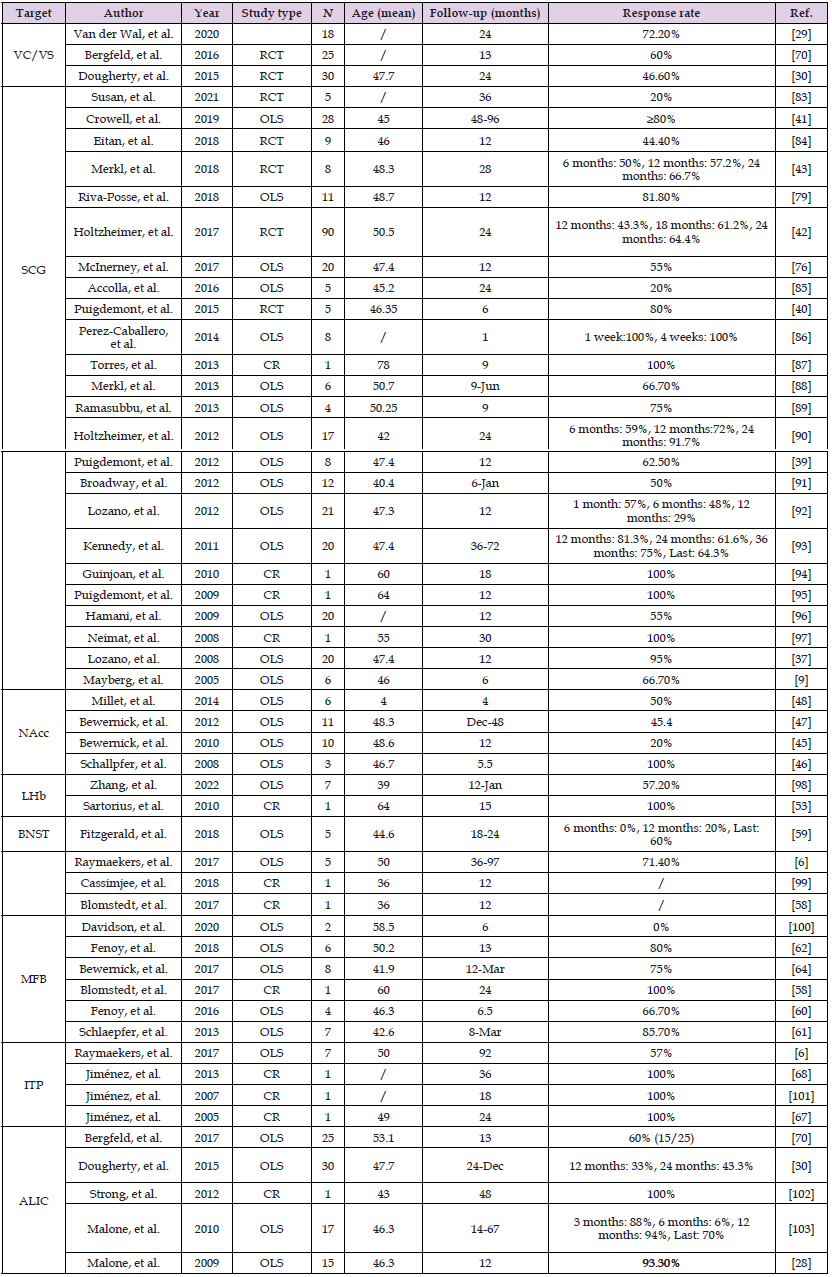
The selection of DBS targets is often based on functional targets in the emotional regulation circuit, and the functional nuclei of the target are closely related to monoamine neuronal nuclei. In addition, the effect of improving emotions can be observed in animal models or other treatments of neuropsychiatric diseases [27]. Currently, the optimal stimulation target for DBS treatment of TRD is still under investigation (Figure 1). The clinical studies of DBS for TRD in recent years are summarized in (Table 1). (Figure 1) Schematic representation of eight DBS targets tested for the management of TRD. The DBS electrode is electrically stimulated by a long lead. (Image adapted from Ref. [11]. Copyright 2018 Nature.)
Figure 1

Table 1: Summary of DBS targets and clinical trials for the treatment of TRD.
VC/VS is closely connected to the NAcc, including various white matter tracts and subcortical gray matter structures related to emotional behavior. As early as 2008, a multicenter open trial treated 15 TRD patients with DBS targeting VC/NS [28]. After 6 months to 4 years of follow-up, the results showed that 6 cases (40%) were effective at 6 months and 8 cases (53%) were effective at 48 months. This provides hope for DBS targeting VC/VS to treat TRD. A recent study has reported that 25 patients with TRD underwent DBS targeting the VC and were followed up for a period of 2 years [29]. The efficacy of the treatment was assessed using the Hamilton Depression Rating Scale (HDRS), Montgomery-Åsberg Depression Rating Scale (MADRS), and a self-rating scale for depressive symptoms. The results indicated that 11 patients (44.4%) experienced significant improvement, and this effect remained stable over time. However, Dougherty, et al. conducted a true-false stimulation control test on 34 TRD patients (true stimulation group: 18 cases, sham stimulation group: 16 cases) with VC/VS as the target for 16 weeks of DBS treatment [30], and the study showed no statistically significant difference in efficacy between the two groups, which may be related to the shorter treatment time. In addition, a case report of a TRD patient developed Tourette-like symptoms associated with stimulation voltage after 32 months of DBS treatment with VC/VS as the target, which was relieved by adjusting the stimulation voltage scheme [31].
The SCG or Broadman 25 (BA25) is a cerebral gyrus located between the inferior cingulate sulcus of the corpus callosum and the sulcus of the corpus callosum. SCG exerts regulatory control over corresponding brain regions through direct or indirect neural pathways, thereby participating in modulating the reward-feedback loop in patients with depression [32]. Revised sentence: Previous studies have demonstrated a correlation between depression and heightened metabolic activity in SCG, as well as dysfunction within the cortical limbic network [33]. Furthermore, SCG-DBS has shown potential in ameliorating depressive symptoms, particularly anhedonia [34]. Simultaneously, studies have demonstrated that SCG-DBS can effectively suppress y oscillation, enhance θ-γ coupling, and facilitate the release of y-aminobutyric acid neurotransmitter, thereby exerting a regulatory impact [35]. Consequently, SCG-DBS stimulation may play a pivotal role in normalizing brain network activity rhythm associated with the neurobiology of depression [11]. In 2005, Mayberg, et al. initially proposed the utilization of SCG as a treatment for TRD. Out of the 6 patients with TRD included in their study, remission was achieved by 4 patients after a span of 6 months during the open trial, indicating promising therapeutic prospects [36]. Subsequently, in 2008, they conducted further follow-up on these initial 6 patients along with an additional cohort of 14 patients. The outcomes revealed that treatment response was observed in 60% of the patients, complete remission was attained by 35% of them, and this effect could be sustained for over a period exceeding twelve months without any notable side effects or intolerance [37].
In 2011, the same research group continued to report on the long-term efficacy of SCG-DBS. The response rates of patients with TRD were found to be 62.5%, 46.2%, and 75% at an average follow-up duration of 1 year, 2 years, and 3 years respectively. Furthermore, at the last follow-up conducted between 3 to 6 years post SCG-DBS, TRD patients exhibited an average response rate of 64.3% [38]. Subsequently, other research groups initiated clinical trials of SCG-DBS for TRD. For instance, Puigdemont D, et al. conducted clinical trials on 8 TRD patients and reported complete symptom relief in 4 patients after one year [39]. Further randomized, double-blind, controlled clinical trials confirmed that 4 out of 5 TRD patients achieved complete symptom relief [40], with high-frequency electrical stimulation demonstrating superior long-term antidepressant effects compared to low-frequency electrical stimulation [32]. In terms of long-term efficacy, Crowell et al conducted a follow-up study for up to 8 years, revealing that the effective rate of SCG-DBS treatment remained consistently above 50%, with a complete remission rate exceeding 30% since the second year [41]. These findings demonstrate the safety and effectiveness of SCG-DBS as a therapeutic approach for TRD. However, a recent randomized, double-blind study of 90 patients revealed no statistically significant difference in the response rate (20%) to SCG-DBS stimulation during the double-blind control phase compared with the control group (17%) [42]. The same conclusion was corroborated by another double-blind trial involving 8 patients with TRD [43].
This result may be attributed to the deviation in electrode implantation position and inappropriate electrode parameters. However, considering long-term efficacy, treatment response rates at 12, 18, and 24 months after DBS stimulation were observed in 29%, 53%, and 49% of patients respectively, indicating a potential enduring therapeutic effect of SCG-DBS [42].
The NAcc is located external to the inferior septum, representing an extension of the caudate nucleus towards the inner and lower region. It plays a pivotal role as a crucial basal forebrain nucleus involved in regulating emotional responses [44]. The electrical stimulation of the NAcc has been shown to normalize hypermetabolism in the prefrontal cortex, including the SCG and orbitofrontal cortex, thereby regulating depression [45]. This finding aligns with the observed effects of SCG-DBS in reducing abnormal cortical hypermetabolism [37]. Therefore, it is hypothesized that the antidepressant effect of SCG-DBS may potentially mediate the antidepressant effect of NAcc concurrently [45]. Currently, the efficacy of NAcc-DBS in treating TRD has been substantiated by multiple clinical trials. Schlaepfer, et al. initially reported the short-term impact of NAcc-DBS on three TRD patients, demonstrating that when the stimulator was activated, there was an improvement in their clinical scores; conversely, when the stimulator was deactivated, their clinical scores deteriorated [46]. Subsequently, Bewernick, et al. reported on a cohort of 10 TRD patients who underwent NAcc-DBS; following 12 months of electrical stimulation, the response rate and remission rate among TRD patients were determined to be 45% and 9%, respectively. Additionally, they observed a decrease in brain metabolism within the regions encompassing the SCG, amygdala, and prefrontal lobe [45]. Meanwhile, 5 patients (45.6%) demonstrated sustained improvement without deterioration after a 4-year follow-up period [47].
In the open trial of NAcc-DBS conducted by Milet, et al., significant improvement was observed in 3 out of 6 patients following NAcc-DBS stimulation. Positron emission tomography-computed tomography (PETCT) revealed decreased glucose metabolism in the posterior cingulate cortex, left superior frontal gyrus, middle frontal gyrus, and bilateral cerebellum, accompanied by increased glucose metabolism in the right anterior cingulate cortex, bilateral superior frontal gyrus, and left medial prefrontal lobe [48]. No evidence of cognitive decline was found one year after NAcc-DBS stimulation, indicating its favorable safety profile [49].
The LHb is situated on the dorsomedial surface of the thalamic tail, which has a triangular shape and extends towards the third ventricle. It mainly receives afferents from the thalamus, striatum and limbic system, and projects to the dorsal raphe nucleus, ventral tegmental area and substantia nigra, and indirectly regulates the hippocampus, hypothalamus, amygdala and frontal cortex, playing an important role in the reward circuit [50,51]. Meng, et al. demonstrated that LHb-DBS intervention significantly ameliorated depressive symptoms in rats, potentially attributed to elevated levels of monoamines (norepinephrine, dopamine, serotonin) in both serum and brain tissues [52]. Sartorius, et al. reported a case of depression that exhibited significant improvement after 4 months of LHb-DBS; however, relapse occurred upon cessation of stimulation [53]. Another case within the same research group demonstrated more than 50% improvement in TRD following treatment with LHb-DBS [54], and an observed notable increase in peripheral blood brain-derived neurotrophic factor (BDNF) levels was found among TRD patients [55]. Due to the compact size of LHb and its close proximity to brainstem and third ventricle, targeting the afferent nerve pathway through electrical stimulation of the striatum emerges as a potentially safer approach [56].
The BNST is situated in the basal forebrain, adjacent to the ALIC and NAcc, and constitutes an integral component of the limbic system. It serves as a principal efferent structure of the amygdala, which plays a pivotal role in modulating stress responses that are implicated in the pathogenesis of depression [57]. Currently, the research on BNST-DBS treatment for TRD remains limited. In a case report, a patient with comorbid anorexia nervosa and TRD initially underwent MEB-DBS but switched to BNST-DBS after 2 years due to the side effect of blurred vision. Remarkable therapeutic efficacy was observed [58]. Fitzgerald, et al. conducted BNST-DBS treatment on five TRD patients, resulting in sustained remission for two patients, significant improvement for two patients, and only one patient exhibiting ineffectiveness to BNST-DBS treatment [59]. In another double-blind trial, the researchers conducted a cross-stimulation test of ITP and BNST in seven patients with TRD. The results demonstrated that BNST stimulation yielded superior outcomes compared to ITP stimulation at 16 months post-operation. Subsequently, after three years of DBS implantation, all patients received BNST-DBS treatment, resulting in sustained remission for two out of seven patients and symptom improvement for the remaining five individuals [6]. These experimental findings suggest that BNST-DBS holds promising prospects for TRD treatment; however, further clinical trials are warranted to substantiate these claims.
MFB is an important component of the dopamine reward circuit, which is a set of fibers connecting the cerebellum, basal forebrain (including the ventral tegmental area and nucleus accumbens), hypothalamus, and projecting to the medial prefrontal cortex [23]. Previous studies have demonstrated that glutamate within the prefrontal cortex exerts regulatory control over dopaminergic neuron activity in the ventral tegmental area, thereby indirectly facilitating activation of dopaminergic neurotransmission within this region. MFB-DBS may modulate dopaminergic and glutamatergic neurotransmission, thereby enhancing neuronal activity in these regions, activating the midbrain-cortical system, and exerting antidepressant effects [60]. Multiple studies have consistently reported that MFB-DBS exhibits rapid and sustained antidepressant effects. The initial report by Schlaepfer, et al. introduced MFB-DBS as a treatment for TRD, demonstrating that 6 out of 7 TRD patients achieved a positive response within one week, with more than 50% improvement in depression scales. Following a 12–33-week observation period, all six patients exhibited sustained responses, with four of them meeting the criteria for complete remission [61]. The results of the open trial conducted by Fenoy, et al. indicated that within one week, more than 50% of patients with TRD experienced a significant improvement in their depression scores. After 26 weeks, over 80% of patients showed an improvement of more than 80% in their depression scores [60].
At the end of 52 weeks, more than 70% of patients demonstrated a depression score improvement exceeding 70% [62]. The long-term efficacy analysis conducted by Bewernick, et al. demonstrated that symptoms improved in 6 out of 8 patients with TRD, and complete remission was achieved in 4 patients after one year, without any observed cognitive or personality changes [63,64]. Notably, potential side effects such as blurred vision and strabismus were reported [58,63]. Additionally, Coenen, et al. discovered that the enlargement of the left frontal pole and a portion of the orbitofrontal region can serve as predictive indicators for the therapeutic efficacy of MFB-DBS, representing a crucial advancement towards personalized treatment [65].
The ITP establishes a bidirectional communication pathway between the dorsomedial thalamus and the orbitofrontal cortex, serving as a crucial link for information exchange. Previous clinical trials have demonstrated that electrical stimulation of the ITP effectively modulates the non-specific thalamic-orbitofrontal cortex circuitry, leading to notable antidepressant effects [66]. Jimenez, et al. reported the results of DBS for ITP in two depression patients, both of whom exhibited the anticipated antidepressant efficacy without any adverse effects [67,68]. Recently, a double-blind crossover trial was conducted to compare the antidepressant efficacy of ITP and ALIC/BNST-DBS. Despite no discernible advantage or disadvantage observed between the two targets, it is noteworthy that 6/7 patients expressed a preference for ALIC/BNST-DBS treatment [6]. Clearly, further exploration is warranted to fully understand the potential of ITP-DBS for TRD.
The ALIC is a pivotal component within the Cortical-Striatal-Thalamocortical (CSTC) circuit, exerting regulatory effects on various structures including the orbitofrontal gyrus [69], inferior cingulate gyrus of the corpus callosum, basal ganglia, and other regions that are critically involved in reward processing and motivational processes. The ALIC was initially developed for the treatment of obsessive-compulsive disorder; however, these studies have also revealed its significant efficacy in alleviating depressive symptoms. Consequently, these findings prompted the researchers to initiate a pilot clinical trial investigating the potential of ALIC-DBS. The findings demonstrated that the response rate and complete remission rate among patients with TRD were 40% and 20% at the 6-month mark, respectively, while these rates increased to 53.3% and 40%, respectively, during the final follow-up assessment [28]. Bergfeld, et al. demonstrated that ALIC-DBS exhibited significant efficacy in reducing depressive symptoms in 10 out of 25 patients and was well-tolerated; however, variations in electrode placement, optimization phase duration, and timing of DBS settings evaluation may yield divergent outcomes [70]. The long-term efficacy of ALIC-DBS has also been reported, with a response rate of 44.4% and sustained efficacy observed during a 2-year follow-up period [29]. Additionally, researchers have demonstrated that ALIC-DBS does not impact the cognitive function of patients with TRD [71]. However, it is worth noting that certain adverse reactions such as severe nausea and suicidal tendencies have been reported during the surgical procedure [70].
However, a recent randomized controlled trial demonstrated that the response rates of ALIC-DBS at 12 and 24 months were 20% and 23.3%, respectively, indicating no statistically significant difference compared to the control group [30].
When searching for the optimal target for DBS, it is imperative to consider the possibility that depression represents a neural circuit disorder involving the disruption of multiple large-scale neural networks rather than isolated damage to a singular brain structure. Consequently, there typically exists no singular ideal DBS target for depression treatment, as antidepressant effects can be achieved through stimulation of various targets. Aberrations in the cortico-striato-thalamo-cortical loops have been proposed as a potential factor in the development of TRD [72,73]. This neurocircuitry involved in depression is believed to encompass the dorsal (prefrontal, dorsal anterior cingulate and premotor cortices), ventral (sACC, orbitofrontal, and insular cortices), and modulatory (pregenual ACC, amygdala, and the hypothalamic-pituitary axis) components [73]. For example, it has been hypothesized that applying DBS in an area where fibers from the ventral and dorsal compartments converge, such as the NAcc, may allow for simultaneous excitation and inhibition in the dorsal and ventral compartments, respectively [27,73], thereby influencing the dysbalanced neural system in a complex manner.
However, it must be acknowledged that the use of DBS for the treatment of TRD is still in the research stage. At present, several targets are being evaluated in clinical trials, with CG, VC/VS, and NAc showing more advanced progress, and slMFB also showing potential [74]. However, the credibility of ITP, LHb, and BNST is limited due to the scarcity of studies and lack of repeated research support. Most clinical trials lack proper blind randomization and control, and the sample size is often relatively small. Additionally, there is a lack of strict control over the heterogeneity of participants' depression, leading to uneven treatment effects. A recent meta-analysis revealed that the 1-year response rate of different DBS targets in TRD ranged from 36% to 60% [75]. Among these, only ALIC and SCG were tested in multi-center, randomized, double-blind controlled trials. However, no significant statistical differences were observed [30,40,42], which may be attributed to the heterogeneity of patient symptoms and individual anatomical differences [11]. Currently, there is no established stimulation parameter for the DBS treatment of TRD. Different stimulation parameters are primarily selected based on different target areas, highlighting the importance of personalized treatment. Furthermore, DBS may elicit a series of adverse reactions. Multiple studies have documented instances of suicide and loss of follow-up during DBS treatment, suggesting that stimulation may exacerbate cognitive impairment [1,76].
An assessment was conducted to evaluate the impact of SCG-DBS on cognitive ability [76]. It was found that TRD patients performed worse compared to the healthy control group, but SCG-DBS did not show any deterioration in neuropsychological function. Additionally, post processing speed and executive function showed improvement at 6 months, and cognitive function did not deteriorate at 1 year. It is suggested that suicide motivation may have originated from other life events. On the contrary, SCG is associated with the neural network of dopamine-related psychomotor processing, including the ventral striatum, nucleus accumbens, amygdala, and prefrontal cortex. Treatment with SCG-DBS can improve the severity of psychomotor delay in patients, suggesting that SCG-DBS may have a promoting effect on dopamine function. Previous studies have found no evidence of cognitive decline during IC/BST or ITP stimulation [6]. The improvement of depression symptoms in patients is dependent on the enhancement of neurocognition. However, it cannot be concluded at this time that cognitive impairment suicide is not related to DBS treatment. In addition, several studies have indicated that acute stimulation during VC/VS, NAcc, and MFB implantation testing may result in adverse reactions such as mild mania, anxiety, tension, and sensory abnormalities [77]. Mild mania is the most frequently reported reaction [1], with others including transient confusion of consciousness, emotional changes, sleep disorders, memory disorders, appetite changes, weight gain, and increased libido [75].
These findings have contributed to skepticism among psychiatrists and patients regarding the use of invasive DBS treatment for TRD, which is not conducive to the conduct of clinical trials or the recruitment of trial subjects. In recent years, advancements in fiber tracking technology have allowed for the reconstruction of individual brain fiber structures through non-invasive methods, which played a crucial role in guiding surgical treatment and postoperative follow-up and monitoring for DBS [23,78,79]. Additionally, the identification of biomarkers for DBS treatment of TRD has emerged as an important research direction [65,80]. The utilization of the aforementioned methods for more efficient planning and personalized guidance of DBS targets and parameter selection is anticipated to further enhance the clinical treatment effectiveness. Currently, research has commenced to identify the biological markers of individuals in a depressive state based on the neural network characteristics of patients with TRD, such as closed-loop therapy, which is a novel DBS method. Unlike traditional DBS treatment, which provides continuous stimulation, closed-loop therapy aims to deliver short intermittent stimulation when patients are in the target state according to their biological markers in a depressive state [81]. Scangos, et al. proposed the implantation of multi-site electrodes in the brain to identify areas related to emotional stimulation. This approach aims to utilize individualized neural data for determining stimulation targets and strategies, effectively alleviating depressive symptoms [81].
The team utilized closed-loop therapy to stimulate the right VC/VS target in a patient with TRD. The study initially involved implanting intracranial multi-site electrodes to identify the EEG signature associated with depressive symptoms, and then administering DBS when the EEG signature was present. As a result, the patient's depressive symptoms showed rapid and sustained improvement [82-103]. This new concept provides a novel and promising treatment approach for future TRD treatment.
In conclusion, DBS is still considered an experimental therapy in TRD. Although the mechanism, optimal brain structure, and appropriate biomarkers of TRD-DBS have not yet been determined, the advantages of brain structure electrical stimulation compared to other treatment programs are evident. It is completely reversible and can be adjusted to accommodate differences in demand between individuals as well as within the same individual, which may arise due to the presence of different disease subtypes and disease progression. This provides a new treatment option for patients with TRD who have not responded well to traditional therapies. In the future, personalized stimulation targets can be determined based on the clinical characteristics of each patient and combined with biological markers, such as stereotactic electroencephalography, direct intracranial stimulation feedback, and neurophysiological recording. Brain imaging methods can be utilized to accurately guide the implantation of stimulation electrodes into the brain target, as well as to optimize DBS devices and treatment strategies for different target locations, such as unilateral or bilateral stimulation, pulse width, frequency, closed-loop stimulation decoding biomarkers, and etc. This personalized and precise DBS treatment can further improve the effectiveness of TRD treatment, reduce adverse reactions, and improve patient tolerance.
Not applicable.
The authors declare that they have no competing interests.
This work was supported by the Guangdong Provincial Basic and Applied Basic Research Foundation [Grant no. 2021A1515220074]; and HaiYa Young Scientist Foundation of Shenzhen University General Hospital [Grant no. 2024-HY005].
Conceptualization: Mengying Dai, Zinan Guo; Supervision: Jianyang Dong; Writing - original draft preparation: Qinji Zhou, Xi Lin; Mapping: Yangkang Zeng; Literature Search: Sijia Liu; Writing - review and editing: All authors.

International Association of Landscape Archaeology, Czech Glass Society, Czech Republic

Department of Chemistry, Semenov Institute of Chemical Physics, USSR Academy of Sciences, Moscow, Russia

Department of Educational Sciences, Research Centre Qualities of Teachers, School of Education – HAN, Nijmegen, Netherlands

Associate Professor at Department of Breast and Thyorid Surgey, Chongqing General Hospital, China

Neurology, LA BioMed Research Institute, USA





 Abstract
 PDF
PDF



























