info@biomedres.us
+1 (502) 904-2126
One Westbrook Corporate Center, Suite 300, Westchester, IL 60154, USA
Site Map
 ISSN: 2574 -1241
ISSN: 2574 -1241
ISSN: 2574 -1241
Received: July 30, 2024; Published: August 09, 2024
*Corresponding author: Martin Msughter Ganyam, Department of Biochemistry, Federal University of Technology, Akure, Ondo, Nigeria
DOI: 10.26717/BJSTR.2024.58.009113
Human steroid 5α-reductase 2 (SRD5α2) as a critical integral membrane enzyme in steroid metabolism, catalyzes the conversion of testosterone to dihydrotestosterone. Mutations on its gene have been linked to 5α-reductase deficiency and prostate cancer. The objectives of the study include; extraction, isolation and purification of the bioactive compounds using column chromatography, identification and characterization of bioactive compounds using HPLC and in silico studies of bioactive compounds. The HPLC results revealed 6 bioactive compounds consisting of various phytochemical classes such as alkaloids, flavonoids and saponins. The absorption, distribution, metabolism, excretory (ADME) and toxicity properties of the 6 compounds revealed three (3) compounds with satisfactory ADME properties, while the toxicity profiles were also satisfactory. Further molecular docking studies using Glide revealed liquiritin with a docking score of (-8.037 kcal/mol), baicalin (-8.29 kcal/mol) and berberine (-6.458 kcal/mol) when compared with the control finasteride (-7.231 kcal/mol) .These compounds also formed hydrogen bonds with various amino acids in the active site of Human steroid 5α-reductase 2 (SRD5α2).Validation of docking scores using MMGBSA further revealed binding energies of -76.46 kcal/mol for liquiritin, -63.32 kcal/mol for baicalin and -67.78 kcal/mol for berberine when compared with finasteride -92.25 kcal/mol. The stability of these compounds was also assessed through 200 ns molecular dynamics (MD) simulations with Desmond software and it revealed liquiritin as the most stable compound. Hence, liquiritin may possess inhibitory potentials against Human steroid 5α-reductase 2 (SRD5α2). However, further in vivo and in vitro studies are required to validate these findings.
Keywords: Human Steroid 5α-Reductase 2; Docking; MMGBSA and Molecular Dynamics
Steriod 5 alpha reductase 2 (SRD5α2) is highly expressed in male reproductive systems to convert testosterone to 5αdihydrotestosterone (DHT) [1]. Overproduction of DHT by SRD5α2 is associated with benign prostatic hyperplasia (BPH), androgenic alopecia and prostate cancer due to excessive androgen receptor signaling [2]. Therefore, inhibitors of 5α-reductase, which catalyzes the reductive conversion of testosterone to 5α-dihydrotestosterone, may be useful in the selective treatment of androgen-dependent diseases. The effects of 5ARIs on the prostate have been extensively studied—they are known to reduce prostate volume and prostate specific antigen (PSA) levels [3] and reduce the risk of prostate cancer [4]. Finasteride competitively and irreversibly inhibits the type II 5α-reductase isoenzyme leading to the suppression of serum DHT by approximately 70% from baseline [5]. Therefore, several 5α-reductase inhibitory active constituents from various plant sources have been isolated [6]. C. olitorius, belonging to the family Malvaceae, is an annual herbaceous plant with a thin stem.
It can be found in all tropical and sub-tropical regions because it is used as a popular leafy soup. It is considered as a nutritious vegetable attributed to its high content of vitamins, minerals, and phenolic compounds [7]. These leaves not only make great ingredients but they have also been found to have numerous medicinal benefits. The Various extracts of C. olitorius have shown to exhibit antioxidant, anti-inflammatory, hepatoprotective, antihyperlipidemic, immunostimulant, antitumor, antimicrobial, antidiabetic, analgesic, wound-healing properties and cardioprotective activities [8]. Hence, the study is aimed at accessing the inhibitory properties of bioactive compounds in jute leaf fractions (Corchorus olitorius) against Human steroid 5α-reductase 2 (SRD5α2) activity insilico.
Materials
Sample Collection: Fresh Corchorus olitorius leaves were purchased from a local market in Makurdi, Benue State of Nigeria. The leaves were taxonomically identified and authenticated by a curator botanist at the Joseph Sarwuan Tarka University, Makurdi, Nigeria.
Chemicals and Reagents: The chemicals and reagent used for this study were of analytical grade and were purchased from standard chemical and reagent stores within Benue State. The chemicals used include; Methanol, Ethanol Ethyl acetate, n-haxane, distilled water and Silica gel.
Equipment, Apparatus and Instrument: Mortar and pestle, Whatman No1 filter paper, water bath, glass column, rotary evaporator, sterile bottles, retort stand, conical flask, scissors, capillary tube, Pasteur pipette.
Methods
Preparation of Corchorus Olitorius (Jute) Leaves: The plant material was freed of extraneous material; air dried at room temperature to a constant weight and milled into a fine powder with a blender. Different extract was prepared sequentially by macerating 500 grams of the dried powdery sample in1500mL of each extracting solvent (n-hexane, ethyl acetate and methanol in the order of polarity) at room temperature. The mixture of n-hexane was allowed to stand for 24 hours and stirred intermittently to facilitate extraction. The crude was further macerated in ethyl acetate and finally in methanol. The extracts were filtered using whatman no 1 filter paper and the resulting volume was concentrated using a rotary evaporator. Final solvent elimination and drying was done by exposing the samples to air. The crude extracts were stored in sterile screwed capped (air-tight) bottles and aliquots were taken when required.
Column Chromatography of Methanol Extract Using Silica Gel 60 120 mesh Chromatography: The concentrated fractions were subjected to chromatography using silica gel 60-120 mesh. Solvent (ethyl acetate and methanol) combinations of increasing polarity were used as mobile phase. In setting up the experiment, the wet packing method was adopted. Firstly, the lower part of the column was packed with a wad of cotton wool using of a glass rod. The slurry was prepared by mixing 75g of silica gel with 200 mL of ethylacetate, and this was carefully poured down into the column with the tap of the column left open to permit free flow of solvent. At the end of the packing process, the tap was closed and allowed 24 hours to stabilize. The clear solvent on top of the silica gel was allowed to drain down to the silica gel bed. The tap was then opened and the fractions ushered by solvent systems of gradual increasing polarity. The following ratios of solvent combinations were sequentially used in the elution process; ethyl acetate/methanol 100:0, 95:5, 90:10, 85:15, 80:20 75:25, 70: 30, 65: 35, 60:40. A total volume of 100 mL of each solvent was used. And a total of 72 fractions were collected in to small vial glass bottles of 8 vials per solvent system.
Thin Layer Chromatography (TLC): Precoated silica gel (F254) aluminium backed was used as a stationary phase while ethyl acetate: methanol (9:1) was mobile phase for the thin layer chromatography analysis. With the aid of a scissors, the plate was cut into uniform strips. Using a capillary tube, spot of the collected fractions was applied on the base line of the TLC plate. Care was taken not to overload the plate to prevent streaking. This allowed the sample application to be made as thin as possible and thus improved resolution. The plates (strips) were developed in a glass chromatographic tank; containing the solvent system and lined with filter paper. This facilitated saturation of the chromatographic tank with solvent vapour and thus improved separation and consequently reduced the time taken for the plates to develop. The tank was covered with a glass lid and the solvent was allowed to ascend until the solvent front was about 3/4 of the length of the plate. The plate was removed, sprayed with Lieberman-Burchard spray and dried. The plate was heated in order to view the spots clearly. The colour reaction was recorded and the relative Retention Factor (rF) value was calculated based on the formula thus: rf = Distance travelled by the component from the starting point ÷ Distance travelled by the solvent on the solvent front. Based on their thin layer chromatography profile vis-à-vis relative retention factor (rF) values of fractions showed similar TLC mobility, band formation pattern and colour reaction were pooled together into a beaker. The pooled fractions were concentrated in open air.
High-Performance Liquid Chromatography (HPLC): HPLC is a method to separate mixture of complex samples. HPLC is an active process in which materials are pumped at high pressure through a superlative Coolum, which contains stationary phase usually a chemical fraction that separate the compound mixtures samples are introduce through the injector, and carried via the mobile phase across the stationary phase to effect the separation after separation through the column, the samples are exposed to a detector system that identify and quantify the individual compounds. Analysis Standard form of analyte profile was first injected into the HPLC and this generate a chromatograph with a given peak area and peak profile. These were then used to create a window in the HPLC in preparation of the test sample analysis. The extracted test sample was then injected into the HPLC. The peak area of the sample is compared with the loss of the standard relative to the concentration of the standard top obtained the concentration of the sample
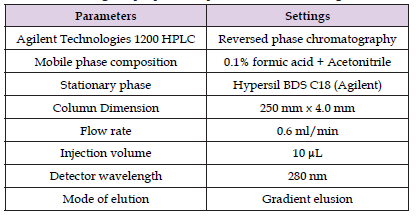
Sample Preparation: About 10mg of the sample was taken to conical flask, 2.5ml of HPLC grade Methanol was added to dissolve the solid sample. Sample was filtered and the clean portion was run-on High Performance Liquid Chromatography according to the following chromatographic conditions (Table 1).
Table 1: Showing the preparation parameters and settings.
In Silico Analysis
Retrieval of Protein and Ligand structure: 5α-reductase 2 has been reported to play a role in a lot of prostate disorders including inflammation and proliferation pathways. From RSCB protein data bank, the protein crystal structure of proteins (7BW1) Human steroid 5α-reductase 2 (SRD5α2) was collected from the protein data bank of RCSB (http://www.rscb.org). Ligands were obtained in 'sdf' format from PubChem (www.pubchem.ncbi.nlm.nih.gov) open chemistry data base.
Absorption, Digestion, Metabolism, Excretion (ADME): SwissADME (http://www.swissadme.ch/index.php) was used to profile the physicochemical, lipophilicity, pharmacokinetics, and Lipinski's drug-likeness of 6 ligands. All the ligands were compared to the control ligand finasteride (PubChem CID:57363) and ranked based on their ADME and toxicity profiles to find the top drug-like candidates.
Protein and Ligand Preparation:
Preparation of Protein Structures and Grid Generation: Human steroid 5α-reductase 2 (SRD5α2) structure (PDB ID: 7BW1, having resolution of 2.80 Å, R-Value Free 0.265, R-Value Work 0.239 was selected and obtained from Protein Data Bank (http://www.rscb.org) with good resolutions. Protein structure was prepared using protein preparation wizard in Maestro panel. During preparation of protein bond orders were assigned and hydrogen atoms were added as well. Water molecules were removed within 3 Ǻ of het groups [9]. Finally, OPLS-2005 force field was applied to minimize the structure of protein (Schrodinger, LLC, NY, USA, 2009) [10]. Further receptor grid boxes were generated using “Glide's Receptor Grid Generation” module at the active site (with the radius of 20 Å around the crystal structure) of co-crystallized ligand with the computing cubic box of 10 Ǻ × 10 Ǻ × 10 Ǻ [11].
Ligand Preparation: Total 6 compounds were selected to perform the molecular docking studies to screen and identify the potent inhibitors of Human steroid 5α-reductase 2. PubChem database was used to extract out the 3D chemical structures of the selected molecules. 3D and geometry optimizations with energy minimization of ligands were executed using algorithms monitored in Schrödinger Maestro v 11.4 [12]. LigPrep module (Schrodinger, LLC, NY, USA, 2009) was used from the Maestro builder panel to prepare ligand and generate 3D structure of the ligands by adding hydrogen atoms and removing salt and ionizing at pH (7 ± 2) [13]. Energy minimization was performed using OPLS_2005 force field by using the standard energy function of molecular mechanics and RMSD cut off 0.01 Ǻ to generate the low-energy ligand isomer [14].
Molecular Docking: Molecular docking is a structure-based drug design approach to identify the essential amino acid interactions between the selected protein and generated ligands with low energy conformation [15]. Minimum interaction of the ligands characterized by the scoring function which used to foretell the binding affinity with the receptor. Glide Standard precision (SP), docking protocol was applied without smearing any constrain. Flexible docking with Glide Standard precision (SP) protocol was performed to predict the binding affinity and ligand efficiency as inhibitor of human steroid 5α-reductase 2 (SRD5α2) target. Concluding energy assessment was done with the dock score. Visualization of docked ligands was done by Maestro interface (Schrödinger Suite, LLC, NY)
MMGBSA Calculations: Binding free energies were calculated using MM-GBSA, VSGB 2.0 implicit solvation model, and OPLS-2005 via Prime [16]. The binding free energy was calculated using the equation:
Where, Gcomplex, Gprotein, and Gligand represent the free binding energy of the protein-ligand complex; protein; and ligand, respectively.
Molecular Dynamic Simulation Analysis: The stability of the best-docked complex was evaluated through a 200 ns MD simulation using Desmond software [17]. The system was prepared using a protein preparation wizard and refined by PROKA pH. The simulation environment model was created using TIP3P solvation model and an orthorhombic box of dimensions 10x10x10 Å was used. Na+ and Cl- ions were added to neutralize the system. The entire system was optimized using the OPLS3e force field [18,19]. The simulation time was set at 200 ns with recording intervals specified as 100.00ps for trajectory and 1.2 for energy. This would result in approximately 1000 frames. The simulation was run in the NPT ensemble class, with a temperature of 300.0K and pressure of 1.01325 bar. Before the simulation, the model system was relaxed using the default relaxation protocol. RESPA integrator parameters include a Time step (fs): bonded:2.0 near:2.0 far: 6.0 For the ensemble, the Nose-Hoover chain thermostat method was chosen with a relaxation time of 1.0ps. For interactions, the Coulombic method was used with a short-range cutoff method. The cutoff radius was set at 9.0 Å. Maestro Simulation interaction diagram module was used to calculate the following values: Root Mean Square Deviation (RMSD) was calculated by aligning with the protein RSMD, root-mean-square fluctuation (RMSF), protein-ligand interactions, radius of gyration (rGyr) and Solvent Accessible Surface Area (SASA). Also, the maestro simulation interaction diagram module was used to plot the corresponding graphs.
Characteristics of Column Fractions of Jute Leaf (Corchorus olitorius)
The results of Corchorus olitorius extract were subjected to TLC in order to separate and identify bioactive compounds. The TLC plates under fluorescence light at 254-365nm wavelength revealed active spots with following Rf values (0.33, 0.35, 0.38, 0.35, 0.25, 0.23) which were pooled together based on similar colour (purple) after spraying (Table 2).
Table 2: Characteristics of Column Fractions of Jute Leaf (Corchorus olitorius).

Characterization of Bioactive Compounds in Pooled Fractions of Jute Leaf (Corchorus olitorius) using HPLC-UV
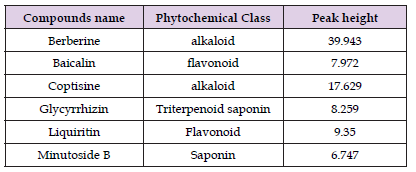
Bioassay-guided fractionation plays a crucial role in optimizing the therapeutic effectiveness of medicinal plants by excluding phytoconstituents that are not relevant to the medicinal potential of a given crude extract [20]. In this study, six compounds belonging to various classes of phytochemicals were indentified using HPLC. They include: Alkaloid, flavonoids, triterpenoid and saponin and are responsible for various pharmacological potentials of the plant (Table 3).
Table 3: Classification of compounds identified by HPLC.
ADME Properties of Compounds Identified in Jute Leaf (Corchorus olitorius)
Pharmacological and physicochemical profiling assesses the potential of a drug to reach the site of action and stay there long enough to elicit a biological response. Physicochemical profiling evaluated Lipinski’s rule of five (molecular weight (Mw) ≤ 500 Da, LogP ≤ 5, hydrogen bond donors ≤ 5, hydrogen bond acceptors ≤ 10, and 40 ≤ mola refractivity ≤ 140) to determine whether a drug with certain pharmacological or biological activity has the chemical and physical properties to make them orally active [21]. Three of the predicted compounds (minutoside B, baicalin and glycyrrhizin) violated the rule while the other three (berberine, liquiritin and coptisine) were orally active since they failed to violate any of the rules. Gastrointestinal absorption (GI) was evaluated to measure the ability of the compounds to be absorbed into the intestines. A good drug candidate is expected to possess a high GI for complete absorption into the bloodstream [22]. Hence, two (2) of the predicted compounds (berberine and coptisine) including the finasteride (control) revealed high intestinal absorption suggesting their potential drug-likeness. High penetration is needed for most of the drugs targeting the central nervous system (CNS), whereas blood brain barrier (BBB) penetration should be minimized for non- CNS drugs to avoid undesired side-effects [23]. Among the predicted compounds, berberine and coptisine penetrated the blood-brain barrier (BBB). Surprisingly, finasteride (control) also penetrated. P-glycoprotein (P-gp) is the product of the multi drug resistance (MDR) gene and an ATP dependent efflux transporter that affects the absorption, distribution and excretion of clinically important drugs [24]. A drug that is a substrate of glycoprotein (P-gp) has the potential of possessing high bioavailability and hence will stay at the active site to elicit a biological effect before being flushed out [25]. All the compounds were predicted to be P-gp substrates (Table 4).
Table 4: Characteristics of Column Fractions of Jute Leaf (Corchorus olitorius).

Predicted Toxicity Properties of Compounds Identified in Jute Leaf (Corchorus olitorius)
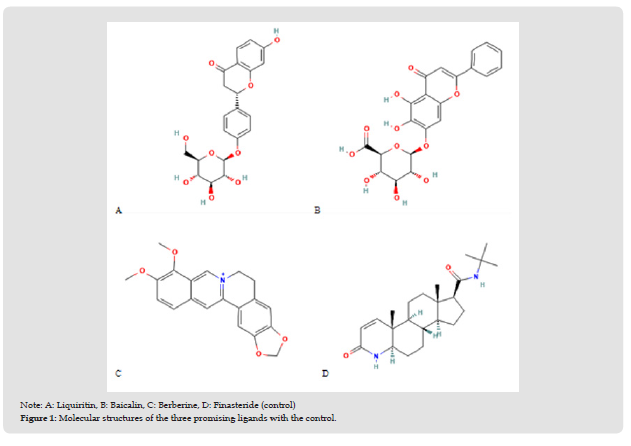
Toxicity assessment of compounds from plant extracts is crucial for determining their safety and potential health benefits. Studies have shown that various plant extracts contain biologically active compounds like flavonoids, coumarins, phenolic acids, and polysaccharides, which can impact acute and chronic toxicity levels [26,27]. The predicted LD 50 and toxicity class of the six (6) compounds revealed the compounds where safe. However, Berberine and Coptisine had the least LD50 of 200mg/kg with a toxicity class of 3 (Table 5).LD50: Lethal Dose of 50, Toxicity class 1: fatal if swallowed (LD50 ≤ 5), Toxicity class 2: fatal if swallowed (5 < LD50 ≤ 50), Toxicity class 3: toxic if swallowed (50 < LD50 ≤ 300), Toxicity class 4: harmful if swallowed (300 < LD50 ≤ 2000), Toxicity class 5: may be harmful if swallowed (2000 < LD50 ≤ 5000), Toxicity class 6: non-toxic (LD50 > 5000) (Figure 1).
Table 5: Characteristics of Column Fractions of Jute Leaf (Corchorus olitorius).

Figure 1
Docking Scores and Interactions of Ligands with Human steroid 5α-Reductase 2 (SRD5α2)
The docking score of the six (6) compounds ranged from 4.87 kcal/mol to -8.29 kcal/mol. The control ligand, exhibited a binding energy of -7.23 kcal/mol. Baicalin, berberine and liquiritin displayed the highest binding energies of -8.29 kcal/mol, -6.45 kcal/mol and -8.03 kcal/mol, respectively. These differences in the scores may be attributed to the structural disparities between these molecules and their subsequent abilities to occupy the active site of the receptor (Table 6).
Table 6: Docking scores, MMGBSA and interactions.

Note: *Interactions common with the Control
Revalidating Docking Scores Using MMGBSA
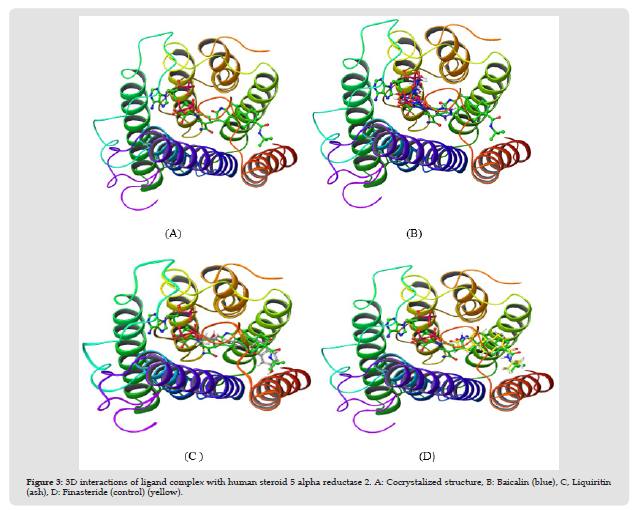
Additionally, the Prime MMGBSA module analyzed the binding energy calculation of selected top three (3) compounds based on their binding affinity towards the active site binding pocket of the target molecule. MMGBSA score of liquiritin was-76.46, whereas, berberine was -67.78 kcal/mol and baicalin had an MMGBSA of -63.32 kcal/mol. Baicalin had a higher docking score than liquiritin but reverse was the case for the MMGBSA score, this may be attributed to rescoring of the poses differently by MM/GBSA and docking method. The docking program uses an empirical scoring function as more like “machine learning” than direct physics-based in nature [28,29]. Thus, the ranks of the poses from two methods could differ significantly (Table 6) (Figures 2 & 3)).
Figure 2
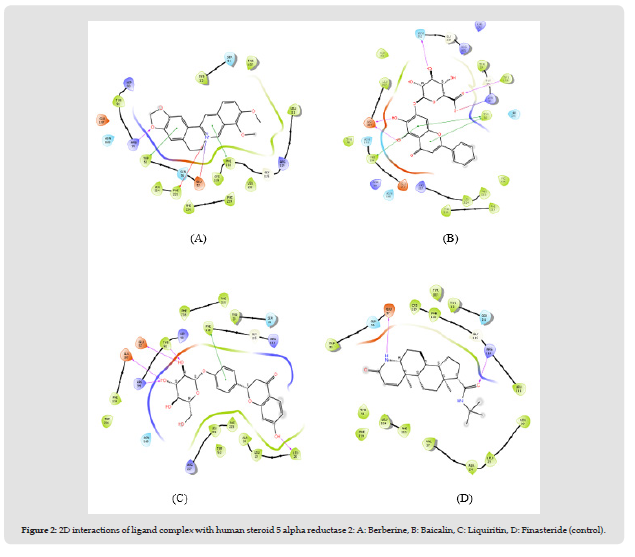
Figure 3
Molecular Interactions of the Selected Compounds with Steroid 5 Alpha Reductase 2 Receptor
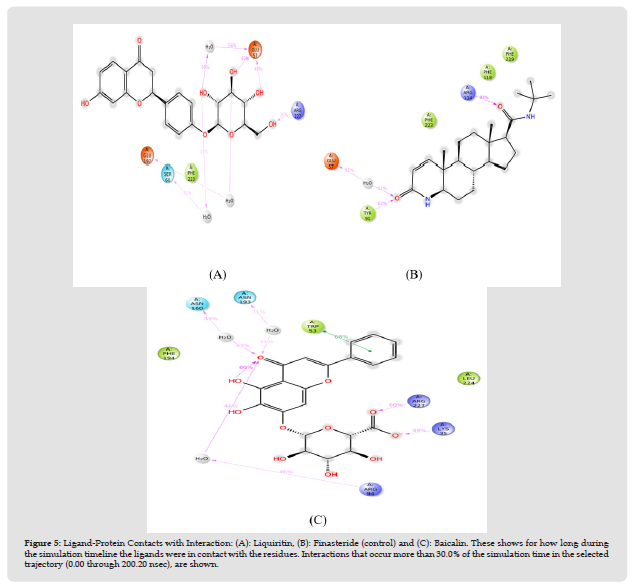
Protein-ligand complex stability relies heavily on interactions between ligand functional groups and amino acid residues in the protein binding site [30]. The elucidation of the structure of 5αR-2, as reported in multiple studies [31,32] highlighted the significance of specific amino acids for the biological activity of the target enzyme. Glu57 and Tyr91 were identified as crucial residues for selective inhibition of 5αR-2, particularly in the binding of inhibitors like finasteride [31]. The ligands, possess cyclic structure with little similarity to finasteride (control) acting as either hydrogen bond donor or acceptor. Berberine interacted with 5αR-2 via 1 conventional hydrogen bonds with ARG94 at distance of 2.32 Å, Baicalin also interacted via 3 hydrogen bonds with TYR128 (1.80 Å), ASN102 (2.75 Å) and ASP (1.98 Å,1.64 Å). Interestingly, liquiritin interacted via 5 hydrogen bonds (GLU197 (1.92 Å), ARG94 (1.85 Å), TYR91 (1.96 Å), GLU57 (1.90 Å) and LUE20 (1.99 Å) which is in line with the studies of [31] who found two of the amino acids (TYR91 and GLU57) interacting with the protein. Finasteride (control) attached within the protein active site via 2 hydrogen bonds ARG114 (1.99), GLU57 (2.18).
Molecular Dynamics
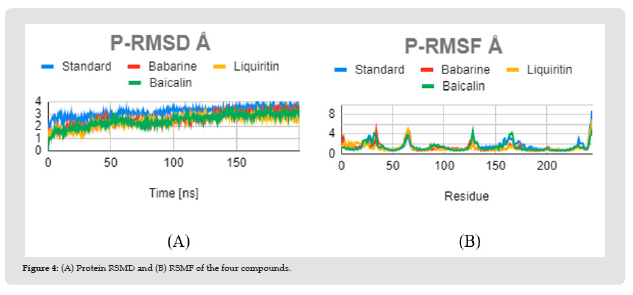
Three compounds and control were subjected to molecular dynamics simulations to predict stability of the complexes and validate bonds formed and corresponding strength. The RMSD measurements were used to evaluate the stability of the docked complexes. The RMSD value of the 4 compounds ranged from 2.44 Å to 3.82 Å (Figure 4A). The four complexes began to converge at 143ns with a minor drift but attained stability again at 200 ns from the simulation. Liquiritin complex was shown to be more stable with an average RSMD of 2.886 Å at 200 ns (Figure 4A). Finasteride (control) complex became stable from 143 ns with a little drift at 167ns and finally stabilized at 200 ns with an average RMSD value of the ~3.56 Å (Figure 4A). The RMSF values indicated the role of each amino acid residue in the binding site [32]. Minor fluctuations in RMSF were noticed in all four complexes with no major alterations observed throughout the simulation. In summary, each complex remains stable at 200 ns (Figure 4B).
Figure 4
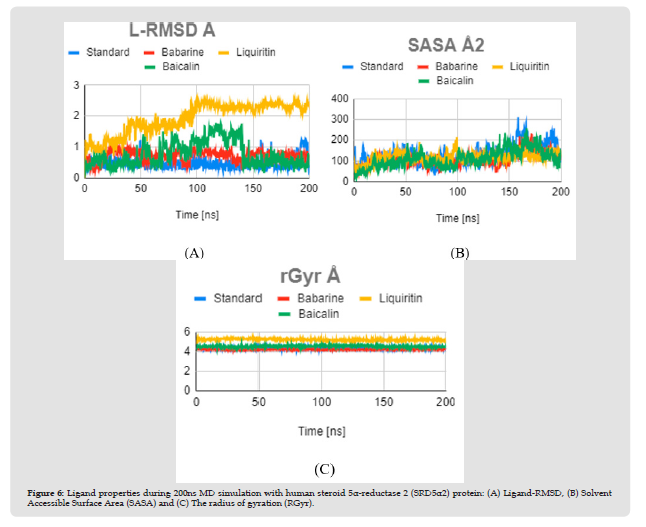
Protein-ligand interactions further revealed liquiritin formed hydrogen bonds with 4 amino acids residue (Glu 57, Ser 60, Glu 197 and Arg 227) of the protein human steroid 5α-reductase 2 (SRD5α2). Baicalin also interacted with 5 amino acid residues (Lys 35, Arg 94, Asn 193, Asn 160 and Arg 227) of the protein. Babarine on the other hand, formed no hydrogen bond with the protein. Finasteride (control) interacted via hydrogen bonds with 3 amino acid residues (Glu 57, Try 91 and Arg 114) of the protein throughout the simulation time of 200 ns (Figure 5). The corroboration by the docking results suggested that at least one amino acid residues (Glu 57) common in both ligands is critical for ligand binding and complex stability. The radius of gyration is a key parameter of the protein drug complex that is used to study the folding properties and conformations of the protein drug complexes. A comparatively high radius of gyration value indicates that a protein molecule is packed loosely while a lower radius of gyration value indicates a more compact protein structure [33]. A more compact protein indicates the drug molecule has not significantly interfered with the folding mechanism of the protein. Analysis of radius of gyration parameter (Figure 6D), shows all the experimented complexes showed similar trajectories. Hence, were compact and neither one displayed a greater amount of fluctuation under dynamic conditions. The average RGyr value of liquiritin, baicalin, babarine and finasteride (control) complexes were 5.12 Å, 4.58 Å, 4.22 Å and 4.271 Å respectively.
Figure 5
Solvent Accessible Surface Area analysis (SASA) reveals a better understand of the hydrophobic and hydrophilic behavior of the protein-drug complexes [32]. The human steroid 5α-reductase 2 (SRD5α2) with liquiritin complex had a SASA value of 154.0 Å2, while SRD5α2 with baicalin complex showed SASA of 144.0 Å2. The SRD5α2 with finasteride (control) complex displayed the highest SASA value 159.8 Å2 (Figure 6C). This suggest complex stability for protein–ligand is enhanced by hydrophobic interactions [32]. Ligand RMSD refers to the Root mean square deviation of a ligand with respect to the reference conformation. The Protein SRD5α2 with liquiritin complex showed the most fluctuation here with a maximum value of 2.4 Å and minimum of 1.2 Å. The other 3 complexes of SRD5α2 with baicalin, baberine and finasteride (control) displayed a more compact curve and stability in their ligand-RMSD curve (Figure 6A). However, ligand complex RSMD value of less than 3Å indicates stability. Thus the potential mechanisms of SRD5α2 catalysis and inhibition is via the enolization of finasteride as the result of hydride transfer involving the C-3 carbonyl and the C-2 group, leading to the covalent bond formation between finasteride and NADP [34]. In our study the existence of C-11 carbonyl group in liquiritin [35] may also be responsible for the transfer of hydride to NADP and subsequently forming covalent bond.
Figure 6
Prostate disorders such as benign prostate hyperplasia (BPH) and cancer have been related to the activities 5 alpha reductase 2 receptor. Various synthetic inhibitors such as finasteride have been developed. Liquiritin a flavonoid of plant origin has proven to be a potent inhibitor of the human steroid 5 alpha reductase 2 receptor after rigorous computational studies. This was validated via molecular dynamic simulation of 200 ns and the complex proved stable [36,37].
None.
Not applicable.
Martin Msughter Ganyam: Writing – review & editing, Writing – original draft, Visualization, Validation, Supervision, Software, Resources, Project administration, Methodology, Investigation, Formal analysis, Data curation, Conceptualization. Sule Ola Salawu: Supervision, Project administration, Methodology, Investigation, Formal analysis. A.A Akindahunsi: Supervision, Project administration, Methodology, Investigation, Formal analysis. Joel Ireoluwa Yinka: Visualization, Validation, Software, Resources, Project administration, Methodology, Formal analysis, Data curation.

International Association of Landscape Archaeology, Czech Glass Society, Czech Republic

Department of Chemistry, Semenov Institute of Chemical Physics, USSR Academy of Sciences, Moscow, Russia

Department of Educational Sciences, Research Centre Qualities of Teachers, School of Education – HAN, Nijmegen, Netherlands

Associate Professor at Department of Breast and Thyorid Surgey, Chongqing General Hospital, China

Neurology, LA BioMed Research Institute, USA





 Abstract
 PDF
PDF



























