Healthcare Assistance Challenges-Driven
Neurosymbolic AI Volume 58- Issue 2
Kaushik Roy
Student in computer science at the AI Institute, University of South Carolina, USA
Received: July 18, 2024; Published: August 09, 2024
*Corresponding author: Kaushik Roy, student in computer science at the AI Institute, University of South Carolina, Columbia, South
Carolina, 29208, USA
Although Artificial Intelligence technology has proven effective in providing healthcare assistance by analyzing
health data, it still falls short in supporting decision-making. This deficiency largely stems from the predominance
of opaque neural networks, particularly in mental health care AI applications, which raise concerns about their
unpredictable and unverifiable nature. This skepticism hinders the transition from information support to
decision support. This presentation will explore neurosymbolic approaches that combine neural networks with
symbolic control and verification mechanisms. These approaches aim to unlock AI’s full potential by enhancing
information analysis and decision-making support for healthcare assistance.
Consider the dataset Χ = {(1,1),(2, 4),(3,9)} , in- dexed by
, χii∈ {1, 2,3} generated from the ground truth function f :χ →χ 2
.Symbolic AI approaches would involve first gathering domain expertise
regarding reconstructing the ground truth function, for example,
by starting with the set of mappings fˆ :χ →χ , fˆ :χ →χ 2
,and fˆ :χ →χ 3 , and then letting an expert human map each point
in χi ∈ Χ. The expert human might map 1 χ = (1,1) to the mapping
fˆ :χ →χ ,χ2 = (2, 4) to the mapping fˆ :χ →χ 2 , and χ3 = (3,9) to the
mapping fˆ :χ →χ 2 . Subsequently, this mapping can be consolidated
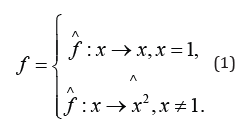
to obtain the symbolic approximation as follows:
It is clear from Equation 1 that symbolic AI can lead to wrong approximations
due to legitimate human errors (e.g., mapping 1 x = (1,1)
to fˆ :χ →χ instead of fˆ :χ →χ 2 ). Note that although this approximation
is inaccurate, it still generalizes well to all cases of f :χ →χ 2
; Generalization is a powerful benefit of symbolic AI.
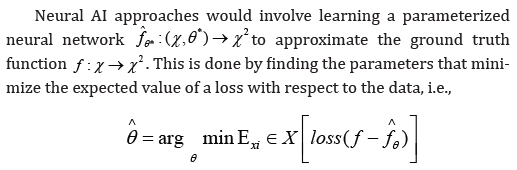
Such a function is expected to do well on the training data but
generalize poorly too far outside of the training distribution [1]. Furthermore,
a significant disadvantage of Neural AI is its black-box nature
makes it challenging to interpret and analyze the mappings from
inputs to outputs.
Neurosymbolic AI involves using a neural network to first map
the data in X to one of the mappings among fˆ :χ →χ , fˆ :χ →χ 2 , and
fˆ :χ →χ 3 . A neural network will not make the error that the hu- man
did in the symbolic AI case, and correctly map (1,1) to f :χ →χ 2 in
relation to the other data points in X (by minimizing the loss mentioned
in the neural AI subsection). Consequently, when such a mapping
is consolidated, we obtain an approximation fˆ :χ →χ 2 ,which
exactly matches the ground truth. This approximation is accurate,
does well onthe training data, and generalizes to all χ ∈ 1 . In this
way, neurosymbolic AI combines the benefits of both neural and symbolic
AI.
These challenges are related to the assistance provided by an AI
system in individual-specific assessments (e.g., diagnostic or symptom
assessments) and recommendations (e.g., treatment methods).
The core challenges lie in adequately capturing the individual’s context
and adhering to decision-making processes followed by human
experts. An Example of Contextualized and Expert Procedure Compliant
Decision-Making A person suffering from the most severe form
of depressive dis- order must be determined by a PHQ-9 questionnaire-
based assessment (specifically, must score in the range of 10-14
on the PHQ-9 assessment scale) (adherence to process followed by
expert). Furthermore, the recommended treatment route is pharmacotherapy;
however, if the person is found to be exhibiting symptoms
of pregnancy, pharmacotherapy is undesirable (contextualized compliance
with expert processes).
Overall Infrastructure-Centric Challenges
In the United States, infrastructure issues are one major obstacle
to accessing healthcare and implementing AI-driven healthcare
support. These include challenges such as healthcare providers
struggling to access essential information and protocols within the
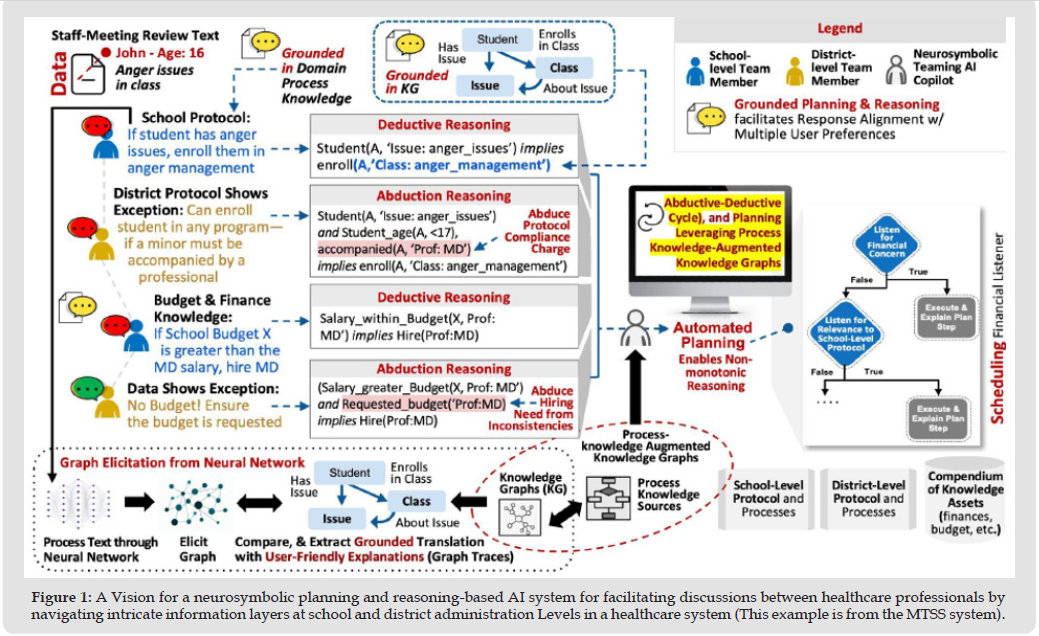
health- care system. A significant hurdle is creating an AI system that
can efficiently navigate the intricate layers of information within the
system, helping healthcare professionals streamline care delivery for
patients in need. Figure 1 illustrates a concept of AI for tackling infrastructure
issues.
Figure 1
Systemic Challenges
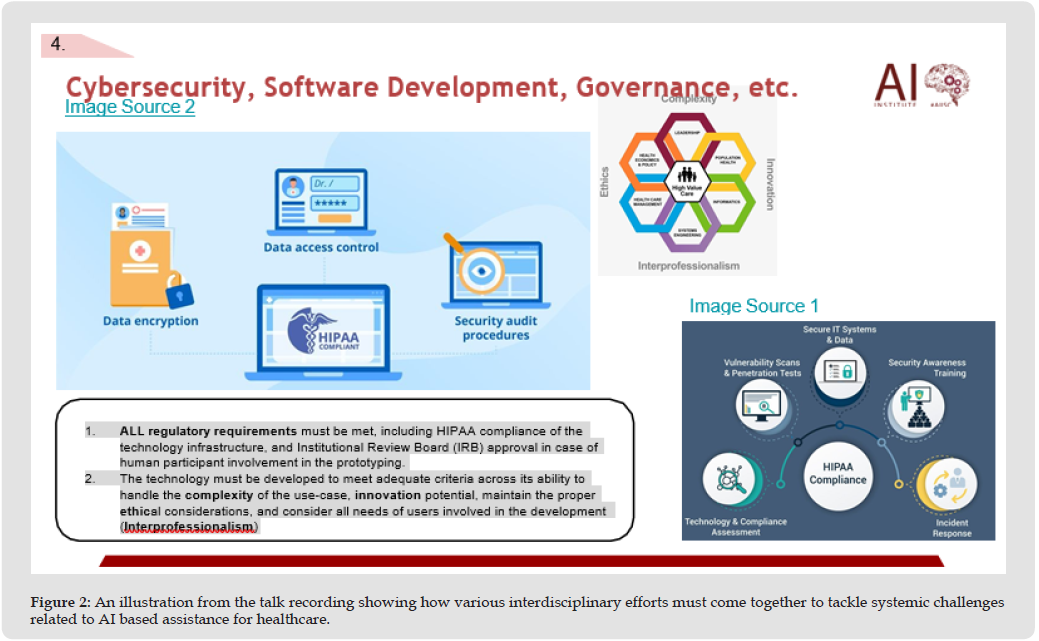
For brevity, we refer to the caption in Figure 2 for an explanation
of systemic issues such as regulatory compliance, ethical standards,
privacy issues, etc.
The talk discusses approaches neuro symbolic AI approaches for
handling various challenges in implementing AI-based assistance for
improving outcomes. It specifically outlines three levels of challenges
at the individual-centric level, the infrastructure- centric level, and
the systemic level. I hope this talk will foster innovation at the frontiers
of human-AI collaboration for healthcare assistance.
Kaushik Roy is currently pursuing his fourth year as a doctoral
student at the AI Institute of the University of South Carolina. His
research focuses on developing algorithms that merge statistical
data-driven learning techniques with domain-specific information
from external sources, with a particular emphasis on ap- plications
for social good. He has a track record of publishing numerous papers
and presenting talks at prestigious conferences, showcasing his work
in areas such as AI for mental health assessment support and other
socially impactful applications. The publications venues include IEEE
[2–13], NeurIPS [14], NAACL [15, 16], AAAI [17–27], Frontiers [28],
KR [29], ECML [30], KDD [31–33], ICAPS [34], KGC [35, 36], ACM [37–
40], ICLR [41], SPIE [42], IJCAI [43], PyData [44], etc. [45–49].
Manas Gaur, Kaushik Roy, Aditya Sharma, Bi- plav Srivastava, Amit Sheth, et al. (2021) “who can help me?”: Knowledge infused matching of support seekers and support providers during covid- 19 on reddit. In IEEE 9th International Conference on Healthcare Informatics (ICHI), pp. 265-269.
 ISSN: 2574 -1241










 Abstract
 PDF
PDF