info@biomedres.us
+1 (502) 904-2126
One Westbrook Corporate Center, Suite 300, Westchester, IL 60154, USA
Site Map
 ISSN: 2574 -1241
ISSN: 2574 -1241
ISSN: 2574 -1241
Received: July 24, 2024; Published: August 01, 2024
*Corresponding author: Oluwatobi Sanusi, Clinical Research, Bioluminux Clinical Research Illinois · Naperville, USA
DOI: 10.26717/BJSTR.2024.57.009076
The SARS-CoV-2 infections had been treated with varied anti-viral therapies to improve patient clinical status and determine safety. There is lack of comprehensive consensus on determining the overall safety and clinical outcomes due to novel anti-viral therapies to synthesize evidence. The systematic review was conducted following PRISMA guidelines. The text words, keywords, and controlled-vocabulary words (MeSH terms were used to retrieve targeted keywords on PubMed, Embase, and Cochrane Library with the following limiters, e.g., studies in the English language, studies from 2020 to 2024, Open access studies, Peer-reviewed articles, and studies with full-text availability. This review included 30 randomized controlled trials of High quality to synthesize evidence with 10,941 patients with a mean age of 49 (ranging from 19 to 90) years, including 55% of males, to treat SARS-CoV-2 infectious patients with mild to severe severity. Remdesivir, Molnupiravir, tofacitinib, Baricitinib combine with Remdesivir, a combination of Favipiravir, Lopinavir, Ritonavir, Monoclonal antibodies (Lenzilumab, AZD 7442, Meplazumab, Bamlanivimab monotherapy and combination with etesevimab, REGENCOV), Immunomodulators (Interferon-beta-1a, Peginterferon Lambda) is found to be effective and showed a statistically significant difference in improving clinical status by ensuring safety for patients with mild, moderate and severe SARS-CoV-2 infections(p<0.05). Novel antiviral therapies Remdesivir, Molnupiravir, and specific monoclonal antibodies have been shown to have significant clinical efficacies in patients, which proves their importance in improving patient clinical status and safety outcomes. The conclusion indicated that these therapies are beneficial in enhancing the likelihood of clinical improvement with tolerable side effects.
Keywords: COVID-19; Efficacy; Novel Anti-Viral Therapies; Safety
The outbreak of COVID-19 from the novel coronavirus, also known as SARS-CoV-2, increased global awareness of emerging infectious diseases. This pandemic has led to multi-omics analysis and database integration to analyze viruses and their evolution and develop early warning system strategies [1]. COVID-19 has also brought to the attention the necessity of enhancing the population’s health literacy and competence in the proper communication channels to address the challenges presented by fake knowledge regarding the disease, which can impact public perception of the disease [2]. Moreover, the COVID-19 has highlighted the need to prioritize investment in public health, build resilient national capacities for early identification and response to threatening diseases, and use evidence for policy-making to improve preparedness in the face of the newly emerged threats as COVID-19 [3]. Thirdly, the continuous influence of new pathogenic diseases, such as coronaviruses that caused COVID-19, calls for international efforts to strengthen the measures of noticing and controlling biosecurity-related risks [4]. For the introduction of novel antiviral therapies for COVID-19, a global perspective should prioritize treatments. The treatment must focus on that hinder coronaviruses replication, target viral proteins or host-virus interface and can be in oral form for easy use especially in resource-poor settings [5]. Further research should focus on using existing drugs and creating new ones as combination therapies. It includes topical gels that prevent the virus from entering host cells, and newer classes of antiviral drugs to effectively target and treat viral diseases like COVID-19 including its variants [6].
Moreover, more focus should be directed towards preclinical drug development, investigating the use of nanotechnological approaches in drug delivery, using phytoconstituents, and polyherbal formulations for managing COVID-19 and subsequent emerging coronaviruses [7]. Novel antiviral therapies contain a range of drugs that intervene with viral life cycle stages and enhance immune regulation. Multiple novel approaches are being explored to inhibit the replication and spread of the virus (SARS-CoV-2), which is evident in the literature [8]. These approaches target the viral cell directly or modify the host cell processes to hinder virus replication [9]. The approaches are Nucleoside analogs (Target viral RNA polymerase) [10], Protease inhibitors [11], Monoclonal antibodies (Target Spike proteins) [12], and host cell targeting agents, e.g., Baricitinib [13]. The mechanism of action varies among all approaches according to their target action sites. The efficacy of Novel antiviral therapies varied among mild to severe COVID-19 patients. The nucleoside analogs Remdesivir, Molnupiravir, and Favipiravir have different mechanisms of action. Remdesivir and Favipiravir inhibit viral RNA-dependent RNA polymerase, and Molnupiravir induces errors in viral RNA replication. Nirmatrelvir and Ritonavir inhibited SARS-CoV-2’s major protease (Mpro) and CYP3A to improve Nirmatrelvir pharmacokinetics [14]. Nirmatrelvir binds to SARS-CoV-2 to stop replication. Nirmatrelvir inhibits the viral protein-processing Mpro enzyme. This inhibits virus production and reduces COVID-19 severity [15].
Ritonavir, a CYP3A inhibitor, enhances SARS-CoV-2 pharmacokinetics. Hence, Paxlovid acts as inhibitors work together to reduce virus activity and augment COVID-19 treatment [14]. Sotrovimab, REGEN- COV (Casirivimab+Imedvimab), and Bamlanivimab are monoclonal antibodies that attach to the spike protein of SARS-CoV-2. They inhibit virus from entering cells and mediate the immune response [16,17]. When given early after a positive test, these antibodies reduce the risk of hospitalization or mortality among high-risk outpatients with mild to moderate COVID-19 [18]. Antibody fragments provide broader neutralization of SARS-CoV-2 variants and reduce the doses required to protect living organisms compared to mAbs [17]. However, host cell target agents (Baricitinib) a JAK inhibitor, have been used to treat COVID-19 to stop viral entry, reduce inflammation, and cytokines levels. Baricitinib inhibits virus-infected cells. It has been used to treat COVID-19 to control virus entrance, inflammation, and cytokine production [19]. Baricitinib targets cytokine in severe COVID-19 pneumonia, improving recovery rates in hospitalized patients [19]. Safety outcomes are also essential in determining these drugs’ clinical and practical application among patients affected by the SARS-CoV-2 virus. New antiviral medicines have been thoroughly researched for COVID-19 therapy safety and efficacy. Remdesivir, Favipiravir, Lopinavir /Ritonavir, ribavirin, interferon, and Hydroxychloroquine have been tried clinically for different viral infections and have had mixed mortality and clinical outcomes.
The safety of these antiviral treatments requires determining adverse symptoms, including gastrointestinal issues, elevated blood uric acid levels, cough, respiration, and immunological reactions.
Novel antivirals that target distinct viral replication stages can aid in the fight against COVID-19. Oral antivirals such as Evusheld, REGEN-COV, Bamlanivimab, etesevimab, Paxlovid, redeliver, Molnupiravir, favipiravir, dual oral protease inhibitor-ribavirin, and others target viral entry factors, viral replication, protein trafficking, post-translational modification, immunomodulation, and immune new etiotropic medications such as Molnupiravir, plitidepsin, and lopinavir/ritonavir remain in therapy regimens. Nonspecific immunoassays and broad-spectrum antivirals, such as RNases and RNAi, can also target viral genomes and proteins, paving the way for new antiviral therapies. Unusual COVID-19 treatments improve upon existing strategies and are acceptable.
The purpose of this review is to extract and synthesize evidence of novel antiviral therapies to determine the most effective treatment options for mild, moderate, and severe SARS-CoV-2 infection symptoms among hospitalized or outpatient departments. The focus was on clinical outcomes improvement, safety of each drug, viral clearance, mortality, incidence of disease, and return to home.
The purpose of this review is to evaluate the efficacy, safety, and outcomes (viral load reduction, viral clearance) of novel antiviral therapies for the treatment of mild, moderate, and severe symptoms in SARS-CoV-2 patients.
This is a systematic review that used PRISMA guidelines (Figure 1) [20] to assess the safety and efficacy of new antiviral therapies for infectious diseases like COVID-19.
Figure 1

The text words, keywords, and controlled-vocabulary words (MeSH terms), e.g., “COVID-19 patients” OR “SARS-CoV-2 patients” AND “Novel anti-viral therapies” OR “anti-viral therapies” OR “Anti- viral agents” OR “Remdesivir” OR “Favipiravir” OR “Molnupiravir” OR Monoclonal antibodies” OR “Protease inhibitors” AND “standard of care” OR “placebo” AND “Safety” OR “Safety outcomes” OR “Effectiveness” OR “Clinical outcomes” OR “adverse events” OR “viral load” OR “Viral clearance” was used with appropriate use of Boolean operators “AND,” “OR” to retrieve literature. The databases e.g. PubMed, Embase, and Cochrane Library were searched with the following limiters; studies in the English language, studies from 2014 to 2024, Open access studies, Peer-reviewed articles, and studies with full-text availability. The PICO framework was mentioned in (Table 1).
Table 1: Methodological quality and risk of bias assessment to determine strength of evidence.

What is the efficacy, safety, outcomes (viral load reduction, viral clearance) of novel antiviral therapies for the treatment of mild, moderate, and severe symptoms in SARS-CoV-2 patients?
In this review, only RCTs in which adult patients of either gender diagnosed or suspected SARS-CoV-2 patients from 2020 to 2024 are included. All studies which are in English language, full text language, peer-reviewed, and open-access published in journals having more than 15 impact factors as per Clarivate journal citation report of web of science. The inclusion criteria of more than 15 impact factor are set to retrieve high impact factors randomized controlled trails studies to ensure robustness while synthesis evidence from high-impact factor journals. Only studies focused on novel antiviral therapies (including, but not limited to, Remdesivir, Molnupiravir, Favipiravir, and monoclonal antibodies) were selected.
Observational studies, case reports, case series, retrospective case series, retrospective chart reviews, Ambispective, systematic reviews, narrative reviews, meta-analyses, letters, editors, and communications were not included. Studies not in English language, paid, published in non-peer reviewed and having less than 15 impact factors were excluded. Studies which were focused on other than COVID-19 emerging infections were not considered.
Two independent reviewers did the selection. In case of conflict, consensus was reached through discussion [21]. The initial recorded studies were screened through abstract and titles reading. The preset exclusion criteria excluded irrelevant studies. Third, eligibility criteria were determined by reading comprehensively in-depth articles as per pre-specified inclusion criteria. Methodological quality assessment was performed on included studies. To ensure reliability, high-quality studies published in journals with impact factors over 15 were selected.
Cochrane Risk of Bias 2.0 categorized studies as high, low, or some concern for bias [22]. GRADE assessed trial recommendation strength. Based on bias risk, GRADE assumptions were applied to determine evidence recommendation strength. High-quality studies had little risk of bias, while uncertain and high-risk studies were considered “moderate” and “low” quality evidence. This evidence-synthesizing systematic review included only high-quality studies [23].
Data were extracted from included RCTs such as study designs, sample size characteristics (age, gender, disease duration, intervention, and controls), novel antiviral therapies, dosage, duration, comparator, outcomes measures, safety outcomes, clinical outcomes, objectives, contributions, and methodological quality assessment. The data was entered in an Excel spreadsheet. The datasheet also contained information about conflict of interest among authors, data availability, ethical concerns, and the number of times the articles were cited. The analysis of the studies was done using a systematic approach. A data was analyzed and synthesized based on thematic analysis approach withdrawing themes and sub-themes [22]. It involves the in-depth analysis of the convergence of these results and a review through an iterative approach. The theme’s critical appraisal aimed to analyze the evidence in order to ensure an informed, evidence- based understanding of novel clinical and safety outcomes for antiviral drugs.
The review was conducted on humans using the Helinski declaration to ensure patient benefit. There was no conflict among the authors. The review was conducted in accordance with PRISMA guidelines to ensure the best evidence-based practice that other authors can replicate in the future (Figure 1). It will be published to disseminate the findings in the best interests of the public.
This review synthesized evidence using PRISMA guidelines. PubMed, Embase, and Cochrane library databases yielded 465 articles using keywords, text words, and controlled vocabulary on the initial search. EndNote x9 identified and eliminated 40 duplicate articles. For screening, 425 articles were chosen. One hundred sixty-two irrelevant articles were deleted after title and abstract screening. Two hundred and ten RCTs met pre-specified inclusion criteria by reading in-depth research.
The methodological quality of 210 RCTs was examined using Cochrane risk of bias 2.0, which assessed five domains of each randomized controlled trial. ROB 2.0 tool classified RCTs into nine (09) highrisk and eighty-seven (87) low-risk, and 114 studies have uncertain risk of bias. Thirty (30) out of 87 low risks of bias RCTs were included in the review because these 30 RCTs retrieved from the journals that had impact factors of more than 15 according to Clarivate Journal citation analysis of Web of Science (Table 2).
Table 2: Characteristics of included studies.
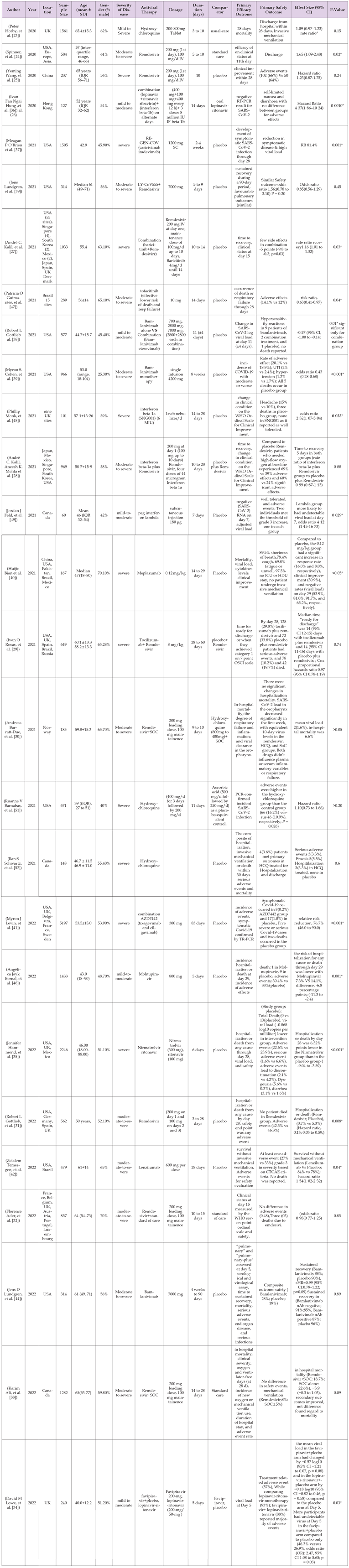
The 30 included RCTs were of low risk of bias RCTs. Therefore, it was upgraded to High quality according to the GRADE tool assumptions. Moreover, 114 RCTs that had unclear risk of bias have downgraded the quality of evidence to “moderate quality.” However, the remaining 09 RCTs were of high risk of bias and rated as “low quality” (Table 2).
The characteristics of included 30 RCTs, categorized as “high quality,” had 10,941 patients with a mean age of 49 years ranging between 19 and 90 years. The majority of patients were in middle or late adulthood. The gender distribution is almost equally among groups, with 55% of whom were males. Each RCT compared novel antiviral therapies with standard of care, usual care, and placebo. The effect of each novel therapy had an equal comparator to determine the significance of novel antiviral therapies that are mentioned in Table 3. The key highlights and findings are also presented in Table 3.
Table 3: Key findings and highlights of included studies.

In this review, combination of Protease inhibitors (Nirmatrelvir and Ritonavir), (Lopinavir Ritonavir), Polymerase inhibitors (Remdesivir), Nucleoside analogue (Molnupiravir), Monoclonal antibodies (Bamlanivimab monotherapy and combination with etesevimab, Sotrovimab, Lenzilumab), Immunomodulators (Interferon, Tofacitinib, Hydroxychloroquine) novel antiviral therapies were used. Each study compared novel anti-viral therapy as an intervention with the standard of care, placebo, or control group with an equal ratio of 1:1. These novel antiviral therapies had effectively treated patients of mild, moderate, and severe SARS-CoV-2 affected patients. It also reported improvements in clinical outcomes and related side effects or adverse events due to each novel antiviral therapy.
Remdesivir
Remdesivir has been used in trials [24-33] to determine its efficacy. In all these trials, dosages of 200 mg for day one and a maintenance dose of 100mg were given among patients for a duration of 10 to 14 days to assess improvement in clinical outcomes such as hospital mortality, respiratory symptoms reduction, and clinical improvement score. Only two trials, (Gottlieb, et al. [31]); (Spinner, et al. [24]) found statistically significant differences while comparing it with the standard of care, usual care, or placebo (p<0.05) [24, 31]. However, the remaining studies showed no statistical difference (p>0.05). During assessment of the safety of Remdesivir, only (Ader, et al. [32]) reported three deaths due to remdesivir comparing its effect with the standard of care [32]. There is no significant difference in adverse events reported due to Remdesivir when given among patients with the standard of care and placebo in any of the above-mentioned trials. However, (Kalil, et al. [27,28]), [27, 28] both applied combination therapy of interferon beta-1a and baricitinib with remdesivir. (Kalil, et al [28]) found that Remdesivir showed better efficacy in combination with Baricitinib than prescribed alone. Therefore, a faster recovery has been evident when this combination is prescribed among SARSCoV- 2 patients. On the other hand, (Kalil, et al [27]) demonstrate that the combination of interferon beta-1a and remdesivir did not demonstrate superiority over remdesivir alone in hospitalized COVID-19 pneumonia (p=0.88) [28].
Protease Inhibitors
The effect size and safety outcomes for protease inhibitors were compared in the three included studies, taking into account differences in dosage, duration, and severity of the disease. (Lowe, et al. [34]) studied the efficacy of Favipiravir alongside lopinavir-ritonavir, involving 240 participants with mild to moderate COVID-19 from the UK [34]. The study revealed a notable viral load reduction (OR: 2. 47, p = 0. 03), although they are characterized by high adverse events, especially those on lopinavir-ritonavir monotherapy (93%). In a randomized trial by (Hammond, et al. [35]), 2246 hospitalized severe COVID-19 patients from the USA, UK, and Mexico received ivermectin. The intervention group had a lower incidence of hospitalization or death by day 28 (p<0.001), lower viral load, and fewer severe adverse events [35]. However, (Hung, et al. [36]) from Hong Kong involving 127 patients with mild to moderate COVID-19 prescribed lopinavir-ritonavir, ribavirin, and IFN beta-1b. They reported a significantly lower hazard ratio of reporting RT-PCR negative compared to the control group (p = 0. 0010) with minimal side effects [36]. The findings suggest that protease inhibitors can be effectively used with other therapies, and their efficacy and safety may significantly differ. Among them, Nirmatrelvir and ritonavir were deemed to have a strong indication for use in severe cases, with reported reductions in severe outcomes and a favorable safety profile [34-36].
Monoclonal Antibodies
The drugs belonging to monoclonal antibodies had been used in nine included RCTs with varying efficacy and safety outcomes. (O’Brien, et al. [37]) recently studied the impact of REGEN-COV (Casirivimab and Imdevimab) in severe COVID-19: a 1200 mg vitamin D subcutaneous dose proved effective in decreasing the emergence of symptomatic SARS-CoV-2 infection by day 28 with an RR of 81 [37]. On the other hand, (Gottlieb, et al. [38]) evaluated Bamlanivimab alone and its combination with Etesevimab in moderate to mild cases [38]. The study showed that the combination treatment decreased the viral load of SARS-CoV-2 at day 11 (p=0. 01), while Bamlanivimab alone did not make a statistically significant difference. (Cohen, et al. [39]) state that in moderate to severe conditions, Bamlanivimab monotherapy reduced moderate or worse COVID-19 by having an odd ratio of 0. 43(p<0. 001), and it pointed out that all five of the deaths were in the placebo group [39]. Furthermore, it is agreed that all five of the deaths were in the placebo group (p=0.00). Another study of Bian et al. [40] on Meplazumab in severe settings also highlighted better clinical efficacy and significantly greater response rate compared with the placebo (p<0. 05) [40]. (Rosas, et al. [29]) conducted research on Tocilizumab plus Remdesivir with severe COVID-19 patients and concluded that median time to discharge was similar to placebo plus Remdesivir (p=0.74) [29]. (Levin, et al. [41]) also revealed that AZD7442 (tixagevimab and cilgavimab) in severe cases reduced the risk of having symptomatic COVID-19 infections by 76.7%, p < 0. 001 [41].
(Temesgen, et al. [42]) studied the efficacy of Lenzilumab in moderate to severe cases that led to an improvement of the primary efficacy endpoint of time to ventilator support or death (HR 1. 54; p 0. 04) [42]. In the study by (Self, et al. [43]), they evaluated the efficacy of Sotrovimab and realized that there were no variations in the clinical recovery or safety profile of the participants who received Sotrovimab as compared to the placebo group (p>0.05) [43]. Last, but not least, (Lundgren, et al. [44)], examining high-dose Bamlanivimab in moderate and severe SARS-CoV-2, observed that the likelihood of sustained recovery or any rate of perceived safety was no different from placebo (p=0. 89) [44]. The results suggested that monoclonal antibodies, including REGEN-COV and AZD7442, reduce SARS-CoV-2 symptoms and enhance clinical outcomes such as mortality, impairment, and discharge. The overall response varied among RCTs as most findings were not statistically significant and showed lower efficacy. Still, these studies did not analyze confounding variables that may impact treatment efficacy. Monoclonal antibody safety is substantial as most of the deaths occurred in placebo groups, or (Rosas, et al. [29]) reported 18.8% deaths in Tocilizumab plus Remdesivir group, which needed to be studied or distinguished [29]. There were no serious adverse effects, ensuring its safety. Researchers may utilize these to vaccinate the populace to reduce SARS-CoV-2 severity.
Nucleoside Analogue
The efficacy and safety of Nucleoside analogues, e.g., Molnupiravir, were investigated in two trials. (Fischer, et al. [45]) conducted trial on severe COVID-19. In this trail three doses of Molnupiravir were used: 200mg, 400mg, and 800mg, for four weeks. The study found that Molnupiravir was well-tolerated across all doses, with adverse events reported as follows: 47.4% for 200 mg, 32% for 400 mg, 3% for 800 mg, and 20% for the placebo: 29%. Another study pointed out one death in the Molnupiravir group; the patient experienced hypoxia. The time duration of treatment was 14 days in the 800 mg Molnupiravir group versus 15 days in the placebo arm. A viral clearance was much superior in the 800 mg group at 92.5% than the placebo group (80.3%). The number of participants positive for infectious virus count was remarkably lower in the 800 mg group (p < 0. 016). However, (Jayk Bernal, et al. [46]) focused on minimizing symptoms of COVID-19 and prescribed Molnupiravir at a dosage of 800 mg for only five days. This placed the proportion of patients who experienced a hospitalization or death by day 29 at a lower 7.3% in the Molnupiravir group as opposed to the placebo group 14.8%, (HR; -11. 3 to -2. 4), p=0.001. In the analysis, patients in the intervention group had a better improvement score than the control group. Mortality was reported as 1 with Molnupiravir and 9 with placebo group. The incidence of adverse events was somewhat lower in the Molnupiravir arm (30.4%) than in the placebo arm (33%). To conclude, Molnupiravir effectively treats mild, moderate, and severe SARS-CoV-2 infection with fewer side effects with only one case of mortality.
Immunomodulators
Five trials evaluated the efficacy of Immunomodulators in treating SARS-CoV-2 infections [47-50]. (Guimarães, et al. [47]) found Tofacitinib (10mg) for fourteen days as effective in lowering risk of death and respiratory failure while treating moderate to severe SARSCoV- 2 patients via reduction in inflammation and immune-mediated response in tissues (Janus-Kinase mechanism) as compared to placebo. The difference is statistically significant as p=0.04; however, 14.1% side effects were reported as compared to 12% side effects in placebo group [47]. Interferon beta-1a (SNG001) for nebulized therapy in severe COVID-19 was studied by (Monk, et al. [48]). They observed betterment in clinical status and no mortality associated with the treatment [48]. However, (Kalil, et al. [28]) gave interferon beta-1a together with remdesivir to moderate-severe patients. There was no difference in recovery duration but increased side effects in patients requiring high-flow oxygen [28]. A recent study by (Feld, et al. [49]) studied the efficacy of subcutaneous peg interferon lambda in mild to moderate cases. Which showed a significant reduction in viral load by day 7 [49]. (Mila B Ortigoza, et al. [50]) studies the effect of COVID-19 convalescent plasma. The use of COVID-19 convalescent plasma did not demonstrate a significant overall effectiveness in improving the clinical condition of hospitalized COVID-19 patients who needed non-invasive supplementary oxygen. However, it is possible that convalescent plasma with high levels of antibodies may have had some benefits during the early stages of the pandemic [50]. Overall, all the studies noted interferon and tofacitinib treatment to be significant effective in terms of improvement in clinical outcomes based on disease severity, time, and dose of interferon administered (p<0.05) except when Interferon beta-1a prescribed with remdesivir (p=0.88). Although, COVID-19 convalescent plasma showed no significant difference but higher levels antibodies may be beneficial which direct future researchers to do further studies which may validate the finding.
Hydroxychloroquine (HCQ)
HCQ dose, intensity, treatment time, and safety issues vary widely between existing published researches. In an open, non-comparative, 3–10-day UK trial; (Horby, et al. [23]) prescribed orally HCQ at 200-800 mg/day to COVID-19 patients. No substantial changes in adverse events and 28-day mortality rate were seen between HCQ and standard care (rate ratio: 1.09; 95% CI 0. 97–1. 23). In 671 severe COVID-19 patients (Barnabas, et al. [51]) [51] in the US randomly given HCQ (400 mg first and then 200 mg daily for 11 days) to a placebo- equivalent ascorbic acid control. The study found 16.2% adverse events in the HCQ group compared to 10.9% in control patients (P = 0.26). However, the hazard ratio of <0.20 did not affect clinical end goals. (Schwartz, et al. [52]) employed HCQ to assess hospitalization, invasive mechanical ventilation, and 30-day death in 148 Canadian severe COVID-19 patients. Despite increased rates of significant side events such as emesis and hospitalization, there was no statistical difference in primary outcomes between HCQ and placebo groups, with a hazard ratio of 0.6 at 95% CI. Overall, no statistically significant difference was found for HCQ. Patient clinical outcomes suggest that HCQ therapy depend on the patient’s condition and disease severity, requiring rigorous research to characterize the effectiveness of SARSCoV- 2 treatment.
This review included 30 randomized controlled trials of High quality to synthesize evidence. The 10,941 patients with a mean age of 49 (ranging from 19 to 90) years, including 55% of males were included in this review to treat with mild to severe SARS-CoV-2 patients. Multiple novel antiviral therapies were used in the included trials. Remdesivir, Molnupiravir, tofacitinib, Baricitinib combine with Remdesivir, a combination of Favipiravir, Lopinavir, Ritonavir, Monoclonal antibodies (Lenzilumab, AZD 7442, Meplazumab, Bamlanivimab monotherapy and combination with etesevimab, REGEN-COV), Immunomodulators (Interferon-beta-1a, Peg interferon Lambda, Tofacitinib) is found to be effective and showed a statistically significant difference in improving clinical status by ensuring safety for patients with mild, moderate and severe SARS-CoV-2 patients. However, Hydroxychloroquine, Sotrovimab, Tocilizumab, and Interferon beta-1a in combination with remdesivir showed statistically insignificant differences. These findings underscore the diverse, varied effectiveness and safety of these novel anti-viral therapies highlighting the necessity for tailored therapeutic intervention based on patients-specific factors, disease severity, age, and rigorous clinical assessment of patients. While comparing the findings of the review with existing literature, Remdesivir showed significant improvement in clinical outcomes and ensured safety. It showed less in-hospital mortality and emphasized its influential role.
Which is aligned with (Wang, et al. [53]) who also found that Remdesivir is effective in vitro coronavirus treatment by inhibiting viral replication and supporting that claim. Another study (Gordon, et al. [54]) also emphasized the effectiveness of improving clinical status. (Feng, et al. [55]) showed that Remdesivir is effective due to its higher viral genetic diversity inhibition among immunocompromised patients, aligning with the review emphasis on patients-specific factors because (Karim Ali, et al. [33]) found significant statistics for Remdesivir in comparison to the standard care of patients [33]. However, the variance in effectiveness may all depend upon patient profile and severity and confounding variables. This is the limitation of this review because it only reported that variance. Furthermore, novel antiviral therapies for monoclonal antibodies showed statistically significant effects in SARS-CoV-2 treatment, except for Sotrovimab and Tocilizumab. Similarly, Immunomodulators also showed statistically significant differences alone, but when Remdesivir is prescribed, its efficacy decreases. The effectiveness variance may be dependent upon immune response, disease severity, age, and confounding variables. Overall, the Immunomodulators and monoclonal antibodies are the safest among all novel antiviral therapies, as no death or mortality is reported in any single trial. Fewer side effects are reported, with no serious adverse event reported in any trial. It is also considered as the best option to treat SARS-CoV-2 patients with severe and critical severity of symptoms. The findings align with the meta-analysis systematic review of (Wungu, et al. [56]), emphasizing that monoclonal antibodies are viable options for severe or critical SARS-CoV-2 infections. A research team suggests that monoclonal antibodies are less aggressive in terms of mortality and are also beneficial in mild to moderate SARS-CoV-2. Although some monoclonal antibodies showed less response, it may be due to the uncertain immune response of patients.
Therefore, future research must address this question and explore treatment options. However, the effectiveness of novel antiviral therapies’ varied responses may be due to the provirus effects of some specific factors, such as aryl hydrocarbon receptors, that provide insights into how they impact the efficacy of antiviral therapies [57]. Moreover, (Giovannoni, et al. [58]) also claimed similar factors which may impede antiviral efficacy. Therefore, the literature debates that these sorts of factors must be answered in future research to determine efficacy by regressively analyzing factors that may influence efficacy. Moreover, (Weston, et al. [59] also emphasized that broad antiviral SARS-CoV2) activity approved by the FDA highlights the importance of repurposed novel anti-viral therapies and also offers diverse perspectives on therapeutic options. To conclude, the findings ensure the overall efficacy and safety of SARS-CoV-2 patients through novel antiviral therapies. It specifically emphasizing the direct focus of health professionals, physicians, and policymakers on establishing guidelines with a special focus on tailored intervention based on patient-specific factors, disease severity, and other confounding variables.
Several limitations inherent to this review must be considered when considering the evidence synthesis. First, the original protocols could have been constrained among RCTs, and the adaptations due to the dynamic COVID-19 crisis might have introduced heterogeneity in the study settings and objectives. Thus, problems such as few RCTs with small sample sizes or a majority of RCT’s short follow-up duration in many individual trials precluded drawing definitive conclusions concerning safety and efficacy. Additionally, the studies were performed earlier when no vaccines had been developed, leaving out vaccinated persons and making the results less generalizable to the contemporary vaccinated population. Despite using pre-specified inclusion criteria and critically appraising the quality of the included studies, the application of the random-effects model for meta-analysis was still hampered by the heterogeneity of treatment efficacy. Further, the patient data across different studies and the variability of the types of populations, stages of disease, and therapeutic approaches utilized also limit the homogeneity among results. More importantly, the review needs to discuss factors affecting effectiveness.
Nevertheless, some limitations are in place. The management of SARS-CoV-2 relies on the conclusions drawn from this review. Available evidence indicates that Remdesivir, Molnupiravir, and other monoclonal antibodies enhance the clinical outcomes and safety of COVID-19 treatment across various disease severities. These drugs have shown significant efficacy in treating COVID-19, particularly in severe cases necessitating intensive treatment. The dangers and benefits mentioned here maintain the importance of tailoring a medical treatment plan according to age, other medical conditions, and the severity of the sickness. When evaluating the impact of these antiviral medications, healthcare practitioners, policymakers, and clinical guidelines should consider the variables. The evaluation also advocates for further investigation into the effectiveness of these medications in individuals who have been vaccinated, as well as any other circumstances that may complicate the analysis. Further research on these factors will be necessary to enhance the management of COVID-19 and improve patient outcomes in contemporary practice.
In conclusion, this systematic review comprehensively discusses the effectiveness and side effects of multiple novel antiviral medications for viral SARS-CoV-2 infections at various disease stages. Drugs such as Remdesivir, Molnupiravir, Tofacitinib and specific monoclonal antibodies have been shown to have substantial clinical efficacies depending upon the disease severity of patients. It proves their importance in improving patient health care, clinical outcomes and reducing side effects. Although a few therapies like Hydroxychloroquine and some monoclonal antibodies (Sotrovimab, Tocilizumab) are found to have no clinically significant benefit, the overall synthesis indicated that these therapies are beneficial in enhancing the likelihood of clinical improvement with tolerable side effects. This has provided direction toward the need for individualized intervention strategies for patients with different characteristics such as the severity of SARS-CoV-2, and confounding factors, as indicated by the review. However, the following issues result from confounding variables attributable to the heterogeneous outcomes and interventions with varied effect sizes. The mentioned antiviral therapies should be incorporated into clinical practice guidelines. Further studies should consider focusing on factors together with various aspects highlighted in discussion with therapeutic outcomes to maximize the care of SARS-CoV-2 infected patients.

International Association of Landscape Archaeology, Czech Glass Society, Czech Republic

Department of Chemistry, Semenov Institute of Chemical Physics, USSR Academy of Sciences, Moscow, Russia

Neurology, LA BioMed Research Institute, USA

Associate Professor at Department of Breast and Thyorid Surgey, Chongqing General Hospital, China

Clinical Radiologist (MD) - Department of RADIOLOGY, Cosenza Hospital, Cosenza, Italy





 Abstract
 PDF
PDF



























