info@biomedres.us
+1 (502) 904-2126
One Westbrook Corporate Center, Suite 300, Westchester, IL 60154, USA
Site Map
 ISSN: 2574 -1241
ISSN: 2574 -1241
ISSN: 2574 -1241
Received: July 05, 2024; Published: July 26 2024
*Corresponding author: Umra Rasool, University of Turin, Italy
DOI: 10.26717/BJSTR.2024.57.009069
Dysbiosis, or changes in the composition of the gut microbiome, can be brought on by a variety of things, including illnesses, antibiotics, stress, and food. Currently, there are a number of methods for modifying the gut microbiome, including dietary modifications and the use of probiotics, prebiotics, synbiotics, postbiotics, and antibiotics. One novel approach to regulating gut microbiota in animals with the goal of reestablishing the recipient’s intestinal microbiome is fecal microbiota transplantation (FMT). This type of bacteriotherapy is successfully applied in human medicine to treat recurrent Clostridium difficile infections (CDI). For a number of years, large animal medicine has been aware of FMT. The application of FMT is not a standard procedure in small animal medicine.
Keywords: Dogs; Faecal Microbiota Transplantation; Gut; Probiotics; Microbiome; Modulation
Abbreviations: FMT: Fecal Microbiota Transplantation; CDI: Clostridium Difficile Infections; CFU: Colony- Forming Units; GIT: Gastrointestinal Tract; SCFAs: Short-Chain Fatty Acids; DI: Dysbiosis Index, AD: Acute Diarrhea; FDA: Food and Drug Administration; ESBL: Extended-Spectrum Beta-Lactamase
The term "faecal microbiota transplantation" refers to an approach whereby feces are transferred from a healthy donor to the gut of an unhealthy recipient through multiple methods. For instance, an endoscopy, enema, nasogastric tube, colonoscopy or in the form of capsules [1-3]. The purpose of treatment is to adjust and reconstruct the recipient's gut composition. Currently, the primary indication for this type of bacteriotherapy in people is recurrent CDI that is not improved by antibiotics [4]. FMT is helpful in treating a number of different gastrointestinal and non-gastrointestinal disorders that are closely linked to dysbiosis. Transfaunation, or the therapeutic transfer of rumen content, was first documented in large animal therapy in the 17th century [5,6]. To put FMT into practice, more study is needed as there aren't many publications currently available that outline its positive effects in both chronic and acute disorders in small animals. In addition to highlighting its advantages, alternatives, and potential application in small animal gastroenterology in the future, the primary goal of this review is to provide a summary of well-known information regarding transplanting feces in small animal medicine.
A diverse range of microorganisms, including bacteria, viruses, fungus, and protozoa, inhabit the gastrointestinal system of every individual. The term "microbiome" refers to the collective genome of all intestinal microbiome [7].
Microbial Diversity in Health
In any organism that hosts the gastrointestinal system, bacteria are the predominant population. From the stomach to the colon, their abundance increases [8]. The concentration of bacteria in a healthy dog stomach varies from 101 to 106 colony-forming units (CFU) per gram [9]. Aerobic and facultative anaerobes comprise the intestinal microbiota of the small intestine, where the microbial concentration ranges from 102 to 106 CFU per gram. In the colon, anaerobes prevail with a bacterial density of about 1011 CFU per gram [9,10]. Each individual, however, has a unique microbial composition; in the gastrointestinal tract (GIT) of healthy dogs and cats, Firmicutes, Actinobacteria, Fusobacteria, and Bacteriodetes are the most common phyla [10,11]. Within this core bacterial ecosystem, the phylum Firmicutes has a large number of important species. Three Clostridium clusters-IV, XI, and XIV-dominate, making Clostridium the most common bacterial class. Within the phylum Firmicutes, Bacilli and Erysipelotrichi are important classes in addition to Clostridium [12-15]. In human beings, the occurrence of phylum Fusobacteria is linked to gastrointestinal disorders, however in dogs, Fusobacteria is linked to a healthy microbiome. This finding suggests that the function of Fusobacterium in animals differs from that in humans [12,13]. It has been observed that Fusobacterium is more prevalent in outdoor dogs as well as other carnivorous species [12,16-19]. The variety of gut microbiota in healthy dogs is shown in Figure 1.
Figure 1

The Function of the Gut Microbiome
In addition to being involved in the pathophysiology of numerous diseases, the gut microbiome has a wide range of functions in maintaining health. Protection of host from infectious agents, improving the function of the intestinal barrier by forming tight junctions, supplying nutrients, and modifying the immune system through interactions between cells (Toll-like receptors, dendritic cells) and the generation of microbial metabolites, such as vitamins, bile acids (Bas), short-chain fatty acids (SCFAs), and tryptophan metabolites, are among its most significant roles [20,21]. Additionally, several bacteria release antimicrobial compounds that directly destroy enteropathogens [22]. Positive effects of the gut microbiota can be observed locally as well as in the surrounding organs because of the systemic transfer of these products and cells produced in the intestine. The gut-organ axis, which encompasses the gut-brain, gut-lung axes and gut-skin, is the term used to describe this phenomenon [23]. As a distinct organ, the gut microbiota participates in numerous processes [24]. Table 1 outlines these gut bacteria metabolic pathways and how they affect the host. A microbiome that is in equilibrium benefits the health of the host. Unbalances within a few of these routes can be detrimental. The indole route, SCFAs, and BAs are the three most significant pathways [24].
Table 1: The gut microbiota’s advantageous and detrimental metabolic pathways and how they affect the host.

The primary species of bacteria that converts BA in dogs is Clostridium hiranonis [25,26]. In the canine colon, these bacteria change basic amino acids (BAs) into secondary BAs, such as deoxycholic and lithocholic acids. Secondary Bas in the colon serve a variety of purposes. via attaching to the natural receptors G protein-coupled bile acid receptor 1 (GPBAR-1), they function as signaling molecules. They help preserve a normal glucose concentration via connecting to the farnesoid X receptor [27]. Furthermore, they prevent Clostridium difficile spores from germinating, while an increase in primary bile acids-a consequence of dysbiosis-allows bacterial spores to germinate [24]. In dogs with chronic enteropathies or following antibiotic treatment, there is a reduction in secondary BAs in the colon [26,28,29]. The fundamental cause of secretory diarrhea, a rise in the concentration of primary BA, is brought on by a decrease in C. hiranonis [24]. Under such circumstances, C. hiranonis can be reinstated by FMT, resulting in the proper conversion of primary to secondary Bas [26]. Bacteria including Turicibacter, Ruminoccocus, and Faecalibacterium ferment dietary carbohydrates to produce butyrate, acetate, and propionate, or SCFAs [30].
These SCFAs serve as nutrients that control intestinal motility, give intestinal epithelial cells a significant source of energy and growth factors, and create an environment that is sensitive to pH-sensitive enteropathogens [31,32]. Additionally, SCFAs modulate immunity. For instance, acetate efficiently improves intestinal permeability, while butyrate stimulates immunoregulatory T-cells [24]. Tryptophane is metabolized to produce indole, a chemical that enhances intestinal permeability and boosts the formation of mucin [31]. Additionally, it has been demonstrated that indole improves intestinal barrier integrity, reduces the expression of interleukin 8, and improves enteropathy brought on by nonsteroidal anti-inflammatory medications in rats [32].
Gut dysbiosis is defined as an imbalance in the composition of the gut microbiota that may result in modifications to the transcriptome, metabolome, or proteome of microorganisms [33]. Dysbiosis is observed in the gastrointestinal tract in a range of diseases, both locally and systemically [34]. The quality and kind of the mother's diet, the makeup of the mother's gut microbiota, stress, and use of antibiotics are some of the elements that affect the microbiota's composition from the time of birth [35]. Apart from these variables, a number of systemic or localized illnesses are linked to dysbiosis and affect the gut microbiome [35]. When compared to healthy individuals, those with intestinal dysbiosis have alterations in the variety, abundance, and function of bacterial species [24]. These alterations in the microbiota cause the intestinal barrier to be destroyed, which raises the risk of pathogen translocation and the emergence of diseases. Inflammatory responses can be encouraged by immune system activation. Variations in the concentration of bacterial metabolites are additional consequences of dysbiosis [36].
Impact of Dysbiosis on Canine Health
Intestinal dysbiosis is most clearly associated with digestive disorders. Intestinal dysbiosis occurs together with gastrointestinal diseases in the majority of dogs and cats [36,37]. Both acute and chronic diseases tend to modify the gut flora. Acute digestive disorders, such as acute uncomplicated diarrhea (AD) and acute hemorrhagic diarrhoea (AHDS), cause significant changes in the microbial compositions of dogs. Actinobacteria and Firmicutes, which produce SCFA, are less common than E. coli, C. perfringen and Sutterella [38,39]. Since C. perfringens is a commensal of the intestines, it can be found in healthy individuals [40]. Intestinal dysbiosis is linked to several chronic GIT illnesses, including inflammatory bowel disease (IBD). Mucosa-adherent Proteobacteria genera (E. coli) have been observed to grow in this chronic situation, while Bacteriodaceae, Prevotellaceae, Fusobacteria, and Clostridiales have declined [41]. The number of Bacteriodetes and Firmicutes was found to be declining in the study that characterized canine luminal dysbiosis in IBD, whereas Actinobabacteria and Proteobacteria were shown to be more abundant [42].
Dysbiosis Index
The dysbiosis index (DI), a unique method, has been developed to evaluate the canine faecal microbiota [32]. Together with the overall bacterial count, the qPCR assay measures the abundances of seven different bacterial groups: Faecalibacterium spp., E. coli, Fusobacterium spp., Turibacter spp., Streptococcus spp., Blatitia spp., and C. hiranonis [43]. It then summarizes these data into a single number (DI) [32]. AlShawaqfeh et al. have provided a description of a mathematical model for calculating DI [32]. Table 2 describes the reference ranges for various bacterial groupings. It is imperative to understand the DI in conjunction with the abundance of specific taxa wherever possible. A normal microbiome is indicated by a DI of less than 0. An ambiguous DI falls between 0 and 2, signifying a slight alteration in the microbiota. In these situations, the examination of the subsequent samples may be carried out a few weeks afterward. An indicator of microbial dysbiosis is a DI > 2. There is a decreased quantity of healthy C. hiranoni bacteria in most of these canines because of an abnormal conversion of primary to secondary bile acids. One important factor contributing to the development of dysbiosis in dogs is the loss of secondary bile acids [37].
Table 2: Final DI and reference intervals for the abundances of seven bacterial groupings.
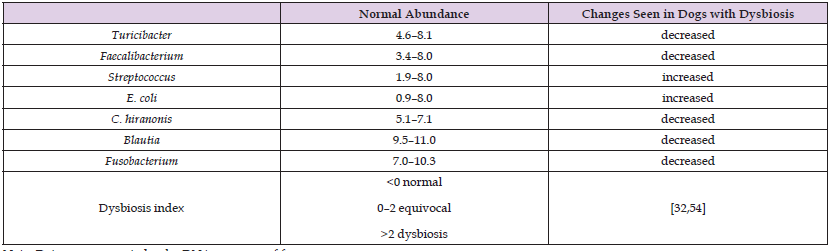
Note: Data were presented as logDNA per gram of faeces.
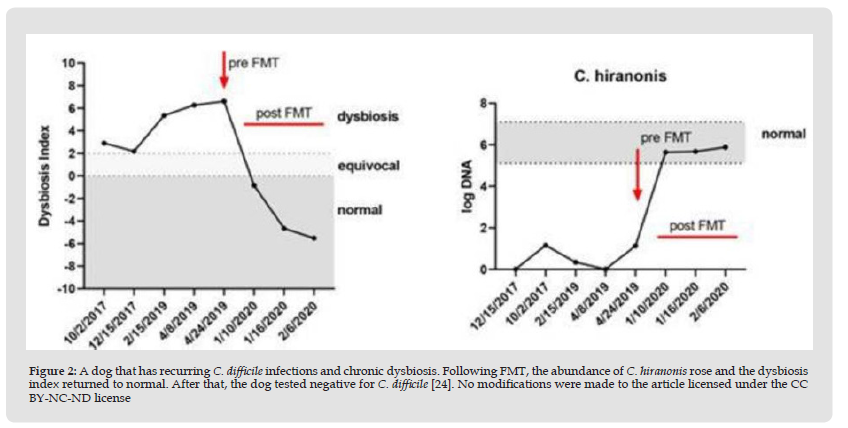
Dogs receiving antibiotic treatment (metronidazole, tylosine) showed an increase in DI along with a decrease in C. hiranonis, as did dogs with EPI and chronic enteropathies [25,26,37]. Conversely, dogs on raw food diets (BARF) or proton-pump inhibitors (omeprazole) showed an increase in DI along with a normal abundance of C. hiranonis [44,45]. Apart from identifying healthy and unhealthy microbiota, DI can evaluate changes in microbial composition over time or in response to therapies such as FMT (Figure 2).
Figure 2
While the pathophysiology of many gastrointestinal and systemic disorders is largely dependent on dysbiosis, a critical therapeutic goal is the restoration of the composition of the gut microbiota. FMT can currently alter the gut microbiota [24].
• FMT
"Faecal microbiota transplantation" is one of the innovative techniques for modifying the gut microbiota. The term "FMT" refers to the process of introducing a donor's fecal matter solution into a recipient's digestive tract with the primary goal of altering the recipient's microbiological nature [46,47]. A duodenoscopy, nasogastric/nasojejunal tube, enema, colonoscopy or peroral capsule can all be used to carry out this treatment [1,2].
History
In veterinary medicine, the transfer of gastrointestinal materials is not a novel technique. Numerous animal species have been documented to consume their own excrement, a practice known as coprophagy [48-50]. This process improves nutrition absorption, strengthens the gastrointestinal tract, and promotes resistance to pathogen colonization [4]. In Europe, the 17th century marked the first descriptions of transfaunation, or the therapeutic transfer of rumen content [5,6]. Ruminal acidosis in sheep and cattle as well as chronic diarrhea in horses were the indications for this treatment experiment. Additionally, it was utilized to strengthen the chicks' defenses against intestinal infections [51-53]. China has been using the FMT method on humans since the fourth century CE [3]. FMT is utilized in Chinese medicine for a variety of gastrointestinal ailments. It can be found in fresh, dried, fermented, and infant-derived products [37]. Faecal ingestion in people and animals has been frequent in Europe since manure had been employed as fertilizer, according to German physician Franz Christian Paullini.
He also wrote about the healing use of human and animal excrement in his book Hailsame Dreck Apotheke (Salutary Filth-Pharmacy), which was published in 1696 [54]. The Ben Eiseman team published a study in 1958 detailing the effective use of faecal enemas in the treatment of four patients with C. difficile-caused pseudomembranous colitis. According to this study, the usage of antibiotics caused the local microbial community that offers defense against infections to be suppressed [55]. They anticipated that the process would undergo standardization and clinical trial testing. Nevertheless, vancomycin's efficacy in treating pseudomembranous colitis was quickly established [55,56]. There is no question that treating patients with CDI has a positive impact in human health, but what is known about its effects and possible applications in canine?
Mechanism of Action of FMT
It's still unclear exactly how the gut microbiome functions. The important advantages of FMT for CDI patients include a shift in the microbial profiles toward those of healthy donors and an increase in the diversity of bacterial species [54,57]. Higher concentrations of Proteobacteria species and lower concentrations of Firmicutes and Bacteriodetes species are known signs of gut dysbiosis in CDI patients. Giving FMT may result in a decrease in Proteobacteria and an increase in communities of Firmicutes and Bacteriodetes [58]. Faecal matter administration not only provides antibiotics to make the environment less conducive to the growth of C. difficile, but it also initiates a process termed as competitive exclusion of pathogens [54]. The reestablishment of secondary bile acid preponderance over primary bile acid prevalence in faeces is one aspect of this mechanism [54,57]. It has been demonstrated that secondary bile acids are strong spore germination inhibitors, primary bile acids have been proven to promote spore germination [20]. A high concentration of secondary bile acids causes C difficile to outcompete it for nutrition and creates an environment that is not conducive to its growth [54].
It is important to note that transplanted feces alter the gut microbiota, which increases the amount of sialic acid that commensal bacteria use. C. difficile has a shortage of the carbohydrate energy supply as a result of this use [59]. The transplanted faecal material helps to restore the integrity of the intestinal barrier by secreting mucin [57]. Additionally, because butyrate-producing bacteria are produced when feces are administered, it helps to modulate the mucosal immune response and reduce the inflammatory response [57,60,61]. Additionally, bacteriophages discovered in the donor's feces probably contribute to the positive effects [61].
Forms of Application
FMT can be administered via a variety of methods, including colonoscopy, nasogastric duodenum, jejunal infusion, enema, and oral capsule intake [62-64]. Each of these techniques has certain drawbacks, such as the risk for nausea and aspiration pneumonia when the naso-gastric tube is being provided, the inability to properly hold the given suspension for the enema, or the possibility of tissue perforation during the colonoscopy and jejunal infusion [65]. In order to solve shortcomings and gaps found in earlier FMT delivery systems, oral capsules were developed. They are the least expensive, most non-invasive, and easiest to store means of administration. There are various procedural concerns associated with conventional FMT treatment methods that are eliminated when using this version of FMT. Oral capsules have been demonstrated by Kao et al. to be a successful treatment for rCDI (refractory Clostridium difficile infection), similar to colonoscopy [2]. The administration of these capsules has been linked to adverse events such as aspiration, vomiting, and inability to reach the intended digestive location [64,66]. There are two categories for FMT. The first involves using the patient's own feces for autologous transplantation, which is done before any kind of treatment. Through the use of antibiotics during allogeneic hematopoietic stem cell transplantation, this type of feces transfer is successfully employed to restore the composition of the damaged microbiota [66,67]. The second category consists of allogenic FMT, which uses a faecal sample from a related or unrelated healthy donor [68]. It seems that allogenic transplantation is highly successful when used for rCDI [69].
Recommendations for the Use of Faecal Microbiota Transplantation in and Dogs
As FMT proves more effective in treating a range of diseases there is an increasing need to standardize faecal material preparation and administration, adhering to recognized guidelines to protect both the donor and the recipient.
Donor Selection in Dogs: There aren't many research in canine medicine that focus on canine donor screening procedures. In order to guarantee that the feces used for FMT are safe and of the highest quality for the receiver, Chaitman and Gaschen proposed broad screening criteria [70]. A summary of these selection criteria can be seen in Table 3.
Table 3: Recommended selection criteria for canine faecal donors.

Preparation and Administration of the Faecal Solution: To make a faecal solution, very identical methods are followed in veterinary medicine. Usually, six to twelve hours after defecation, twenty to one hundred grams of donor feces are used for the FMT treatment. After that, 4 volumes of 0.9% NaCl are combined with 1 volume of feces and filtered. After that, 10% final concentration of glycerol is added, and it is kept at 80°C for storage [1,2].
Recent Uses of FMT in Small Animals specifically in canines: Reports detailing the impact of FMT in small animal medicine are very few [70]. Burton et al. attempted to prevent postweaning diarrhea in puppies by giving the faecal inoculum orally. There was no discernible clinical improvement in this instance [71]. In a different study, the researchers combined normal treatment with FMT in an attempt to improve the survival rate of puppies infected with parvovirus. Although the duration of hospitalization was shortened and the duration of diarrhea was reduced to two days, this experiment did not significantly increase survival [72]. In dogs with simple, non-infectious diarrhea, Chaitman et al. conducted a trial comparing the administration of faecal material via enema versus a 7-day oral treatment of metronidazole (15 mg/kg q 12 h). Even though both groups' stools became more consistent after a week of treatment, only those receiving FMT showed firmer faeces by day 28. In most dogs treated with FMT, the faecal dysbiosis index returned to normal within one week, whereas it did not improve in the majority of patients receiving metronidazole [26,32]. Only dogs receiving FMT treatment showed a decrease in E. coli and an increase in beneficial bacteria such as Faecalibacterium and hiranonis in their feces [37]. A case study involving a toy poodle with refractory IBD proved to the beneficial effects of FMT even in cases of chronic illnesses. Nine FMTs were given to this dog via enema. The dog's stool consistency and Clinical IBD Activity Index both improved after six months [73]. An 8-month-old French bulldog with chronic colitis and a positive C difficile faecal culture was the subject of another study. FMT was given to this dog orally just once. By the end of two or three days, there was a noticeable improvement in both the frequency and consistency of feces. At least six months passed without any signs of relapse [72].
A single FMT seems to be quite effective when given to dogs suffering from acute diarrhea (AD), per Chaitman et al. [26]. Negative effects including decreased microbial diversity, alterations in particular bacterial taxa, abundance, and metabolic shift are avoided when an FMT is used in place of antibiotics [26,70]. Additionally, FMT appears to be a potential treatment for dogs suffering from long-term illnesses such exocrine pancreatic insufficiency or chronic enteropathies. Regrettably, relapses frequently occur after a few days of recovery following faecal transplant application. For this reason, in the majority of cases, multiple FMTs may be necessary [26]. These days, an FMT may help with acute and chronic dysbiosis-related disorders in small animal practice. Few studies have been conducted on its use, thus further study is needed to standardize it.
One of the cutting-edge techniques for modifying the genetic make-up of the human gut microbiota is an FMT. Although FMT is the most well-established treatment for recurrent CDI, it may also be useful in the treatment of a variety of additional diseases linked to intestinal dysbiosis. Research indicates that the effects of FMT on IBD and other diseases are not as significant as those on CDI. While alterations in the microbiome are a common feature of both CDI and IBD, IBD is a more intricate disease that involves complex interactions between the host and its surroundings [74]. Even for individuals who are at high risk, this type of bacteriotherapy is usually regarded as safe and well-tolerated. On the other hand, others believe that the safety of a fecal microbiota test (FMT) is still debatable because of the unknown pathogenicity and composition of faecal bacteria [75]. The majority of short-term dangers are associated mostly to delivery techniques. These consist of brief fevers, diarrhoea, gas, bloating, elevated inflammatory markers, and vomiting (after duodenal infusions) [76].
The Food and Drug Administration (FDA) has released a safety alert that has sparked controversy. It warns of the possible hazards of spreading multi-drug resistance germs and contracting future illnesses that could be fatal. Extended-spectrum beta-lactamase (ESBL)-producing E. coli has been linked to CMV infection, norovirus gastroenteritis, E. coli bacteremia, and FMT in a number of cases [77-80]. Spreading disease-causing genes is another option, in addition to the spread of viruses. There is a chance that, in the process of transferring feces, some unidentified elements of the donor's stool will be transferred to the recipient and cause chronic illnesses (such as obesity, cardiovascular, autism, autoimmune, or gastrointestinal disorders) [77-99]. In order to guarantee patient safety and the appropriate administration of an FMT, standardized protocols for donor screening, stool preparation, delivery methods, and recipient reasons for therapy are expected to develop [65].
Transplanting fecal microbiota offers an additional therapeutic option in the event that traditional therapy is not successful or as a complement to it. We are just beginning to look into how an FMT might be used in veterinary medicine to modify the gut flora. Even yet, there is still plenty of information required in this field as we don't know about the precise mechanism of action. In the upcoming years, it is anticipated that an FMT will become more widely recognized and standardized. The area of gut microbiota targeted modification and personalized medicine are currently gaining popularity in human medicine; therefore, its advancement and application to veterinary medicine may be crucial to the future treatment of numerous gastrointestinal and extra gastrointestinal disorders.

International Association of Landscape Archaeology, Czech Glass Society, Czech Republic

Department of Chemistry, Semenov Institute of Chemical Physics, USSR Academy of Sciences, Moscow, Russia

Neurology, LA BioMed Research Institute, USA

Associate Professor at Department of Breast and Thyorid Surgey, Chongqing General Hospital, China

Clinical Radiologist (MD) - Department of RADIOLOGY, Cosenza Hospital, Cosenza, Italy





 Abstract
 PDF
PDF



























