info@biomedres.us
+1 (502) 904-2126
One Westbrook Corporate Center, Suite 300, Westchester, IL 60154, USA
Site Map
 ISSN: 2574 -1241
ISSN: 2574 -1241
ISSN: 2574 -1241
Received: July 11, 2024; Published: July 24, 2024
*Corresponding author: Najim A J Al Awwadi, Department of Pharmacology, University of Thi qare, Faculty of Pharmacy, Al Nasiriyah, Iraq
DOI: 10.26717/BJSTR.2024.57.009053
During the last two decades, many extensive studies have revealed that obesity is a major risk factor for diabetes Mellitus type 2, cancer, atherosclerosis, and other chronic diseases, and is a proinflammatory disease. Several polyphenolic compounds have been proven to have remarkable activity against obesity through antioxidant and anti-inflammatory mechanisms. Among these polyphenolic compounds, those found in Armagnac fractions have been investigated most extensively as a treatment for obesity and related metabolic disorders. In our present study was to evaluate the efficacity of a chronic oral administration of Armagnac fractions to correct metabolic disorders induced by a cafeteria diet in rat. In this study a freeze-dried crude extract was prepared from the same 1995 Armagnac (BNIA, Eauze, France) used in previous studies It was prepared by de-alcoholising under a vacuum of 500 ml of spirit before freeze-drying to yield the crude extract. This step yielded 0.89 ± 0.03 grams (n=5) of an amorphous brown powder. Male Sprague-Dawley rats weighing 80-100g (Charles River, Le Vaudreuil, France). were used and they were subdivided into four groups of homogeneous weights with two dietary conditions for 12 weeks: cafeteria groups were daily offered a “sandwich” with cookies, and treated with a different composition of Armagnac extractions.
By a Kone lab automatic plasma analyzer to determine plasma glucose, HDL (High-Density Lipoprotein) cholesterol, total cholesterol, triglycerides, and phospholipids in all animal groups. The results showed from the 11th day, cafeteria rats started getting fatter than the control rats. At the end of the study, cafeteria-fed and untreated rats had significantly higher weight gain than the control group. Plasma triglycerides and phospholipids were significantly higher in cafeteria-fed rats than in control groups and total cholesterol was significantly higher in cafeteria-fed rats than in the untreated control group. No significant difference was seen in HDL cholesterol. Armagnac- treatment of cafeteria-fed rats restored triglycerides and phospholipids to a level not significantly different from that of control animals. The results showed the Armagnac-treated cafeteria rats had a significant reduction in overweight, glycemia, and leptinaemia compared to control rats. Moreover, cafeteria-fed rats have developed a leptin-resistance.
Keywords: Armagnac; Rat Cafeteria; Obesity; Metabolic Disorder; Triglycerides; Phospholipids; Cholesterol, Glucose; Leptino-Resistance
Obesity is a major public health problem and overweight has been positively correlated with insulin resistance in humans [1,2] and in genetically defective animals such as fatty Zucker rats [3] and predisposes to hypertension, atheroma and dyslipidaemia, in particular hypertriglyceridemia. Furthermore the association between obesity, hypertension, insulin-resistance and dyslipidaemia has been described as the metabolic syndrome or syndrome X [4-6]. Combination of genetic and environmental factors is highly implicated. Within environmental factors, the consumption of enriched food in lipids and sugar contributes to obesity development. For a long time, cafeteria diet has been used as an experimental model to study obesity. It represents a model of human obesity induced by “Western” diet.Most of the time the overweight induced by the cafeteria diet is associated with hyperinsulinemia and insulin resistance [7,8] and with other metabolic abnormalities such as hypertriglyceridemia or hypercholesterolemia. It has been known for some time that moderate and regular consumption of red wine can reduce the risk of cardiovascular diseases [8]. This concept is known as “the French Paradox”8. Such effects are due to various compounds of wine, particularly polyphenols. These natural constituents, found in most of fruit and vegetables (tea, apple, grapes…) are particularly known for their antioxidant and free radical-scavenging properties leading to a decrease in LDL oxidation [9,10] and platelet aggregation [11].
They possess a lot of other biological activities, such as anti-inflammatory, anti-cholesterol-emic, Vaso-active or anti-carcinogenic effects. Yet their mechanism of action remains uncertain. There are no studies concerning the effect of Armagnac and polyphenolic compounds obesity and dyslipidaemia. The aim of our present study was therefore to evaluate the ability of a chronic oral administration of Armagnac extract to correct metabolic disorders induced by a cafeteria diet in the rat, and consequently to understand better their mechanism of action. Effects on classics biochemical parameters were determined. The main findings of the present study are that Armagnac treatment restores lipids abnormalities (triglycerides, phospholipids), leptin, and glucose level in cafeteria treated rats. Moreover cafeteria-fed rats have developed an leptin-resistance: leptin levels haven’t influenced food intake. In obese patients leptin-resistance is associated with insulin-resistance and lipidic disorders. Armagnac treated cafeteria rats had a significant reduction in overweight and leptinaemia compared to controls rats.
Preparation of Armagnac Crude Extract
A freeze-dried crude extract was prepared from the same 1995 Armagnac (BNIA, Eauze, France) used in previous studies [12,13]. It was prepared by de-alcoholising under vacuum of 500 ml of spirit before freeze-drying to yield the crude extract. This step yielded 0.89 ± 0.03 grams (n=5) of an amorphous brown powder.
Animals and Treatment
Male Sprague-Dawley rats weighing 80-100g (Charles River, Le Vaudreuil, France). were used and maintained on a 12 hour light / dark (6:00 am – 6: 00 pm), temperature and humidity controlled environment. After an adaptation period of one week, they were subdivided into four groups of homogeneous weights with two dietary conditions for 12 weeks: an untreated control group (C), a treated control group (C+A), an untreated cafeteria group (Caf), and a treated cafeteria group (Caf+A), 9 animals in each group, one animal per cage. The two control groups received A04 standard rat chow commercialised by UAR (Villemoisson-sur-Orge, France) with a composition described in detail in Table 1
Table 1: Composition of diet “A 04”.

Cafeteria groups were daily offered cookies, liver pate (as a “sandwich” with cookies), bacon, standard chow, water, and whole milk supplemented with 10% sucrose. All the food items were weighed and daily presented in excess. Selective food consumption and the weight of all animals were measured every day.
C+A and Caf+A groups were daily treated by oral gavage. Untreated groups received water in the same conditions. At the end of the study, animals were killed by decapitation and blood collected on heparinized tube. Plasma was stored at –20 °C until further use (Table 2).
Table 2: Composition of cafeteria diet.

Classical Biochemical Parameters
Plasma glucose, HDL (High Density Lipoprotein) cholesterol, total cholesterol, triglycerides, and phospholipids were determined using a Konelab automatic plasma analyser.
Determination of Cholesterol Level
The principle consists in the hydrolysis of the esterified cholesterol by cholesterol esterase in free cholesterol and fatty acids. Then cholesterol oxidase oxides cholesterol in cholestene-4, one-3 et en hydroperoxide, which combines using a peroxidase with amino-4-phénazone and phenol to give water and a coloured compound absorbing at 500nm, monoiminoparabenzoquinone-4-phenazone.
Determination of Triglyceride Level
Triglycerides’ hydrolysis by lipase gives glycerol and free acids. Glycerol, by the action of glycerolises in presence of' ATP, gives glycerol-3-phosphate and ADP. Glycerol-3-phosphate undergoes the action of glycerol-3-phosphate oxidase to give dehydroarene. Hydroperoxide, using a peroxidase, combines with amino-4-antipyrine and Para-chlorophenol to give water and a coloured compound absorbing at 500nm, quinonimine.
Determination of Phospholipid Level
Phospholipids are hydrolysed in presence of water by phospholipase D in choline which is dosed by the Trinder reaction, phosphatidic acid, lysophosphatidic acid and N-acylphenol phosphate. Choline is oxidized by choline oxidase in betaine and hydroperoxide, which combines using a peroxidase with amino-4 antipyrine and Para-chlorophenol to give water and quinonimine, a compound absorbing at 500nm.It must be noted that the technique does not allow the dosage of all the phospholipids: glycerophospholipids as phosphatidylcholine, phosphatidylethanolamine or phosphatidylserine, and ceramides as sphingomyelin. Only choline phospholipids (phosphatidylcholine or lecithin, lysolecithin and sphingomyelin) are evaluated.
Assessment of the Plasma Insulin Level
It was determined by the radioimmunological method [13] using rat insulin as standard, 125I, and an pig anti-serum . Dosage was made in a final volume of 500 of borate buffer 0.025M with 0.5% BSA. After two days of incubation at 4 °C, separation of the free insulin was achieved using activated coal 5% (Prolabo, ref.26008.296) in borate buffer 0.1M after addition of 100µl of horse serum (BioMed) by sample. Samples were then diluted in 2ml of borate buffer 0.1M and centrifuged at 3000rpm during 5 min and residue containing insulin unbound and complexed with coal, was counted with a scintillation gamma counter (LKB-Wallac).
Assessment of the Leptin Level
Statistical Analysis:
Data are shown as the mean ± SEM Statistical comparisons were performed with the Statgraphics software (Uniware, Paris, France) using a multiple range test after ANOVA analysis. When a significant difference was obtained (p ≤ 0.05), a least significance difference (LSD) test was used to compare each pair of means.
General Features of the Animals (Figures 1 -6)
In this figure the results showed from the 11th day, cafeteria rats started getting fatter than the control rats. At the end of the study, cafeteria-fed and untreated rats had significantly higher weight gain than the control group. Plasma triglycerides, and phospholipids were significantly higher in cafeteria-fed rats than in control groups and total cholesterol was significantly higher in cafeteria-fed rats than in untreated control group. No significant difference was seen in HDL cholesterol. Armagnac- treatment of cafeteria-fed rats restored triglycerides and phospholipids to a level not significantly different from that of control animals.
Figure 1

Figure 2
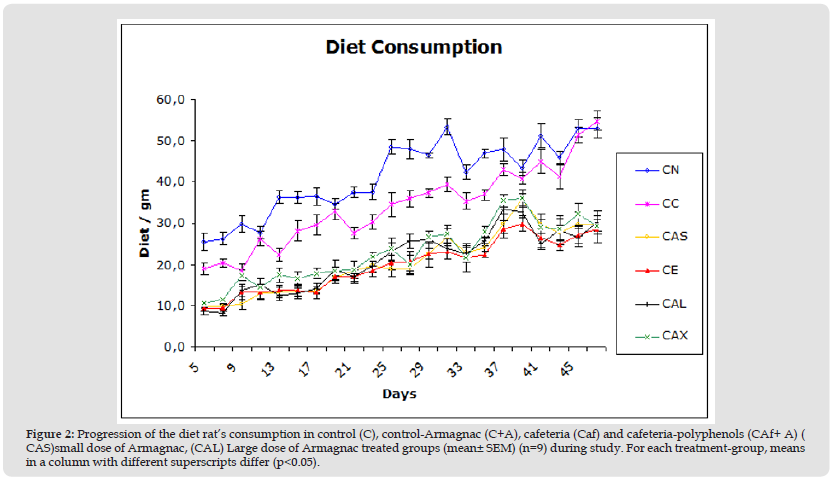
Figure 3
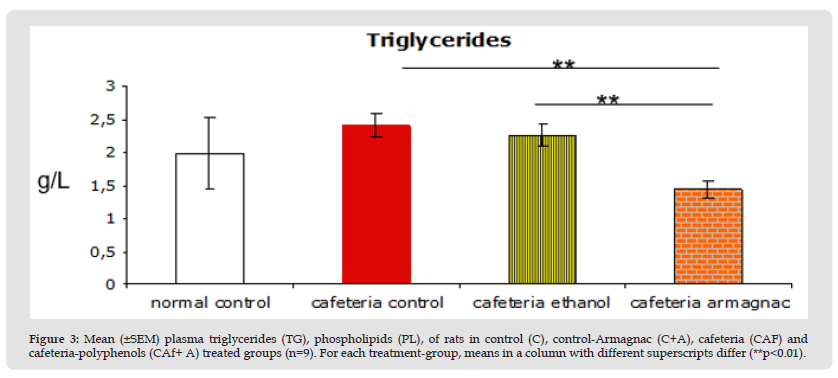
Figure 4

Figure 5

Figure 6
The present study investigated in Sprague-Dawley rats the effects of a cafeteria diet, on growth, and metabolic parameters, and determined the ability of Armagnac administrated by chronic oral administration to prevent alterations induced by this model. Such a diet has been extensively used as an experimental model to study obesity and energy balance expenditure. Offering several energy dense human foods to the rats induced voluntary hyperphagia leading to an increase in energy intake, in agreement with previous reports [11,14,15], as cafeteria diet rats consumed about twice more calories than control rats, and this induced overweight. These findings are consistent with those of other authors who study the cafeteria model [7,14,16-18] or the high fat diet model [11,19,20]. Our cafeteria rats had a significant overweight associated with early alterations in metabolic parameters. Highly palatable diet significantly increased metabolic (lipids, glucose and leptin) parameters. We know that these parameters play important roles in the development of cardio-vascular disease in obesity. Armagnac treatment had a significant effect on the hyperphagia and the following increases in energy intake and weight gain [8].
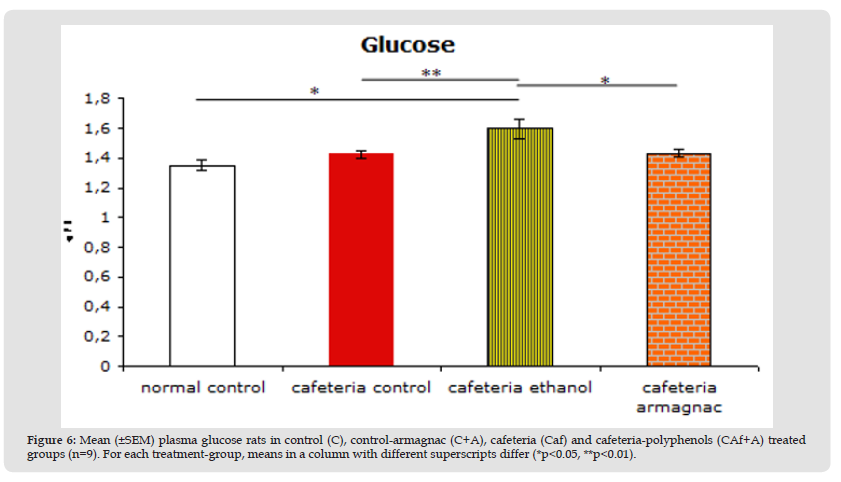
Concerning the metabolic parameters overweight was associated with dyslipidaemia, triglycerides and phospholipids underwent a significantly increase. Armagnac administration decreased these augmentations. These findings contrast with Zhan et al. studies [11,21] on tea polyphenols who didn’t observe any differences in total cholesterol and triglycerides concentrations. Armagnac treated cafeteria rats had a significant reduction in overweight, glycemia and leptinaemia compared to controls rats. Moreover cafeteria-fed rats have developed an leptino-resistance: leptin levels haven’t influenced food intake. In obese patients leptino-resistance is associated with insulino-resistance and lipidic disorders [22-26].

International Association of Landscape Archaeology, Czech Glass Society, Czech Republic

Department of Chemistry, Semenov Institute of Chemical Physics, USSR Academy of Sciences, Moscow, Russia

Neurology, LA BioMed Research Institute, USA

Associate Professor at Department of Breast and Thyorid Surgey, Chongqing General Hospital, China

Clinical Radiologist (MD) - Department of RADIOLOGY, Cosenza Hospital, Cosenza, Italy





 Abstract
 PDF
PDF



























