info@biomedres.us
+1 (502) 904-2126
One Westbrook Corporate Center, Suite 300, Westchester, IL 60154, USA
Site Map
 ISSN: 2574 -1241
ISSN: 2574 -1241
ISSN: 2574 -1241
Received: July 09, 2024; Published: July 22, 2024
*Corresponding author: Moiz Ahmed Khan, Section of Microbiology, Department of Pathology, Indus Hospital and Health Network, Karachi, Pakistan
DOI: 10.26717/BJSTR.2024.57.009047
Introduction: Substandard drugs pose a public health risk, contributing to resistance, prolonging infection duration, and increasing the economic burden. To address concerns regarding the efficacy of different brands of commercially available antibiotics in Pakistan, we compared the in-vitro minimal inhibitory concentrations (MICs) of the antibiotics, ceftriaxone and ciprofloxacin, manufactured by the local and multinational brands.
Methods: This cross-sectional study was conducted at the Microbiology Department, Main Campus, Dadabhoy Institute of Higher Education, Karachi, Pakistan from January 2023 to March 2023. Local and multinational brands of antibiotics, ceftriaxone and ciprofloxacin, were tested against clinical isolates of Escherichia coli, Staphylococcus aureus, Proteus mirabilis, Salmonella typhi and Pseudomonas aeruginosa using Agar Dilution method. MICs of these antibiotics among the clinical isolates were also determined via E-test method, which were used as reference for comparing MICs of the local and multinational brands. All MICs were interpreted in accordance with the clinical breakpoints mentioned in CLSI M100 guidelines.
Results: The MICs (µg/ml) of ceftriaxone and ciprofloxacin determined via E-test method in isolates of aureus (16; 64), P. mirabilis (>64; >64), S. typhi (>64; 64) and P. aeruginosa (>64; >64) were in the resistant range. In E. coli, ceftriaxone was sensitive (1) while ciprofloxacin was resistant (1). Regarding brand comparison, the multinational brand of ceftriaxone was found to be sensitive against E. coli (1) as compared to the local brand (64) and S. aureus, though resistant with both brands, showed relatively lesser MICs with the multinational brand as compared to the local brand (16; >64). Although ciprofloxacin was resistant in all isolates, MICs of the multinational brand were relatively lesser as compared to the local brand in E. coli (1; 8) and S. typhi (64; >64). MICs of the multinational brands of ceftriaxone and ciprofloxacin in all clinical isolates were in 100% agreement with MICs determined via E-test method.
Conclusion: This in-vitro study suggests that local brands of ceftriaxone and ciprofloxacin are of lower quality as compared to multinational brands in Pakistan. However, in-vivo bioequivalence testing and therapeutic equivalence reporting are needed to confirm the findings. Also, all commercially available antibiotics must undergo extensive testing before distribution.
Keywords: Ceftriaxone; Ciprofloxacin; Local; Multinational; Minimum Inhibitory Concentration
Abbreviations: MICs: Minimal Inhibitory Concentrations; WHO: World Health Organization; SBA: Sheep Blood Agar; PBS: Phosphate-Buffered Saline; MHA: Mueller-Hinton Agar; CDDEP: Centre for Disease Dynamics, Economics, and Policy
Resistance to numerous antimicrobial drugs has emerged as a serious threat in health care facilities and hospitals around the world. This is most likely due to their indiscriminate and injudicious use. The World Health Organization (WHO) cites a lack of knowledge among prescribing doctors as a contributing factor to antimicrobial resistance, resulting in unnecessary prescriptions [1]. Furthermore, antimicrobials are often used as part of empirical treatment for undiagnosed or suspected infections. Prescriptions for incorrect antibiotics or incorrect doses, routes, and durations of treatment are often influenced by profit motives and pressure from companies or patients. It has been observed that medical representatives from pharmaceutical industries and commercially-oriented publications are often the main sources of information about antibiotics in South Asia. Oftentimes, clinicians prescribing antibiotics may be uncertain about whether they meet optimal manufacturing standards. Substandard drugs are generally defined as medicines that have not met the standards and quality testing protocols established by the International Pharmacopoeias and WHO [2,3].
Though there is no standard and uniform definition for these drugs, the WHO defines them as drugs that are deliberately and fraudulently mislabeled with respect to identity and/or source [4]. According to a literature review, 50% of the 163 counterfeit antibiotics discovered were beta-lactams. β-lactams are the most common substandard antibiotics produced [5,6]. Suboptimal counterparts of other classes of antibiotics have also been manufactured, including quinolones. It has been reported that 13 patients died following a sterilization camp after receiving substandard drugs, including ciprofloxacin, indicating the fatal outcome if substandard drugs are administered [7]. In contrast, some clinicians and pharmacists believe that expensive products are more effective. Such misconceptions can lead to excessive use of broad-spectrum antibiotics, resulting in the selection of resistant microorganisms and increased costs for no apparent benefit [1]. In this scenario, we can include antibiotics manufactured by both local and global companies. Clinicians often assume that locally manufactured products are of poor quality and ineffective due to their low cost.
In fact, effectiveness and safety are crucial for all medicines, particularly antibiotics, as they can jeopardize patient health, whether manufactured locally or globally. To address concerns regarding the efficacy of different brands of commercially available antibiotics in our country, we conducted a cross-sectional study to compare the in-vitro minimal inhibitory concentrations (MICs) of the antibiotics, ceftriaxone and ciprofloxacin, manufactured by the local and multinational brands.
Study Setting and Design
This is was a cross-sectional study conducted at the Microbiology Department, Main Campus, Dadabhoy Institute of Higher Education, Karachi, Pakistan from January to March 2023. A local and multinational brand for each of the two antibiotics, ceftriaxone and ciprofloxacin, were tested against clinical isolates of gram-positive and gram-negative bacteria using Agar Dilution method. Clinical isolates of Escherichia coli, Staphylococcus aureus, Proteus mirabilis, Salmonella typhi and Pseudomonas aeruginosa were collected from the Clinical Microbiology laboratory of Ziauddin hospital, Karachi, Pakistan. Furthermore, MICs of ceftriaxone and ciprofloxacin in the clinical isolates were also determined via the E-test method, which were used as reference for comparing the MICs of the local and multinational brands of these antibiotics. All MICs were interpreted in accordance with the clinical breakpoints mentioned in CLSI M100 guidelines [8].
Agar Dilution Method
Clinical isolates of E. coli, S. aureus, P. mirabilis, S. typhi and P. aeruginosa were revived through inoculation on 5% sheep blood agar (SBA), which was incubated in 5% CO2 for 24 hours. Once, strains were revived, the bacterial colonies were inoculated in phosphate-buffered saline (PBS) to obtain a turbidity index of 0.5 MacFarland. After the bacterial suspensions were prepared, Agar Dilution method was performed to assess the MIC for each of the strains. The protocol mentioned in the CLSI guidelines was followed for performing Agar Dilution method. According to the procedure, ceftriaxone and ciprofloxacin were dissolved in dimethyl sulfoxide. In order to produce continuous two-fold dilutions, antibiotics ceftriaxone and ciprofloxacin were added to the Mueller-Hinton agar (MHA) medium, in concentrations ranging from 0.0015 to 16 ug/ml for ceftriaxone and from 0.002 to 2 ug/mL for ciprofloxacin. The adjusted inoculum of each of the bacterial suspensions was then delivered to the surface of the agar plates containing varying concentrations of the antibiotics, through inoculating loops.
To assess adequate growth for each bacterial isolate, two plates without antibiotics were inoculated, one plate labelled as positive control was inoculated with the bacterial suspension and a second plate labelled as negative control was left uninoculated. The MHA plates were incubated at 35-37oC in ambient air for 20-24 hours. The MIC of the antibiotic for the specific bacterium was characterized as the lowest antibiotic concentration that prevented visible bacterial growth.
Data regarding the MICs for both local and multinational brands of ceftriaxone and ciprofloxacin against each of the clinical strains of E. coli, S. aureus, P. aeruginosa, P. mirabilis and S. typhi was documented on a standardized proforma. The MIC data along with the susceptibility interpretation according to the CLSI guidelines, was entered in the Microsoft Excel software (Microsoft Excel 2013 {15.0.5553.1000} 32-bit) for a comparison of quality of the local and multinational antibiotic brands. The MIC results were compared in reference to the MICs of ceftriaxone and ciprofloxacin determined via the E-test method. The results are presented as table and figures.
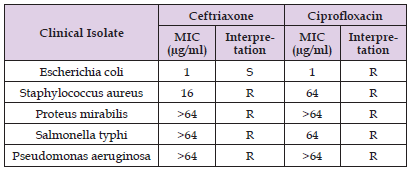
The MICs of ceftriaxone and ciprofloxacin determined via E-test method against the clinical isolates of S. aureus, P. mirabilis, S. typhi and P. aeruginosa were found to be in the resistant range. In E. coli, ceftriaxone was found to be sensitive while ciprofloxacin was resistant (Table 1). The quality of bacterial growth as assessed by the positive and negative controls was adequate. Both local and multinational brands of ceftriaxone tested using the Agar Dilution method were found to be mostly resistant in the clinical isolates with MICs of >64 µg/ml & 16 µg/ml for S. aureus, >64 µg/ml & >64 µg/ml for P. mirabilis, >64 µg/ml & >64 µg/ml for S. typhi and >64 µg/ml & >64 µg/ml for P. aeruginosa respectively. However, the multinational brand of ceftriaxone was found to be sensitive against E. coli (1 µg/ml) as compared to the local brand (64 µg/ml). Overall, isolates of S. aureus and E. coli showed relatively lesser MICs when tested using the multinational brand as compared to the local brand. Moreover, MICs of the multinational brand of ceftriaxone against the clinical isolates were in 100% agreement with the MICs determined via the E-test method (Figure 1).
Table 1: MICs of ceftriaxone and ciprofloxacin among the clinical isolates via E-test method.
Note: S=Sensitive
R=Resistant
Figure 1

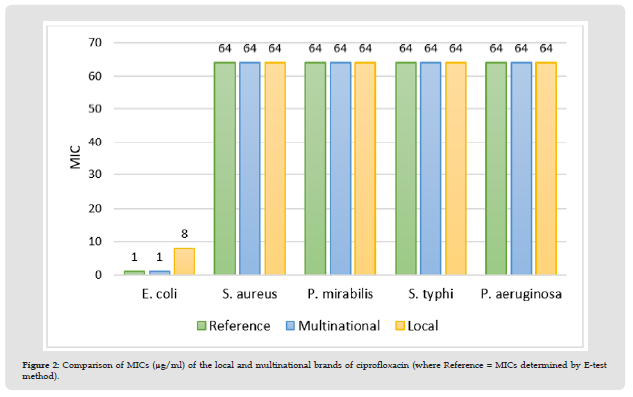
For ciprofloxacin, both local and multinational brands were found to be resistant in all the clinical isolates with MICs of 8 µg/ml & 1 µg/ml for E. coli, 64 µg/ml & 64 µg/ml for S. aureus, >64 µg/ml & >64 µg/ml for P. mirabilis, >64 µg/ml & 64 µg/ml for S. typhi and >64 µg/ml & >64 µg/ml for P. aeruginosa respectively. Though ciprofloxacin was resistant in all the isolates tested, the MICs of the multinational brand were relatively lesser than those of the local brand in E. coli and S. typhi. Similar to ceftriaxone, MICs of the multinational brand of ciprofloxacin against the clinical isolates were in 100% agreement with the MICs determined via the E-test method (Figure 2).
Figure 2
In this study, we assessed the quality of commercially available local and multinational brands of ceftriaxone and ciprofloxacin by comparing their MICs determined using the Agar Dilution method in clinical isolates of E. coli, S. aureus, P. mirabilis, S. typhi and P. aeruginosa. Our results showed that multinational brands of these antibiotics were in better quality than the local brands as shown by the comparison of their MICs with the reference E-test method in isolates of E. coli, S. aureus and S. typhi. Several studies have previously been conducted in Pakistan and internationally to compare the in-vitro efficacy of various brands of the beta-lactam and fluoroquinolone class of antibiotics. A study from India, compared the in-vitro efficacy of a generic formulation of amoxicillin/clavulanate with five branded formulations using Kirby Bauer Disk Diffusion method in strains of E. coli and S. aureus. At least one of the branded formulations was found to have a statistically lesser zone of inhibition as compared to the generic formulation in the bacterial isolates [9]. Similarly, in a study comparing the antimicrobial susceptibilities of 29 different brands of levofloxacin from different cities of Pakistan, in clinical isolates of S. aureus, S. epidermidis, E. coli and K. pneumoniae via Disk Diffusion method, different antimicrobial susceptibilities among the brands were observed regardless of their price and local/ multinational status [10].
In addition, there are several other studies such as Rodriguez, et al. and Moet, et al., that found a decrease in the in-vitro potency of generic beta-lactam drug formulations when compared to their branded counterparts [11,12]. In contrast, a study conducted in Columbia compared the antimicrobial efficacies of the generic preparations of meropenem and piperacillin/tazobactam with their equivalent brand-name formulations, against ATCC strains of several gram-positive and gram-negative bacteria using the Broth microdilution method. The MICs for both formulations were similar in all isolates and no significant differences were observed [13]. Furthermore, in-vitro activity of five different local and multinational brands of moxifloxacin was assessed using Disk Diffusion and Broth microdilution methods against isolates of S. aureus, P. aeruginosa and E. coli, in a study from Karachi, Pakistan. In addition to various physicochemical parameters including disintegration time and in-vitro dissolution evaluation, similar antimicrobial efficacy of moxifloxacin was observed among the different brands [14]. In comparison to these studies, which showed no significant differences among the different formulations/ brands of beta-lactam and fluroquinolone class of antibiotics, our results showed relatively lesser MICs when tested using multinational brands of ceftriaxone and ciprofloxacin in E. coli, S. aureus and S. typhi isolates.
One limitation in these studies was the absence a reference method for determining antimicrobial susceptibilities of the study isolates in order to compare them with the susceptibility results obtained from testing different brands/ formulations of antibiotics. In contrast, we employed E-test method for determining the MICs of our study isolates, which were then used as a reference for comparing the efficacy of local and multinational brands of ceftriaxone and ciprofloxacin. Moreover, we compared different brands of ceftriaxone and ciprofloxacin based on their MICs, which provide a quantitative rather than qualitative assessment of the degree of susceptibility in contrast to the Disk Diffusion method. Our study findings point to the fact that different brands of ceftriaxone and ciprofloxacin sold in Pakistan might have different efficacies depending on the brand/ manufacturer. Multinational brands showed a higher efficacy as compared to the local brands when compared with the reference method. There are several factors that may account for this difference as reported by previous studies, which include differences in quality of the raw materials used, mishandling during distribution and poor storage facilities [15,16].
Furthermore, the stability and storage conditions of antibiotics can influence their therapeutic potency, and this effect is more pronounced when antibiotics contain hydrophilic excipients and are transported in hot and humid countries such as Pakistan [17,18]. These differences in efficacy between available antibiotic brands pose a potential risk to patients' health. Various studies have found that many antibiotics manufactured in developing countries are of low quality [19,20]. The marketing strategies of the manufacturer frequently influence the decision to use an antibiotic in developing countries [16,21]. Despite strict guidelines, substandard drugs continue to exist in the market, according to studies and our findings. Substandard drugs pose a public health risk, contributing to resistance, prolonging infection duration, and increasing the economic burden. According to the 2015 State of the World's Antibiotics report by the Washington-based Centre for Disease Dynamics, Economics, and Policy (CDDEP), a large private laboratory network recorded a significant increase in MRSA isolates from 29% in 2009 to 47% in 2014 [22]. Hence, it is critical for Pakistan to strengthen its regulatory infrastructure to ensure high-quality drugs.
There are a few limitations in our study. We tested and compared one brand each of local and multinational antibiotics in our study and did not test all the available brands in the market. Nonetheless, our results point to the fact that there exists some degree of difference in the in-vitro efficacies of commercially available antibiotic brands in the market and provide a catalyst for further assessment in this regard, as laboratory reporting of antimicrobial susceptibility guide physicians regarding patient therapy and hence, may significantly affect patient health outcomes. Furthermore, we did not evaluate some of the factors influencing the choice of one brand over the other in our study, such as the price range, perceived clinical efficacy and other physicochemical parameters including differences in physical properties, disintegration time and drug stability. The authors acknowledge that these factors seem to have an impact on the physician’s choice and plan to conduct a more comprehensive analysis in future, incorporating all these parameters. Lastly, while in-vitro studies are cost-effective and can assess drug performance, in-vivo bioequivalence studies are necessary to confirm the results.
The current in-vitro study suggests that local brands of ceftriaxone and ciprofloxacin are of lower quality compared to multinational brands in Pakistan. However, in-vivo bioequivalence testing and therapeutic equivalence reporting are needed to confirm the findings. Also, all commercially available antibiotics must undergo extensive testing before distribution.
Ethical Approval
The study was exempted from ethical review by the Institutional Review Board of the Dadabhoy Institute of Higher Education.
Conflict of Interests
The authors declare no conflict of interests.
Funding
The authors didn’t receive any funding for this work.
Availability of Data and Materials
All data generated during the course of this study is included in this article.
Author Contributions
a) SH – Conceptualization, Investigation, Methodology, Resources, Validation and Writing – review & editing.
b) MK – Formal analysis, Project administration, Supervision, Visualization and Writing – original draft.
c) SZ – Visualization and Writing – review & editing.

International Association of Landscape Archaeology, Czech Glass Society, Czech Republic

Department of Chemistry, Semenov Institute of Chemical Physics, USSR Academy of Sciences, Moscow, Russia

Neurology, LA BioMed Research Institute, USA

Associate Professor at Department of Breast and Thyorid Surgey, Chongqing General Hospital, China

Clinical Radiologist (MD) - Department of RADIOLOGY, Cosenza Hospital, Cosenza, Italy





 Abstract
 PDF
PDF



























