info@biomedres.us
+1 (502) 904-2126
One Westbrook Corporate Center, Suite 300, Westchester, IL 60154, USA
Site Map
 ISSN: 2574 -1241
ISSN: 2574 -1241
ISSN: 2574 -1241
Received: July 09, 2024; Published: July 22, 2024
*Corresponding author: Bandinelli D, Department of Orthopedics and Traumatology, Bambino Gesù Children’s Hospital (IRCCS), Rome, Italy
DOI: 10.26717/BJSTR.2024.57.009046
The Anterior Cruciate Ligament Reconstruction (ACLR) is a recurrent successfully surgery, however the literature shows from 3 to 15% of failure. Many recurrent ACL roptures are due to technical surgical mistakes, however, even when the neo-ligament is correctly located and well tensioned, a high rate of partial anterolateral rotatory instability can be responsible of knee instability in those patients. We hypothesized that a recurrent ACL injury would often be associated with an Antero-Lateral Ligament (ALL) lesion and so with a high grade of pivoting. The purpose of our retrospective study is to demonstrate if, in the recurrent ACLR surgery, the Anterolateral Ligament Reconstruction (ALLR) is necessary due to restore a correct rotatory stability of the knee, to improve clinical outcomes and to obtain a better performance in sport activities. In our study we included a total of 63 patients undergoning to ACLR performed by the same surgeon. We created two different groups: group A had an ACLR with bone-patellar-tendon-bone autograft, group B had a ACLR with bone-patellar-tendon-bone autograft + ALLR. Mean follow-up was 18.75 +/- 8.27 months. LYSHOLM score, IKDC and ACL-RSI scale clinical questionnaires were used to subjective evaluation.
Pivot-shift test and Rolimeter (Aircast Europa) arthrometric evaluation were used for an objective evaluation. Our study shows in recurrent ACLR surgery, the association with ALLR is totally necessary and complementary due to statistically significantly reduction of the residual anterolateral rotatory instability of the knee (p-value under 0.05).
Keywords: Anterior Cruciate Ligament; Anterolateral Ligament; Knee Instability; Revision Surgery; Recurrent ACL Lesion
Abbreviations: ACLR: Anterior Cruciate Ligament Reconstruction; ALL: Antero-Lateral Ligament; ALLR: Anterolateral Ligament Reconstruction; ROM: Reduced Range of Motion; RM: Magnetic Resonance; BTPB: Bone-Patellar-Tendon-Bone; IKDC: International Knee Documentation Committee; ACL-RSI: Anterior Cruciate Ligament Return to Sport After Injury; SD: Standard Deviation; SE: Standard Error
Although primary Anterior Cruciate Ligament (ACL) reconstruction is routinely a successful surgery, failure rates of 3-15% have been reported [1,2]. Most cases see a correlation with loss of motion, recurrent trauma, or failure to incorporate the graft; however, it should be noted that causes can often also be the result of surgical technique and failure to recognize concomitant pathologies [3-12]. In fact, according to literature, the most common cause of recurrence in anterior cruciate ligament reconstructions appears to be due to tunnel malpositioning, which predisposes to rupture of the new graft (70%-80%) [13,14]. The main factors leading to reduced range of motion (ROM) are attributed to the timing interposed between injury and primary reconstruction, tunnel position, excessive graft tension, arthrofibrosis, multiple ligamentous injury, and to prolonged immobilization [15]. The clinical evaluation of the patient is based on a proper history, with collection of subjective evaluations of the patient and objective evaluations regarding dynamics of the first traumatic event, timing between this event and reconstructive surgery, and finally the operative report to know the type of surgery.
Next steps are the clinical assessment of the patient, focused on the overall gait and alignment of the lower extremity, and the articular ROM, quadriceps trophism, and every specific signs and symptoms of the knee structures. Subjective assessment tests of antero-posterior and rotational stability, such as Anterior Drawer Test, Lachmann Test, and Pivotshift Test, are used, at last, the collateral ligaments and structures of the postero-lateral angle are evaluated. If instability remains after primary reconstruction, it can be due to: traumatic failure, malposition or loss of graft fixation. In all these cases, the history, clinical and instrumental examination are essential. Instrumental evaluation is performed by weight-bearing knee X-ray in standard projections (Antero-Posterior and Lateral) but also in Merchant's and Rosemberg's projections, which allow estimation of tunnel placement and quantification of tunnel enlargement [16,17]. Magnetic Resonance (RM) provides informations about graft integrity or conflict, incorporation of bone slabs or bioresorbable screws, the possible presence of intra-articular fibrosis. Furthermore, RM has also been used to calculate the transverse cross-sectional area of the femoral and tibial tunnels in case of tunnel enlargement [18,19], in order to decide to perform the revision with specific techniques or a two-stage procedure.
The purpose of every revision surgery should be to provide knee stability in order to maximize its functional assessment and protect the articular cartilage and meniscal structures [20], not forgetting the necessity to return to a high functional level in some patients. Choosing the graft type of the primary reconstruction and ensuring appropriate graft selection for revision is crucial; it’s controversial the ideal graft type for revision surgery [21]. Analyzing the recent literature looking for "Graft- failure" rates based on the type of graft chosen for primary ACL reconstruction, we noticed that Matjaz Sajovic, et al. [22] and Dany Mouarbes, et al. [23] found no difference in failure rates comparing ACL reconstructions with Hamstrings versus Bone-Patellar-Tendon-Bone (BTPB) autograft, in contrast to Wenbo Chen, et al. [24] who found a reduced risk of failure with the use of BPTB. Recent anatomical and biomechanical knee studies have highlighted the importance of two structures, which play a key role in restoring joint stability in the knee: Antero-Lateral Ligament (ALL) and joint capsule. ALL originates from the posterior and proximal area of the prominence of the lateral femoral epicondyle, anterior and distal to the proximal insertion of the lateral collateral ligament, proximal and posterior to the insertion of the popliteal tendon.
His oblique course in close contact with the lateral meniscus ends with its insertion on the anterolateral area of the proximal tibia, posterior to Gerdy's tubercle and anterior to the fibula head, without connections with the iliotibial band. Biomechanically, ALL has maximum tension at 30° of flexion and with tibial intrarotation, while it is detented at 120° of flexion and in tibial extrarotation. Injuries to the anterolateral ligament, which acts as a secondary stabilizer by opposing anterior translation and tibial intra-rotation [25-28], are responsible for the "pivoting" that often remains in primary reconstructions. Recent cadaver studies with complete anterior cruciate ligament injury, have shown that section of the iliotibial band or anterolateral ligament significantly increases rotatory instability [29]. Other studies suggest that, combined reconstruction of the anterior cruciate ligament and antero-lateral ligament markedly improve the rotatory stability of the knee, compared with isolated anterior cruciate ligament reconstruction [30]. Residual and persistent pivot-shift is responsible for permanent damage to the anterolateral complex, therefore, reconstruction of the anterolateral ligament, in anterior cruciate ligament revision surgery, represents a surgical gesture that should no longer be considered accessory, but absolutely required to restore knee rotatory stability [31-34].
Spencer, et al. [35] demonstrated that concomitant ACL and ALL reconstruction allows better control over anterior tibial translation (Lachman test) and tibial intra rotation (Pivotshift test) than only ACL reconstruction. In that way, the anterior cruciate neo ligament has a higher probability of integration and healing, improving rates of return to sports activity and pre-intervention functional levels [36-41]. The decision to reconstruct the ACL is based on clinical assessment of instability, age, instrumental evaluations and also according to the patient's activity level, so it is "custom-made." Indications for reconstruction are grade III pivoting, presence of Segond fractures, ACL revision, Telos value >10mm, ACL injuries in high-level athletes, chronic ACL injuries, radiographic sign of lateral femoral chondyle depression. The surgical techniques described in the literature are Lemaire’s [42], modified Lemaire [43], Macintosh [44] and modified Macintosh according to Arnold [45]. In all of these cases, reconstruction is made by use of autografts such as gracilis or semitendinosus tendon or iliotibial band.
Our study was conducted by recruiting a total of 63 patients who underwent revision of ACL reconstruction surgery between January 2018 and January 2020 at the Orthopedic and Trauma Department of Santa Maria della Misericordia Hospital in Perugia, Italy. All surgeries were performed by a single operator, to minimize differences and performance bias. The patients were divided into two groups: Group A had 30 patients who underwent isolated revision with BPTB; Group B had 33 patients who underwent revision with BPTB and ALL reconstruction. Inclusion criteria were imposed: age less than 45 years; recurrence of instability after primary ACL reconstruction; revision ACL with BPTB. Exclusion criteria were: multiple ligament injuries, contralateral ACL injuries or reconstructions, sub-total meniscectomy, two-stage revision, allograft reconstructions, and synthetic ligaments. In group A, 11 patients were excluded: 3 because of for multiple ligament injuries, 1 for contralateral knee surgeries, 1 for subtotal meniscectomy, and 6 patients left follow-up. In group B, 12 patients were excluded from the study: 1 had multiple ligamentous injuries, 2 have had contralateral knee surgeries, 2 subtotal meniscectomy, and 7 patients were lost during follow-up. At least 40 patients were selected, 19 in group A and 21 in group B. The mean age of patients in group A was 28±8.03 years; the mean age of patients in group B was 23.61±4.8 years. The male/female ratio in group A was 14/5, in group B 17/4 (Table 1).
Table 1: Population Study and Results.
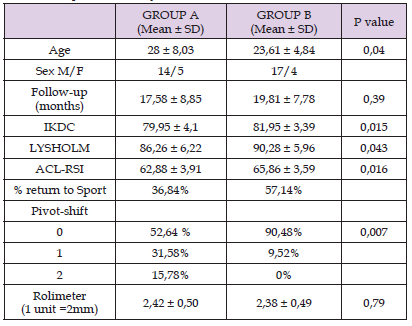
Femoral interference screws have been never removed to avoid creating a larger bone defect. We found reabsorbable interference screws in 32 cases and metallic interference screws in 3 cases. In 5 cases the previous metal button suspension fixation system was removed. In all cases, the tunnels used in the first implant did not obstruct the creation of a new tunnel according the correct placement criteria.
Every surger started with a diagnostic arthroscopy to evaluate meniscus and articular cartilage status and the residual graft lodged in the intercondylar throat. The tibial footprint and femoral footprint are meticulously evaluated, and the remnant of the previous graft is removed. Finally, a throat debridement is performed. To prepare the patellar tendon graft we make a longitudinal 5-6 cm long incision centered on the patellar tendon. We emove 1/3 of the tendon diameter with the respective tibial and femoral bone slabs using dedicated instrument (dyonics motorized saw) for a length of approximately 2 cm. Residual tendon gap is sutured and the graft is prepared for implantation by applying traction wires such as Vycril 2 and Ti-Cron 5. We proceed to the arthroscopic phase in which the femoral and tibial tunnels are performed with a freehand otuside-in technique by identifying the ideal femoral and tibial footprint (which represents an isometric area and not a precise insertion point). In all patients, the primitive femoral tunnel was not conflicting with the new tunnel. Then we pushed the neo-graft through the bone tunnels and we fixed it with the proper tension by an interference screws (reabsorbable PLLA coated hydroxyapatite screw or a metal screw depending to the age of the patient).
Finally, tension, proper graft placement, and range of motion are assessed to rule out impingement. Our ACL reconstruction involved the use the original surgical technique that takes its cue from previous Lemaire, modified Lemaire, Macintosh, and modified Macintosh techniques described in the literature.
Lateral incision at the third distal of the thigh, about 5 cm long, centered on the lateral femoral epicondyle, extended to the anterolateral region of the leg about 1 cm posterior to Gerdy's tubercle. The ileo-tibial band is exposed. Next, a repere is placed at the level of the proximal insertion of the anterolateral ligament; a strip of iliotibial band (about 8-10 cm long and 1 cm wide) is clipped in the disto-proximal direction, leaving the insertion on the lateral epicondyle intact. This graft is based in the free portion with Ti-Cron 5 non-absorbable wire (Figure 1). The distal insertion of the antero-lateral ligament is identified: it is located approximately 2 cm anterior to the fibula head, 2 cm posterior to Gerdy's tubercle, and 1 cm inferior to the articular rhyme. A trans-tibial metal guide wire is placed at the foot- print, and then a bone tunnel is made approximately 28-30 mm in length and appropriate diameter for the graft size, usually about 5-6 mm (Figure 2). Now the graft is pushed deep inside the iliotibial band, and throught the bone tunnel at the level of the tibial foot-print. Tension of the graft is provided by pulling the Ti-Cron wire from the medial side of the leg. Flexion and extension movements are performed to assess proper graft tension. At the end, the knee is positioned at 30° of flexion and with the foot in extra-rotation, the graft is properly tensioned, so we fixed it by an interference screw, usually 1 mm larger than the tunnel and with a length of 23-28 mm (Figure 3).
Figure 1

Figure 2
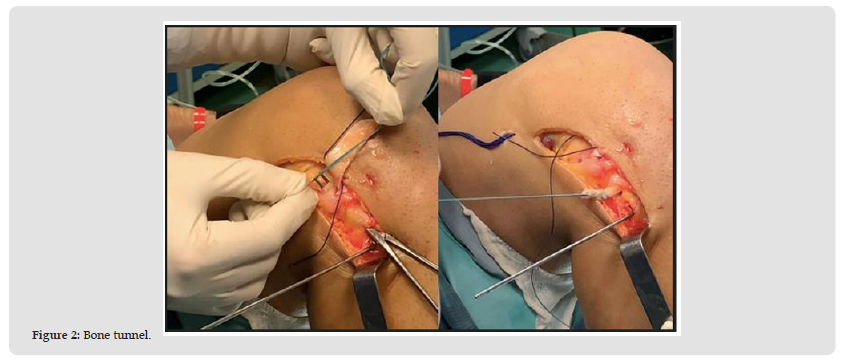
Figure 3
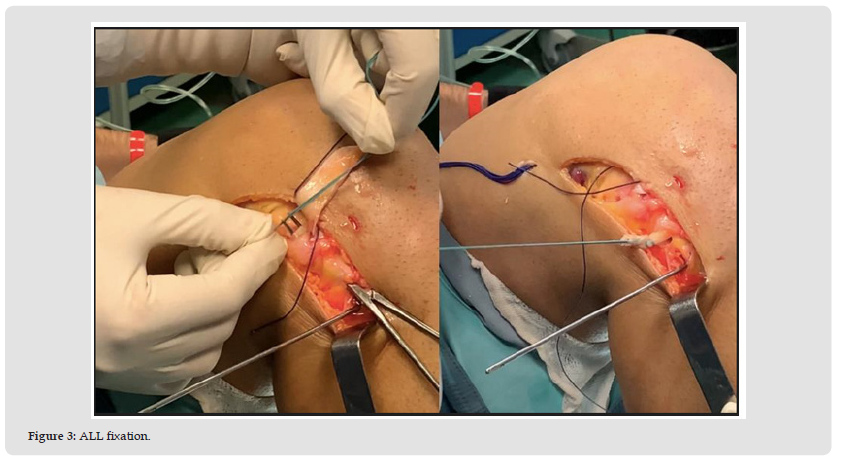
The choice to fix the graft at 30° knee flexion and with extra-rotated foot is a consequence of the biomechanics of postero-lateral knee structures. Infact, in our experience, fixation with the knee flexed at 30° and extra-rotated foot ensures good tension of the anterolateral neo-ligament, in order to get better resistance to tibial intra-rotation movements with the knee flexed between 30° and 60°. In addition, sutures of the neo-ALL are applied along its course, to fix it to the lateral capsuloligamentous structures. We close the iliotibial band gap too, by Vycril 2 wire suture. Finally, the stability of the knee is assayed by intra-operative dynamic tests: Jerk-Test, Pivot-Shift test and postero-lateral drawer in intra- and extra-rotation with the knee flexed at 90°.
At the beginning the rehabilitation protocol in case of ACL+ALL reconstruction initially the use of an articulated brace with ROM 0° and walking with no-weight for the first 12 days to protect the graft and not overload the knee. Isometric contractions of the quadriceps femoris were granted in the immediate postoperative period. Subsequently, passive knee mobilization using Kinetec machine with ROM between 0°- 60° during the first week and 0°-120° the following week. For the first month, all patients were evaluated weekly to monitor the recovery of joint ROM. At two months after surgery, every patients started a neuromuscular reeducation program with proprioception exercises and muscle strengthening with kinetic closed-chain exercises.
Once rehabilitation was completed, clinical score questionnaires were administered to patients in order to assess their general condition and functional status. The scales used were the LYSHOLM knee scoring scale, the IKDC (International Knee Documentation Committee Score) and the ACL-RSI (Anterior Cruciate Ligament Return to Sport after Injury) scale. In addition, we analyzed the rates of return to sports activity that the patients performed before the injury. All of these scores give subjective results. In order to have objective outcomes, all patients underwent clinical evaluation with Pivot-shift and arthrometric evaluation with Rolimeter (instrument made by Aircast Europe).
Statistical analysis was performed with IBM-SPSS for Mac version 22.0 software. The results obtained were summarized as mean ± standard deviation (SD) or standard error (SE) or percent prevalence when appropriate. To compare the data obtained with the clinical scores and assessments submitted to the two groups, we used T-test for paired data and Chi-quadro test in case of percentage comparisons.
We talked about 40 patients who enlisted in the study, they were divided into two groups: group A with 21 patients who underwent single ACL reconstruction; group B with 19 patients who underwent ACL and ALL reconstruction. Mean follow-up of patients was 18.75 ± 8.27 months, 17.58 ± 8.85 for group A and 19.81 ± 7.78 for group B, respectively. Results obtained with clinical scores were for 78.95 ± 4.1 IKDC in group A and 81.95 ± 3.39 in group B (P value 0.015). LYSHOLM: 86.26 ± 6.22 in group A and 90.28 ± 5.96 in group B (P value 0.043). ACL-RSI: 62.88 ± 3.91 in group A and 65.86 ± 3.59 in group B (P value 0.016). Finally, the rate of return to sport activity at the same level before the injury was 36.84% in group A and 57.14% in group B. Pivot-Shift Test at clinical evaluation was negative in 52,64% of group A cases; grade 1 pivoting in 31,58% of cases and grade 2 pivoting in 15,78% of the cases. In group B, on the other hand, we found pivot-shift negativization in 90,48% of the cases; grade 1 pivoting in 9,52% of cases and there was no grade 2. The percentage of pivot shift negativisation in group B is significantly higher than in group A, so this difference appears statistically significant (p value 0.007).
The results of arthrometric evaluation with Rolimeter, in all subjects in whom measurement was taken, did not find differences greater than 4 mm between the healthy knee and the operated knee (2.42 ± 0.50 VS 2.38 ± 0.49) into the two groups with a P value of 0.79, which represents a non-significant statistical difference (Table 1). Six months after surgery every patients got an X-ray control in antero-posterior, lateral and sec. Rosemberg projections, to make sure the correct position of fixation means.
Considering that a recent study by Tramer, et al. in 2019 demonstrated that approximately 78.8% of patients undergoing primary ACL reconstruction have signal alteration at the level of the LAL on MRI [46], and that in approximately 25% of patients undergoing primary ACL reconstruction pivoting remains after rehabilitation due to rotatory instability associated with injury of the antero-alter complex [47], the challenge facing surgeon in revision surgery presents significant complexities. Thus, our purpose was to demonstrate whether or not, in revision surgery, reconstruction of the ACL is a surgical act that required to restore rotational stability of the knee, in order to obtain better clinical outcomes and ensure a higher rate of return to pre-injury levels of sport activity. To obtain our study population as homogeneous as possible, we selected patients with mentioned inclusion and exclusion criteria, in addition every surgery was performed by a single experienced operator who used same surgical technique. Scores administered to the patients, clinical evaluation with pivot-shift test and arthrometric evaluation with rolimeter were performed by a single operator with considerable experience in ACL revision surgery.
Results detected that anatomic reconstruction of the anterolateral ligament, in conjunction with anterior cruciate ligament reconstruction in revision surgery reduce rotatory instability and gives to patients a higher rate of return to the same level pre-injury sport activity. Reviewing literature, we found only a few studies that compared outcomes between isolated and LAL-associated ACL reconstruction in revision surgery. What's more, only two of these had homogeneous, single-operator case histories. According to a study performed by the M.A.K.S., preoperative pivotshift ≥2 grade and knee hyperextension are positive predictive risk factors for pivoting one year after ACL reconstruction surgery; therefore combined ALL reconstruction is required to reduce rotatory instability [41]. Lee, et al. demonstrated that 64% (176/275) of patients with acute complete ACL injury also had an anterolateral ligament injury, and 84% of the 275 patients examined had high-grade pivot-shift [47]. Numerous studies analyzed the risk factors for high-grade pivot-shift after an anterior cruciate ligament injury, and their conclusion is that an anterolateral ligament injury is associated with increased rotatory instability of the knee such as a severe knee pivoting [48,49].
Sonnery-Cottet, et al. suggested that the failure of anterior cruciate ligament reconstructions, is caused by a persistent rotatory instability of the knee during sport activity. Therefore, in these cases, postero-lateral stabilization with tenodesis of the iliotibial band or anatomic reconstruction of the anterolateral ligament should be considered [50]. Trojani, et al. reported pivot-shift negative rates in 80% of patients who underwent revision in association with tenodesis of the iliotibial bandage, and in 60% of patients who underwent isolated revision, although the association with tenodesis did not influence the IKDC score [51] Louis, et al. 34 claim that 99% of 349 patients who participated in their study, and who underwent revision with anterior cruciate ligament reconstruction in conjunction with the anterolateral ligament, showed pivot-shift negativity at the end of follow-up. Furthermore, this multicenter study shows a new instability recurrence rate of 1.2%. Based on these literature data, we hypothesized that knee instability recurrence after primary reconstruction of the anterior cruciate ligament more frequently results in injury with anterolateral ligament lesion and a high-grade of pivot-shift.
According with literature, results of our study show that a statistical significant value (p value=0.007) association with anterolateral ligament reconstruction results in a significant increase of pivot-shift negativity. However due to the lack of a long-term follow-up, we are not yet able to evaluate the rate of new neoligament rupture; in the literature a study by Sonnery-Cottet, et al. [52] proves that in this type of surgery failure rate is twice lower than isolated ACL reconstruction. Taking into consideration the relevant literature and the data in our possession, we can assert that anatomic reconstruction of the LAL associated with ACL reconstruction should be considered in revision surgery in order to improve clinical otucomes and rotatory instability, to reduce failure. These considerations are in agreement with biomechanical studies that support the protective role of extracapsular structures against the graft used, according to the concepts of "belt and suspender" and "backup for ACL."[39,46,53-56]. Finally, in our opinion, because of ACL is an isometric structure whose maximum tension is appreciated between 30° and 60° of knee flexion with internal rotation of the tibia, reconstruction of this ligament must be as anatomical as possible in order to ensure biomechanical properties similar to the native structure.
Although knowledge of this anatomic structure has improved over the years further progress and research are desirable in order to understand all its biomechanical properties and clinical implications. However, our study has some limitations, such as: the small sample size, despite the fact that all patients were treated by a single operator; it’s a retrospective comparative study, we need prospective randomized clinical trials and meta-analysis to confirm our thesis; the absence of an universal instrument to measure Pivot-Shift deegrees quantitatively and objectively; a short follow-up which prevents us from evalsating rate of recurrence, early arthrosis of the lateral knee compartment rather than lateral overload or increased tension of extraarticular structures.
In conclusion, anterolateral ligament reconstruction in combination with anterior cruciate ligament reconstruction is a required and complementary surgical act, as it statistically significantly reduces residual anterolateral rotatory instability (p value < 0.05). This fact increases the percentage of patients returning to pre-injury levels of sports activity, improves clinical outcomes and patient satisfaction. The clinical results we obtained totally agree with the scientific literature, but these data are still preliminary. Therefore, further Prospective Randomized Studies and Meta-Analyses are required in order to confirm hypothesis that Anterolateral Ligament Reconstruction should necessarily be performed in ACL revision surgery.
T.E., P.M. and B.D. conceived of the presented idea. C.G. and T.A.N. performed the measurements and were involved in planning and supervised the work, P.M. and B.D. processed the experimental data, performed the analysis, drafted the manuscript and designed table, C.G. took pictures and was data curator, T.A.N. performed the data analysis. T.E. took care original draft preparation and was the project supervisor. P.M. aided in interpreting the results, B.D. worked on the English version of the text. All authors have read and agreed to the published final version of the manuscript.
This research received no external founding.
The study was conducted in accordance with the Declaration of Helsinki, and approved by the Institutional Review Board (or Ethics Committee) of Santa Maria della Misericordia Hospital.
Informed consent was obtained from all subjects involved in the study.
The data that support the findings of this study are available from the corresponding author, B.D., upon reasonable request.
The authors declare no conflict of interest.

International Association of Landscape Archaeology, Czech Glass Society, Czech Republic

Department of Chemistry, Semenov Institute of Chemical Physics, USSR Academy of Sciences, Moscow, Russia

Neurology, LA BioMed Research Institute, USA

Associate Professor at Department of Breast and Thyorid Surgey, Chongqing General Hospital, China

Clinical Radiologist (MD) - Department of RADIOLOGY, Cosenza Hospital, Cosenza, Italy





 Abstract
 PDF
PDF