info@biomedres.us
+1 (502) 904-2126
One Westbrook Corporate Center, Suite 300, Westchester, IL 60154, USA
Site Map
 ISSN: 2574 -1241
ISSN: 2574 -1241
ISSN: 2574 -1241
Received: July 05, 2024; Published: July 22, 2024
*Corresponding author: Tímea Hevér, North-Pest Centre Hospital - Military Hospital, Budapest, Hungary
DOI: 10.26717/BJSTR.2024.57.009043
Chronic lower limb ulcers have different aetiologies. Their treatment requires a complex, individualized approach. Of course, the treatment of the cause is the priority. In addition to the choice of smart dressings adapted to the individual and the wound, the use of alternative treatment methods such as zinc hyaluronate and Norway spruce resin should be considered, especially if their effect has already been demonstrated in preliminary studies. In this article, positive experiences with the use of Norway spruce (Picea abies) resin, known as Abilar®, are described.
Keywords: Picea Abies Resin; Abilar®; Chronic Wounds; Atypical Wounds; Wound Healing; Antibacterial; Infection Management
Key Messages: Abilar®, a Norway spruce resin, is safe to use as a topical wound treatment for acute, complicated, and chronic wounds; it has antibacterial properties and promotes wound healing
Wound healing can be delayed by a wide range of factors, such as old age, infections, immobilization, ischemia, malnutrition, smoking, hyperglycaemia, anaemia, chronic diseases (e.g. cancer, liver, or kidney failure) and the use of certain drugs (e.g. corticosteroids and other immunosuppressive drugs). Chronic lower limb ulcers that take a long time to heal can be classified into vascular ulcers (e.g. venous and arterial ulcers), diabetic foot ulcers and Pressure Ulcers (PU) [1,2]. The problem of chronic lower limb ulcers in diabetes has already been discussed in detail in articles [3,4]. Atypical wounds comprise approximately 20% of all chronic wounds [5-11]. They are a broad spectrum of conditions or diseases caused by inflammation, infection, malignancy, chronic illnesses, or genetic disorders. With an aging population and increase in comorbidities these numbers are expected to rise. From a surgical perspective, infection of the surgical site contributes significantly to delayed wound healing [12-14]. To provide individualized and successful wound care, continuous training and education is essential, as well as learning about new, proven and successfully used products. One such product, which is not yet widely used in Hungary, there are no reports or articles about it, and it is not yet used in wound treatment practice, is a cream made from a natural substance, Norway spruce resin, known as Abilar®. There are hardly any articles about it in the international literature.
In this article, I summarize my experience of using the cream. At the Cardiac, Vascular and Thoracic Surgery Department of the North Pest Centre Hospital - Military Hospital, we provide outpatient care for chronic wounds to relieve the inpatient ward. Abilar® cream has been tested in nearly 10 patients. Forefoot amputation wounds, leg ulcers and acute trauma wounds were treated. The primary disease was treated. Exceptions were two patients where a healed wound was a prerequisite for cardiac surgery or cardiac intervention. Each patient was treated with a nutritional supplement, a wound and individually selected smart dressing and a compression bandage.
• Case-1: The first patient is a 72-year-old man with diabetes. Following lower limb reconstruction (femoro-popliteal (I) venous bypass), he underwent toe amputation, total longitudinal incision, plantar fasciectomy for right IV toe gangrene and plantar fasciitis. After surgery, the tendon in the foot remained uncovered. The patient started using Abilar® after one month of smart dressings and formula. The wound was no longer scabby, there were no signs of inflammation, the wound size was reduced in all directions. Granulation and exfoliation accelerated, and overall, the wound started to heal faster. Currently, after one and half months of Abilar® use, the wound size has shrunk to one third (Figure 1).
• Case-2: Our second patient is a 68-year-old man with diabetes and significant aortic stenosis requiring surgery. A right common femoral artery occlusion was confirmed in the background of the 5th finger gangrene of the right leg. Femoral thrombendarteriectomy and 5th toe amputation was performed. Two months later due to severe diabetic peripheral vascular stenosis and soft tissue infection, forefoot amputation was required. After that, despite two months of physical vascular therapy (BEMER®) and the use of smart dressings, stagnation of the wound was seen. When the patient started to use Abilar® cream, there was significant discharge, but the plaque was easily removable, which was not the case before. At the same time, within one month, granulation started to occur in the critical, resected area of the 1st metatarsus, which had previously not shown granulation, and the wound was fused into one level wound. Unfortunately, the arch of the foot collapsed due to osteomyelitis. In the late presenting patient, we had to perform crural level amputation due to sepsis, despite of it the patient died (Figure 2)
• Case-3: The 68-year-old woman has a history of varicose veins and severe coronary artery disease. Risk factors are smoking and obesity. She presented with non-healing leg ulcers of mixed venous and arterial origin for almost a year ago. After percutaneous coronary intervention, bilateral venous crossectomy, right femoral artery and popliteal 2nd segment thrombendarterectomy and femoro-popliteal bypass surgery were performed. The leg wound was rapidly drying up, covered with black necrosis, which, with the use of Abilar®, was detachable within one month, the necrosis and plaque were increasingly dissolving, and granulation was starting. Treatment of the wound is still ongoing (Figure 3).
• Case-4: The 80-year-old patient developed a growing ulcer on his leg after a blow years ago for an unknown reason. The wound was continuously covered with a biofilm layer, which could not be broken down for three months, despite various dressings and treatment methods. Abilar® treatment started on the patient gradually broke down the biofilm and within a month and a half the wound started to granulate (Figure 4).
• Case-5: An 80-year-old female patient has a rapidly growing, extremely painful wound caused by pyoderma gangrenosum. After two months of immunosuppressive treatment, a gradual improvement started. Now, after two months of Abilar® use, the wound bed has levelled out and the wound edges have started to exfoliate spectacularly (Figure 5).
• Case-6: The 70-year-old female patient underwent left iliofemoral reconstruction surgery due to gangrene of the toe. Distal extension was not an option due to severe damage to the leg arteries. Forefoot amputation was performed due to progressive gangrene. After her emission, she used physical vascular therapy (BEMER®), which achieved bone coverage with granulation tissue in two months. Her treatment was supplemented with Abilar® to promote the wound exfoliation for one month (Figure 6).
• Case-7: The 81-year-old female patient has a history of hypertension. The severity of aortic and mitral stenosis requires surgery. Due to gangrene of the fingers of both legs, first left superficial femoral artery stent-PTA, then femoro-crural bypass surgery, on the right side femoro-popliteal (I) bypass surgery was performed. Amputation of the left forefoot became necessary. For cardiological reasons, continuous bacteriological sampling of the patient's wound was performed. Despite targeted intravenous antibiotic treatment, Pseudomonas aeruginosa, ESBL-producing Klebsiella pneumoniae, Morganella morganii, Enterococcus faecalis pathogens were cultured in the wound. One week after the use of Abilar, it was observed that the pathogens cultured had changed to Staphylococcus epidermidis, Enterococcus faecalis és Morganella morganii. Two weeks after treatment, granulation of the wound bed has started, and the wound bed is clearing. After a month the change is impressive (Figure 7).
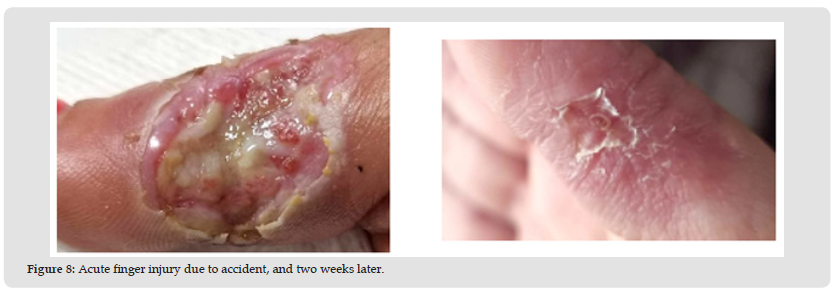
• Case-8: The 33-year-old female patient has no internal medical conditions. Her finger was injured by a hand tool. After the wound was treated, the skin along the sutures was necrotic and detached, leaving a necrotic wound bed one millimetre deep. Following the application of Abilar®, the wound continuously cleared up, intense granulation started and completely exfoliated within two weeks (Figure 8).
Figure 1

Figure 2
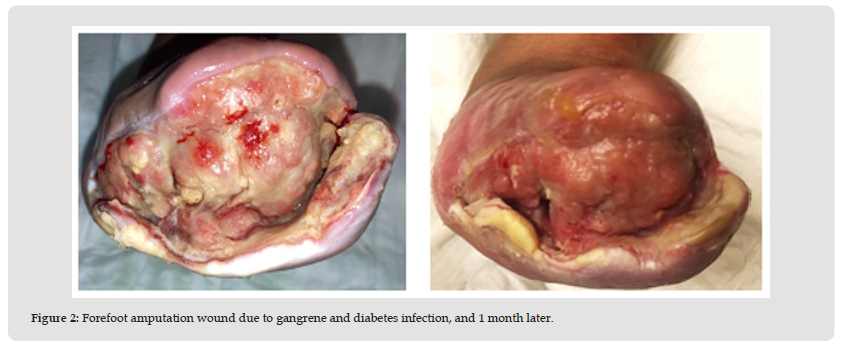
Figure 3
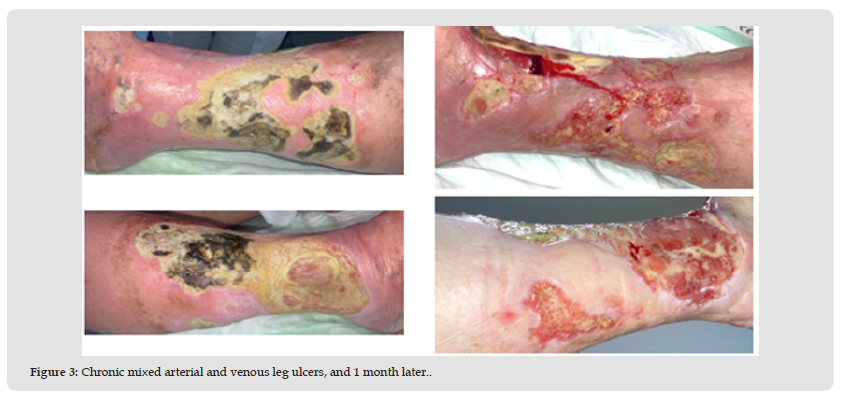
Figure 4
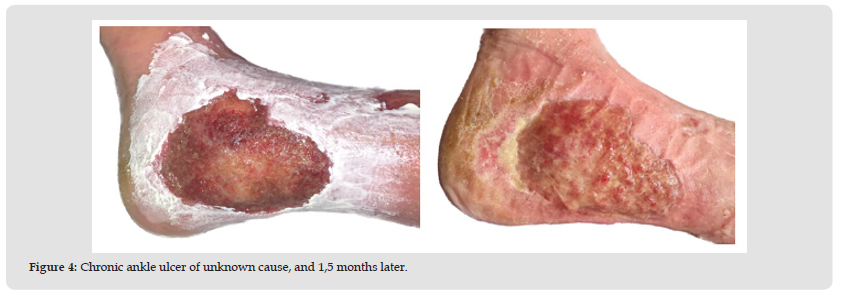
Figure 5

Figure 6

Figure 7

Figure 8
Norway spruce (Picea abies) is available in two forms. Vulpuran® contains 20% Norway spruce balm in pork lard, and Abilar® (Repolar Pharmaceuticals Ltd, Espoo, Finland), 10% Norway spruce resin in a salve base (petroleum, paraffinum liquidum, alcohol denat., cera microcristallina, sorbitan oleate, cera alba, hydrogenated castor oil, and stearic acid). Both are registered as medical devices class II b, which are meant to form a physical barrier against bacteria and yeasts. Only Abilar® is available in Hungary. There are few articles in the literature on Abilar®, a Norway spruce resin (Picea abies). Its effects have been studied in detail mainly by one working group (Sipponen A. et al.). According to their studies, the product is an effective fungicide (Candida, Trichophyton) [15,16], and antibacterial, more specifically bacteriostatic against Gram-positive bacteria (including methicillin-resistant Staphylococcus aureus /MRSA/ and vancomycin-resistant Enterococci /VRE/) and against Escherichia coli, Pseudomonas aeruginosa, Proteus vulgaris of the Gram-negative bacteria [15,17,18]. In contrast to Merja Rautio's study, our clinical experience showed that despite targeted intravenous antibiotic treatment, Pseudomonas aeruginosa, ESBL-producing Klebsiella pneumoniae pathogens remaining in the wound disappeared after Abilar® treatment. Désirée Prokop and colleagues have found that Norway spruce not only has antibacterial and antifungal effects, but also promotes wound healing [19].
The callus resin of Picea abies is known for its wound healing properties and contains (hydroxy)cinnamic acid derivatives (i.e. coumaric, ferulic and caffeic acid derivatives) and lignans [20,21]. The presence of oleoresin has anti-desiccation/antibacterial properties and is mainly composed of resin acids. Wound size, the use of corticosteroids or other immunosuppressants, and immobilization are statistically significant contributors to delayed wound healing and impaired re epithelialization. Delayed post-operative wound healing with Abilar® shows a good healing response [22]. The same favorable outcome was observed by Arno Sapponen and colleagues in pressure ulcers where sodium carboxymethylcellulose hydrocolloid polymer was used without or with ionic silver (Aquacel® or Aquacel Ag®; ConvaTec Ltd, London, U.K.) as a control [20]. In four patients with complicated surgical wounds, three patients with chronic ulcers and one patient with acute wounds, we observed a reduction in the bacterial count of the wounds, wound cleansing, acceleration of granulation and exfoliation processes with Abilar, which is supported by the photo documentation. Allergic contact dermatitis from medical devices containing spruce resin can occur in ~2% of patients [22,21,23].
One study has investigated in detail the sensitizing effect of Picea abies [24]. While oxidized resin acids of the abietic acid type are the main sensitizers in Picea abies, this resin may also contain other contact sensitizers. During our use, no patient reported intolerance and no allergic contact dermatitis was observed. This article describes the positive results of the safe use of Abilar, a topical wound treatment not previously used in Hungary, in the treatment of acute, complicated and chronic wounds. Of course, further and wider application results will allow definitive conclusions to be drawn.

International Association of Landscape Archaeology, Czech Glass Society, Czech Republic

Department of Chemistry, Semenov Institute of Chemical Physics, USSR Academy of Sciences, Moscow, Russia

Neurology, LA BioMed Research Institute, USA

Associate Professor at Department of Breast and Thyorid Surgey, Chongqing General Hospital, China

Clinical Radiologist (MD) - Department of RADIOLOGY, Cosenza Hospital, Cosenza, Italy





 Abstract
 PDF
PDF