info@biomedres.us
+1 (502) 904-2126
One Westbrook Corporate Center, Suite 300, Westchester, IL 60154, USA
Site Map
 ISSN: 2574 -1241
ISSN: 2574 -1241
ISSN: 2574 -1241
Received: July 09, 2024; Published: July 15, 2024
*Corresponding author: Bellido-Casado J, Emergency Primary Care Department Unit, Institut Català de la Salut, Barcelona Ciutat, Spain
DOI: 10.26717/BJSTR.2024.57.009026
Artificial intelligence (AI) is almost ready to be used in both the outpatient and emergency settings. Right now the clinical use of AI is not spread out because machine learning is nowadays inaccurate and in debate (supervised versus unspervised machine learning), based in actual neural networks; thus several pitfalls must be considered [1]. Related to some basic and conventional medical techniques like ECG, machine learning is developing and promising. For exemple, AI enabled ECG will be routinely performed when prospective clinical studies (clinical trials) shown a clear beneficial over medical direct decision making in early detection of cardíac diseases [2]. However authors prevent from knowing pitfalls that could guide to unsafety and unethical decisions [3]. As an exemple of the following case we can discuss about the potential beneficial of decisions based on wellknown paterns in ECG like The Wellnes patern (Figure 1). Figure 2 shows the ECG patern of the patient one year before. The patient gave permission to use the ECGs.
Figure 1
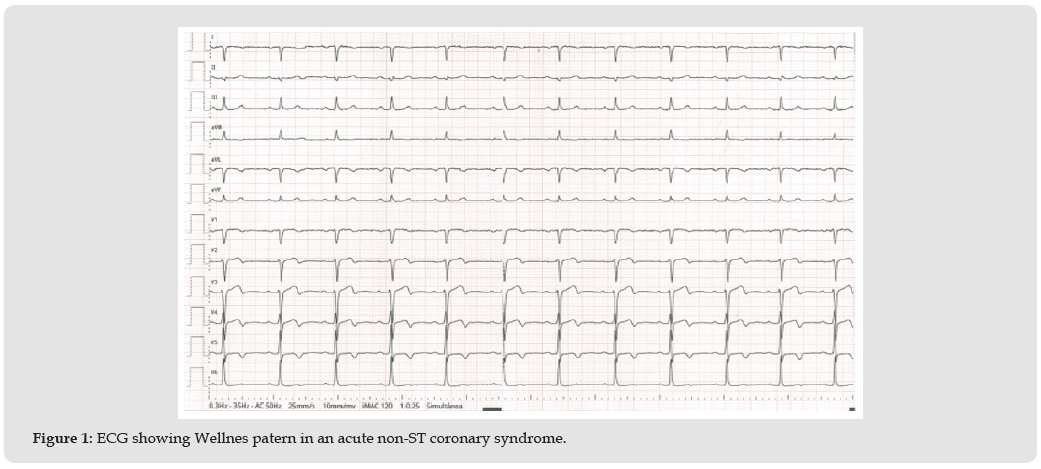
Figure 2
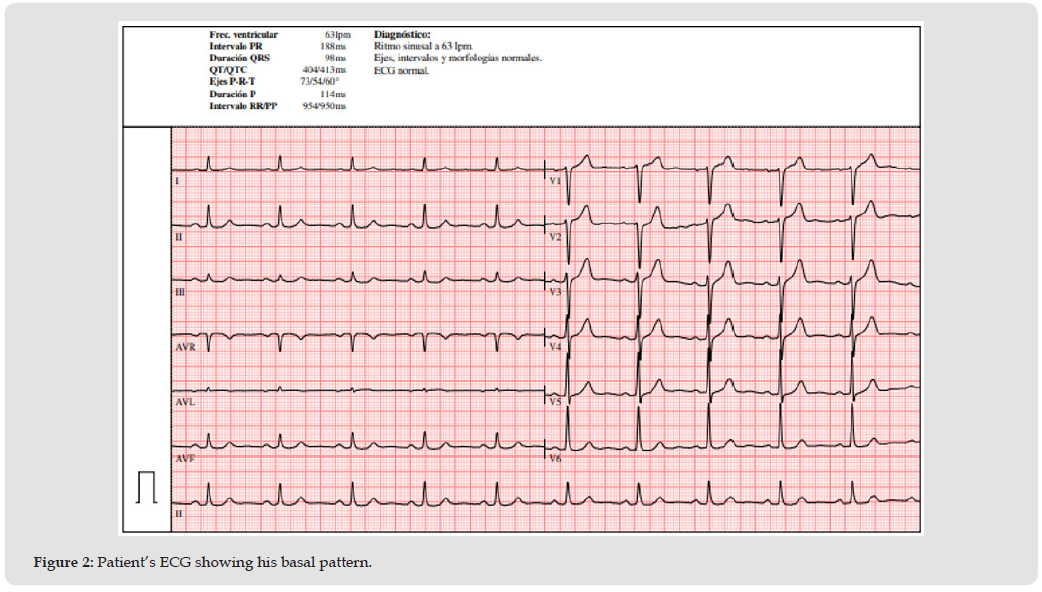
78 years old, caucasian, male. He arrived at the emergency room with with intermittent chest pain suffering from the las three weeks. The pain began when walking and subsided at rest. The ECGs howed negative T waves from V1 to V4 (Wellens pattern) (Figure 1) with negative troponins. An Acute non-ST coronary syndrome code was activated immediately and a radial coronary angiography was performed. A 3-vessel coronary artery disease, TCd 30-30%, DAp-m 90%, D1 80%, OM1 70%, OM2 90%CDm 70-90% was shown. He went to surgical revascularization and triple coronary bypass with extracorporeal circulation was performed. He recovered completely with a FE 45% and discharged with medical treatment and cardiology control. In this case the Wellnes ECG patern was immediately recognised by the doctor when it confronted to the normal patient’s ECG patern, so he activated the emergency code to perform an haemodinamic procedeure in the cardiologist unit. On the other hand, we think that a deep learning model ECG realised by AI (deep neural networks) performed in the case above mentioned would had made the same clinical decision without confronting to the previously known patern of the patient. Although ECG interpretability of the AI decision is the most probably guarantee, the complete explainability to the patient in this case would be a more complex decision if no patient preferences of managing are considered by deep neural networks. Intense debate about human decison making or AI decison making is currently undefined.

International Association of Landscape Archaeology, Czech Glass Society, Czech Republic

Department of Chemistry, Semenov Institute of Chemical Physics, USSR Academy of Sciences, Moscow, Russia

Neurology, LA BioMed Research Institute, USA

Associate Professor at Department of Breast and Thyorid Surgey, Chongqing General Hospital, China

Clinical Radiologist (MD) - Department of RADIOLOGY, Cosenza Hospital, Cosenza, Italy





 Abstract
 PDF
PDF



























