info@biomedres.us
+1 (502) 904-2126
One Westbrook Corporate Center, Suite 300, Westchester, IL 60154, USA
Site Map
 ISSN: 2574 -1241
ISSN: 2574 -1241
ISSN: 2574 -1241
Received: July 03, 2024; Published: July 15, 2024
*Corresponding author: Nviiri Geofrey, Ngetta Zonal Agricultural Research and Development Institute, Uganda P.O Box 52 Lira, Uganda
DOI: 10.26717/BJSTR.2024.57.009023
Defined as a scientifically structured progression of determining the probability and severity of a hazard, risk assessment is a key instrument in mitigating deficits associated with areas of mathematical uncertainties. To avoid having a distorted perspective of the reality that arises from nonscientific risk reporting, agricultural research has to identify, analyze, and develop research-cognizant extenuation mechanisms to the unending risks. In rational risk mitigation, quantitative assessment fundamentally underpins the other two components of Risk Analysis; i.e. Risk Management and Communication. Although in rudimentary mode, risk analysis has been principally applied to financial and to insignificant extents in technological risks to address catastrophic chemical hazards. Specifically, most food and feed for livestock-derived food products contain high levels of chemical hazards which alone constitute aflatoxicosis among other biochemical risks. The resolve of this review, therefore, is to highlight the role of scientific risk analysis in the identification of prime intervention targets for the most proficient resolutions to agricultural research problems based on the aflatoxicosis risk as a case study. To deliver on this objective, 30 published papers attempting to address aflatoxicosis and the related chemical hazard related risks were reviewed from 1990 to date. Based on the literature, it was inferred that only the scientific quantitative risk assessment tools presented efficient mechanisms for problem identification through fault tree analysis and hence targeted the most effective critical control points to guide research interventions. In addition, it is also evident that agricultural scientists have to use findings of both predictive modeling and quantitative risk management to determine whether a research product will be safely acceptable for consumption based on Hazard Analysis Critical Control Points. Therefore, besides basing on nonscientific subjective reports, agricultural research managers must have quantitative information validated by scientifically collected data, to guide the targeting of the most suitable logic gates on the fault tree problem matrices to avoid distortion of the reality.
Keywords: Risk Assessment; Probability; Fault Tree Analysis; Risk Characterization
Despite the significant increases in crop and forage feed yields brought about by the Green Revolution, over a billion people still suffer from malnutrition, and over two billion become ill every year as a result of dietary-related risks [1,2]. This is ascribed to the risks that go unrecognized and the subjectivity of risk reporting, which originate with agricultural research and end with food consumption [2]. As a consequence, millions more die from diseases that emerge from irrational chemical use among other inadequate postharvest practices. Specifically, 25% of the hepatocellular carcinogen-related deaths are attributed to chronic aflatoxicosis which is attributed to poor postharvest handling of agricultural products and livestock feeds [3,4]. However, the few attempts made to communicate the associated risks are an account of the largely subjective qualitative hazard reports with restricted scientific justification [5]. Defined as the probability of exposure of an individual to a hazard and the likely ingestion of a toxic dose of a hazard, scientific risk assessment is the only instrument that can provide input for the selected risk impact models [6].
On the other hand, Risk characterization, a component of assessment necessitates evaluation of the probability that a certain research project will suffer antithetical effects as a result of the hazard [2]. Risk characterization therefore should represent the final stage of aflatoxin risk assessment, to estimate both the probability (infectious disease triangle dependent) and the severity due to aflatoxicosis. In the scientific sphere, quantitative Risk Assessment is one of three components of Risk Analysis before Risk Management and Risk Communication yet at present, risk analysis is subjectively applied to financial and a very small extent to environmental risks. Therefore it must be empirically well recognized that the four major elements of risk assessment must be applied to constitute a logical and sequential pathway of hazard identification, and characterization before addressing the biochemical and related hazards among Agricultural research products [5].
The Statistics of Risk Analysis
The objective of quantitative risk characterization from a statistical perspective is to determine the contribution of each logical step in a specific food pathway to the risk level, as well as the confidence intervals associated with the risk estimates. This can be done effectively thanks to sensitivity analyses, which are used in simulation modeling tools like Monte Carlo analysis. Because of the inherent variability in biological systems, food processing technologies, food preparation methods, and human behavior, as well as the uncertainty resulting from incomplete information, caution must be taken when interpreting the results of such analyses [2]. Project directors therefore can objectively weigh various risk management options and assess the impact of various mitigation strategies (agricultural research interventions) by using risk characterization and assessment tools [2]. As was previously mentioned, risk characterizations should include an assessment of the likely severity of a hazard in addition to determining the likelihood that it will negatively affect the technology end users. In fact, all likely impacts that might be connected to that specific event as decomposed by the fault tree analysis must be considered when evaluating all research treatment effects resulting from the utilization of agricultural products beyond the recommended levels of the aflatoxin. However, such associated impacts are closely related to well-thought-out choices that can only be made during scientific risk analysis and management.
Justification for Aflatoxin Case Study
The development of liver cancer is the health effect for which chronic aflatoxin consumption is most strongly associated. Aflatoxin is testified to be the cause of over 25% of the over 0.6 million new cases of liver cancer that are reported each year worldwide [7]. Furthermore, according to multiple authors, over 85% of children in African nations have detectable levels of urinary aflatoxins or serum AF-alb [8-10]. In addition, several studies have also reported to have found aflatoxin B1 and its metabolite aflatoxin M1 in excreted breast milk samples which poses an extended risk to the infants [9]. Also more challenging, several studies demonstrate correlations between aflatoxicosis and stillbirths, liver cirrhosis, and immunosuppression [10]. On that background, this review sought to prompt research project managers of the importance of researchers integrating risk assessment instruments for increased efficacy and efficiency, as the goal of risk assessment is to provide a mathematical estimate of the impacts of a hazard alongside the probabilities of their occurrence. This implies that, besides having qualitative reports, agricultural research managers must have quantitative information derived from scientifically collected data, to guide the targeting of the most suitable logic gates on the fault tree matrices.
Aflatoxin Hazard and Food Security from the Uganda Agricultural Research Perspective
In 1992, due to serious concerns about nationwide hunger due to emerging pests and diseases that threatened the country’s strategic crops, the National Agricultural Research Organization (NARO) was formed and has had great success in carrying out agricultural research for developing communities. As a consequence, NARO is rated as one of the best Agricultural research institutes on the African continent. Whereas minimizing food production risks (pests and diseases) was the principal goal for its establishment, food safety concerns have emerged risking rejection of our products on the international market. Consequently, detailed risk analysis of the genesis of the aflatoxin as a biological hazard warrants evaluation for the organization to establish the basic events using tested tools like the Fault tree and expected monetary value. Largely, fungal toxins, inappropriate use of chemicals and antibiotics, role in climate change, disease consequences, and health effects of altered agricultural ecosystems are a few crucial health issues related to agriculture that call for evidence-based interventions [2].
This paper emphasizes how scientific risk assessment in agricultural research can lower health risks in low-income consumers and boost opportunities for farmers’ market access as a consequence of aflatoxin hazard mitigation. This case study thus was designated to demonstrate how risk-based research and innovative risk-mitigating technologies can support and augment upcoming research on aflatoxins and beyond [5]. In food aflatoxicology, the risk is represented by the occurrence of aflatoxins in food, their multiplication, and/or production of aflatoxicosis clinical signs [11]. However, NARO already started small-scale research related to food safety on both commercial and staple crops that resist pests so that farmers can reduce dependence on expensive, environmentally unfriendly, and potentially hazardous inputs. Whereas aflatoxin research has dominated safety concerns, there is a need for expansion of risk assessment and prioritization activities alongside substantial programs on the safety of perishables, zoonotic diseases, occupational hazards, and toxin-associated threats [12].
Risk-Based Approach to the Identification of Research Problems (Fault Tree Analysis)
Agricultural research and production risks are a function of genetics, environmental interaction, and the social setting of the farming communities. This implies that these parameters naturally interact to yield synergistic statistical risk impacts [11]. By now, quantitative risk analysis is widely recognized as the principal process for evaluating concerns related to agricultural research, production, and food safety [2]. Whereas other research institutes elsewhere in the world have attempted to conduct several risk assessments and hence risk management studies, no similar approaches have been reported in evolving programs [5]. As a consequence, developing methods for applying risk assessment to the research data and resource-poor informal value chains in the developing risky farming communities is in its infancy [2]. So, risk can only be controlled if the hazard severity and likelihood can be quantified to assess the impact if no control measures are put in place. Therefore, risk assessment recruits must be furnished with an acquaintance with both qualitative and quantitative tools to ably mitigate the associated hazard impacts.
Figure 1
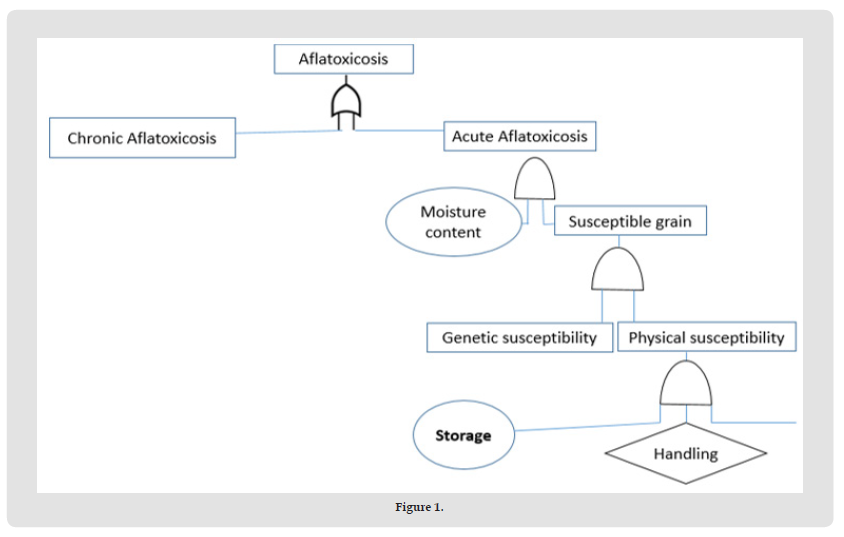
What cannot be measured cannot be assessed and managed, risk identification, ranking, and prioritizing leads to efficient direction of research resources for problem-solving [13]. In terms of global disease burden, acute aflatoxicosis causes hundreds of deaths per year and chronic aflatoxicosis causes around 90,000 deaths a year from liver cancer so, rankings of the aflatoxicosis-associated risks classify this hazard as catastrophic. However, a better understanding and quantification of the hazard impacts of aflatoxicosis is the only instrument that can generate quantifiable critical control points as exemplified in the figure below in the fault tree analysis. The Figure 1 above illustrates how a fault tree can be scientifically applied to decompose the aflatoxicosis risk from the broad problem to the basic events indicated by the logic gates. In principle, research interventions must target the nearest AND logic gate to the hazard for maximum resource utilization efficiency. Targeting the OR logic gate implies having more research interventions to tackle all the possible hazards roots which implies more resources invested to solve the same problem. Therefore, commonsensical management which focuses on controlling the level of aflatoxin hazards cannot economically mitigate the impact of aflatoxicosis-related risks without the logic gate technique.
Determining the Basic Event for the Aflatoxin-Related Hazard Using Fault Tree Analysis
The probabilities and severity of aflatoxins demonstrate the challenges in ascribing relationships. Specifically, this can best be appreciated after carefully constructing the problem tree right from the leaves to the roots (basic event). Epidemiologically, if two disease-associated factors are strongly and consistently associated it can be anticipated that either one factor causes or a confounding factor causes both factors. In such associations, the logic gate-based fault tree analysis comes to the rescue as it scientifically decomposes the risk into its constituents to the basic event. However, since correlation does not infer causation, scientific disciplines like epidemiology, pathology, and agronomy have to complement the fault tree analysis to understand whether the association is causal or due to baffling events. Moreover, there is also a very wide species variation in susceptibility to aflatoxins. Furthermore, since aflatoxicosis impacts differently on weight gain across species, animal research risk analysts may need to conduct independent studies which is challenging for human-related subjects [14].
Interestingly, though most studies on aflatoxin and stunting have been cross-sectional, some studies have shown temporal relationships but with little to no scientific explanations [8]. Finally, based on research data and statistics probability theories complement the other disciplines to scientifically determine the associated risks. Consequently, research risk managers need to look for biological plausibility as suggested by laboratory and animal studies which imply the complementarity between risk analysis and technology development. So, with human subjects where multiple restrictions come into play thorough risk analysis based on proven statistical tools must guide the problem statement for rational identification of the critical control points.
The Need for Practicability of Risk Analysis in Agricultural Research
Developing agricultural research systems have diverse, non-linear, shifting, and data-scarce structures. To achieve the government's strategic goal of Agro-industrialization which is typically hinged around expansively mechanized and standardized factory production schemes, risk minimization has to complement profit optimization [2]. This is attributed to aflatoxin and other residual chemical hazards that have largely led to the rejection of food products on foreign markets as a consequence of the limited application of scientific risk analysis tools to control the chemical hazards [4]. Therefore, where subjective risk analysis particularly, in agricultural research and human resource-related dimensions has been heavily inclined toward damage control, the undeveloped events always incubate into more catastrophic risks [5]. It therefore should come as no surprise that agricultural research risk-based approaches have had no impact apart from complicating activity implementation. Therefore, the case study discussed in this paper lends credence to the idea that risk-based strategies could be an effective means of resolving issues with agricultural research efficiency, production as well as food safety in unsanctioned markets. Scientific risk management strategies consequently will require testing, modification, and adoption of research outputs in accordance with risk management.
Severity and Incidence of Agricultural Risks and Undeveloped Events
In agricultural research, the undeveloped events constitute the unstated research problem which warrants logic gate-based fault tree analysis before developing the research methodology. Agricultural production on the other hand, current yields for rain-fed agriculture and even less for irrigated agriculture only account for 20-33% of potential yields for maize, millet, rice, and sorghum [2,13]. This is partly attributed to a lack of high-quality, vigorous, disease-free, drought-resistant, and high-yielding seeds/ planting materials. This implies that the risks associated with the undeveloped events (hazards severity and probability) need to be fully analyzed to identify the basic events through the logic gate-based fault tree analysis if that problem is to be effectively and efficiently addressed. Similarly, in addition to the roughly 30% of commercial seeds sold in Uganda that do not sprout, Transparency International reports that sales of inorganic fertilizer, herbicide, and counterfeit maize cause Ugandan farmers to lose up to USD 22.4 million per year [10].
For Ugandan farmers, this ultimately results in low yields and large losses to complement other undeveloped events. As a result, the overall impact of the input risk may exceed the previously mentioned amounts which cannot be controlled if they cannot be identified and measured. Therefore the resultant yield gap can only be addressed by researching developing events thorough scientific analysis of the problem in terms of severity and incidence using appropriate risk analysis instruments. Besides genetics and physical environmental interaction, between 10% and 15% of the national agrochemicals valued at U$ 6 million are estimated to be counterfeit according to ASARECA. The hazard occurs more frequently and has a higher likelihood for farmers who purchase improved inputs, constituting a major risk. Specifically, between 3% and 4.5% of farmers are impacted by the risk annually overall as reported by the Bill and Melinda Gates Foundation, (2015). Therefore certain risks that involve technology adopters as compared to non-adopters can only be scientifically analyzed using mathematical theories of conditional probability.
In conclusion, when using aflatoxin hazard analysis risk predictive modeling, the food industry and the research projects develop dissimilar goals. The use of HACCP as a qualitative system for risk management is the only economically viable tool for increased security of research products by both fundamental and adaptive research institutes. Aflaotocxicological quantitative risk assessment has to be utilized by agricultural research agencies to measure the risk associated with specific food and feed items. Risk quantification increases when quantitative risk assessment studies are connected to national goals. Ultimately, it is evident that agricultural research institutes have to use findings of both predictive modeling and quantitative risk management to determine whether a product will be safe to eat when implementing HACCP.

International Association of Landscape Archaeology, Czech Glass Society, Czech Republic

Department of Chemistry, Semenov Institute of Chemical Physics, USSR Academy of Sciences, Moscow, Russia

Department of Educational Sciences, Research Centre Qualities of Teachers, School of Education – HAN, Nijmegen, Netherlands

Associate Professor at Department of Breast and Thyorid Surgey, Chongqing General Hospital, China

Neurology, LA BioMed Research Institute, USA





 Abstract
 PDF
PDF



























