info@biomedres.us
+1 (502) 904-2126
One Westbrook Corporate Center, Suite 300, Westchester, IL 60154, USA
Site Map
 ISSN: 2574 -1241
ISSN: 2574 -1241
ISSN: 2574 -1241
Received: June 12, 2024; Published: July 09, 2024
*Corresponding author: Töysa T, Licentiate of Medicine, Specialty General Practice, Finland
DOI: 10.26717/BJSTR.2024.57.009004
Etiology of heart infarct can be divided in two categories: occlusion of the coronary arteries and metabolic factors. This article is assessing atherosclerosis, pure calcification is excluded. Metabolic and mechanical factors can cause irritation, inflammation, collection of fat in monocytes, atheroma formation and occlusion, which can cause infarction. Characteristics of medial and outer layers of coronaries can have role in vascular changes.
The main aim of this survey is to discuss on the development of heart necrosis without coronary occlusion.
Keywords: CHD; Infarct; Inflammation; Atherosclerosis; Mg; ROS; Se; Si; Lactate; GAG
Abbreviations: AtSO: Atherosclerosis; BP: Blood Pressure; LCAT: Lecithin- Cholesterol Acyltransferase; Si: Silicon; ROS: Reactive Oxygen Species; GSH: Glutathione; SOD: Superoxide Dismutase; Cu: copper; Zn: zinc; Mn: Manganese; Fe: Iron; FA: Fatty Acids; Se: Selenium; MAP: Microangiopathy; GAG: Glycosaminoglycans
Infarction is tissue death (necrosis) due to inadequate blood supply to the affected area. It may be caused by artery blockages, rupture, mechanical compression, or vasoconstriction [1]. It is not uncommon that human cardiac death happens without coronary occlusion: Professor of cardiology in Helsinki University taught in 1973, that heart infarct is a “necrosis of myocardium”, and divided its etiology in two groups [2]:
a) Ischaemic (stoppage of blood flow [3]) and
b) An unknown metabolic factor.
He told, that if a patient dies from a heart infarct immediately, no infarcts are seen, if within 1-2 days thrombi are seen by 20 %, but after 2 weeks thrombi are detected in 90 % of cases. He even concluded, that thrombi are obviously secondary [2]. In 1986 Vikhert published that he had found acute coronary thrombosis in about 20 percent of the CHD patients who died suddenly and according of the literature survey, frequencies of acute coronary thrombosis were between 4-93%, without consistent time dependence [4]. A similar grade of atherosclerosis was discovered in patients with ischaemic heart disease not dying suddenly [4].
As early as 1969 Robbins Pathology wrote: “In the series of patients studied at the Boston City Hospital, roughly 40 % of the coronary occlusions were found in the right coronary artery, 40 % in the left anterior descending artery and the remainder in the left circumflex”, but independently “whichever the artery occluded, over 95 % of infarcts occur in the left ventricle or in the interventricular septum” [5]. The discrepancy between locality of coronary occlusions and myocardial infarcts was explained unsatisfactorily [5]. Even “the exact mechanism producing paroxysmal hypoxia (e.g. angina pectoris without strain) is poorly understood” [5]. It has been explained e.g. by arterial spasms and compensatory mechanisms via anastomotic supply. According to Blumgart et al. (1940, 1941) hearts of angina pectoris patients invariably revealed occlusions of small arterial branches (in [5]) Stress ECG could not predict the grade of angiographic atherosclerosis [6].
Atherosclerosis (AtSO) is narrowing of arteries and can cause arterial occlusion [5]. The generally known/accepted risk factors of (coronary) atherosclerosis are age, gender, smoking, blood pressure (BP) and (total cholesterol/HDL cholesterol) ratio (Tot/HDL) [7]. Seelig has published a compilation with 237 references [8], which presents e.g. how magnesium deficiency can be a cause and its correction a treatment for atherosclerosis, diastolic and systolic BP, hypokalemia, hyponatremia, Tot/HDL ratio and cardiac arrhythmias and nervous irritability and how high fat diet can promote loss of divalent cations via feces [8]. Mg is controlling cholesterol synthesis (about like statins) [9] and increasing cholesterol esterification by Lecithin- Cholesterol Acyltransferase (LCAT) [9,10] with decreasing effect on Tot/HDL ratio [9,11]. Mechanical factors can increase vascular wall irritation (especially in coronary arteries, which are disposed to multi-dimensional stretching) and atheroma formation [12], partially depending on Mg and silicon (Si) supply [13]. AtSO changes are highest at the first third (the largest part) of arterial branches [13]. Oxidation of LDL cholesterol causes inflammation, which promotes AtSO [14]. Inflammation marker hsCRP and vasospastic marker endothelin- 1 have been suggested for (negative) indicators of body Mg content [15]. Mg can protect against coronary occlusion by antagonizing calcium, promoting fibrinolysis, and stabilizing fibrinogen and blood platelets [16,17].
“Necrosis happens when cytoplasm and mitochondria swell up to cause cell lysis, or a rupture in the cell membrane” [18]. Necrosis can even be defined as final injury of a cell or a group of cells, but infarct by observed changes in EKG, blood tests, which can be reversible. (Determination of myocardial “necrosis” needed (earlier) 12 hours [5], postmortem).
Examples
Cardiac beriberi is known to cause hydropic degeneration, fatty changes, cloudy swelling. Flabby swelling of heart, preferentially right-sided dilatation of heart. In animals even myocardial necroses [5.b].
Alcohol effects on heart: “mitochondrial swelling, alteration of mitochondrial cristae with depletion of mitochondrial enzymes. Swelling of the endoplasmic reticulum and increased numbers of lysosome like bodies …” (Ferrans et al., Hibbs et al.) [5.c]” and occasionally non-specific “foci of myocytolysis and increased interstitial and perivascular fibrosis” [5c]. (Comment: These findings can explain “metabolic infarction”). Vitamin B1 does not relieve symptoms of alcoholic heart [5c]. Seelig wrote that Vitamin B1 can be harmful without Mg supplementation [8].
Low S-Mg [8] as well as low Mg:Ca ratio have been published to be associated with sympathicotonia (hyperirritability), which can increase glycolysis [19] and lactate production [19] obviously via decreased ATP production [19]. Mg deficiency is known to increase body temperature [20], decrease serum pH [20] and cause muscle lesions, e.g. [20]. Swine sympaticotonia (e.g. Porcine stress syndrome, “malignant hyperthermia or transport myopathy”, [21]) is known to change muscle structure to Pale, Soft and Exudative meat (PSE meat) [22,23], obviously non-resistant to body Mg changes (i.e. possible to prevent with Mg to some extent), because the pigs that eventually succumbed to stress or showed PSE-meat condition had a lower respiratory control, due to an inhibited respiratory rate, when the mitochondria were actively phosphorylating; these preparations also had a lower mitochondrial ATPase activity [23], demonstrated by the lower oxygen consumption [23].
Correction of Mg deficiency can increase ATP synthase activity, because ATP synthase is Mg dependent [24] and obviously so prevent lactate accumulation and pH drop [19,20]. Glycolysis produces stoichiometrically [H+] and lactate ions [25]. Even dysfunction of (monocarboxylase) lactic acid transporter to remove excess lactate from cells can cause cell death in hyperacidity [25]. “The pKa of lactic acid is 3.86 at 20 degrees C, and the pH of a 1 mM solution of lactic acid in water is about 3.5” [26]. That’s why it is not a surprise that low pH predicted best mortality in cases of Metformin overdose [19,27].
Enzymatic glycogen metabolism disorders in humans can affect skeletal muscles and promote exercise-induced cramps and rhabdomyolysis with higher-intensity exercise, even cause a (paradoxic) failure of serum lactate to rise with exercise and an exaggerated ammonia response [28] – possibly uncommon (?).
A good and bad (side)products of the mitochondrial electron transport chain in energy production are the reactive oxygen species (ROS) [29]. ROS can (besides of their beneficial effects) injure cells by damaging lipids (DNA, RNA, and proteins) and induce chronic inflammation e.g. via COX-2, TNFα, IL-1, IL-6 and NF-κB (Gupta & al., 2012) [29]. (Damaged lipids, lipid peroxides, can promote atherosclerosis [14] and TNFα and IL-1 increase cholesterol synthesis [30]).
Oxidative damages, tissue injuries of ROS [29] can be counteracted by antioxidative defense mechanisms [31] (examples: Glutathione (GSH), glutathione peroxidase (GPx-1) (selenium compound), superoxide dismutase(s) (SOD), catalase, vit A, C, E [31]). SOD enzymes need proper amounts of copper (Cu), zinc (Zn), manganese (Mn) or iron (Fe) [31]. Mg is needed for GSH synthesis (with potassium) [32.a]. Decrease of cellular magnesium can initiate oxidative damage of cell(s) by reducing cellular capacity to defy ROS [H2O2] [33]. This can increase susceptibility of myocardium to ROS. Activation of enzymes for decomposing H2O2 needs 18,000 cal./mole without catalyst, with catalase < 2,000 cal. (< 8,400 J)/mole [32.b], but decomposition of H2O2 is exothermic and producuces 2,884.5 kJ/kg H2O2, resp. 52,000 kJ/mol [34]. Dekomposition of peroxides can explain a part of the temperature changes in Mg deficiency [19,20].
Plain muscle spasm produced pharmacologically with diazinon [35] can cause lactic acid production. Human experiment (in which reduction of diameter of coronary lumen before experiment was less than 50 %) revealed, that acetylcholine, which caused spasms in visible coronary arteries, without heart symptoms and without lactate production, caused lactate production in coronary veins and ECG changes in patients with “microvascular spasm” [36].
This “microvascular spasm” [36] seems to be quite different to (partially experimental produced) dietary microangiopathy of pigs [37], which is divided in two groups (simplified presentation): “MAP is the term applied particular lesions in the capillaries and small muscular vessels of the myocardium (cardiac MAP) and sometimes other tissues (extracardiac MAP). MAP may follow an episodic pattern; if a pig survives an episode, the lesions recognized as initial-phase MAP can then give way to changes aiming at restoration of vascular structure, “restitution-phase MAP” ([37], p. 98). The usual appearance of MAP pigs is dominated by changes in myocardium (vivid red mottling – “mulberry heart”, [37], p.6), transudation to the major serous cavities, and signs of acute circulatory failure. Myocardial changes, however, vary greatly from pig to pig and need not to be grossly evident. Secondary effects of extracardiac MAP are sometimes manifest as local oedema or, in the skin, as distinct macules… Affected segments of capillaries, precapillary arterioles and arterioles are wholly or partially obstructed by PAS-positive material, compatible with neutral glycoprotein… (in introduction “hyaline thrombi”) Within the myocardium initial-phase MAP is mainly a capillary lesion and is found in conjunction with varying degrees of local vascular engorgement, haemorrhage, degeneration of myocardial fibers, and sometimes an exudative inflammatory reaction. These changes are spatially and quantitatively subordinate to MAP and have been interpreted as secondary and dependent phenomena. The presence of restitution-phase MAP associated with focal myocardial scarring has been taken as a sign of the potentially episodic nature of MAP [37]. These changes were commonly prevented by vitamin E and/or selenium (Se). Grant discovered that “yellow fat” pigments, caused by fish oil (before refrigerator transportation) were not prevented by Se (possibly dose dependently). Anyhow pig MAP seemed to respond better than muscle degeneration to antioxidants (at given level). Features of pig MAP (episodic nature, association with haemolysis and occasional thrombosytopenia) resemble those of human “Thrombotic thrombocytopenic purpura” [37]. Even directly has been detected that Mg deficiency can produce TNF-α, IL-6, which can cause “sterile inflammation” and tissue destruction (necrosis) [38].
Cows contra swines: In grass tetany or winter tetany of cows acidosis is not usually detected, because “Lack of dietary energy (fermentable carbohydrates): A lack of fermentable carbohydrates in rumen fluid results in fewer short-chain fatty acids (SCFA) increase in ammonia concentration, which decreases Mg²⁺ ion absorption, additionally to other disbalances (forages high in K⁺ but low in Mg²⁺, calcium (Ca²⁺), sodium (Na⁺) and energy) [39]. pH of 1 M “ammonia water” is between 11 and 12 [40], which protects against acidosis. Grass/winter tetany resembles ammonia poisoning, in deficiency of “sugars” [41]. Swines contra humans: Life expectancy of slaughter pigs is 6 months, without MAP. Mortality in the whole swine population from MAP occurs between 2 months and a few years [41,42]. The patient can die suddenly without preceding symptoms, or symptoms can be detectable for a few days, before death. Sometimes occur spontaneous recovering for a while (c.f. [36]), but the disease is mostly lethal without treatments (which were scanty). As early as 1951 was presented, based on ECG analyses on pigs, that MAP can be explained by “Myocardial anoxia caused by neurovegetative factors”. [43] Human myocardial infarcts are not associated with elevation of temperature, but human myocardial anoxia (sive ATP deficiency) can be associated with “neurovegetative base”, which can be Mg dependent, e.g. [20].
Lipids are important in energy supply of myocardium, because approximately 70% to 90% of cardiac ATP is produced by the oxidation of fatty acids (FA) [44]. The initial step of FA degradation is their transformation to the corresponding acyl CoA derivatives by thiokinases. These enzymes are catalyzed by Mg++. [32.c], i.e. Mg deficiency can disturb energy (ATP) production in fatty cells. Intermediate products, “α,β-unsaturated fatty acyl CoA’s”, in FA degradation can be a target to oxidative injury without protective substances [31]. (Polyunsaturated FA’s are often naturally protected by antioxidants [45].) But deficiency of antioxidant capacity (e.g. body-Mg) by FA degradation can produce of lipid peroxides in myocardium and coronaries and be one of the causes of the metabolic-ischemic block. (Peroxides are produced in peroxisomes, too [34]).
Ischemia, stoppage of blood flow [3] means stoppage of input (e.g. oxygen and glucose) and output of CO2, lactate and H+. Metabolism of cells is predestined by reservoirs of energy and protective substrates, by which the half-time can variate greatly. Closer discussion concerning roles of Se, Si, Cu, Zn, Mn, Fe and other micro- or macroelements are excluded from this assessment. Evaluation of intracellular contents of protective nutrients via extracellular measurements can be misleading.
The descriptions of alcoholic myocardial “alteration of mitochondrial cristae with depletion of mitochondrial enzymes“ can describe the changes, which can be caused by increased intracellular ROS [29] and acidity [20,25]. Alcoholism can be an indicator of Mg deficiency [19]. Degrease in Mg reduces cell ability to regulate ROS. These can cause “degeneration of myocardial fibers, (sometimes) an exudative inflammatory reaction” [37], which seem to be common with pig MAP and associated with SPE meat [20]. SPE meat formation can be preceded by malignant hyperthermia via porcine stress syndrome (cf delirium tremens [19]).
The role of glycosaminoglycans (GAG) is discussable [47]. It is suggested that GAG’s work in vascular wall like in tenosynovitis (anti- inflammatory, in proper amounts in proper phase and with proper GAG).
One effect of magnesium is the relaxation of muscles (and nerves). [20]. If this occurs properly in myocardium, it suggests on higher ejection fraction, which could save heart from exhaustion and production of lactate [20].
There are a plenty of single studies, which support the protective effects of Mg against heart infarction, e.g. [48,49], but not [50], in which oral 15 mmol (351 mg Mg) daily dose (MgO) was not beneficial. Remarkable is, that S-Mg in the study group (vs placebo group) was at the baseline 0.85 (0.84) after 12 months 0.85 (0.86) mmol/L, which suggests that half of the experimentees in the study and placebo group suffered of Mg deficiency at the baseline and at the end of the study (S-Mg below 0.85 mmol/L [46]). This suggests on unproper randomization and high need on proper total or tissue Mg determination, which could be made through biopsy from muscle [49] or bone (via trochanter – exchangeability of Mg in bones is age dependent [41]) [46] instead of inconvenient Mg load tests, during waiting new methods and instruments [46].
Acethylcholine can be included in dynamic metabolic factors. Its effects on vessels are primarily vasodilative [51,52]. Magnesium deficiency promotes excretion of inflammatory cytokines and endothelin [53], which obviously explain the “vasospasm” in [36]. On the other side Mg can counteract vasospastic effects of endothelin-1 [53]. The process producing PSE meat is very intensive, promoted by acidity and temperature. The most decisive is the stress 45 minutes before death [54]. Additionally important factors are genetic structure [21]) and obviously preceding dietary habits (the half-time of Mg is 1 000 hours [46]).
Disturbances in energy supply from lipids and carbohydrates can cause slowly myocardial destruction and sensitivity to “microvascular spasm” [36] (possibly via Mg dependent ATP deficiency), possibly similarly with hypoxia and prolonged muscle contraction [35,36] and cause arrhytmias (like ventricular fibrillation and asystole), and tissue injury of myocardium and possibly heart necrosis.
Heart infarcts can be explained by coronary occlusion, via metabolic and even mechanical causes (possibly associated with neurovegetative factors). It seems possible that deficiency of ATP synthase or dysfunction of lactic acid transporter can cause pure metabolic infarcts
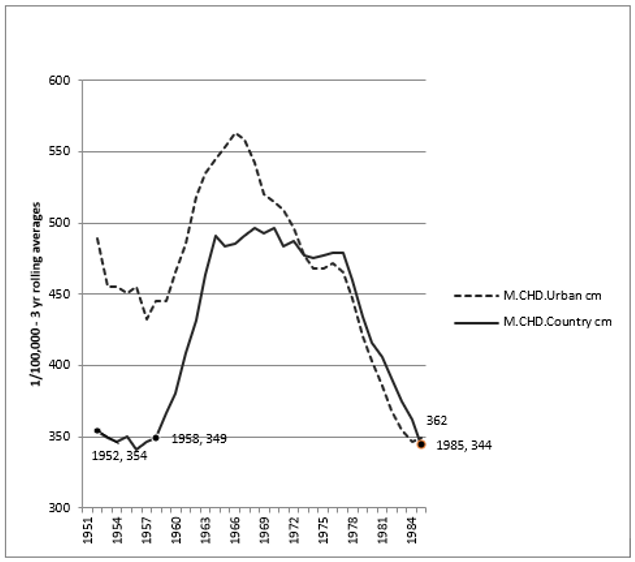
It seems plausible that the common CHD risk factors [7], cannot fully explain the low rural male CHD mortality [55] in 1951-57 (Fig.1), when people especially in the countryside consumed raw milk, with fat content 4.5-5 % [55], (before the era of statin medication).
Figure 1: Age adjusted male CHD mortality, 35-64yrs, in urban and rural Finland
I am grateful to Professor Osmo Hänninen and veterinary surgeon Seppo Haaranen for several discussions.

International Association of Landscape Archaeology, Czech Glass Society, Czech Republic

Department of Chemistry, Semenov Institute of Chemical Physics, USSR Academy of Sciences, Moscow, Russia

Department of Educational Sciences, Research Centre Qualities of Teachers, School of Education – HAN, Nijmegen, Netherlands

Associate Professor at Department of Breast and Thyorid Surgey, Chongqing General Hospital, China

Neurology, LA BioMed Research Institute, USA





 Abstract
 PDF
PDF



























