Background and objective: The safety of plant-derived bioactive compounds has become a global concern.
The present study investigated the acute toxicity of ethanol extract of Phyllanthus amarus (EEPA) leaves in
Wistar rats.
Methods: Adult male Wistar rats (n = 13) weighing 150 – 180 g (mean weight = 165 ± 15 g) were used for
this study. The ethanol extract of the plant leaves was obtained using cold maceration method. The method
described by Lorke was used to determine oral LD50 of the extract. Signs of toxicity and possible death of rats
were monitored for twenty-four (24) h.
Results: The major sign of toxicity observed within 24 h was general body weakness. No deaths were recorded
in both phases and all the animals survived. The oral LD50 of EEPA leaves was greater than 5000 mg/kg body
weight (bwt).
Conclusion: The results of this study indicate that ethanol extract of P. amarus leaves is not toxic at doses not
exceeding 5000 mg/kg bwt.
Plant-derived substances have gained huge attention in recent
times due to their many applications [1,2]. Medicinal plants are important
sources of therapeutically active compounds [3]. These plant
components exist as complex mixtures of many phytochemicals (alkaloids,
glycosides, terpenoids, phenols, flavonoids and lignans) [4-6].
Phytomedicinal studies support the identification and characterization
of bioactive compounds from natural sources [7,8]. Furthermore,
the safety of plant-derived bioactive compounds remains a global
concern [9-14]. Phyllanthus amarus is a herbaceous plant native to
tropical regions of the world. It grows to a height of 30 - 60 cm with
elliptic leaves. The plant is used to treat conditions such as jaundice,
urogenital problems, diarrhoea, dyspepsia, arthritis, ulcers, genitourinary
tract infections, hemorrhoids, gonorrhea, neurological debility,
epilepsy, dropsy, hepatic and urolitic diseases, as well as Hepatitis
B and C viruses [15]. Phyllanthus amarus has been demonstrated to
possess a wide range of therapeutic and pharmacological properties.
Its antiviral, antitumor, anti-inflammatory, hepatoprotective, diuretic
and antioxidant effects have been established [16]. The present study
investigated the acute toxicity of EEPA leaves in Wistar rats.
Fresh leaves of Phyllanthus amarus were collected from a forest
area at Isiohor, Benin City, and identified at the Department of Plant
Biology and Biotechnology, University of Benin, Benin City, Nigeria.
Plant Preparation and Extraction
The leaves were washed, and air-dried at room temperature for
one month at the Department of Biochemistry, Faculty of Life Sciences, University of Benin, Benin City, Nigeria. They were subsequently
ground into powder using a mechanical blender. Exactly 500 g of the
pulverized sample was cold macerated in absolute ethanol (5 L) for
72 h in a bell jar and filtered using a muslin cloth. The resultant ethanol
extract was thereafter concentrated using rotary evaporator and
freeze-dried with a lyophilizer [17-21].
Experimental Rats
Adult male Wistar rats (n = 13) weighing 150 – 180 g (mean
weight = 165 ± 15 g) were obtained from the Department of Anatomy,
University of Benin, Benin City, Nigeria. The rats were housed in metal
cages under standard laboratory conditions: temperature of 25 oC; 55
– 65 % humidity and 12-h light/12-h dark cycle. They were allowed
free access to rat feed (pelletized growers mash) and clean drinking
water. The rats were acclimatized to the laboratory environment for
one week prior to commencement of the study.
Acute Toxicity Test
Acute toxicity test was carried out on the extract using Lorke’s
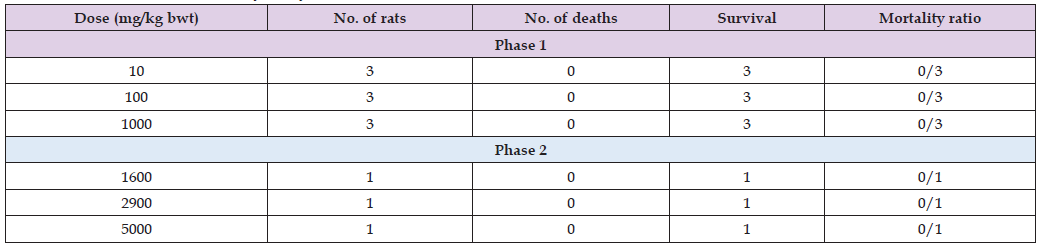
method [22]. In the first phase, nine (9) rats were divided into three
groups of three (3) rats each. Each group of rats was administered
EEPA leaves at doses of 10, 100 and 1000 mg/kg bwt. The rats were
placed under observation for 24 h to monitor their behaviour and
mortality. In the second phase, 4 rats were randomly assigned to four
groups of 1 rat each. The rats were administered higher doses of the
extract (1600, 2900 and 5000 mg/kg bwt) orally, and then, observed
for 24 h for signs of behaviour and mortality.
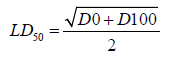
The lethal dose (LD50) of EEPA leaves was calculated thus:
where D0 = Highest dose that gave no mortality; D100 = Lowest
dose that produced mortality.
Statistical Analysis
Data are expressed as mean ± SEM, and statistical analysis was
performed using GraphPad Prism Demo (6.07).
There have been growing interests in the toxicity of substances
isolated from plants. This study investigated the acute toxicity of
EEPA leaves in Wistar rats. The results showed that no death was recorded
in both phases after 24 h and all the rats in each group survived.
Thus, the median lethal dose (LD50 oral) of EEPA leaves was
greater than 5000 mg/kg bwt. These results suggest that the ethanol
extract of Phyllanthus amarus leaves may be relatively safe [23]. One
major and overriding criterion in the selection of herbal preparations
for use in medical practice is safety. Phytochemicals present in plant
extracts should not only be clinically effective, but safe for consumption.
Therefore, screening of bioactive components present in plant
extracts to identify their toxic potential is necessary for selection of
plants for drug formulations [25-52].
The authors wish to appreciate staff of the laboratory unit of the
Department of Biochemistry, Faculty of Life Sciences, University of
Benin, Benin City, Nigeria, for their technical assistance.
Remington, J P (2005) Remington: The Science and Practice of Pharmacy, 21st Edition, Lippincott Williams & Wilkins, pp. 773-774.
Handa S S, Khanuja S P S, Longo G, Rakesh D D (2008) Extraction technologies for medicinal and aromatic plants. International Centre for Science and High Technology, Trieste. Italy, p. 21-25.
Hostettmann K, Marston A (1995) Saponins. Cambridge: Cambridge University press, pp. 3.
Abu O D, Onoagbe I O, Ojo I (2021) Determination of effective dose for ethanol extract of Dialium guineense stem bark. Journal of Medical Research and Case Reports 3(2): 1- 4.
Abu O D, Onoagbe I O, Ojo I (2021) Graded and quantal dose response of total tannins isolated from the stem bark of Dialium guineense. Advanced Research Journal of Medicine and Clinical Science 08(10): 699-703
Zubair M F, Atolani O, 1Ibrahim S O, Adebisi O O, Hamid A A, et al. (2017) Chemical Constituents and Antimicrobial Properties of Phyllanthus amarus. Bayero Journal of Pure and Applied Sciences 10(1): 238- 246.
Adomi P O, Owhe Ureghe U B, Asagba S O (2017) Evaluation of the toxicity of Phyllanthus amarus in Wistar albino rats. African Journal of Cellular Pathology 8: 27-35.
Abu O D, Imafidon K E, Obayuwana H O, Okuofu E D (2017) Phytochemical, proximate, and metal content analysis of citrullus lanatus (watermelon) seeds. FUDMA Journal of Sciences 2(2): 153-156.
Abu O D, Avenbuan S E, Osarhenomase E G (2023) Renal Oxidative Status in Diabetic Wistar Rats Administered Ethanol Extract of Cucumis sativus Whole Fruit. Int. J. of Clinical Studies and Medical Case Reports 30(1): 1-4.
Abu O D, Imafidon K E, Iribhogbe M E (2015) Biochemical effect of aqueous leaf extract of Icacina trichanta Oliv. on urea, creatinine and kidney oxidative status in CCl4-induced Wistar rats. Nigerian Journal of Life Sciences 5(1): 85-89.
Abu O D, Iyare H E, Omoruyi I J (2022) Toxic Responses of the Blood of Rats Exposed to Aqueous Extract of Dialium guineense Stem Bark. FUDMA Journal of Science 7(2): 117-120.
Adeogun E F, Olude O M, Abu O D (2019) Phenolic and antioxidant evaluation of the aqueous and ethanol extracts of unripe Citrus reticulata peels. Ife Journal of Science 21(1): 187-194.
Abu O D, Onoagbe I O (2019) Biochemical effect of aqueous extract of Dialium Guineense stem bark on oxidative status of normal Wistar rats. International Journal of Clinical Biology and Biochemistry 1(2): 15-18.
 ISSN: 2574 -1241










 Abstract
 PDF
PDF



























