info@biomedres.us
+1 (502) 904-2126
One Westbrook Corporate Center, Suite 300, Westchester, IL 60154, USA
Site Map
 ISSN: 2574 -1241
ISSN: 2574 -1241
ISSN: 2574 -1241
Received: May 05, 2024; Published: June 11, 2024
*Corresponding author: Wangqing Chen, The Department of Dermatology, Xiangya Hospital, Central South University, Changsha 410008,
Hunan, China and National Clinical Research Center for Geriatric Disorders, Xiangya Hospital, Changsha 410008, Hunan, China and Hunan
Key Laboratory of Skin Cancer and Psoriasis, Xiangya Hospital, Changsha 410008, Hunan, China and Hunan Engineering Research Center of
Skin Health and Disease, Xiangya Hospital, Changsha 410008, Hunan, China
Wu Zhu, The Department of Dermatology, Xiangya Hospital, Central South University, Changsha 410008, Hunan, China and National Clinical
Research Center for Geriatric Disorders, Xiangya Hospital, Changsha 410008, Hunan, China and Hunan Key Laboratory of Skin Cancer and
Psoriasis, Xiangya Hospital, Changsha 410008, Hunan, China and Hunan Engineering Research Center of Skin Health and Disease, Xiangya
Hospital, Changsha 410008, Hunan, China
DOI: 10.26717/BJSTR.2024.57.008934
Objective: To explore the potential anti-inflammatory role of dihydromyricetin (DMY) in treating psoriasis.
Methods: The cells viability were assessed by CCK8 assay. The anti- inflammatory effects of DMY in HaCat,
RAW 264.7 cells, and bone marrow-derived macrophages (BMDMs) were investigated by quantitative PCR
(qPCR) or flow cytometry. Psoriatic inflammation model was established by topically applying imiquimod
on the back skin of BALB/c mice, followed by treatment with DMY ointment to observe its therapeutic effect.
The severity of skin injury is estimated through PASI scores, qPCR, and histopathological examination. The
expression of proliferating cell nuclear antigen (PCNA) and infiltration of macrophages and in mouse skin was
observed through immunohistochemistry. Research investigated the expression level of TLR4 in macrophage
evaluated with immunohistochemistry and Western Blot analyses.
Results: The findings demonstrated that the administration of DMY effectively suppressed inflammation in
HaCat cells and inhibited the polarization of M1 macrophages in RAW 264.7 cells and BMDMs. The study
observed a significant decrease in PASI scores, epidermal thickness, cytokine levels, PCNA positive cell count,
and macrophage infiltration following the administration of DMY in mice skin.
Furthermore, this research showed that DMY effectively downregulated the number of TLR4 co-localization
with F4/80+ macrophages in imiquimod-induced psoriasis mouse skin and reduced the protein expression
levels of TLR4 in BMDMs.
Conclusions: These findings indicated that DMY possesses inhibitory effects on inflammatory formation in
keratinocytes and macrophages, thereby ameliorating imiquimod-induced psoriasis-like symptoms in mice.
Keywords: Psoriasis; Dihydromyricetin; Keratinocytes; Macrophages; TLR4
The efficacy of various traditional Chinese remedies in the treatment of physiological disorders has been remarkably demonstrated. The conspicuous efficacy and high safety of natural medicines have contributed to their long-standing use. In recent years, researchers have shown significant interest in the extraction of active chemical components from herbal medicines used for the treatment of diseases, as well as elucidation their mechanisms of action [1,2]. The dihydromyricetin (DMY), a flavonoid primarily extracted from Rattan tea [3], exhibits a diverse range of medicinal properties. The application of DMY treatment has been extensively documented in various therapeutic fields, encompassing antioxidant, antimicrobial, antiviral, anti-tumor, anti-hypertensive as well as its potential in alleviating pathology associated with diabetes and skin damage [4-6]. However, the anti- inflammatory activities in chronic inflammatory skin disease of DMY remains unclarified. Psoriasis is an immune-mediated chronic inflammatory skin disease characterized by excessive epidermal proliferation, dermal blood vessel dilation and increased numbers of inflammatory cellular infiltrates [7,8]. The present study aims to investigate the effects DMY on psoriasis through in vitro and in vivo experiments, thereby providing a promising candidate therapeutic approach for the chronic inflammatory skin disease treatment.
Cell Culture and Isolation of Bone Marrow
The RAW 264.7 cells and the HaCat were cultured in Dulbecco’s Modified Eagle’s Medium (DMEM, Viva Cell, China) and Roswell Park Memorial Institute (RPMI) 1640 (Gibco, USA) respectively supplemented with 10 % fetal bovine serum under a constant-temperature and humidity conditions in an incubator at 37 °C and 5 % CO2. BALB/ c mice were anesthetized and euthanized to collect the tibias and femurs for medullary washes collection using PBS and then cultured in Iscove Modified Dulbecco Media (IMDM) (Peprotech, USA) solution containing 10% Fetal Bovine Serum (FBS), 1% MEM Non-Essential Amino Acids Solution (Gibco, USA), 1% sodium pyruvate (Gibco, USA), 1‰ 2-Mercaptoethanol (Gibco, USA) and 1% penicillin- streptomycin (BI, Israel). Cells were maintained in IMDM medium with 20 ng/ml mouse monocyte growth factor (M-CSF) (Peprotech, USA) for 6 days for cell differentiation at 37 °C and 5% CO2. The RAW 264.7 cells (5 × 10⁵ cells) or bone marrow-derived macrophages (BMDMs) (1 × 10⁶ cells) were treated with 100 ng/mL of lipopolysaccharide (LPS) for 24 h to induce the M1 inflammatory phenotype in macrophages, and the inflammatory state of macrophages was assessed in the presence or absence of DMY at a concentration of 50 μM (dissolved in DMSO).
Cell Counting Kit-8 (CCK8) Assay
The CCK8 assay utilized to assess cells viability. HaCat or BMDMs were seeded into 96-well plates at a density of 3000 cells per well and treated with varying concentrations of DMY for 24 h. Subsequently, CCK-8 reagent was added to each well and incubated at 37 ℃ for a period of 2 hours. The absorbance at a wavelength of 450 nm was then measured using a microplate reader.
Quantitative PCR (qPCR)
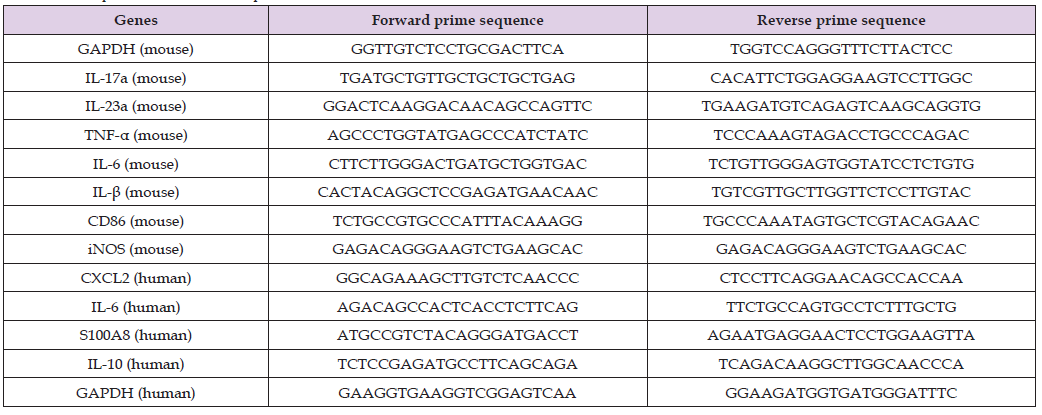
Total RNA extraction from Hacat, RAW 264.7 cells and BMDMs were performed with the MagZol reagent (Magen, China) and then RNA was reverse transcribed by HiScript Q RT Kit (Yeasen, China) according to the manufacturer’s instructions. qPCR reactions were performed to quantify the amount of specific cDNA in each sample by SYBR Green (Bimake, USA). The sequences of primers are detailed in Table 1.
Table 1: The primers used in the qPCR.
Flow Cytometric Cell Staining
The BMDMs and RAW 264.7 cells were dissociated with EDTA- free trypsin and PBS respectively and harvested after centrifugation at 2000 rpm, 4 °C for 5 min. Subsequently, the BMDMs or RAW 264.7 cells were washed with 1 ml of PBS and subjected to centrifugation (2000 rpm at 4 °C for 5 minutes). Live/dead (Bio Legend, USA) and Fc block staining were performed. Afterward, the BMDMs were incubated with fluorescence antibodies (F4/80 and MHCII) (Bio Legend, USA) for all- night at 4 °C. Finally, flow Jo software was utilized to analyze the stained populations.
Preparation of DMY Ointment
To prepare DMY ointment, DMY (1%) was added into propene carbonate, followed by the addition of propylene glycol and vigorous vortexing to obtain a homogeneous solution. Subsequently, vaseline, liquid paraffin, and water-based lanolin were mixed together after being heated at 65℃ and stirred thoroughly to create the mixture. Finally, the prepared solution was gradually incorporated into to the mixture while constantly stirring until DMY ointment was obtained. The manufacturing process for the vehicle formulation is identical to that of DMY ointment, however, in this case, DMY is omitted.
IMQ-Induced Mouse Model of Psoriasis and DMY Ointment Treatment
A total of eighteen male BALB/c mice (6-8 weeks of age) obtained from Hunan SJA Laboratory Animal Co.Ltd were housed in groups of five per cage under standard laboratory conditions (at 25 ◦C, 12 h light/dark cycle) with ad libitum access to food and water. The mice were randomly assigned into three groups (n = 6) as follows: Control group (untreated normal group), IMQ+vehicle group (IMQ and vehicle only), IMQ+DMY group (IMQ and DMY ointment). After one week of acclimatization, the hair in the back was removed region using a shaver and depilatory cream, leaving an area measuring 2cm×3cm, two days prior to the experiment. All treatment groups were topically administered a daily dose of 62.5 mg of 5% imiquimod cream (Aldara; 3M Pharmaceuticals) on the shaved back for five consecutive days. The DMY ointment was applied once daily after 6-8 h after IMQ administration. The collection of skin samples was conducted from all mice 6 days post- treatment.
Scoring Severity of Skin Inflammation
The Psoriasis Area and Severity Index (PASI) was utilized for the evaluation of psoriasis-like skin inflammation in mice and recorded on each day of treatment. This index encompasses evaluations of erythema, scaling, and thickness of skin. Each symptom was graded four points (0 means no symptoms, 1means mild, 2 means moderate, 3 means severe, 4 means very severe) with total scores of twelve.
Haematoxylin and Eosin (H&E) Staining and Immunohistochemistry (IHC)
In the histopathological examination, the skin tissues from the back were fixed in 4% paraformaldehyde for 24 h at room temperature and subsequently embedded in paraffin. Following dewaxing and rehydration, the sections were stained with H&E and immunohistochemistry techniques. The thickness of the epidermis or dermis was quantified with Adobe Photoshop (2019). Primary antibodies including PCNA (CST, USA) and F4/80 (proteintech, China) were used according to the instructions provided with the IHC staining kit.
Measurement of Proliferating Cell Nuclear Antigen (PCNA) and F4/80+ Content
The skin samples were stained using immunohistochemical techniques (IHC) to determine the number of proliferating cell nuclear antigen (PCNA)+ cell and immune-reactive F4/80+ macrophage by counting positively stained cells on photomicrographs obtained from three random microscopic fields (20× magnification) under a microscope, followed by imaging with light microscopy.
Tyramide Signal Amplification (TSA) IHC
Multiplex immunohistochemical staining of paraffin-embedded skin tissues was performed. The antibodies were applied sequentially according to the IHC method and followed by horseradish peroxidase- conjugated secondary antibody incubation and tyramide signal amplification (TSA) (AiFang biological, China). Antibodies used included F4/80 (proteintech, China), TLR4 (AiFang biological, China). Nuclei were stained with DAPI.
Western Blotting (WB)
The BMDMs were pretreated with RIPA lysate (Beyotime, China) containing Phosphatase Inhibitor Cocktail (Bimake, USA) and Protease Inhibitor Cocktail (Bimake, USA) for western blot analysis. The BCA protein concentration assay kit (Cwbio, China) was used to measure protein concentration. Equal amounts of protein were separated by Future PAGE™ (ACE, China) and transferred to a PVDF membrane. The membranes were blocked with 5% nonfat milk at room temperature for 1 h. Subsequently, the membranes were incubated overnight at 4°C with primary antibodies including mouse anti-TLR4 Ab (CST, USA), mouse anti-GAPDH Ab (Proteintech, China). Following three washes with Tris- Buffered Saline and Tween (TBST) for 5 minutes each time, the membranes were incubated with secondary antibodies for 1 h before visualization using a chemiluminescent solution.
Statistic Analysis
The data were analyzed by GraphPad Prism (Version 9.0.0.). Difference among three groups were compared using a one-way ANOVA test. The level of statistical significance was set at p < 0.05 with “*” indicating p < 0.05, “**” indicating p < 0.01, “***” indicating p < 0.001, “****” indicating p < 0.0001. “ns” means p < 0.05.
Effects of DMY on Cells Viability
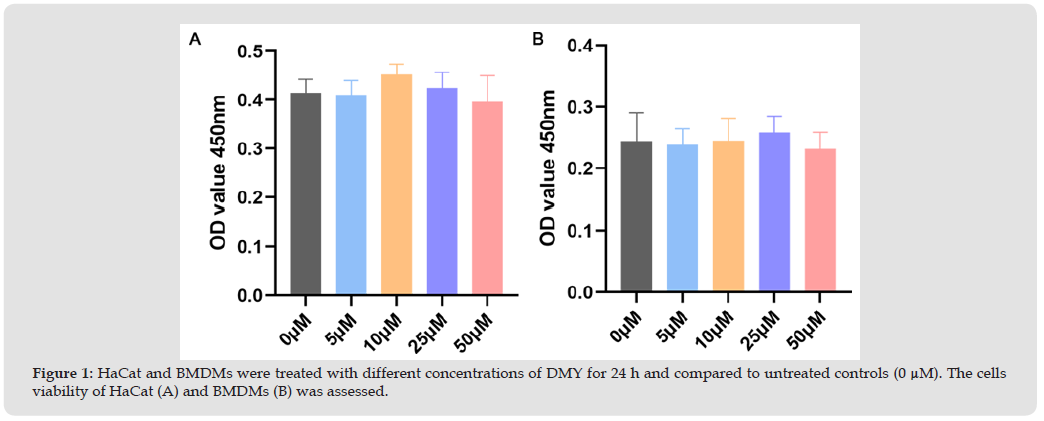
Firstly, we determined the concentration of RAW 264.7 cells (50 μM) according to previous investigation [9,10]. Next, we explored the concentration of HaCat and bone marrow-derived macrophages (BMDMs). HaCat or BMDMs were implanted in 96-well cell plates and then incubated with different concentrations of DMY (0 μM, 5 μM, 10 μM, 25 μM, 50 μM) lasting 24h. As shown in the Figures 1A & 1B, DMY had no effect on cell viability in HaCat and BMDMs, indicating that DMY was not toxic to HaCat and BMDMs at concentration 50 μM. We chose the dose of 50 μM for this study.
Figure 1
The Anti-Inflammatory Activity of DMY in HaCat
We also created a keratinocyte psoriasis-like cell model induced by M5(IL-17A; IL-22; TNF-a; IL-1α; Oncostatin M) cytokines. The levels of IL-6, CXCL2, and S100A8 were significantly increased under the stimulation of M5, which were subsequently downregulated by DMY treatment. Conversely, the level of IL-10 was significantly reduced following M5 application but increased after DMY administration (Figure 2).
Figure 2

DMY Inhibited Macrophage M1 Activation in RAW 264.7 Cells
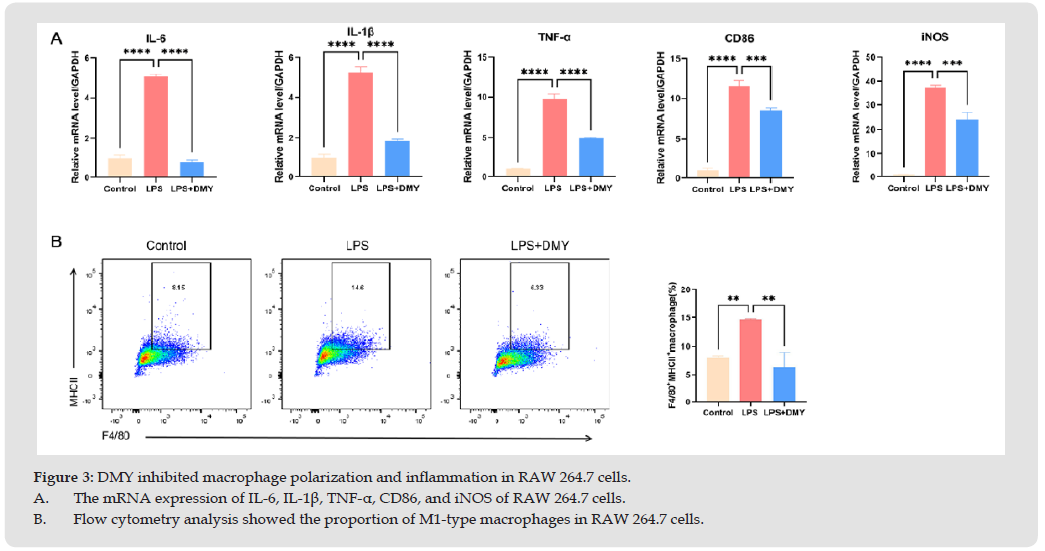
The polarization of M1 macrophages was induced by LPS, then the mediator (IL-6, IL-1β, TNF-α, CD86, and iNOS) levels of M1 macrophage polarization were examined in RAW 264.7 cells [11,12]. Following treatment with DMY, we observed a reduction in mRNA expression of markers associated with M1 macrophages in RAW 264.7 cells (Figure 3A). Additionally, F4/80+MHCII+ is a commonly used biomarker for M1 macrophage. Flow cytometry analysis revealed a significant decrease in the percentage of F4/80+MHCII+ macrophages following DMY treatment in RAW 264.7 cells (Figure 3B).
Figure 3
DMY Inhibited Macrophage M1 Activation in BMDMs
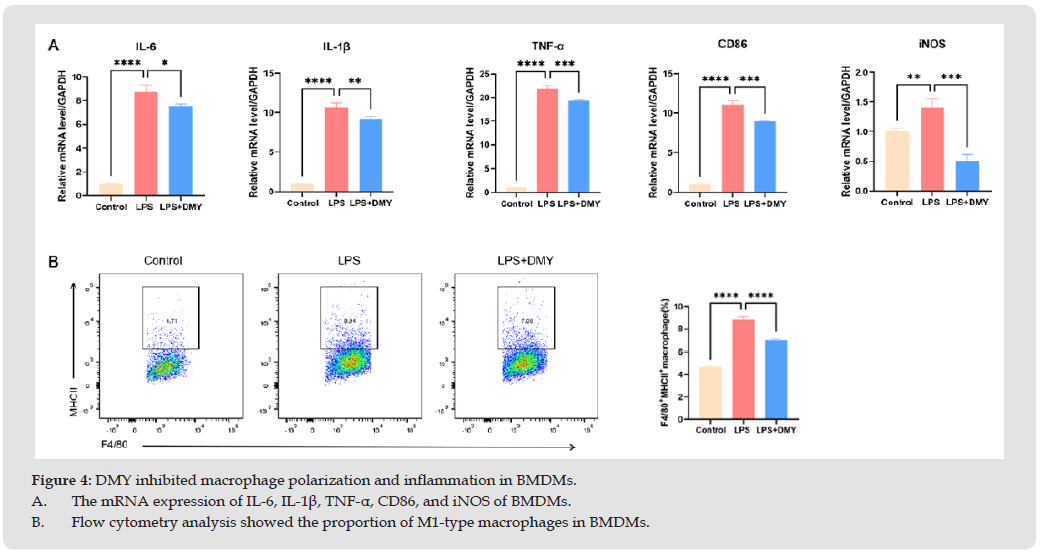
Next, we observed that DMY treatment attenuated the polarization of M1 macrophage in BMDMs. The mRNA expression levels of IL- 6, IL- 1β, TNF-α, CD86, and iNOS were significantly reduced after DMY treatment in LPS induced macrophages (Figure 4A). Flow cytometry analysis showed that DMY elicited a comparable reduction in the proportion of F4/80+MHCII+ macrophages in BMDMs (Figure 4B). Collectively, these findings indicate that the DMY inhibits M1 macrophage polarization in both RAW 264.7 cells and BMDMs.
Figure 4
Effect of Topical Administration of DMY on Body Weight in Mice
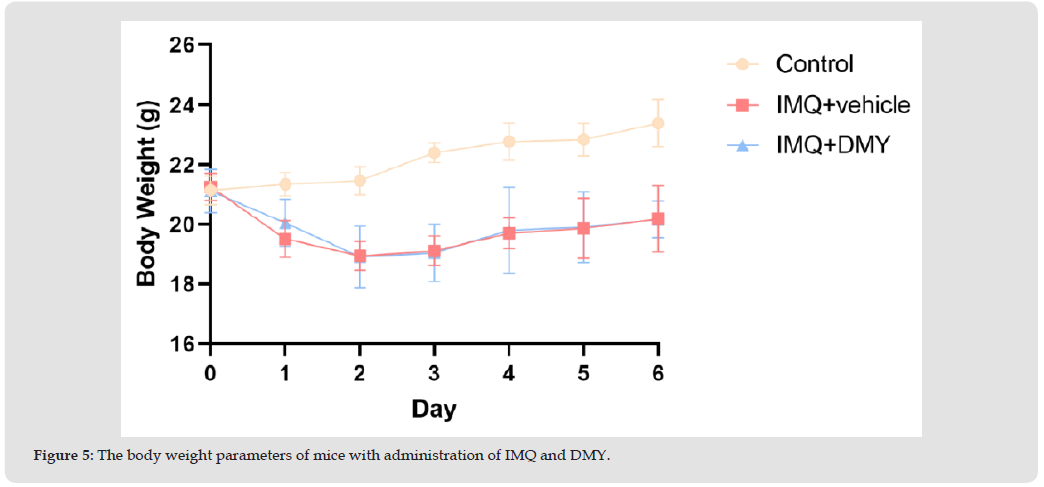
To investigate the therapeutical effect of DMY on psoriasis, we induced a murine model of psoriasis. The stimulation of IMQ resulted in the development of psoriasis-like dermatitis, then DMY ointment was administered topically. The effects of IMQ and DMY on the body weight of mice were initially examined. The results demonstrated a significant decrease in body weight among mice in the IMQ + vehicle group compared to the control group. Additionally, the body weight of mice in the IMQ + vehicle group and IMQ+DMY group exhibited an initial decline followed by an increase (Figure 5), indicating that the mice were tolerant to DMY.
Figure 5
DMY Ointment Alleviates Symptoms in IMQ-Induced Mice Model
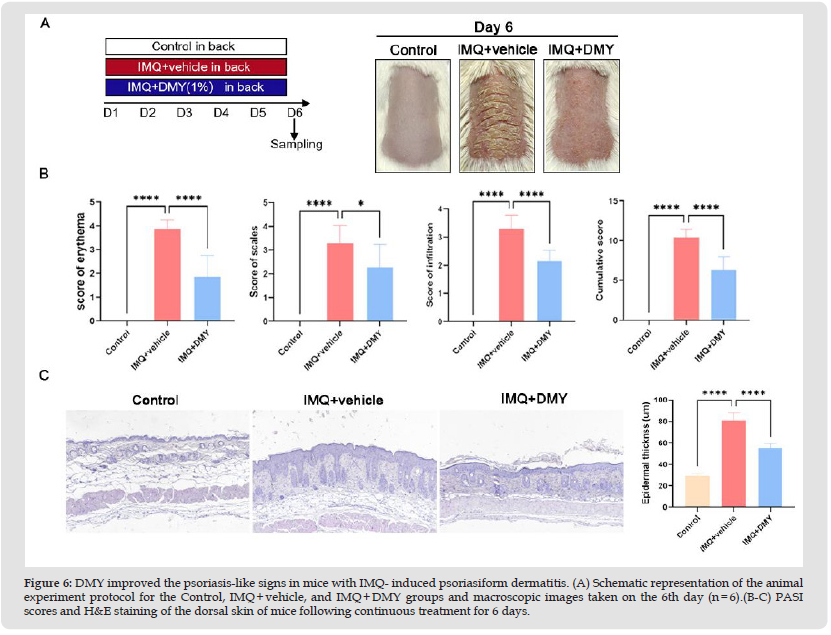
The severity of skin lesions in mice was further evaluated by the daily Psoriasis Area and Severity Index (PASI) scores criterion. On day 6, we observed clear erythema, scales, an increase in skin thickness, as well as higher cumulative PASI scores in the IMQ + vehicle group compared to the control group (Figures 5A & 5B). However, analysis of erythema, scales, skin thickness and cumulative PASI scores revealed that mice treated with topical DMY ointment had significantly lower scores than those in the IMQ + vehicle group (Figures 6A & 6B). The histopathological evaluations of skin specimens obtained from mice treated with IMQ showed acanthosis and moderate cellular infiltration in the dermis. Microscopic examination confirmed the clinical efficacy of topical DMY, as it effectively suppressed major pathological findings such as keratinocyte hyperproliferation, hyperkeratosis, and inflammatory cell infiltration in the IMQ + DMY group (Figure 6C).
Figure 6
DMY Reduced Inflammatory Cytokine Levels in the Skin
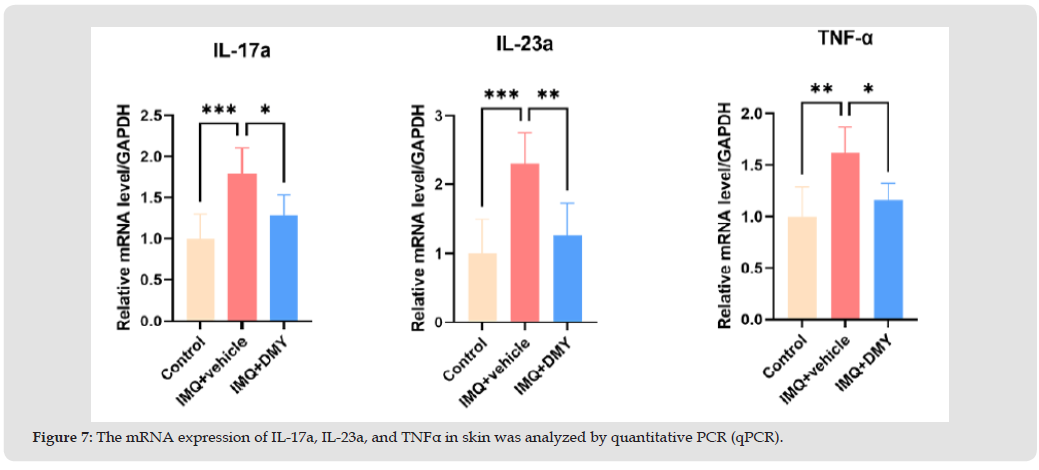
The evidence suggests that inflammatory cytokines, such as tumor necrosis factor-α (TNF-α), interleukin (IL)-17, and interleukin (IL)-23 play a crucial role in the pathophysiology of psoriasis [13,14]. We observed the mRNA expressions of IL-17a, IL-23a, and TNF-α significantly decreased in skin tissues of IMQ+DMY group, compared with the IMQ + vehicle group (Figure 7). DMY effectively reduced skin inflammation.
Figure 7
The DMY Treatment Attenuated Epidermal Hyperplasia and Reduced the Abundance of Macrophages
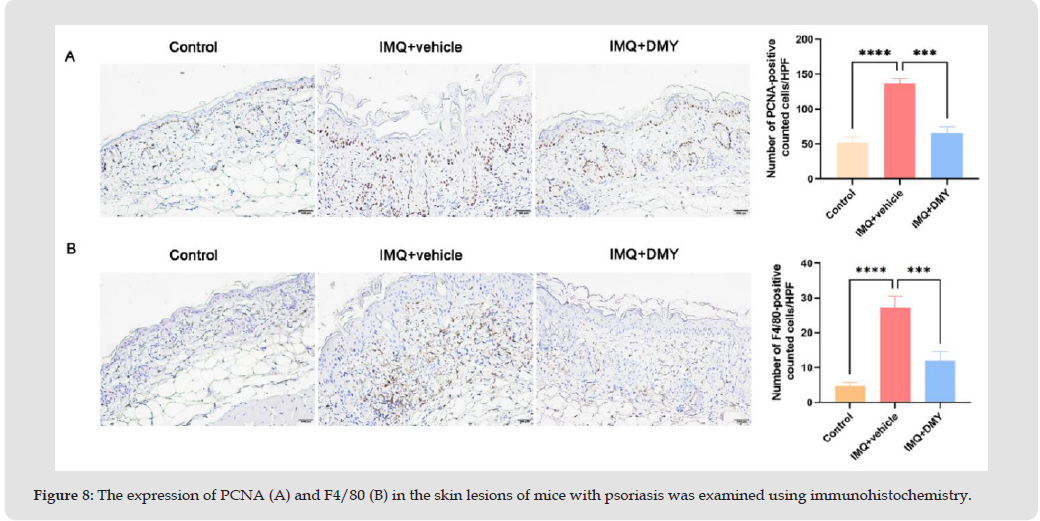
The expression of proliferating cell nuclear antigen (PCNA), an indicator of cell proliferation, is usually observed in the basal layer of the epidermis with lower levels in normal skin. Our study revealed that IMQ treatment significantly increased the number of PCNA -positive cells in psoriatic lesions on mouse epidermis, while topical application of DMY effectively reduced PCNA levels on the trunk skin of IMQ-induced BALB/c mice (Figure 8A). These findings suggest that DMY administration leads to remission of IMQ-induced psoriasis. To assess the impact of DMY on infiltrating macrophages, we examined the levels of F4/80+ macrophages in IMQ-induced mice. We observed a significant increase in F4/80+ macrophage levels in the dermal skin following exposure to IMQ compared to the control group. However, treatment with DMY significantly suppressed the population of F4/80+ macrophages in the skin from IMQ-treated mice when compared to vehicle treatment (Figure 8B).
Figure 8
DMY Decreased the Expression of TLR4 In Vitro and Vivo
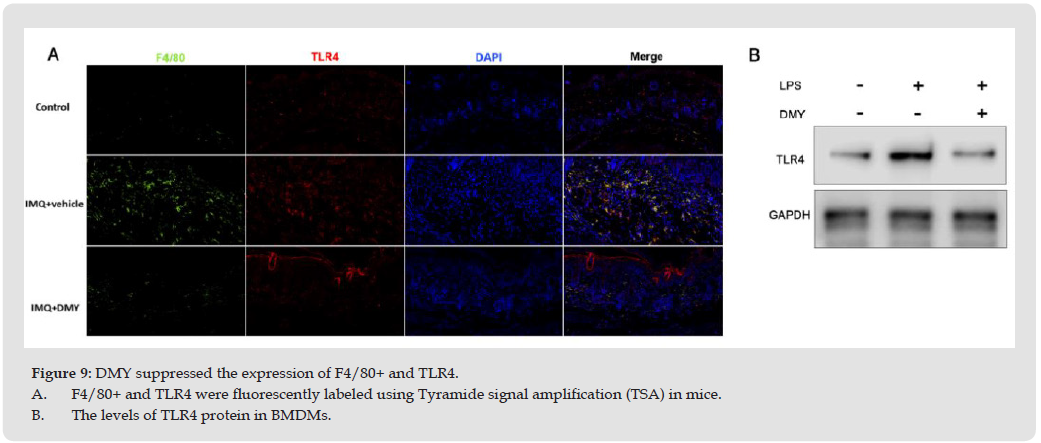
The Toll-like receptors (TLRs) play a pivotal role as essential pattern recognition receptors for immune cells. Immunofluorescence analysis revealed that TLR4 co-localization with F4/80+ macrophages in IMQ- induced psoriasis mouse skin, and a higher degree of co-expression between F4/80 and TLR4 was observed in the psoriasis mouse skin. However, after DMY application, a significant reduction in the co- expression of F4/80 and TLR4 was observed (Figure 9A). The LPS is capable of binding to TLR4, leading to pro-inflammatory response. In this study, we stimulated primary macrophages with LPS and investigated the impact of DMY on TLR4 signaling in these cells. Our findings revealed that LPS significantly upregulated the expression levels of TLR4 protein, whereas treatment with DMY resulted in a significant reduction in TLR4 protein levels compared to the LPS group (Figure 9B).
Figure 9
Traditional Chinese herbal medicine has obtained extensive attention in recent years in the treatment of all kinds of disease because of its safety. Our team has dedicated efforts to investigate alternative therapies for inflammatory skin diseases. A growing body of evidence supports the DMY, primarily extracted from vine tea, as an effective active pharmaceutical ingredient, has a potential anti-inflammatory property. The present study first reveals the remarkable therapeutic efficacy of DMY in the treatment of psoriasis, an inflammatory dermatological disorder. This is supported by experimental evidence in vitro and in vivo. The interaction between keratinocytes and innate immune cells contributes to histopathological manifestations of psoriasis [15,16]. The role of keratinocytes as key contributors to the development of psoriasis is well-established. In response to inflammation, keratinocytes actively produce a diverse range of cytokines, antimicrobial peptides, and chemokines that trigger and amplify the inflammatory response in psoriasis [17,18]. Our results demonstrated that DMY resisted M5- induced alterations in the expression of IL- 6, IL-10, CXCL2, and S100A8 in HaCat.
The macrophages possess high plasticity and can be polarized into the pro-inflammatory M1-type or anti-inflammatory M2-type phenotypes. The study has revealed a significant increase in the ratio of ratio of pro-inflammatory M1-type macrophages among individuals with psoriasis [19]. To investigate the impact of DMY on macrophage polarization regulation, we assessed the expression of IL-6, IL-1β, TNF-α, CD86, and iNOS in RAW 264.7 cells and BMDMs. Our findings suggest that DMY exhibits significant potential in modulating macrophage polarization. Furthermore, treatment with DMY resulted in a notable reduction in the percentage of F4/80+MHCII+ M1 macrophages induced by LPS stimulation in RAW 264.7 cells and BMDMs. These results suggest that DMY may possess the potential for exerting anti- psoriatic effects in vitro.
In addition, the imiquimod (IMQ)-induced psoriasis-like inflammation serves as the most extensively utilized preclinical animal model of psoriasis, effectively inducing scaly lesions that closely resemble plaque-type psoriasis both histopathologically and immunologically. We observed whether DMY effectively alleviated psoriasiform inflammation in mice with IMQ-induced psoriasis. We found that DMY obviously alleviated PASI scores and epidermal hyperplasia in mice psoriatic lesions. Activated plasmacytoid DCs and macrophages can produce IL-23, which subsequently leads to further differentiation and proliferation of Th17 cells in the pathogenesis of psoriasis. Consequently, Th17 cells secrete IL-17, IL-22, and TNF-α to promote skin inflammation [20]. Additionally, IL-17a upregulates the proliferation of keratinocytes and the expression of chemokines by keratinocytes [21]. These findings indicate that TNF-α, IL-23, IL-17 likely play a crucial role in the development of psoriatic lesions since antibodies against TNF-α, IL-23, IL-17a demonstrate remarkable clinical effects in treating psoriasis. The improvement of skin inflammation by DMY has been indicated with the decline in levels of pro-inflammatory cytokines TNF-α, IL-23, and IL-17a level in our study.
The abnormal proliferation of keratinocytes in the epidermis serves as a significant indicator for psoriasis. The PCNA protein, functioning as a crucial factor for interacting with DNA polymerase δ in eukaryotic cells, serves as a pivotal proliferation index and plays an indispensable role in DNA replication [22,23]. Our study revealed that DMY effectively reduced PCNA expression in skin lesions of psoriatic mice and decreased epidermal thickness. As what mentioned before, emerging evidence has indicated a significant increase in the presence of macrophages in patients with psoriasis and IMQ-induced skin lesions in mice with psoriasis-like symptoms. Our study demonstrated that treatment with DMY alleviated this process, while the mice treated with the vehicle showed greater infiltration of dermal macrophages. Toll-like receptor are membrane-bound pattern recognition receptors that recognize molecular patterns associated with exogenous pathogens or those associated with endogenous damage. The activation of TLR4 could induced the nuclear translocation of the transcription factor NF-κB,further triggering an inflammatory state and participating in expression of proinflammatory cytokines IL-1, IL-6, IL-1β, and TNF-α [24].
TLR4 can regulate macrophage inflammation and mediate the M1 polarization [25,26]. The blockade of TLR4 signaling alleviates the production of inflammatory factors in macrophages [27,28], thereby inhibiting the progression of psoriasis. In this study, DMY showed to reduce the TLR4 inflammatory signaling pathway in macrophages, exerting an anti- psoriatic effect. In summary, this study revealed that the herb-derived active ingredient DMY exhibits a relieving effect on psoriasis mice, exerting an anti-inflammatory function. Future research should focus on observing evaluating its clinical safety and effectiveness to promote its potential for clinical application. Additionally, further investigation is warranted to elucidate the underlying mechanisms for future applications.
All authors declare no conflict of interest.
Rao Li and Xingchen Zhou: conceived and designed the research and performed the experiments; Manyun Mao: data acquisition and interpretation; Rao Li and Wangqing Chen: manuscript writing; Wangqing Chen and Wu Zhu: manuscript revision/review. All authors approved the final version.
This work was supported by the National Natural Science Foundation of China (Grant No.82173426), Natural Science Foundation of Hunan Province (Grant No. 2023JJ30984).

International Association of Landscape Archaeology, Czech Glass Society, Czech Republic

Department of Chemistry, Semenov Institute of Chemical Physics, USSR Academy of Sciences, Moscow, Russia

Department of Educational Sciences, Research Centre Qualities of Teachers, School of Education – HAN, Nijmegen, Netherlands

Associate Professor at Department of Breast and Thyorid Surgey, Chongqing General Hospital, China

Neurology, LA BioMed Research Institute, USA





 Abstract
 PDF
PDF



























