info@biomedres.us
+1 (502) 904-2126
One Westbrook Corporate Center, Suite 300, Westchester, IL 60154, USA
Site Map
 ISSN: 2574 -1241
ISSN: 2574 -1241
ISSN: 2574 -1241
Received: March 10, 2024; Published: May 23, 2024
*Corresponding author: Li Jun Li, Department of Cardiology, The Seventh Affiliated Hospital, Southern Medical University, Desheng Road
section 28, Foshan 528200, China
Zhang Hong Zhe, Department of Cardiology, The Seventh Affiliated Hospital, Southern Medical University, Desheng Road section 28, Foshan
528200, China
DOI: 10.26717/BJSTR.2024.56.008899
At previous studies on the correlation of between polycyclic aromatic hydrocarbon receptor (AhR) gene
polymorphism rs2066853 and CAD. So our purpose of this study was to the relationship between polycyclic
AhR gene polymorphism rs2066853 and ACS susceptibility.
Methods: A total of 939 Chinese patients with CAD diagnosed by coronary angiography including 266 patients
with ACS. Analysis of AhR gene polymorphism rs2066853 for the research subjects.
Results: The distribution of the AhR genotypes were 414 (44.1%), 422 (45.0%) and 102 (10.9%) for GG, AG
and AA, respectively. According to genotypes were increased significantly in ACS patients compared with the
stable angina groups (P<0.05). The combined (AG+AA) genotype allele (OR: 1.51, 95%CI: 1.12-2.02, p<0.001)
and hypertension (OR:1.43, 95% CI:1.07-1.91, p<0.05) were significant predictors of ACS in CAD patients.
Conclusion: AhR rs2066853 variant gene A may be related to the pathogenesis of ACS.
Keywords: Aromatic Hydrocarbon Receptor; Acute Coronary Syndrome; Relationship; Clinical Research
Abbreviations: ACS: Acute Coronary Syndrome; STEMI: ST-Segment Elevation Myocardial Infarction; NSTEMI: Non-ST-Segment Elevation Myocardial Infarction; UA: Unstable Angina; CVD: Cardiovascular Disease; AhR: Aryl Hydrocarbon Receptor; XMEs: Xenobiotic Metabolizing Enzymes; SNPs: Single Nucleotide Polymorphisms; SA: Stable Angina
Acute coronary syndrome (ACS) is the leading cause of morbidity and mortality globally. Acute coronary syndrome (ACS) ranges from ST-segment elevation myocardial infarction (STEMI), non-ST-segment elevation myocardial infarction (NSTEMI) and unstable angina (UA). Many studies have demonstrated that polycyclic aromatic hydrocarbons (PHAs), which are major constituents of cigarette tobacco tar, are strongly involved in the pathogenesis of the cardiovascular disease (CVD) [1]. Knowing that PAH-induced toxicities are mediated by the activation of a cytosolic receptor, aryl hydrocarbon receptor (AhR), which regulates the expression of a group of xenobiotic metabolizing enzymes (XMEs), suggests a direct link between AhR-regulated XMEs and CVD [2,3]. More recently, the functions of AhR expression levels and functional AhR polymorphisms appear to affect the susceptibility and progression of CVD, which increases our understanding of the mechanism by which dioxin pollution and cigarette smoke trigger CVD [4]. In the past, it is well established that these results provide a AhR and polymorphisms is new potential factor in the targeted treatment of CVD.
However, little is known about the role of AhR in ACS. So, investigation of the potential correlation between AhR polymorphisms and ACS susceptibility would hence provide a valuable insight into the role of AhR in ACS. The AhR belongs to the family of basic-helix-loop-helix transcription factors [5]. It is known that polymorphisms of the AhR gene have negative effects on the affinity and sensitivity of the AhR proteins and activation of the AhR signaling pathway. Among the previous reports on single nucleotide polymorphisms (SNPs) of the AhR gene, rs2066853 has attracted considerable attention for its association with the risk [6]. However, no association between AhR polymorphisms and ACS has yet been determined. Therefore, based on a cohort study of 938 incident CVD cases, we identified AhR as a novel ACS susceptibility gene.
Study Population
Informed written consent was obtained from all CAD and the study protocol was approved by the Institutional Ethics Committee of the Affiliated hospital of Guangdong Medical College. All experimental methods applied in this study were carried out according to approved guidelines. A total of 939 patients with CAD were recruited from the Affiliated Hospital of Guangdong Medical College (Zhanjiang, China) between May 2011 and August 2013. The clinical diagnosis of CAD was performed as follows: existing myocardial infarction, treated by percutaneous coronary intervention or coronary artery bypass graft, more than 50% stenosis in at least one of the main coronary arteries demonstrated angiographically, together with physiological examination including increased hs-TnI, MYO, CK and CK-MB. According to the degree of severity and clinical pathological characteristics, the CAD group was divided into too subgroups: ACS and stable angina (SA), based on the American College of Cardiology/American Heart Association Task Force on Practice Guidelines [7,8]. Those with acute or chronic infections, systemic inflammatory diseases, autoimmune diseases, blood diseases, severe liver or renal function defects, malignant tumors, heart failure, arrhythmia, cardiomyopathies, and hematologic disorders were excluded from the study.
Genotyping
Human genomic DNA was isolated from peripheral blood using the TIAN amp Blood DNA Kit (Tiangen Biotech, Beijing, China), according to the manufacturer’s instruction. Direct sequencing was used for genotyping analysis. A total of 10 ng of genomic DNA from each subject was used as a template to PCR-amplify DNA fragments of 150–250 bp containing AhR rs2066853 using the following primers: forward, 59-GATTGATTTTGAAGACCTCA-39 and reverse, 59-CTGAAGGTA TGAAGGGAG-39. After purification and precipitation by polyethylene glycol electrophoresis, the DNA fragment underwent direct sequencing on an ABI 3130XL DNA sequence detector with the Big DyeH Terminator v3.1 Kit (Applied Biosystems, Foster City, CA, USA). The result was documented and analyzed by the Gene Mapper 4.0 system (Applied Biosystems).
Statistical Analysis
All data were shown as means ±standard errors or percentage frequencies. Statistical analyses were performed using SPSS (ver. 12.0, IBM, New York, NY, USA) software. Allele frequencies of AhR were calculated based on subject genotypes, and differences in allele and genotype distributions between ACS and SA groups were analyzed by binary logistic regression or the chi-squared test. Multiple comparison corrections were performed with a one-way ANOVA using Bonferroni correction. Two-tailed P values, odds ratios, and 95% confidence intervals are presented for all association tests. A value of P< 0.05 was considered statistically significant.
Patients
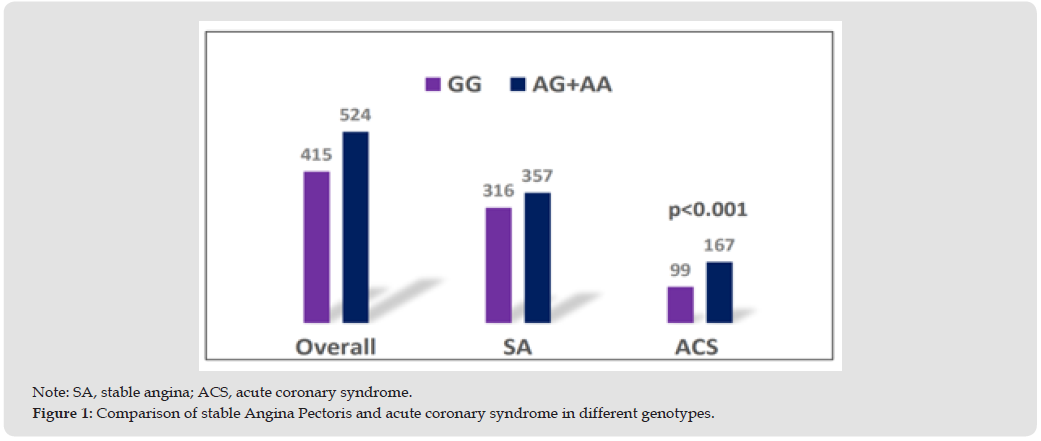
A total of 938 CAD patients, which contained 672 stable angina and 266 ACS. Baseline characteristics were well match across the AhR phenotype are summarized in Table 1. The distribution of the AhR genotypes were 414 (44.1%), 422 (45.0%) and 102 (10.9%) for GG, AG and AA, respectively. Thus, 524 (55.9%) patients were combined (AG+AA) genotype. According to genotypes were increased significantly in ACS patients compared with the SA groups P<0.05, Figure 1. These results suggested that AhR polymorphisms were related to ACS pathogenesis.
Table 1: Clinical, laboratory, and procedural characteristics of the study population.
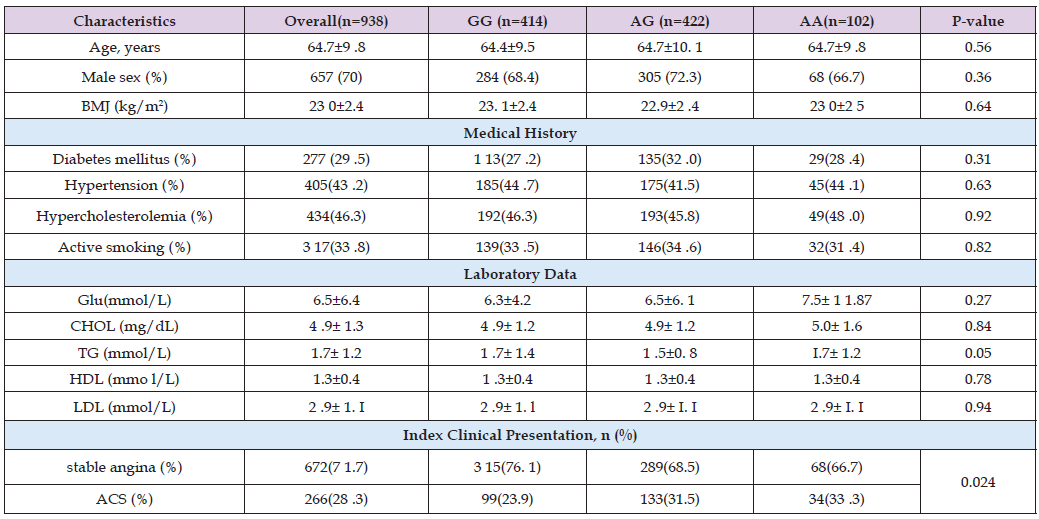
Note: Continuous data are shown as mean ±S D. Dichotomous data are shown as n (%). BMI, body mass index; Glu, glucose; CHOL, cholesterol; TG, triglyceride; HDL, Hight density lipoprotein; LDL, low density lipoprotein. ACS, acute coronary syndrome.
Figure 1
Logistic Regression Analysis for Prediction of ACS
To determine predictors of ACS, a univariate regression analysis was performed to evaluate. The impact of sex, hypertension, smoking, diabetes mellitus, hype-rcholesterolemia and AhR phenotype (Table 2). We found that the ACS risk associated with the variant genotype of AhR, and hypertension increased significantly. The combined (AG+AA) genotype allele (OR: 1.51, 95%CI: 1.12-2.02, p<0.001) and hypertension (OR:1.43, 95% CI:1.07-1.91, p<0.05) were significant predictors of ACS.
Table 2: Logistic regression analysis of independent risk factors of ACS.
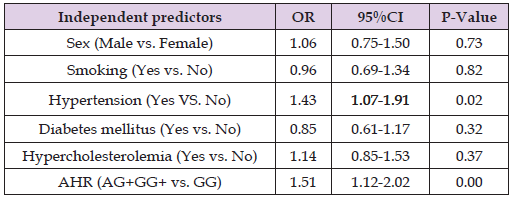
Note: The combined (AG+AA) genotype allele: OR: 1.51. 95% CI: 1 .12-2.02. p<0.001. hypertension: OR:1.43, 95% Cl:1.07-1.91, p<0.05.
This study is the first to compare the data AhR phenotype for ACS status in coronary artery disease patients. Recently, the incidence of cardiovascular disease has been on the rise in the environmentally exposed population. As a critical transducer for contaminant dioxin, a mass of evidence has indicated AhR plays a role in the pathogenesis of CAD 3.4. [9-11]. A recent study showed that AhR contributed to plaque vulnerability and promoted atherosclerosis by inducing vascular inflammation [11]. Based on this hospital case research, we investigated the associations between AhR genotype and the risk of ACS. Activating the AhR signaling pathway induces vascular inflammation and promotes atherosclerosis, thereby increasing the occurrence and development of CAD [12]. AhR is bound up with various pathogenic factors of ACS, despite it is not clear whether AhR directly led to the development of ACS, there has been no previous research on the role of AhR variants in the risk of ACS. In this study, we surveyed the relationship between AhR rs2066853 and ACS susceptibility. Our current research shows significant correlation the relationship between AhR phenotype and the risk of ACS in the Chinese population. The rs2066853 G >A missense mutation site is in the exon 10 of AhR, which also causes the arginine in the transcription activation domain of AhR protein to become lysine [13].
Therefore, the hereditary stability of AhR rs2066853 has a strong influence on the structure and function of the protein encoded. So, it explains the individual susceptibility of certain diseases [14-17]. Former research about rs2066853 that mainly focused on cancer, but their verdicts were quite contradictory and disputable. Huang [3] et al, showed that the AhR expression level and functional AhR polymorphism have a potential impact on the susceptibility and development of Chinese CAD. According to our study, it was found that the significantly increased risk of ACS is related to the A allele of rs2066853. When further studying the combined (AG + AA) genotype of rs2066853, the proportion of (AG + AA) genotypes in patients with ACS was significantly higher than that of (GG) phenotype (Figure 1). All the subjects in this study were patients who had been diagnosed with CAD by coronary angiography. Logistic regression analysis of independent risk factors of ACS (Table 2) showed that hypertension and AHR (AG + AA) were significantly different (P <0.05). Smoking, hypertension, diabetes, and low-density lipoprotein, hypercholesterolemia are all risk factors for CAD, ACS is a subtype of CAD, so considering smoking, cholesterol, low density lipoprotein, hypertension, and diabetes can increase the incidence of ACS [6.7]. Since our study subjects are all diagnosed patients with coronary artery disease, these risk factors for ACS do not show significant differences, except for hypertension. Significant differences in the occurrence of hypertension are considered to be significantly related to poor blood pressure control in patients with CAD who have hypertension.
In conclusion, we provide evidence that the functional polymorphisms of the AhR gene may affect the susceptibility and clinical progress of ACS in the Chinese population, which opens new horizons for the etiology of ACS and may be beneficial for future ACS treatment. However, a larger sample of research may be needed to confirm these findings and further explore its mechanism of action.
The study was supported by a grant from the National Natural Science Foundation of China (no. 81760046), Supported by Guizhou Provincial Natural Science Foundation (QKH [2018]2758,QKH[2020]1Z058).

International Association of Landscape Archaeology, Czech Glass Society, Czech Republic

Department of Chemistry, Semenov Institute of Chemical Physics, USSR Academy of Sciences, Moscow, Russia

Department of Educational Sciences, Research Centre Qualities of Teachers, School of Education – HAN, Nijmegen, Netherlands

Associate Professor at Department of Breast and Thyorid Surgey, Chongqing General Hospital, China

Neurology, LA BioMed Research Institute, USA





 Abstract
 PDF
PDF



























