info@biomedres.us
+1 (502) 904-2126
One Westbrook Corporate Center, Suite 300, Westchester, IL 60154, USA
Site Map
 ISSN: 2574 -1241
ISSN: 2574 -1241
ISSN: 2574 -1241
Received: May 09, 2024; Published: May 20, 2024
*Corresponding author: D Starokadomsky, Chuiko Institute of Surface Chemistry, National Academy of Sciences of Ukraine (NASU), Kyiv, Ukraine, M.P. Semenenko Institute of Geochemistry, Mineralogy and Ore Formation, NASU, Kyiv Junior Academy of Sciences (KMAN), Ukrain, Science-Natural Lyceum N145, Kyiv, Ukraine,National Museum of Natural History NASU, Kyiv, Ukraine
DOI: 10.26717/BJSTR.2024.56.008886
The relevance of the work is considered obvious in connection with the high price of imported epoxy resin and the availability of local cheap and recyclable vegetable oils. This direction is actively being developed by scientists of Ukraine and countries producing or supplying vegetable oils. The purpose of this work is to perform a study of the complex properties of epoxy-oil compositions in a wide range of their concentrations. In the course of the work, it was planned to determine the optimal percentage of the studied sunflower oil that can be contained in epoxy compositions, without harming the physical, mechanical and chemical properties of epoxy resins. The study made it possible to find out the difference between refined and unrefined oil and the difference in their effects. In this work, 7 samples of epoxy composites with refined and unrefined sunflower oil and 1 unfilled sample were tested for comparison according to the following properties: microhardness, resistance to mechanical compression, adhesion to metals during tearing and shearing, resistance of samples to aggressive chemical environments, such as peroxide hydrogen, acetone, nitric acid. The author’s scheme-model of the epoxy oil composition with refined and unrefined oils, is presented.
It was assumed that even in the case of a certain deterioration of a number of properties, the profitability and prospects of epoxy oil compositions will be high due to the increase in biocompatibility and the decrease in the price of epoxy polymer composites. As a result of our research, we were able to obtain data on our samples that confirm the possibility of mixing epoxy resin with sunflower oil, without a particular loss of physical, mechanical and chemical properties. In almost all cases (except for highly filled samples - with 20 and 33 wt% refined), composite materials of various degrees of porosity were formed, with acceptable indicators of strength, heat resistance and resistance to aggressive liquids. A number of samples showed the ability to increase strength after severe heat treatment (275 oC) or after treatment with aggressive acidic and oxidizing liquids (concentrated H2O2 and HNO3). It has been experimentally shown that diluting with oils can even slightly increase the fire resistance of composites.
Epoxy filling has been very relevant for 60 years, and the number of profilate scientific collectives and its publications in the world is regularly growing. But it is not only filling that can adjust the properties of polyepoxides. For example, the resin can be diluted with a solvent or other liquids. This can make the final product cheaper if the diluent is cheap or available. In Ukraine, such a diluent may well be vegetable oils, namely sunflower oils, since they are produced and exported. The price of a liter of new oil is almost 10 times lower than the price of epoxy resin or hardener, and if you take used oil (for example, from food establishments that are obliged to dispose of it) or rancid oil (which is available in any warehouse in a large city) - then we can be paid extra for this according state or municipal utilization programs. So, if you prove that the properties of such diluted plastics will not be significantly worse than undiluted epoxy polymers, it will already be a success. Scientists in the world are constantly working with epoxy-oil systems [1-6]. Epoxy polymers with the addition of vegetable oils make it possible to obtain cheaper polymer materials and to dispose of used vegetable oils. They also make it possible to obtain plasticized and otherwise modified composites, which is why they are of constant scientific interest [1-6].
For the experiment, we take Epoxy520 epoxy resin (Czech production) and PEPA hardener (Czech production). Such a resin is also sold in stores, but it is obviously already diluted, because the resins from store kits (such as “EDP Glue” and “Tiger”) are much less viscous than the one I used in the laboratory. Oil samples were collected in a syringe, from where it was quantitatively dosed into the resin and there it was subjected to intensive manual mixing. We mixed the resin with oil in different proportions to understand the maximum amount of vegetable oil (TM Golden Bouquet) that could be added without losing the properties of the epoxy resin. So, in total, we got 8 types of samples- 0% (unfilled sample), 5%,10%, 20% and 33.5% of rafined (R) or un (non-)refined (NR) sunflower oil. For each sample, 10 g of epoxy resin, 1.5 g of hardener, and 0.57, 1.15, 2.8, 5.75 g of oil were used, for 5, 10, 20, and 33.5%, respectively. That will allow me to monitor the gradual increase in the effect of the diluent (which is oil) on the resin composition.
First, the oil was mixed with epoxy resin in all the necessary proportions, later, after adding a hardener, the resulting mixture was poured into the following forms: cylinders with an area of 5 cm2, which were glued together with an epoxy mixture, cubes with a side of 1 cm, flat hexagons, cylinders with with a surface area of 0.42 cm2 and a height of 1.2 to 1.5 cm, glued, using a mixture, of steel and fiberglass plates with an area of 2 cm2, .The following were used for the experiments: electronic electronic caliper, scales, LuisShopper measuring press, ID-1 tearing machine, UMM press. A microhardness test was conducted by indentation of an ultra-hard needle. Adhesion at separation was measured on the glued with epoxy mixture, using the UMM machine (Figure 1). Carrying out measurements on the UMM machine). Shore microhardness was determined using a type D durometer used for hard plastics. Microscopy was performed on a ULAB optical laboratory microscope.
Figure 1

Visual Appearance and Consistency of Compositions and Composites
The introduction of oil into epoxies should lead to the formation of an emulsion, and at the level of polymerization processes, oil can have a significant effect. To evaluate the effect of oils on the composition, we choose a series of 5, 10, 20 and 33.5 wt% oils (Figure 2) (Table 1). In all cases, only highly concentrated ones with refined-oil are not completely hardened in their entirety. And the same 20P (20 wt% - a very heavy ball of oil in epoxy) and especially 33P (33.5 wt% - samples was hardened in ½ of form volume), where the oil was touched and rose above the hardened polymer. Also, such a quantity of oil no longer produces a homogeneous emulsion with epoxy resin; it disintegrates either immediately or during the curing process. However, the unrefined oil does not allow disintegration at 33 wt% - on the surface of the hardened sample there is no meniscus with the oil, and only single drops and pores with inclusions of the oil. Note that mixtures with machine oil (automotive synthetic oil) produce oil-like ointments that do not harden after mixing with amine hardener.
Figure 2

Table 1: Visual characteristics of compositions (15+-5 оС)..

Microscopy of Composition and Modeling of Possible Interactions
All unhardened mixtures were analyzed under a microscope. Can see that the introduction of unrefined oil causes the appearance of a few more streaks and (singing) droplets of oil. However, in general, the offensive type of oil will give approximately a new influx, changing the homogeneity of the system. The fragments provide visual information based on the dispersion of the oil into resins (either cloudy, dissolved in hardened composites, etc.), it is possible to create song modeling. Figure 3 can notice approximately a change in the structure of polyepoxide after dilution with olive oil. Pure epoxy resin produces a polymer that contains beads and water vapor (which is a product of the hardening reaction). In addition, there are still microcracks, fragments of epoxy resin (according to the literature [2,6-9]) and shrinkage, which can lead to their curing (under optimal curing conditions, there are few of them). The introduction of refined oil let the emerging oils of different sizes turn on, as well as a meniscus with pure (not included in polymer) oil, which will appear on the upper surface of sample (Figure 3). Such structure of the composite must will be weaker than pure epoxypolymer, and it may reduce all basic indicators (strength, durability, homogeneity). The fragments of unrefined oil have integrated entirely into the structure of the composite, so, here can reproduce the other scheme (Figure 3, left). Here there will also be inclusions of oil (both pure and mixed with water and air), but they will be only in the structure of the composite itself, and there will be no “salting” of pure oil on sample surface (Figure 3, right). Also, with such a scheme, you can experience a slight decrease in all basic indicators due to a higher percentage of dilution with oils of both types (especially refined).
Figure 3

Adhesion
Apriority, adhesion to steel is theoretically likely to decrease after dilution, since the oleic inclusions are likely to weaken interfacial contact. The weakening must be greater the greater the percentage of dilution, so that in large quantities (20-35 wt%) the oil may act as an anti-adhesive. To be sure, we also know that a significant amount of the oil is emulsified into the surrounding fraction during the process of hardening the composition (Figures 1 & 3). However, the experiment revealed another, - stronger (more than predicted) influx of plant species. Dilution with olive oil gives a somewhat weaker effect, but not such a great one, and not for all percentages of dilution. As can be seen from Table 2, at a very high (maximal possible) concentration of 33.5 wt% of unrefined oil, the solution is more likely to be a pure polymer, and some parameters may increase!What is most noteworthy is the fact that there is an even significant increase in adhesion. Olive particles can grow no less than 1.5-2, but even more (as can be seen from the displays of 10НР, 20Р, 33НР and 33Р). It is possible that the oil will quickly integrate into the adhesive, which is more springy
Table 2: Indicators of adhesive strength of epoxy-oil composites.

And if you keep such a sample for several years, its value can increase even more.But the most interesting was the fact of a very significant increase in tearing adhesion (Table 2). Oil samples can increase it not only by 1.5-2 and more (this can be seen from the indicators of samples 10НР, 20Р, 33НР and 33Р). So far, it is difficult to find a scientific explanation for this, and for future, it is important to find him. Perhaps the oil is somehow embedded in the adhesive film, making it, for example, more elastic. Compressive strength. This is one of the main characteristics of polymers. Its change show - how strong is destructive effect of oil inclusions in the epoxy-oil composite. For research, unheated samples and samples after 270 oC were taken. Tests of 3-6 samples from one series were performed, after which the average value was entered into the table. Before the tests, the samples were subjected to normal processing (necessary for complete hardening) It can be seen (Table 3) that with normal heat treatment, the unfilled sample gives a value close to 700 kgf/cm2. All oil samples, indeed, give much lower indicators – (400-450), and (!) the concentration and quality of the oil does not really affect it. This can be explained by the influence of oil inclusions, as it was already described in the scheme of Figure 3.
Table 3: The strength of elastic resistance F to compression (kgf/ cm2) of samples. The index shows the strength of the final complete destruction (after the loss of elasticity and the beginning of plastic deformation). * - estimated

Figure 4
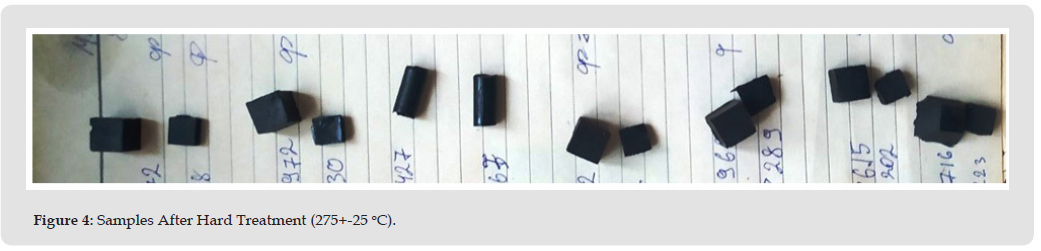
It is important that we do not have a collapse in strength, but only a decrease in ≈1,5 times. After hard heating, all the samples are carbonized (Figure 4). But unfilled sample keeps the compression strength F at the original untreated level (Table 3). Oil samples change F in different ways. For 5P (5 wt% of refined), the indicator increases even to the level of unfilled (without warming it was much lower, ... kgf/cm2). Also, the 20P sample (with 20 wt% refined oil) shows a significant increase after special heating, while the 20HP practically does not change the indicator. Such interesting effects can be called “thermostrengthening” of epoxy plastics. Regarding it, there are publications on epoxy-iron , epoxy-carbide and epoxy-gypsum compositions [7-9]. But epoxy-oil composites theoretically do not have solid microparticles, heat-resistant inclusions and other that can give such strengthening. This strange fact can be explained by the fact that weak and fast-burning inclusions disappear at 275 oC, and the polymer network has not yet destroyed, and therefore we have amplification. Obviously, this can only happen at certain optimal dilution concentrations. Indeed, at 33%, and especially at 10% dilution with both oils, heating leads to a decrease in strength.
It is interesting that after standing in a strong HNO3 solution, the influence of oils becomes positive at all taken concentrations. An unfilled sample after such exposure loses its strength more than one and a half times (from 670 to 430 kgf/cm2), as well as 20 HP and some others. However, some oil samples sometimes increased it or slightly lost it. Thus, 5P reduced F from 670 to 610 kgf, and 33HP increased it by 1.5 times(from 420 to 610 kgf). Thus, there are optimal concentrations of oil, at which we have a significant increase in resistance to a strongly acidic oxidizing environment.
Microhardness
Unfilled epoxy compositions without heating give a result of 70- 85 units (Table 4). This, for comparison, is equal to the strength of the plastic used in the manufacture of industrial protective helmets. According to my expectations, the oil should have significantly reduced this indicator due to its density, but to my surprise this did not happen. За the average value of the three measurements made for each composite, it can be observed that the oil, both refined and unrefined, gave results that are within these limits, this means that the oil has no effect on the microhardness of epoxy compositions in such proportions According Table 4, the oil has stronger effect on the microhardness of epoxy compositions, that increases to 10-15%.
Table 4: Microhardness of unheated composites.

1. This work is relevant in wide industrial sectors, due to the reduction in the price of the final solidified biocompatible material. This is confirmed by a number of modern publications in the scientific literature.
2. The compositions “epoxy resin - vegetable oil” can be obtained in a fairly wide range of concentrations, up to 35% by weight of oil. Further filling carries the risk of phase separation in the mixture, and this is more likely for refined than for unrefined. It was also noticed that at medium and high contents (20-33%) unrefined oil gives visually more solid composites (yellow in color), while refined oil forms an oil layer separated from the composition on surface of the samples. Optical microscopy shows that the introduction of oil leads to the appearance of large drops-inclusions of oil in the epoxy-oil emulsion.
3. Also, it was established that all oil-diluted samples (after normal treatment at 70-80°C) show a noticeable (in ≈1.5 times) decrease in compressive strength. This decrease depends little on the concentration and refinement of the tested oil. This can be explained by the softening effect of oil inclusions. However, after severe heat treatment (275 oC) unfilled loses his strength, but some oil samples (with 5-10% refined oil) can significantly increase compressive strength, or do not change it (with 20% unrefined). Even more clearly, this effect of strengthening after aggressive influences is manifested after exposure to a strong solution of nitric acid, where the unfilled sample loses its strength by 1.5 times, and some oil samples do not lose strength much (with 5% and 33% raf. and with 10% unrefined) or significantly increase it (from 33.5% unrefined). These effects may indicate an important stabilizing role of oil inclusions during extreme actions.
4. Based on all the obtained data, the author’s model scheme of the formation of the epoxy-oil mixture is presented, as well as the possible placement of inclusions and inhomogeneities in it. It partially explains the effects of the different action of refined and unrefined oil in the composition with epoxy resin.
5. The obtained results allow us to talk about the high prospects of creating such compositions to reduce the price of epoxy materials, improve their biocompatibility, resistance to aggressive influences, and increase some important strength indicators.
6. According the obtained data, the author’s model scheme of the formation of the epoxy-oil mixture (and possible placement of inclusions and inhomogeneities in it) is presented. It partially explains the effects of the different action of refined and unrefined oil in the composition with epoxy resin.
7. The obtained results allow us to talk about the high prospects of creating such biocompositions - for reduce the price of epoxy materials, improve their biocompatibility, resistance to aggressive influences, and increase some important strength indicators.

International Association of Landscape Archaeology, Czech Glass Society, Czech Republic

Department of Chemistry, Semenov Institute of Chemical Physics, USSR Academy of Sciences, Moscow, Russia

Associate Professor at Department of Breast and Thyorid Surgey, Chongqing General Hospital, China

Professor of Nuclear Medicine, Faculty of Medicine and Surgery, University of Milan, Milan, Italy

Department of Pharmaceutical Sciences, South University School of Pharmacy, USA





 Abstract
 PDF
PDF



























