info@biomedres.us
+1 (502) 904-2126
One Westbrook Corporate Center, Suite 300, Westchester, IL 60154, USA
Site Map
 ISSN: 2574 -1241
ISSN: 2574 -1241
ISSN: 2574 -1241
Received: April 10, 2024; Published: May 20, 2024
*Corresponding author: Philip Park, The University of Texas Rio Grande Valley, Edinburg, 1201 W University, TX 78539, 956- 882-6532 Texas, USA
DOI: 10.26717/BJSTR.2024.56.008885
Objective: Bioprosthetic valves using either porcine or bovine pericardium have been widely used for
transcatheter heart valve replacements. However, producing bioprosthetic valves is not a sustainable solution.
Acquiring animal tissue is often not readily available and costly and requires time-consuming modifications.
Moreover, its primary tissue failure requires reoperation after roughly 15 years. The suggested replacement of
porcine and bovine leaflets with biocompatible polymers appears to be an attractive alternative to bioprosthetic
valves. In this study, engineered fiber-reinforced polymers were developed, which are less degenerative and
offer greater hemocompatibility in relation to mechanical valves.
Methods: Polydimethylsiloxane (PDMS) polymer reduces calcification significantly and has been long proven
to be biocompatible. Although the naturally low tensile strength of PDMS is undesirable for prosthetic heart
valves, the structural fiber mesh reinforcement overcomes these mechanical shortcomings, making PDMS
leaflets viable for prosthetic heart valves. The fabrication process of the fiber reinforced PDMS leaflets was
suggested, and short-term in vitro tests under cyclic flow generated by a pulse duplicator were conducted.
Results: The proposed tricuspids heart valve made of the fiber reinforced PDMS leaflets were successfully
fabricated following the suggested process. The in vitro tests using a pulse duplicator show that the fiberreinforced
tricuspid valve is open and close properly under the pressure of blood flow and has sufficient
strength.
Conclusion: The proposed polymeric valve made of fiber reinforced PDMS leaflets and ABS stent is promising
in the context of finding a biocompatible, durable, and cost-efficient alternative to the current clinically
available valves.
Keywords: Aortic Valve; Polydimethylsiloxane (PDMS); Polymeric Heart Valve; Calcification; Endocarditis
Valvular heart disease is an illness caused by damage to human heart valves. A human heart has four valves: the aortic, mitral (bicuspid), tricuspid, and pulmonary valves. These valves facilitate the controlled flow of blood through the heart. Thus, damage to the valves, caused by calcification, endocarditis, rheumatic disease, and congenital heart valve disease, have devastating effects on health. To treat valvular heart disease, patients must undergo valve replacement surgery, where a prosthetic heart valve is used to replace the diseased heart valve. There are two main prosthetic heart valves used today: mechanical and bioprosthetic. Mechanical heart valves are mostly made of stainless steel or titanium with leaflets of pyrolytic carbon with graphite coating [1-5]. While very resilient, mechanical heart valve replacements create high amounts of shear stress upon the blood, causing excessive coagulation, which requires patients to undergo a lifetime of therapeutic anticoagulation to reduce thrombus formation and stroke [6-8]. Meanwhile, bioprosthetic heart valves are made of bovine and porcine pericardium sewn to frames. These alternatives maintain the shape of native heart valves and are largely hem compatible, significantly lowering the risk of thrombosis and the need for anticoagulants in patients. However, bioprosthetic valves deteriorate over time because of the body’s immunological response which causes calcific degeneration upon the valve. Eventually, the patient must undergo another replacement valve within 15 years, making bioprosthetic valves non-viable for younger patients [9].
Moreover, bioprosthetic valves cannot be mass-produced, and animal pericardium is not a readily available resource, making it challenging to produce bioprosthetic valves at its demanded rate. As both mechanical heart valves and bioprosthetic valves have significant drawbacks, alternative valve replacements have gained significant interest. The principal among them are polymeric valve prostheses, which are capable of combining the mechanical durability of mechanical heart valves and the hemocompatibility of bioprosthetic valves [10-12]. Yet, polymeric valves continue to present concerns which make only a select few viable. Particularly, thrombotic complications can be provoked by changes in the hemodynamics along the valve. Indeed, the rigidity in leaflet materials and certain valve designs create high shear stresses upon the blood, leading to hemolysis, platelet activation, and ultimately thrombosis. However, modern polymeric valves have developed a tricuspid design that minimizes shear stress and damage to red blood cells, reducing thrombosis [13-15]. The properties of the polymer itself have a significant effect on thrombus formation as well. Interactions between the blood and the polymer often led to the absorption of proteins upon the surface of the leaflets due to a variety of chemical properties of each polymer. A number of these proteins (Fibrin, clotting factors) in turn stimulate platelet activation and coagulation, which commonly lead to thrombosis [16-19]. Thus, it is important that the polymers chosen have desirable chemical properties to reduce the risk of thrombosis.
Calcification, additionally, may also induce failure in unsuitable polymeric heart valves, as calcium deposits restrict leaflet mobility and lead to regurgitation and valve failure [20-22]. Some rigorous long-term in vivo tests showed that the issues such as inflammation along the valve, polymers accelerating the mineralization process, and the accumulation of blood proteins and phospholipids can accelerate the calcification process and cause even earlier valve failure. Particularly, polyurethane (PU)-based valves and expanded polytetrafluoroethylene (ePTFE) valves demonstrated issues with calcification due to calcium deposits building up in the porous structure or in cracks in the polymer to reduce flexibility [20-22]. Another main factor for polymeric valve failure is the degradation of the polymeric leaflets due to both mechanical and physiological factors. Polymers used for heart valve leaflets must possess sufficient tensile strength, flexibility, and fatigue resistance, enough to survive constant pressures of up to 1 MPa experienced by the leaflets [23,24]. To withstand these pressures, native heart valves are capable of withstanding pressures of approximately 2 MPa, which is further supported by the regenerative ability of native valves [25,26]. However, replacement valves are thought to need a significantly larger tensile strength due to their inability to recover. For example, bioprosthetic valves have tensile strengths of over 10 MPa. As a result, a large number of polymers (polyetheretherketone, etc.) are immediately unsuitable by themselves due to their inferior elasticity and strength, despite their biocompatibility.
Of similar importance, the leaflets of polymeric valves must also have sufficient fatigue and creep resistances to withstand the cumulative effect of countless loading-unloading cycles and resist deformation. Then, polymers like polyethylene are less viable alone due to their weak intermolecular bonds causing deformation over time [25,27,28]. Additionally, the physiological processes of the human body can degrade the polymer due to interactions with water, ions, proteins, and lipids in the body. These different molecules in turn lead to changes in mechanical properties in the leaflets (plasticization among others), leading to eventual failure [25,29]. Particularly, hydrolysis and oxidation create biodegradation in many polymers [30, 31]. To satisfy these various requirements for polymeric heart valve replacements, in this paper, we present a novel approach fiber-reinforced polymeric heart valve replacement, which utilizes additional structure to provide greater support. Polydimethylsiloxane (PDMS) has been observed to reduce calcification in heart valves [32]. PDMS is a polymer with well-proven, high hemocompatibility, biostability, and good elasticity, which is used today in a variety of biomedical applications ranging from aneurysm grafts to coating implantable devices and is the most frequently utilized polymer in implantation devices. Due to these qualities, using PDMS in polymeric heart valves is expected to reduce thrombus formation and calcification on the polymer’s surface, highly desirable attributes for heart valves.
Despite its superior biocompatibility, PDMS is largely regarded as a suboptimal material for polymeric heart valve leaflets due to its unfavorable mechanical qualities for a heart valve. However, PDMS has a tensile strength between 2.2 and 6.7 MPa [33], which presents concerns regarding the valve’s ability to withstand the pressure of blood flow over extended periods of time. Additionally, although PDMS is considered to have relatively decent fatigue resistance, it presented significant structural degradation under long term testing in heart valve leaflets [33]. To overcome this problem, PDMS grafting on the surface of polyurethane leaflets was recently tested, where the increased hydrophobicity of the PDMS was seen mitigating the calcification process significantly. On the other hand, imperfections in the grafting process made the graft degrade over time, leading to the same concerns with physical degradation seen in normal polyurethane valves [34]. To circumvent issues concerning grafting, this study obtains inspiration from the optimal structure of the native heart valve. In native valve leaflets, there are three primary layers: the fibrosa, spongiosa, and ventricularis layer, as shown in Figure 1a. The outermost fibrosa layer is composed of collagen fibers, which provides structural strength to the leaflet under higher stress, taking the load off the weaker spongiosa and ventricularis [35-37]. Beneath it, the spongiosa layer consists of polysaccharide compounds so that it maintains flexibility and provides additional support under lower load.
Figure 1

The innermost ventricularis layer consists of endothelial cells and provides the valve with its hemodynamic properties, preventing clot formation and reducing shear stress. Figure 1b shows a perspective view of the aortic heart valve leaflets mimicking the natural fiber structure. Imitating the optimal design of native valves – fiber embedded flexible matrix – can eliminate the issues with grafting PDMS. This study investigates fiber reinforced PDMS leaflets as an alternative to grafting solutions. First, we describe the fabrication process of the fiber reinforced PDMS leaflets. Then, PDMS leaflets reinforced with various fiber meshes were fabricated, and their mechanical performances were tested in vitro.
Leaflet Design
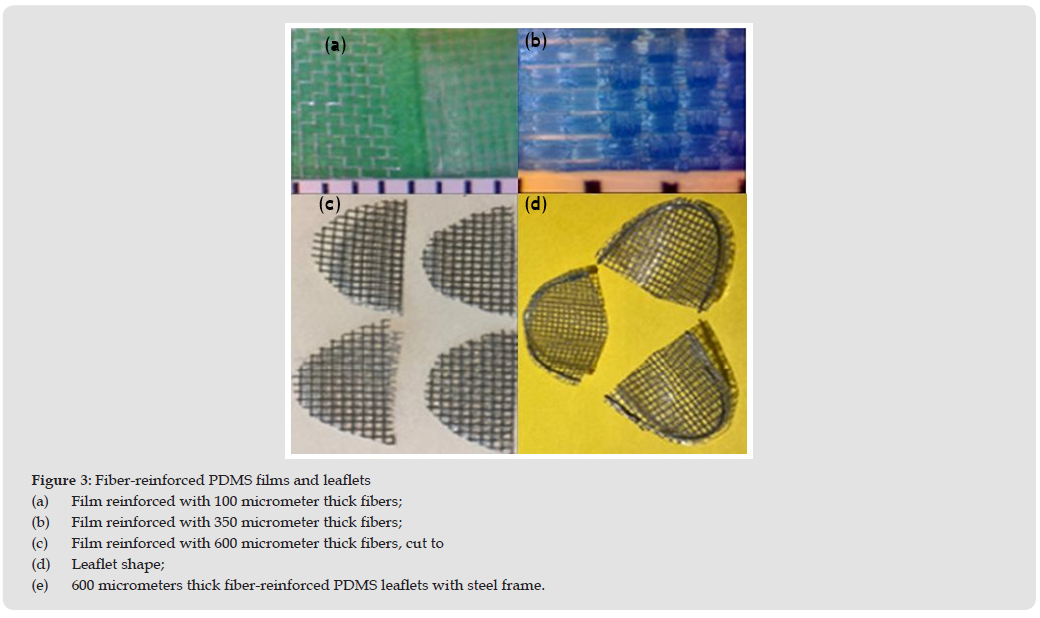
The given polymeric heart valve leaflets consist of three layers: the fiber mesh layer in between the PDMS matrix layers. The fiber mesh layer has an evenly spaced grid of nylon fiber of a specified thickness embedded within the PDMS matrix. The density of the grid is determined by the thickness of the fiber – thinner fibers have denser grids. In this study, fiber meshes of three different thicknesses were manufactured to demonstrate the customizability of the fiber mesh: 100, 350, and 600 micrometers. The heart valve proposed herein is imitating a triscupid valve, and the fiber reinforced polymeric leaflets are designed to have an elliptical semilunar shape. The semicircular edge of the leaflets were sewed onto the top part of the valve to create stability and easy attachment.
Forming the Fiber-Reinforced PDMS
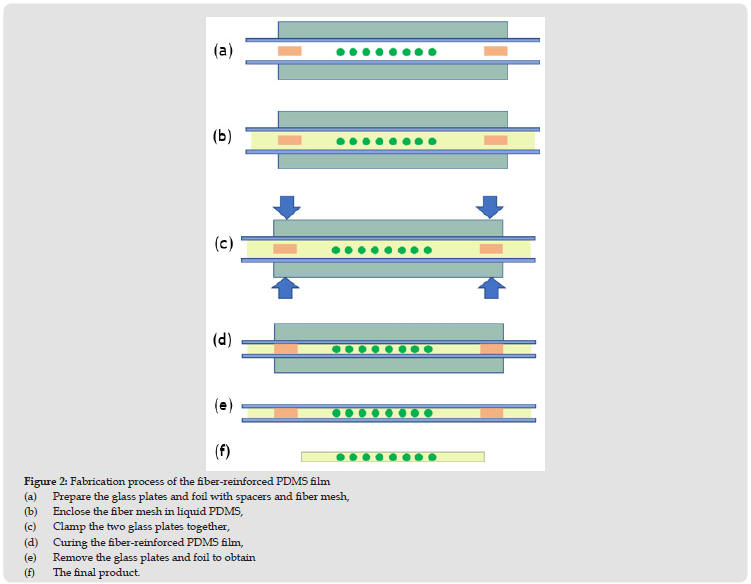
Figure 2 shows the fabrication process of the fiber reinforced polymeric leaflets. Two 4-inch by 4-inch glass plates and four spacers are prepared as mold for the leaflets. Both glass plates are covered with aluminum foil to make the removal process easier and ensure that both pieces of glass have no remaining debris. The thickness of the composite leaflet is controlled with four spacers that are placed between the two glass plates (Figure 2a).
To create the PDMS matrix, the Dow Corning Sylgard 184 silicone elastomer kit including both a silicone elastomer base and a curing agent is utilized. The ratio of the silicone base to curing agent is 10:1, and the elastomer is carefully mixed for 10 minutes. Before curing, the liquid PDMS is placed into an air vacuum to remove air pockets generated during mixing and to create uniform silicone leaflets. The prepared fiber mesh is put in a container, then a sufficient amount of the liquid PDMS is poured in the container to fully wet the fiber mesh. The wet fiber mesh is placed into the air vacuum to remove air pockets between fibers. The liquid PDMS is also poured on both glass plates to form the top and bottom matrix layers.
When the air pockets were removed, the PDMS covered fiber mesh is sandwiched between 2 glass plates as shown in Figure 2b. Then, the glass plates are clipped together (Figure 2c) so that the gap between the glass plates has the thickness of the spacer. The fiber reinforced PDMS in liquid phase is cured into a solid by heating at 135℃ for 30 minutes (Figure 2d). After the PDMS liquid has formed into a soft silicone, the fiber mesh film is left to cool to room temperature before prying away the foil and glass plate to create the elastomer (Figures 2e & 2f). In this final step of removing the glass plates and foils, caution should be taken to retain the elastomer’s form prior to manipulating the shape and structure. These leaflets are shown in Figures 3a & 3b, respectively.
Figure 2
Fabricating a Polymeric Valve
Using a size guide, the fiber reinforced PDMS film is cut into the shape of semicircles (Figure 3c). To make a frame for the leaflet, 8 inches of stainless-steel wire, with a diameter of 1.0 mm, is cut, straightened, and folded in a way in which the wire is parallel with itself, but one half is slightly longer than the other. The cut fiber mesh film is placed between the steel wire so that the folded portion is tightly hooked perpendicular to the arcuate edge of the semicircle. Then the wire is gently manipulated to follow the arcuate edge all the way around, leaving. 1.0 mm of space between the wire and the arcuate edge on both sides of the fiber mesh film (Figure 3d). Then a 2- inch piece of thin stainless-steel wire (0.3 mm diameter) is utilized to stitch the steel wire frame to the silicone leaflet. Similar to the thicker steel wire frame, the 0.3 mm wire is folded to where one half is a centimeter longer than the other. Then, following the guide of the thicker steel wire, the 0.3 mm thin wire is punctured through the fiber mesh film ensuring that the 2 different halves of the wire are on opposite sides of the thick wire frame. Once the 0.3 mm wire has been pulled secured, the two thin wires are twisted using pliers. The twists should be tight and about 2.0 mm long, any excess is then cut. Continue this cycle of stitching with the 0.3 mm wire 4 more times for a total of 5 stitches evenly dispersed throughout the arcuate edge of the silicone leaflet. As a final step, the thicker 1.0 mm wire, acting as the frame of the leaflet, is cut to line up with the end of the flat edge perpendicular to the arcuate edge, and the slightly longer half on the parallel side of the silicone leaflet is bent using pliers to enclose the frame-like structure.
Figure 3
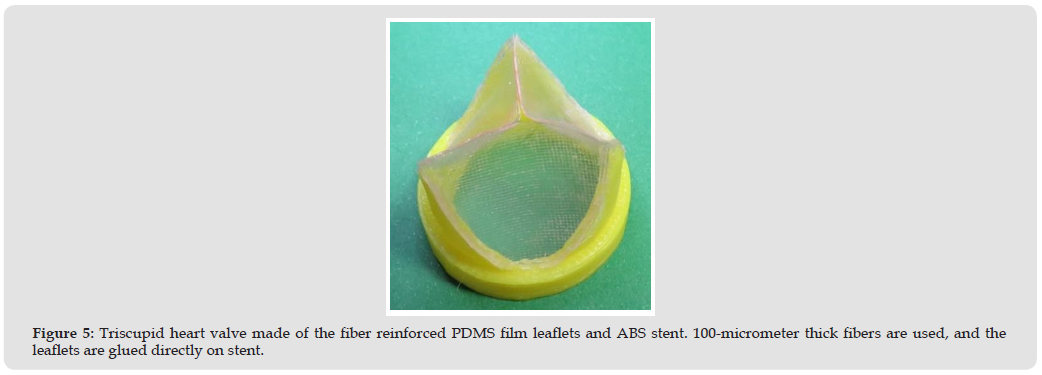
This process is repeated to create a total of three uniform leaflets all with the same wire structure, and finally the three leaflets are arranged in a form resembling a native heart valve, stitched to secure proper commissure points, placed on a short stent, and glued onto the arcuate edge of the leaflets, beginning slightly below each commissure point (Figure 4). Alternatively, the fiber reinforced PDMS leaflets may also forgo the use of stainless wire for stability altogether and, instead, use a slightly taller stent. In this configuration, after the artificial leaflets with PDMS and fiber mesh are created, the leaflets’ arcuate edge is immediately glued to the altered stent to simplify the manufacturing process (Figure 5). The commissure points are formed at the corners of each leaflet as in the other manufacturing process; however, the leaflets will be glued together instead of sewn together with wire. Additionally, the leaflets may also be sewn to the stent instead. The stent is made of acrylonitrile butadiene styrene (ABS) and fabricated using a 3-D printer.
Figure 4
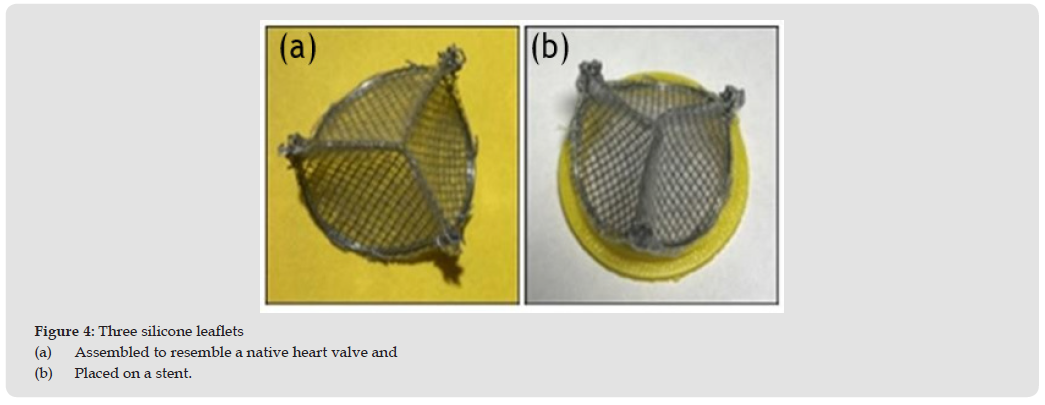
Figure 5
Experimental Set-Up
The hemodynamic performance of the fiber-reinforced polymeric heart valve created using the fabrication method was tested in vitro to verify its performance in a pulse duplicator. Figure 6 shows the conceptual view of our custom-designed pulse duplicator. For testing, two heart valves with 100-micrometer thick fiber-reinforced leaflets glued directly onto the stent without a metal wire structure (Figure 5) were placed onto the pulse duplicator simulating a mitral valve and an aortic valve. The pulse duplicator was then set to imitate the hemodynamic conditions of the native heart valve with a forward pressure of 100 mmHg across the valves, created by the pump. The fluid flow resistors maintain an average flow rate of approximately 5 liters per minute.
Figure 6
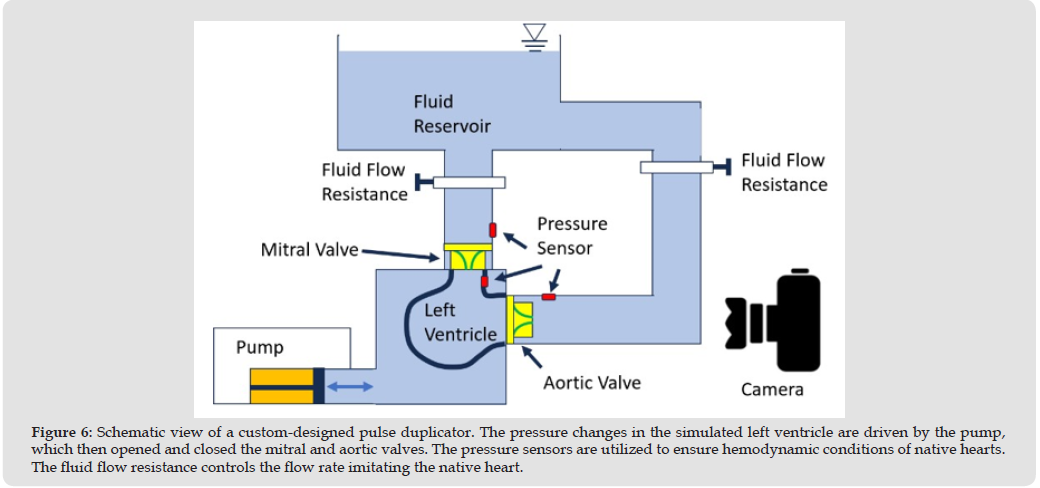
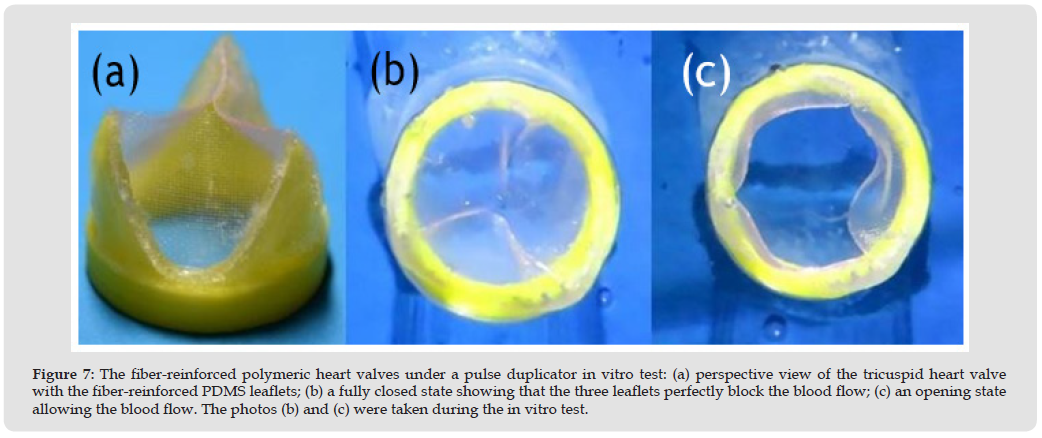
In the in vitro pulse duplicator test simulating blood flow in hearts, the fiber reinforced PDMS valves demonstrated promising hemodynamic behavior. Both valves demonstrated sufficient leaflet functionality: the valves opened and closed properly without any issue and responded quickly to changes in pressure caused by the pump. The valves appeared to be stable and entirely functional over repeated cycles with full opening and closing each cycle, indicating that the insertion of a fiber mesh layer does not significantly hinder the flow rate or cause regurgitation. Furthermore, the possible viability for long-term use is indicated. The valve leaflets did not undergo plastic deformation and maintained their physical properties after the tests, which demonstrate that the suggested fiber reinforced PDMS leaflets are capable of withstanding the mechanical conditions of the heart. Among the leaflets reinforced with three different fiber thicknesses, the leaflet reinforced with 100- micrometer thick nylon-mesh showed the best functionality during the opening and closing cycles as shown in Figure 7. Therefore, the leaflet reinforced with 100-micrometer thick nylon-mesh can be used for heart valve replacements without concerns regarding effective orifice area and regurgitation and with hopes of long-term structural integrity.
Figure 7
A sufficiently high strength is one of the essential requirements of successful polymeric heart valve to maintain the functionality of the leaflet under high-pressure conditions. As aforementioned in Figure 1b, in native heart valves, the high strength is accomplished by circumferential collagen fibers in the leaflet. In the polymeric heart valve proposed herein, the fiber mesh placed within the PDMS matrix plays the role of the circumferential fibers of the native heart valve. The strength of nylon is 85 MPa while that of PDMS is 3-5 MPa, and the insufficient strength of PDMS can be complemented by the nylon reinforcement. The composite strength can be adjusted by changing the density of fibers in the cross section. The fibers reinforcement can prevent the surrounding PDMS matrix from excessive strain, and correspondingly, the normally weak PDMS leaflet’s fatigue resistance increases and, structural damage of the PDMS matrix is prevented. Thus, by adding this additional layer of support to the leaflet, the mechanical properties of the PDMS layer are favorably altered to allow for use in heart valve leaflets. On the other hand, a successful heart valve leaflet should have the ability to stretch under relatively low strain conditions within the heart. Within native valves, the low Young’s modulus (0.3–1 MPa) and high ductility (strain of 150%) of the elastin in the ventriculitis layer provides high flexibility, allowing the valve to open and close easily in normal condition [38]. In terms of flexibility and ductility, PDMS is a perfect material mimicking the behavior of natural heart valve leaflets because PDMS has similar Young’s modulus (0.36–0.87 MPa) [33] and ductility (~140%) [39].
Although the Young’s modulus of nylon fiber is very high (0.5-3 GPa), the effect of the fiber mesh on the flexibility can be eliminated by aligning the fiber mesh in diagonal direction to the circumferential direction (the direction of maximum strain) of leaflets. The collagen fibers in natural heart valve leaflets also have diagonal alignment as shown in Figure 1b. Under low-pressure conditions, the flexibility of leaflets is a critical factor for the functionality of heart valves [40]. The fiber reinforced PDMS leaflets are highly customizable due to the fabrication method. The mechanical behavior and the life of the proposed leaflets can be engineered by adjusting the type, grid density, thickness, and direction of the fibers. These possible modifications also ensure the ability to further optimize the current design in future iterations. The thickness of the PDMS matrix is also customizable, allowing for fine- tuning of the valve’s mechanical behavior. Furthermore, the simple customizability of each leaflet allows for a variety of possibilities in optimizing the leaflets’ mechanical integrity and hemodynamic interactions by changing the mechanical properties of each leaflet. To provide additional structural stability to the leaflets, the fabrication process of the proposed valve utilizes a metal support wire along the arcuate edge of the leaflets. This added structure is expected to significantly improve the structural integrity of the leaflet along the edge attached to the stent by glue. More significantly, the stiffer support wire allows for much simpler attachment between the leaflet and valve stent, as the arcuate edge is stiffer and easier to maneuver, reducing the risk of manufacturing errors.
This wire- framed fabrication allows the fiber-reinforced polymeric heart valve to be clampable on a catheter and can be used for Transcatheter Aortic Valve Replacement (TAVR) [41,42]. Although TAVR is one of leading medical procedures in this field, this article is focused on the fabrication of the fiber-reinforced polymeric leaflets assuming regular heart valve replacements. However, it should be noted that the fiber-reinforced polymeric heart valve has potential for being optimized for TAVR through future work. An additional benefit of using PDMS for heart valve leaflets is the hydrophobicity of PDMS. The hydrophobic leaflet surface decreases the shear stress caused by the blood flow through the heart valve and eventually reduces the thrombogenicity of the valve. This then removes the necessity for the prescription of anticoagulants for patients. Moreover, the superior biocompatibility of PDMS, which only causes minimal inflammation for a short period after insertion, significantly reduces the amount of calcification occurring on the leaflets by reducing the body’s immune response to the foreign polymer, and eventually increases the valve’s longevity and structural integrity compared to other biomechanical valves. Also, the increased fatigue resistance, achieved by the fiber-reinforcement, reduces long term structural valve degradation, and increases the life of the valve.
An artificial heart valve made of fiber reinforced PDMS leaflets that has advantages over conventional mechanical and bioprosthetic valves is suggested, and its fabrication process is proposed. The hemodynamic performance of the fabricated composite valves with fiber reinforced PDMS leaflets were successfully validated through short-term in vitro tests under cyclic flow generated by a pulse duplicator. PDMS has excellent hemocompatibility and biocompatibility but is not a favorable polymer for heart valve leaflets because of its weak strength. However, the shortcoming of PDMS can be eliminated by embedding the fiber mesh reinforcement layer that is inspired by the collagen fibers of natural heart valves. The suggested leaflet fabrication process is simple and has potential to be customized through selection of fiber, grid density, and fiber alignment. Thus, customizability of the valve leaflets allows for the optimization of the given design and thus shows great promise. The mechanical durability of the fiber reinforced PDMS valve is expected to be superior due to the reduced stress in PDMS matrix. For further investigations, interactions between the valve and blood, particularly regarding calcification and thrombus formation, are suggested as a follow-up test with a long-term experimental setup. While the PDMS matrix is expected to reduce calcification, it needs to be confirmed whether certain protein interactions along its surface may induce undesirable calcification.
Furthermore, the effects of various modification factors such as fiber type, direction, mesh density, leaflet thickness, and wireframe on the mechanical behavior need to be investigated for the optimization and TAVR application of the fiber reinforced PDMS. In conclusion, the optimistic results of the in vitro pilot tests for the proposed design shows that the proposed fiber-reinforced PDMS valve is promising in the context of finding a biocompatible, durable, and cost- efficient alternative to the current mechanical and bioprosthetic valves and opens many exciting avenues for further research.
This work was conducted with the support of the University of Texas Rio Grande Valley.

International Association of Landscape Archaeology, Czech Glass Society, Czech Republic

Department of Chemistry, Semenov Institute of Chemical Physics, USSR Academy of Sciences, Moscow, Russia

Department of Educational Sciences, Research Centre Qualities of Teachers, School of Education – HAN, Nijmegen, Netherlands

Associate Professor at Department of Breast and Thyorid Surgey, Chongqing General Hospital, China

Neurology, LA BioMed Research Institute, USA





 Abstract
 PDF
PDF



























