info@biomedres.us
+1 (502) 904-2126
One Westbrook Corporate Center, Suite 300, Westchester, IL 60154, USA
Site Map
 ISSN: 2574 -1241
ISSN: 2574 -1241
ISSN: 2574 -1241
Received: April 16, 2024; Published: April 25, 2024
*Corresponding author: Gilberto Cruz Arteaga, Medical specialist in Family Medicine, Admission: Family Medicine, Family Medicine Unit No. 20, Calzada Vallejo 675, Col. Nueva Vallej CP 07750, Gustavo A. Madero Delegation, Mexico
DOI: 10.26717/BJSTR.2024.56.008835
The World Health Organization establishes intimate partner violence against women as a severe and growing Public Health problem worldwide, also considering it a serious violation of Human Rights, which translates into a negative impact on their quality of life, their decisions, their attitudes, and their physical, mental, sexual, reproductive, and economic well-being. This is why the timely detection of possible cases of violence is of vital importance. The objective was to identify the prevalence of female patients aged 20-59 years from the U.M.F. 20 “Vallejo” who are at risk of suffering from intimate partner violence. Material and methods: This is a descriptive cross-sectional study, with prior informed consent in 1043 patients the WAST instrument was applied to screen for intimate partner violence against women, performing descriptive statistics on age, occupation, education, marital status, and monthly income; with bivariate analysis compared by age groups and chi-square statistics using SPSS version 26.0. Results: Of 1043 patients, the predominant age group was 25 to 29 years, 19.2% (n=200). There were 20.7% (n= 216) of suspected cases according to the WAST instrument as a method to detect intimate partner violence, predominating in the age group of 55 to 59 years with 24.5% (n= 53). This group being primary school, service employees, separate marital status with p = .000, 95% CI (0.000 – 0.003); and low monthly income, p = .000, CI (0.037 – 0.051), p = 0.037, as predominantly suspected cases compared to negative cases.
Keywords: Violence; Couple; Women
Abbreviations: ISA: Index of Spouse Abuse; PVS: Partner Violence Screen; AAS: Abuse Assessment Screen; WAST: Woman Abuse Screening Tool; IMSS: Mexican Social Security Institute
The Royal Spanish Academy defines “woman” as “a person of the female sex,” “who has reached adulthood” and/or “who has the qualities considered feminine par excellence.” [1]; Sex” is the biological, anatomical and genetic characteristic with which a person is born [2] and “gender” is the dynamic, psychological and cultural construct to which one is rooted, susceptible to transformation and variable according to the sociodemographic conditions of each region. of the world [3]; without necessarily existing a dependency between the two [4]. The archetype of the word comes from an uncertain etymological root of the Latin “mulier” or “Mulieris”, and has had different interpretations, in Rome, during the 1st century BC, as something “soft or watery”; at the beginning of the 20th century in Europe, as “weaker and more tender”; America, as “soft and delicate”; In the 21st century, it begins to be understood as “being feminine”, but without complete attachment to Latin [5]. Women have fought to change the concept in an erroneous way, such as the “weaker sex” [6], with “enlightened feminism” [7] women have shown to have outstanding intellectual, strategic, and artistic capacity [8], with the arrival of the Industrial Revolution women have acquired an economic independence never seen before [9]. In Mexico, there are traditional ideas that the function of women is reproductive and domestic [10], with the decree of women’s right to vote, [11] the presentation of voluntary motherhood, the end of sexual violence and the right to free choice sexual, [12] the creation of norms for Equality between Women and Men, [13] it has been possible to modify that notion [14].
However, the growing wave of violence that women currently face, inside and outside their home, must be considered [15]; acts of multi-causal origin to regain the physical, economic, sexual, and psychological submission of women [16]. The World Health Organization refers to a Public Health problem in women, called violence within the couple. In 2018, 2.7 out of every 10 women between 15 and 49 years old experienced physical, sexual or both violence at the hands of your romantic partner at some point in your life [17]; This act being a behavior of the partner or ex-partner that causes physical, sexual, psychological and economic harm to the woman [18], of multi-causal origin [19], with repercussions on the quality of life of the woman and those around her, mainly her children [20]. However, culture and social environment for women have an important role, considering religion, ideology, customs, and traditions [21]. The most common prevalence and characteristics of intimate partner violence against women have been identified [22]. Some studies refer to the age of 15 years or less, sexual violence prevails [23], physical violence in young adults [24], and psychological violence at older ages [25]. Predominant in married [26], separated, and divorced women [27], with low or no schooling [28], correlated with unemployment, low or no monthly income and little opportunity for the victim to become independent [29]. A history of having experienced some type of domestic violence increases the risk of exposure to a new violent episode [30]; and especially if the victim’s mother also suffered some type of abuse [31].
The use and abuse of addictive substances is also closely related [32]. Referring as the most frequent violence to psychological violence, followed by physical and sexual violence [33]. Various instruments have been used to measure violence against women, such as the Index of Spouse Abuse (ISA) [34]; the Partner Violence Screen (PVS) [35], the Abuse Assessment Screen (AAS) [36]. However, due to the small population studied and the few items they cover, their uses have been limited [37]. The Woman Abuse Screening Tool (WAST) instrument has been the most appropriate questionnaire for screening intimate partner violence against women [38], presenting added items to leave eight items on sexual violence [39], evaluating whether there is confrontation with the couple [40]. This instrument is practical, flexible, easy to understand and use in non-established contexts of violence [41], with a Cronbach’s alpha of 91.5% [42]. In Mexico, in 2019, psychological violence is identified as the most common exercised by the current partner [43]. In 2022, in a Family Medicine Unit of the Mexican Social Security Institute (IMSS), the emotional dependence between the victim and their perpetrator is reported as a risk factor [44]. Also implementing in the IMSS the virtual help module [45], with a gender violence detection system through the resolution of a variant of the WAST instrument [46]. Therefore, the present objective is to identify the prevalence of female patients aged 20-59 years from the U.M.F. 20 “Vallejo” who are at risk of suffering from intimate partner violence.
This is an observational, cross-sectional, descriptive study, carried out with prior informed consent in 1,043 women between 20 and 59 years of age, users of the U.M.F. No. 20 “Vallejo”, first level care unit of the Mexican Social Security Institute, in both care shifts, within the period from March 2023 to February 2024.
Method
If the patient, with prior informed consent, agreed to participate in the study according to the following inclusion criteria: women between 20 and 59 years of age who were beneficiaries of the Family Medicine Unit No. 20 Vallejo, of the IMSS in any care shift, who were in a heterosexual romantic relationship currently or within the previous year 2022. Exclusion criteria: illiterate women; who came to the consultation accompanied by their partner or children; who presented severe cognitive impairment or with mental health disorders and those who found it difficult or impossible to sign the informed consent or complete the instrument. And elimination criteria: female patients who did not sign the informed consent due to forgetfulness, error or own desire and those who decided to withdraw from the study even after providing personal information, signing the consent or answering the instrument.
Variables
In the questionnaire used as the first part, sociodemographic and employment data were collected from the women surveyed, identifying the following variables: age, which was defined as the number of years of existence of the woman expressed as the period from her birth to the current moment, with interval measurement scale categorized as 20-24 years of age, 25-29, 30-34, 35-39, 40-44, respectively.; civil status defined as the legal status of the person in the family and society, determining her capacity to exercise certain rights and obligations, with a nominal measurement scale categorized as single, married, common law, divorced, separated, widowed.; schooling defined as the highest level of studies carried out by a student within an educational establishment and that has already been completed, with an ordinal measurement scale categorized as preschool, primary, secondary, technical baccalaureate, high school, university, postgraduate or master’s degree.; occupation defined as the job, job or trade performed by an economically active person, with a nominal scale categorized as legislator or manager, professional, technician, office worker, service or sales employee, farmer or fisherwoman, artisan, machinery operator or assembler, merchant, cleaning worker, security guard, armed forces, unemployed.; average monthly income defined as different human groups into which a given society is stratified, based on their related social and economic conditions, based on their similar social and economic conditions, with an ordinal scale categorized as A/B: Upper class ($51,100/month), C+: Lower upper class ($27,800/month), C: Upper middle class ($19,900/month), D+: Lower middle class ($12,300/month), D: Upper lower class ($8,900/ month), E: Lower class ($5,400/month).
The variable that describes Intimate Partner Violence against women, defined as any deliberate act or omission that causes psychological, physical, patrimonial, economic, sexual harm or death to the woman, simply due to her gender condition and that occurs within of an intimate relationship, current or past, with an ordinal scale categorized as a suspicious case if the score is 15 points or more and a negative case if the score is 14 points or less. sing the WAST questionnaire as the second part of the questionnaire to measure this last variable, containing 8 Likert-type questions, from 1 to 3 where 1 is the least intense option or “never”, 2 is “sometimes” or “some difficulty”.” and 3 “many times; obtaining a minimum score of 8 and a maximum of 24. The cut-off points are: 14 or less, negative case; 15 or more points indicates a suspicious case. The time given to patients to complete the test was approximately 5 to 10 minutes.
Statistics
To calculate the sample size, statistical data from the U.M.F. No. 20 “Vallejo” on the number of female users between 20 and 59 years of age, within the year 2022; determining a total of 45,964 women. Subsequently, using the formula of finite populations, with a Confidence Interval of 95%, a maximum accepted estimation error of 3%, assuming a probability of success of 50%, it was established that it was necessary to survey the number of 1,043 women, to carry out the study. Descriptive statistics were used for the variables age, marital status, education, occupation, and monthly income. For the variable intimate partner violence against women, indicated as a suspicious case if a score of 15 points or more is obtained and a negative case if a score of 14 points or less is obtained, according to the WAST instrument and age by age group, a contingency table using the Pearson Chisquare test, adding in this contingency table demographic variables (education, occupation, monthly income, occupation) in bar graphs, considering a value p < 0.05, as statistically significant, using the IBM SPSS statistical package version 26.0 for the analysis.
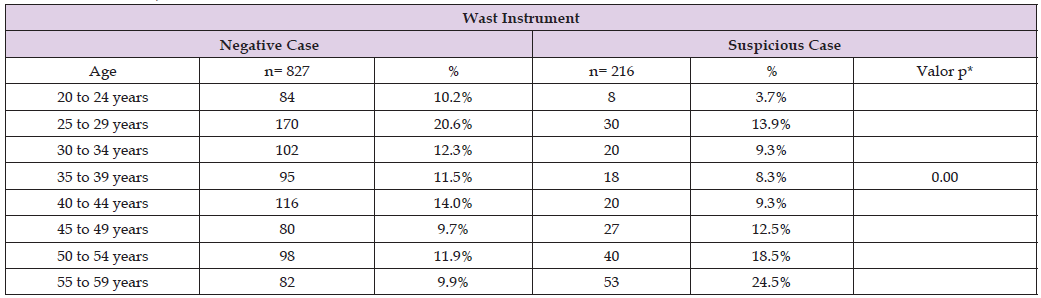
In the present study, 1043 women from the Family Medicine Unit Number 20 were analyzed, predominating the age group of 25 to 29 years, 19.2% (n=200), followed by 50 to 54 years, 13.2% (n=138) and in last place the group of 20 to 24 years old 8.8% (n=92); respectively; marital status with the same frequency in Married and Single 31.3% (n= 326) and lastly divorced 5.1% (n=53); Schooling predominated bachelor’s degree 31.4% (n=327) followed by high school 23.9% (n=249), lastly preschool 0.5% (n=5); occupation predominantly unemployed 27.0% (n= 282), followed by professional 24.5% (n= 256); monthly income predominated lower lower class 41.4% (n=432) and lastly the upper upper class 2.0% (n=21) (Table 1). It was reported in the outcome of women by age group from 20 to 59 years according to the WAST instrument as a method to detect intimate partner violence in the U.M.F. 20 Vallejo 20.7% (n= 216) of suspicious cases and 79.3% (n= 827) of negative cases, with p value=0.000. Suspected cases predominated in the age groups of 55 to 59 years, 50 to 54 years and 45 to 49 years, with 24.5% (n= 53), 18.5% (n= 40) and 12.5% (n= 27); respectively. Negative cases predominated in the age groups of 25 to 29 years, 40 to 44 years, and 30 to 34 years, with 20.6% (n= 170), 14.0% (n= 116) and 12.3% (n= 102); respectively (Table 2).
Table 1: Demographic characteristics of the of the female population between 20 and 59 years old at risk of suffering intimate partner violence from the U.M.F. 20 Vallejo.

Note: A/B $51.100/ month; C+ $ 27.800/month; C $ 199800/month; D+ $ 12.300/month; D $ 8.900/month; E $ 5.400/month.
Table 2: Contingency table of woman aged 20-59 years according to the WAST instrument as a method for detecting intimate partner violence at the U.M.F. 20 Vallejo.
Note: *p< 0.05 Pearson Chi-square test
Suspected cases in women in the age group of 20 to 59 years by education according to the WAST instrument as a method to detect intimate partner violence at the U.M.F. 20, primary education predominated 8.8% (n= 19) in the age group 55 to 59 years and bachelor’s degree 6.02% (n=13) in the age group 30 to 34 years, 95% CI (0.000 – 0.003), p =0.000 (Figure 1). The negative cases predominated in the bachelor’s degree 11.85% (n= 98) in the age group 25 to 29 years and high school 5.80% (n= 48) in the age group 20 to 24 years, 95% CI (0.000 – 0.003), p =0.000 (Figure 2). Suspected cases in women in the age group of 20 to 59 years by occupation, reported to service employees 6.02% (n= 13), followed by unemployed 5.09% (n= 11) in the age group 55 to 59 years and professional 5.09% (n=11) in the age group 25 to 29 years; 95% CI (0.000 – 0.003), p =0.000 (Figure 3). Negative cases predominated in professional occupation 8.46% (n= 70) in the age group 25 to 29 years, 95% CI (0.000 – 0.003), p =0.000. Suspected cases in women in the age group of 20 to 59 years by marital status, predominance separated in first place 7.87% (n= 17), followed by widowed 6.02% (n=13) in age group 55 to 59 years; single 7.41% (n=16) in age group 25 to 29 years, 95% CI (0.000 – 0.003), p =0.000 (Figure 4).
The negative cases were dominated by single marital status 14.03% (n= 116) and 7.50% (n=62) in the age group 20 to 29 years and 20 to 24 years; respectively, 95% CI (0.000 – 0.003), p =0.000 (Figure 5). The behavior of suspected cases in women in the age group of 20 to 59 years by monthly income, reports monthly income E: Low lower class with first place 12.50% (n= 27) in age group 55 to 59 years and 7.87 % (n= 17) in age group 50 to 54 years, 95% CI (0.000 – 0.003), p =0.000 (Figure 6). Negative cases also predominated E: the lower lower class 7.50% (n= 62) in the age group 50 to 54 years and second place 7.13% (n= 59) in the age group 20 to 24 years; respectively, 95% CI (0.037 – 0.051), p=0.037.
Figure 1

Figure 2

Figure 3
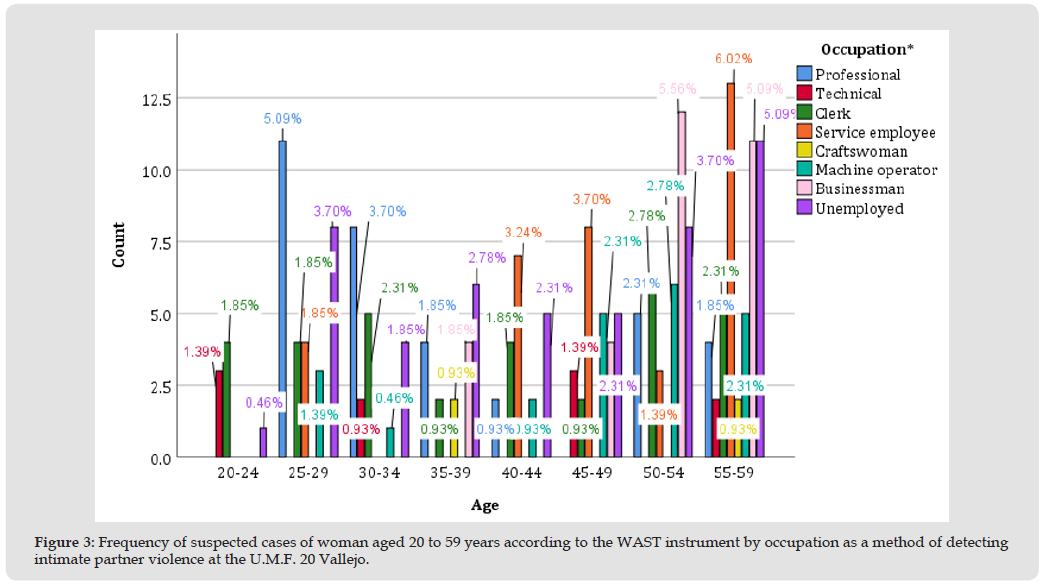
Figure 4
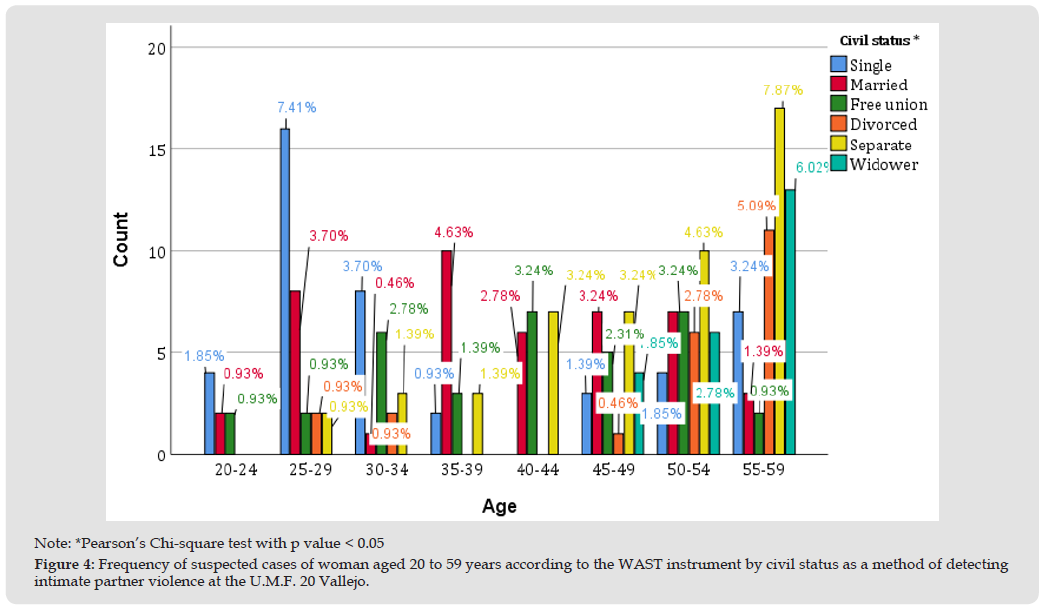
Figure 5
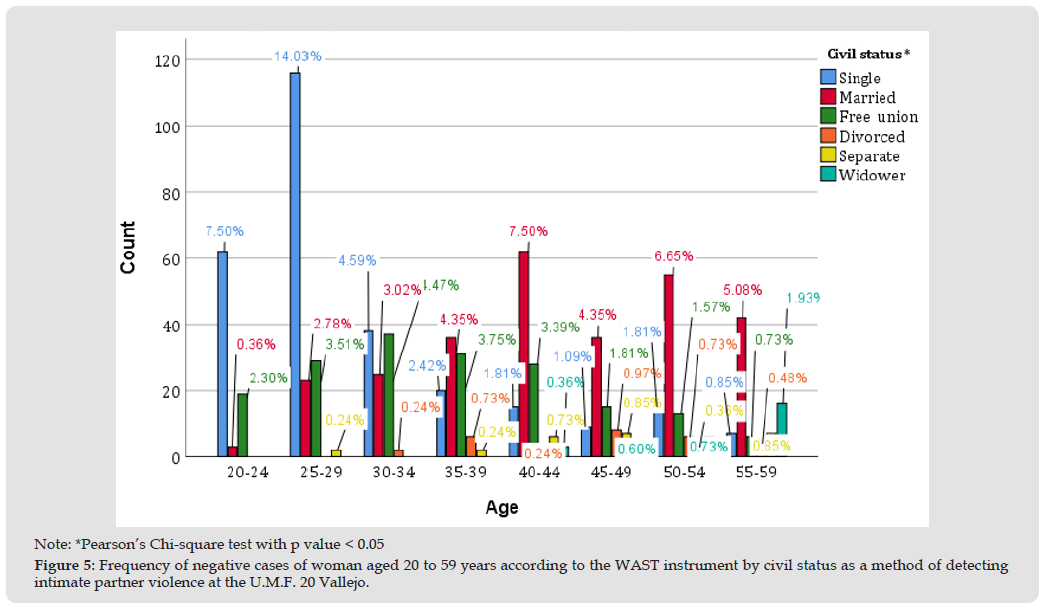
Figure 6

It is important to consider the social context of the present study in relation to the place where it was carried out as a method to detect intimate partner violence in women in suspected cases where significant differences were reported in separated marital status, primary schooling and age from 55 to 59 years. with 24.5% (n=53), unlike a study carried out on women in Brazil where post-traumatic stress disorders due to sexual assault were studied, which contrasts with age (24.4 years), education (secondary) and marital status [47] (single); without significant difference for education and marital status., another study from Brazil reports physical violence against women where married marital status, occupation as a housewife and ages between 20 and 40 years predominate [48]. Similar psychological dimensions involved in the WAST instrument of our study were developed in a study from Chile with gender violence in university students, reporting psychological violence through emotional blackmail and threats with a prevalence of 28% and 30.4%, respectively. Also highlighting that higher education is not a protective factor against gender violence [49], however there are mechanisms such as reporting to respond and preventive actions with care workshops [50].
In Spain, a study carried out on childhood victimization reported an increase of 4.7 times the risk of presenting a risk of victimization in the partner (p=0.002) and 3.1 times the risk of presenting it in women vs. men (p=0.016). [51] In Colombia, it was determined that those who seek social support for gender violence are separated-divorced people [52]. In Ecuador, the poverty factor has a risk of presenting violence against women, being consistent with our study, with reporting of E: low lower class in suspected cases as a method to detect intimate partner violence in women with 12.50% (n= 27), predominantly [53].
In the present study, it was possible to identify a prevalence of 20.7% in women aged 20 to 59 years in the context of the U.M.F. 20 “Vallejo” who are at risk of suffering intimate partner violence, with specific characteristics in certain age groups, education, occupation and monthly income, this corresponds to continuing with prevention actions in social, psychological and clinical aspects on the risk of suffer intimate partner violence to avoid recurrence and improve the quality of life of users.
To the management staff of the OOAD DF Norte, director of the UMF 20, to the medical staff who contributed as a work team to make this article a reality for the benefit of IMSS users.
Ethical and Legal Aspects
Data was included in a registry approved by the ethics and health research committee.
Conflict of Interests
The researchers of this article declare that there is no financial interest or conflict of interest.

International Association of Landscape Archaeology, Czech Glass Society, Czech Republic

Department of Chemistry, Semenov Institute of Chemical Physics, USSR Academy of Sciences, Moscow, Russia

Neurology, LA BioMed Research Institute, USA

Associate Professor at Department of Breast and Thyorid Surgey, Chongqing General Hospital, China

Clinical Radiologist (MD) - Department of RADIOLOGY, Cosenza Hospital, Cosenza, Italy





 Abstract
 PDF
PDF



























