info@biomedres.us
+1 (502) 904-2126
One Westbrook Corporate Center, Suite 300, Westchester, IL 60154, USA
Site Map
 ISSN: 2574 -1241
ISSN: 2574 -1241
ISSN: 2574 -1241
Received: April 02, 2024; Published: April 19, 2024
*Corresponding author: Moges Abebe, Department of Biological and Physical Sciences, Saint Augustine University, USA
DOI: 10.26717/BJSTR.2024.56.008827
In Ethiopia, injera is a significant cultural and dietary ingredient, deeply embedded in the people’s culinary traditions. However, despite its widespread consumption, the prevalence of diabetes poses a critical health concern. The current research study investigates the use of the enzyme amylase to lower the starch content of teff, the main ingredient in injera. UV-visible spectroscopy was employed to analyze starch concentration, revealing a discernible pattern of starch reduction with the introduction of amylase during the preparation of injera. Additionally, experiments explained the solubility of teff components in water and the impact of amylase concentration on starch absorption rates. Overall, this study highlights the potential of incorporating amylase in starch reduction processes to enhance food quality, address dietary concerns, and improve health outcomes, particularly in populations vulnerable to diabetes. With the results obtained in this paper, we strongly recommend incorporating amylase into the teff fermentation and injera preparation process. This food preparation strategy can promote healthier diets and accommodate healthier nutritional requirements.
Ethiopians have a profound fondness for injera, a dietary staple deeply ingrained in their culinary culture. With Ethiopia’s population estimated at approximately 120 million, alongside an additional 10 million in the diaspora, it is common for a significant portion of the populace to incorporate injera into their daily meals, often regarding it as indispensable. However, amidst its widespread popularity, it’s imperative to recognize the prevalence of diabetes, which impacts over 5% of Ethiopia’s adult population aged between 20 and 79 years (Berhe, [1]). Injera is a significant source of carbohydrates, fiber, and various nutrients. Nevertheless, responsible consumption is paramount. According to the International Diabetes Federation (IDF), as of 2019, only about half of individuals with diabetes adequately manage their condition (IDF, [2]). Approximately 50% of people with diabetes are not successful in controlling their blood sugar levels through medication, lifestyle modifications, and other interventions. Studies also show that diabetes was responsible for an estimated 4.2 million deaths globally in 2019 (IDF, [2]). This figure includes deaths directly attributed to diabetes as well as deaths from complications related to the disease.
Disparities in healthcare access and quality, as well as challenges in diabetes management, can contribute to preventable deaths from diabetes-related complications. In managing type II diabetes globally, meticulous evaluation of starch levels in staple foods is crucial, particularly concerning ingredients like teff, the fundamental element of injera. UV-visible spectroscopy has become an essential analytical technique in this field. Here, we use absorption spectra analysis to explore the complex dynamics of starch content in teff, concentrating on the 520, 590, and 700 nm wavelengths. Additionally, our investigation establishes the starch concentration at 5%, complemented by a distinctive iodine-to-potassium iodide ratio of 2:1. Amylase is a critical facilitator in the efficient breakdown of starch molecules in the human digestive system (Brown, [3]). Amylase is produced in the salivary glands and various microorganisms and acts as a starch-reducing agent, catalyzing the hydrolysis of starch molecules into simpler sugars. There are two primary types of amylases: alpha-amylase and beta-amylase. Alpha-amylase is chiefly responsible for breaking down starch into shorter carbohydrate chains such as maltose and glucose by cleaving the alpha-1,4 glycosidic bonds in starch molecules. Beyond its biological role, amylase is extensively utilized in industrial processes, particularly within the food industry (Brown, [3]). Amylase plays a critical role in converting starch into sugars while producing various food products, and it is widely accepted as safe. For instance, in baking, the incorporation of amylase enzymes into dough facilitates the breakdown of starch into simple sugars. Yeast ferments these sugars, leading to the production of carbon dioxide gas, which effectively leavens the injera batter. In this paper, amylase is a crucial enzyme both in biological contexts and the food industry, facilitating the breakdown of starch molecules into smaller, more readily eliminated components. Once amylase breaks down starch, the resulting fragments, comprised of monosaccharides and disaccharides, dissolve in water and can be siphoned out, leaving behind a gluten-free paste that contains little to no carbohydrates. Adding amylase to teff offers a straightforward and practical method of preparing injera with a lower glycemic index suitable for consumption by type II diabetic patients and individuals mindful of their dietary intake and producing low carb teff dietary options for individuals managing diabetes [4].
To prepare the teff solution, fine flour powder was weighed according to the experiment’s requirements. The teff was then dissolved in water in a test tube, ensuring thorough mixing to achieve a homogeneous solution. Specific amylase enzyme concentrations were measured and added to the teff solution, followed by stirring to ensure even enzyme distribution. The solution was left to react for approximately 30 minutes, allowing the enzyme to catalyze the hydrolysis of starch molecules into simple sugars. Control samples of pure starch with known concentrations served as a reference for comparison. Iodine solution, made of I2/KI in a 1:2 ratio, was added to the control samples and the teff solution [5]. Starch molecules react with iodine to form a blue-black complex, indicating the presence of starch. The intensity of the color change correlates with the concentration of starch in the sample. A spectrophotometer compared the color intensity between the experimental and control samples to assess amylase’s effectiveness in hydrolyzing teff starch. Solution absorbance of the solution was measured across a range of wavelengths (520, 590, and 800 nanometers).
We suggest the following steps for employing the α-amylase enzyme for injera starter preparation and starch reduction. The α-amylase enzyme, traditionally used in brewing and baking, finds additional application in injera preparation. To prepare the ersho or injera starter, thoroughly combine a small amount of teff flour with water in a large mixing bowl. A small amount of amylase enzyme was incorporated into the mixture to facilitate fermentation [6]. The prepared mixture can then be transferred into a closed container for anaerobic fermentation. The mixture was allowed to ferment undisturbed for three days, enabling the natural fermentation process to develop the ersho or injera starter. After fermentation, the liquid was drained from the fermented batter to remove excess sugars, ensuring the desired consistency and flavor for the injera. Teff flour may be blended with water to prepare the teff batter in a separate mixing dish. The ersho is mixed with batter; water is added to obtain the desired consistency.
UV-visible spectroscopy was employed as the primary analytical method to assess the starch levels present in teff, the critical ingredient of injera. Analysis of absorption spectra, particularly at wavelengths of 520 nm, 590 nm, and 700 nm, yielded significant insights. The solubility of starch in water varies based on factors like temperature, pH, and starch type, typically ranging from 1 to 10 mg per liter at room temperature. Starch concentration in the presence of amylase and iodine was evaluated through the spectrophotometer. Figure 1 and Table 1 summarize the absorbance readings obtained at different starch concentrations. Figure 2 and Table 2 show absorbance readings of starch with amylase in an iodine solution. (Figure 3) The data demonstrate a consistent increase in absorbance readings across all three wavelengths as the starch concentration escalates from 0.03125 mg/L to 1 mg/L (Table 3). This indicates a proportional surge in the interaction between starch, amylase, and iodine with heightened starch concentrations. Furthermore, a general decrease in absorbance readings is observed as the wavelength increases, with the peak absorption occurring at 520 nm and the lowest at 700 nm. This behavior aligns with the expected characteristics of iodine-starch complexes, where maximal absorption is observed at shorter wavelengths.
Table 1: Mass of teff before and after solubility assessment.

Table 2: Absorbance readings of pure starch with amylase solutions.
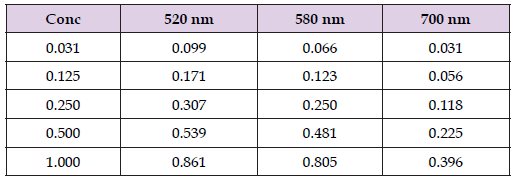
Figure 1

Figure 2

Figure 3

Table 3: Absorbance readings of teff with amylase solutions.

Based on the comprehensive analysis conducted in this study, it is evident that using amylase to reduce starch levels in teff holds significant promise. UV-visible spectroscopy has provided invaluable insights into the starch content of teff. Particularly at the 520, 590, and 700 nm wavelengths, a noticeable pattern of starch reduction with the introduction of amylase is observed. These findings firmly establish the feasibility of using amylase to effectively lower starch concentrations in teff, which could have profound implications for various applications in food processing and dietary management. Moreover, exploring starch-amylase interactions further clarifies the potential benefits of employing amylase to modulate starch levels. The significant trends in absorbance readings across different wavelengths underscore the intricate interplay between starch concentration, enzymatic function, and iodine complex formation.
The data indicates a proportional surge in interaction between starch, amylase, and iodine, reinforcing the notion that heightened amylase concentrations correspond to amplified starch breakdown. With transmission levels stabilizing after reaching a certain threshold of amylase concentration, there appears to be a saturation point in the effect of amylase on starch reduction. These findings emphasize the importance of carefully optimizing amylase concentration to achieve desired outcomes, paving the way for further research and development in utilizing amylase for starch reduction in teff and beyond. Through continued exploration and innovation, the incorporation of amylase in starch reduction processes holds immense potential for addressing dietary concerns and enhancing food quality and nutritional value.
We thank Lydia Moges for her participation.

International Association of Landscape Archaeology, Czech Glass Society, Czech Republic

Department of Chemistry, Semenov Institute of Chemical Physics, USSR Academy of Sciences, Moscow, Russia

Neurology, LA BioMed Research Institute, USA

Associate Professor at Department of Breast and Thyorid Surgey, Chongqing General Hospital, China

Clinical Radiologist (MD) - Department of RADIOLOGY, Cosenza Hospital, Cosenza, Italy





 Abstract
 PDF
PDF